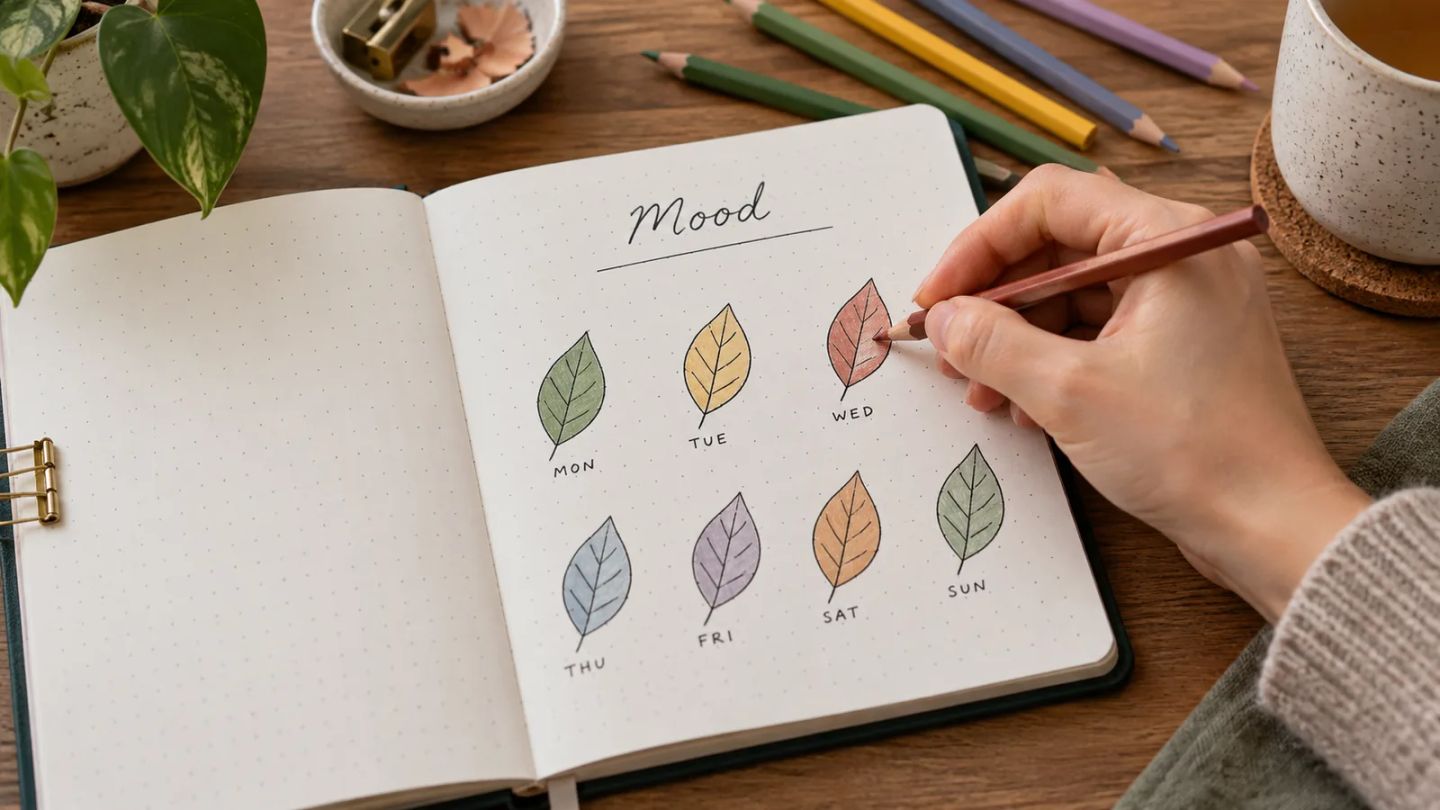
A bullet journal mood tracker is a simple monthly layout where you fill one small space each day with a colour that stands for how you felt. That is all it needs to be. If you want to start tonight, draw a row of numbered boxes for the days left in the month, jot down four or five colours and what each one means, and colour in today. You do not need a ruler, a fancy pen or a good drawing hand, and you do not need to fill it in every single day for it to be worth keeping.
So many people track mood on paper because the making of the page is part of the calm. You choose the shapes, the colours and the moods that matter to you, and the tracker ends up fitting your life instead of someone else's template. What follows is three layouts you can copy straight into your notebook, a way to pick a mood scale you will keep using, and an honest look at what this habit does and does not do.
What a mood tracker does, and what it does not
The useful part of tracking mood is not the pretty page. It is the two small acts underneath it: naming how you feel, and seeing those names line up over a month.
Naming the feeling does more than you would expect. Work gathered by the Greater Good Science Center at Berkeley suggests that putting a word to a strong, unpleasant emotion can take some of the heat out of it, with brain imaging showing calmer activity in the areas linked to distress when people label what they feel. The same summary is careful about the limits. Naming works best for intense feelings. For mild ones, reaching for a label can sometimes make them louder. A colour a day is a light version of this, so treat it as a nudge towards noticing, not a fix.
Seeing the pattern is the other half. A study of mood-tracking apps and their users found that people tracked partly to raise their own awareness and partly to find the things that shaped their mood, the sleep, the people, the weeks that ran too hard. A paper tracker does the same job. After a few weeks you can glance at a page and notice that the low colours cluster around bad sleep, or the good ones gather at weekends, and that noticing is where any real use begins.
Be clear about the edge of this, though. A mood tracker is a wellbeing habit, not a treatment. The NCCIH, reviewing mindfulness and related practices, notes that even well-studied wellbeing tools help many people yet leave some feeling worse, and advises against using them to put off seeing a health professional about something that needs care. A colouring page carries the same caveat. If watching your own low days closely starts to pull your mood down further, that is a signal to ease off the tracking, not to track harder.
Choose your mood scale and colours
Before you draw anything, decide what you are measuring. Two scales are common, and they answer different questions.
A rating scale runs from low to high, usually five steps, and answers "how good was today". It is quick and it produces a clean gradient across the month.
A named-emotion scale uses words like calm, anxious, content, flat or restless, and answers "what did today feel like". It is richer and it pairs well with the naming benefit above, though it asks a little more of you at the end of a tired day.
Whichever you choose, keep it to around five options. Most trackers work well with five to eight, and five is the friendliest place to start, because a key you can hold in your head is a key you will use. Give each mood a colour that feels right to you, not one from a chart. Warm colours for warm feelings and cool ones for flat or heavy days is a reliable starting point, but your associations win. Leave one neutral colour or an empty box for days you did not log, so a gap looks like a gap and not a failure.
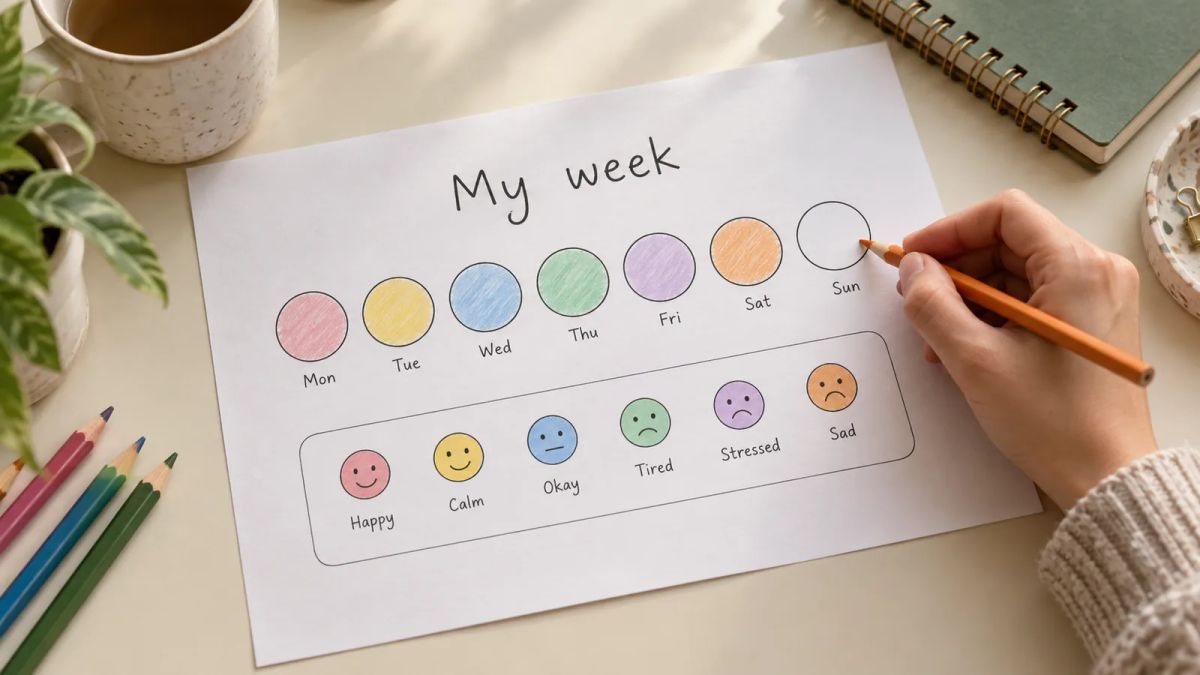
Here is a key you can copy and change:
Mood key
🟦 Great 🟩 Good 🟨 Okay 🟧 Low 🟥 Rough ⬜ Not logged
Swap the words for your own if calm, anxious and content describe your days better than good and okay.
Three layouts you can copy tonight
Each of these fits on a single page. Draw the blank version once, keep the key in a corner, and add one mark a day.
The monthly grid
This is the workhorse. A numbered box for every day, coloured in with your key, so the whole month reads at a glance. It is the easiest to keep and the easiest to read back.
Copy this blank grid for the days in your month:
Mood key: 🟦 Great 🟩 Good 🟨 Okay 🟧 Low 🟥 Rough ⬜ Not logged
1 ⬜ 2 ⬜ 3 ⬜ 4 ⬜ 5 ⬜ 6 ⬜ 7 ⬜
8 ⬜ 9 ⬜ 10 ⬜ 11 ⬜ 12 ⬜ 13 ⬜ 14 ⬜
15 ⬜ 16 ⬜ 17 ⬜ 18 ⬜ 19 ⬜ 20 ⬜ 21 ⬜
22 ⬜ 23 ⬜ 24 ⬜ 25 ⬜ 26 ⬜ 27 ⬜ 28 ⬜
29 ⬜ 30 ⬜ 31 ⬜
Filled in for a first week, it might look like this:
1 🟩 2 🟨 3 🟦 4 🟧 5 🟩 6 🟥 7 🟨
You can read that week in a second. A bright start, a dip on the sixth, an even keel by Sunday. That is the grid earning its place.
The mood mandala
A mandala turns the month into a set of rings. The centre is day one, and each ring out is the next day, so a finished page looks like a coloured flower and the making of it is calming in itself. You do not need a compass.
- Draw a small circle in the middle of the page, then a ring around it, then another, until you have as many rings as there are days in the month. Rough circles are fine.
- Divide the whole thing into wedges like slices of a cake, six or eight is plenty, so each ring is broken into segments.
- Each day, colour one segment of the next ring out, working from the centre towards the edge, using the same mood key as the grid.
- Keep your key written beside the mandala so future you can read it.
The mandala trades the grid's quick read for something more pleasing to fill in, which is the point for people who want the tracker to be a small ritual rather than a form.
The habit-and-mood combo
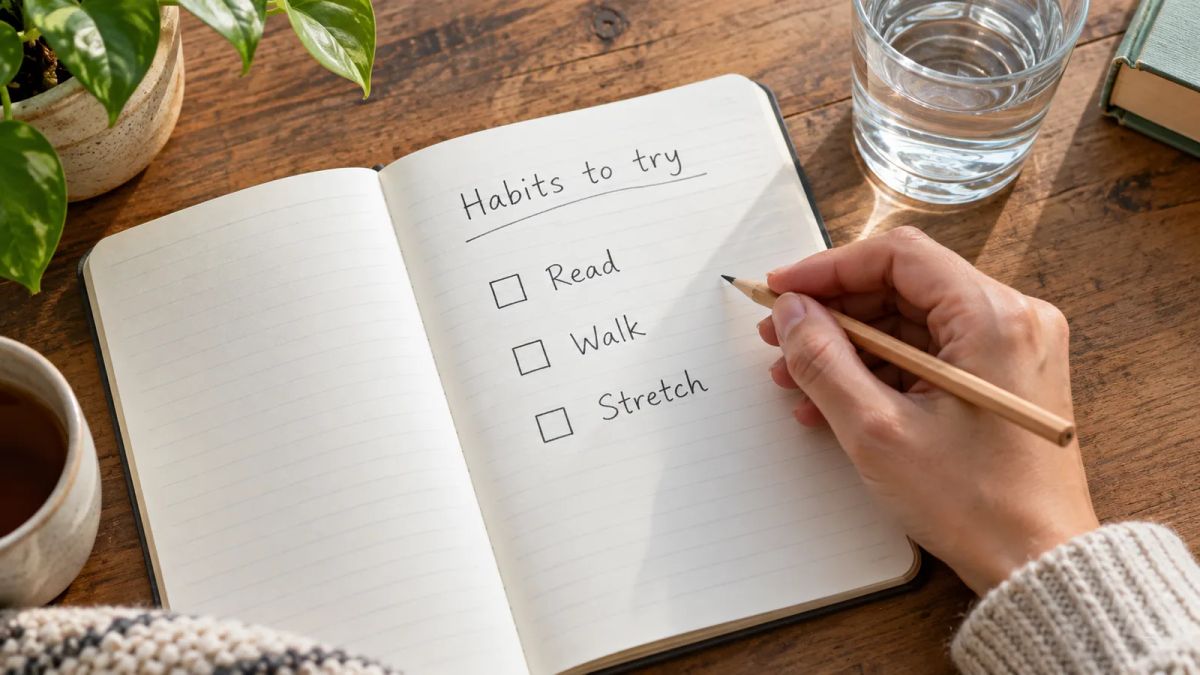
This one puts your mood next to two or three small habits, so you can see whether the days you move, drink water or get outside are also the days you feel better. It will not prove that one caused the other, but the pairing is often where the useful hunches come from.
Copy this weekly block:
Day Mood Move Water Outside
Mon ⬜ ☐ ☐ ☐
Tue ⬜ ☐ ☐ ☐
Wed ⬜ ☐ ☐ ☐
Thu ⬜ ☐ ☐ ☐
Fri ⬜ ☐ ☐ ☐
Sat ⬜ ☐ ☐ ☐
Sun ⬜ ☐ ☐ ☐
Filled in, a week might read:
Mon 🟨 ☑ ☑ ☐
Tue 🟩 ☑ ☑ ☑
Wed 🟧 ☐ ☐ ☐
Three days in, a pattern is already whispering. The greenest day is also the one with every box ticked, and the low day is the one where nothing got done. Swap the three habits for the ones that matter to you. If you want more on choosing what to log, our guide to the habit tracker walks through it.
Making it a small habit that sticks
Finding a layout you like is the easy part. Remembering to colour it in, night after night, is where most mood trackers quietly stop after a fortnight. The way through is to lean less on willpower and more on a cue that already happens.
The American Heart Association, on making habits stick, suggests attaching a new action to a routine you already have, so it rides along with something automatic. "After I get into bed, I colour in today" works well, because bed happens every night. Keep the notebook and a pen on the bedside table and the whole thing takes ten seconds.
There is decent evidence that the act of checking in is worth the effort. A meta-analysis of 138 studies found that prompting people to monitor their progress towards a goal made them more likely to reach it, and monitoring more often helped more. Colouring a box is a small version of that same monitoring, aimed at your mood.
Decide your smaller version now, while you feel okay, so a hard day does not end the habit. On a night when even choosing a colour feels like too much, let a single dot in the corner mean "logged, feeling low", and leave it there. A rough mark keeps the thread alive, and keeping the thread alive is what turns a page you tried into a page you keep.
When you miss days, and you will, colour the next one and move on. There is no need to guess your way backwards and fill in the gaps, since a mood you cannot remember is not worth inventing. Research on how habits form found that a single missed day did not undo people's progress, and that the time it takes for something to feel automatic varies widely from person to person. So there is no streak to protect and no magic number of days to hit. There is only the next box.
A softer way to log your mood
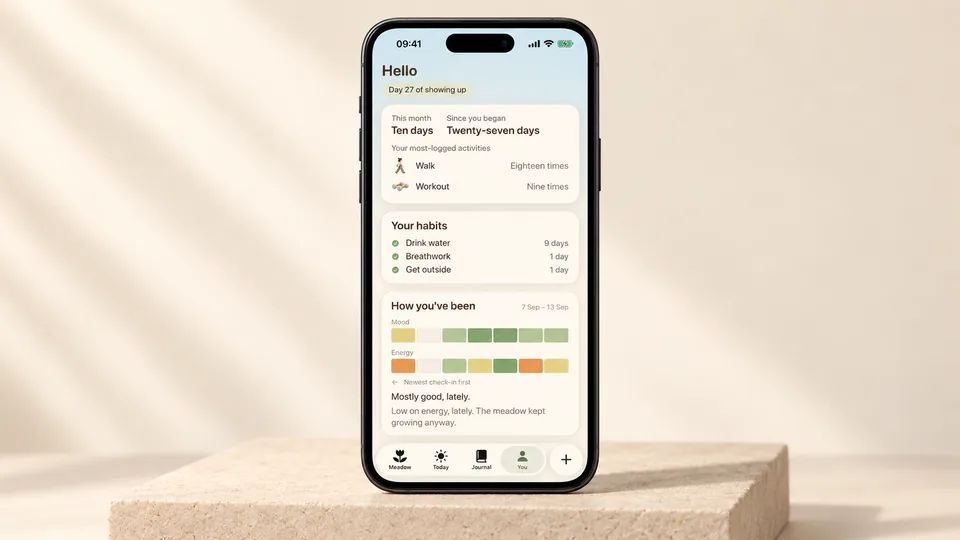
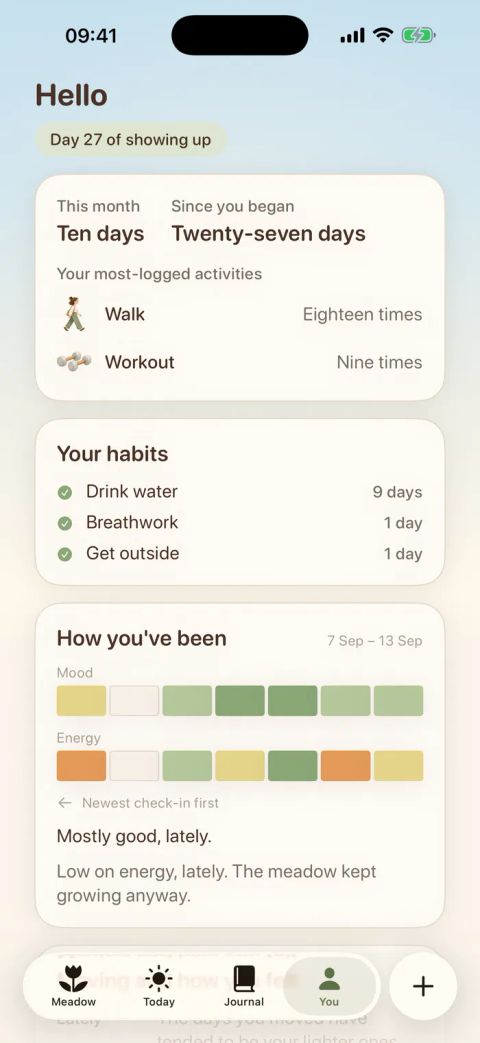
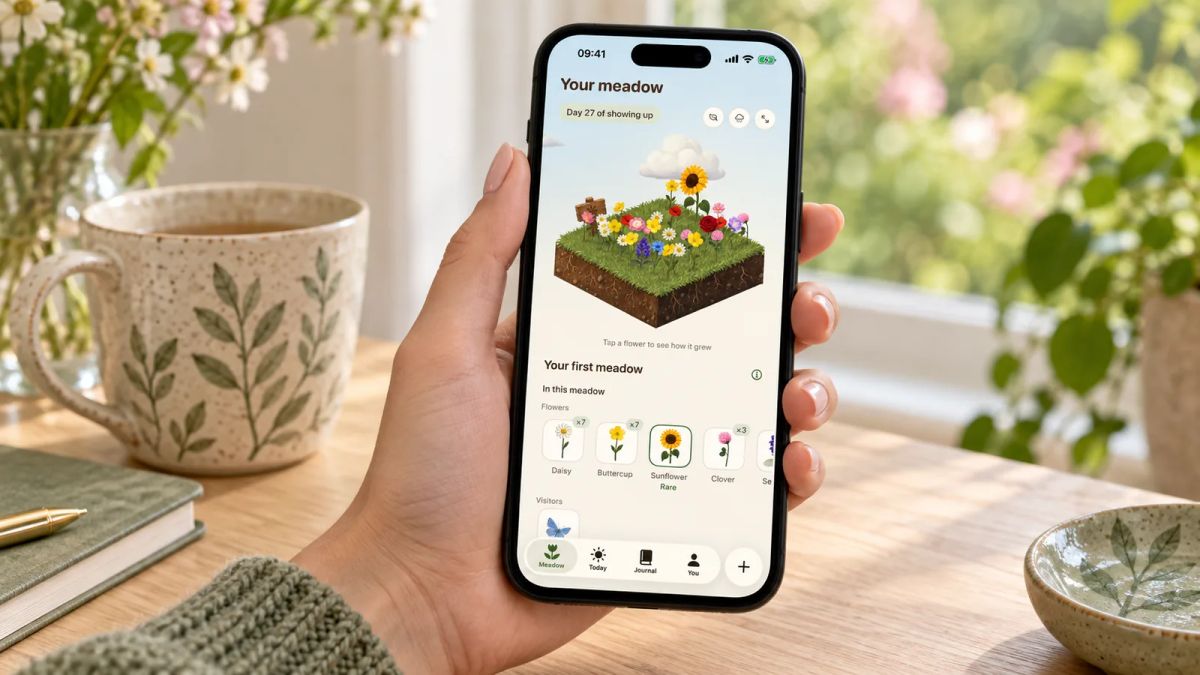
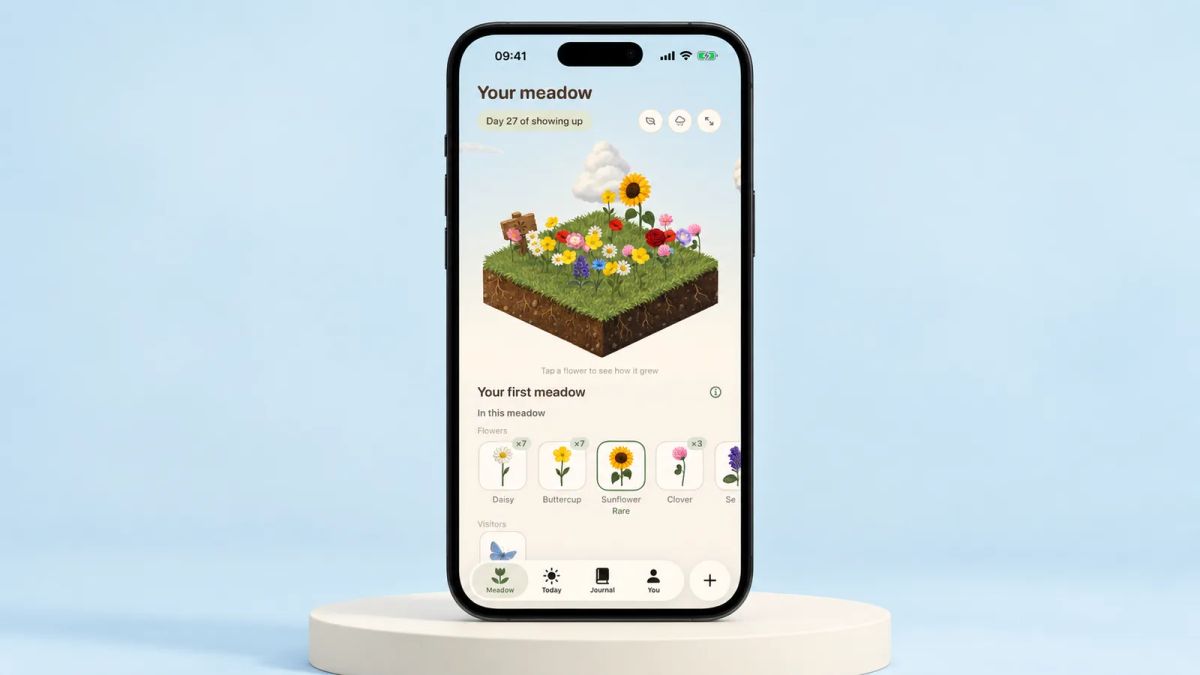
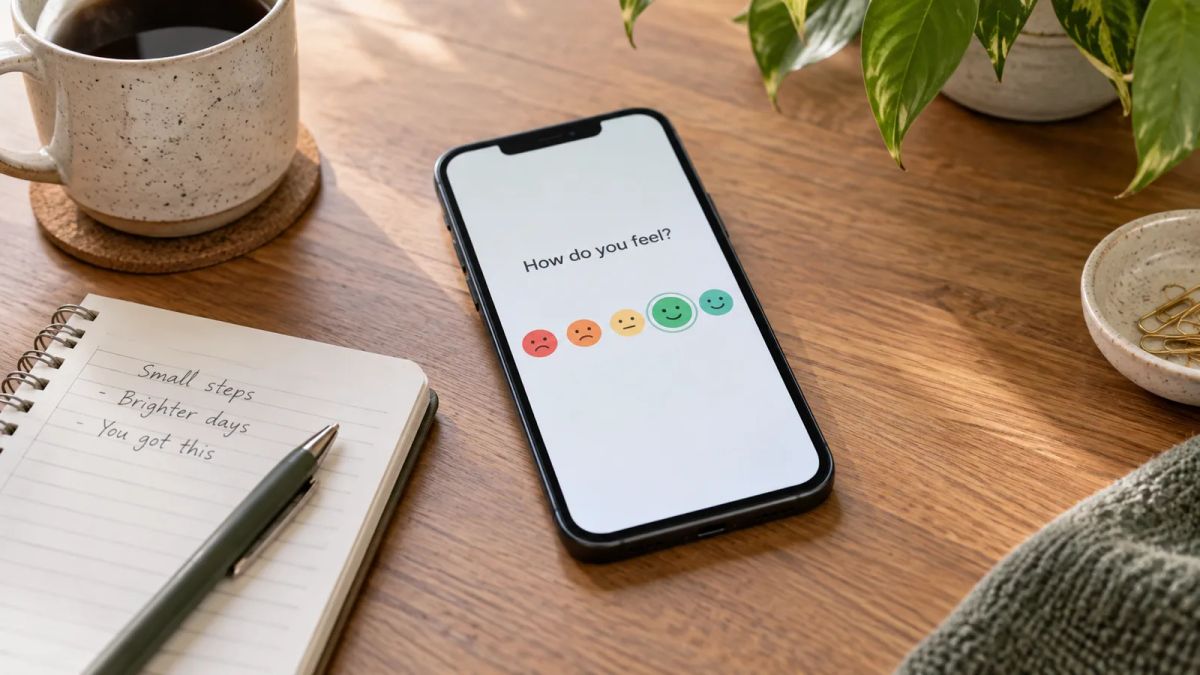
If you like the idea of a mood log but doubt a paper journal will last the month, Meadow keeps the check-in on your phone where it is harder to lose. It is a gentle movement and habit app for iPhone. Each day you note your mood and energy, write down one good thing, and tick off small habits like a walk or a glass of water, and every day you show up grows a wildflower in your own patch. There are no streaks, so a missed day resets nothing and your flowers never wilt. If you would rather compare a few options first, we round up more choices in our guide to the best mood tracker apps.
When to look for more support
A mood tracker sits alongside the ordinary work of looking after yourself, next to sleep, daylight and a bit of movement. It is a good way to notice a pattern and a poor substitute for care when things are hard in ways a colouring page cannot touch. If low mood or anxiety carries on for weeks, gets in the way of daily life, or your own pages start to worry you, that is a sensible reason to speak to your GP. The NHS mental health pages explain how to find talking therapies and urgent help, and a tracker is at its best sitting beside that support, not standing in for it.
Tonight, do the small thing. Draw a row of numbered boxes for the rest of this month, write down five moods and their colours, and fill in today. If a page of colours is not your style, a line of words works as well, and our gratitude journal prompts give you somewhere to start.
AUTHOR
Co-founder of Meadow.
Ash is co-founder of Meadow, a habit and movement tracking app that turns small acts of self-care into a growing wildflower meadow.
See how far you've come
Your habits, moods and little wins, all in one place
Meadow keeps track of the walks, the water and the good days, so you can look back and watch your effort add up.
Download Meadow