Lower-body mobility is how freely your hips, knees and ankles move together, and this is a connected routine of eight drills that trains all three in one go. It takes about twelve minutes, needs nothing beyond a wall or a chair to hold, and helps whether you're stiff from a day at a desk or you want to squat, climb stairs and walk with less effort.
Your hips, knees and ankles share every job your legs do. One step, one flight of stairs, one lowering into a chair, and the three of them pass the movement down the line between them. When they all move well, the load spreads and nothing has to strain. When one stiffens, the others cover for it, and that borrowed movement is where the aches usually begin.
Most routines pick a single joint. This one works the whole chain, because that's how your legs move.
Mobility and flexibility are not the same thing
It helps to be clear on the words, because they get thrown around as if they mean one thing. The American Council on Exercise draws the line like this. Flexibility is the available range at a joint, the passive stretch of the muscle and connective tissue around it. Mobility is usable range, the ability to move and control a joint through that range with strength and coordination.
The gap between the two is the point. You can have plenty of passive range lying on the floor and still lose control of it standing up. As ACE puts it, a person can look flexible and still struggle to control hip motion during a squat or lunge. Stretching on its own builds the first. A mobility routine like this one trains the range and the control at the same time, which is what your legs draw on when you're moving for real.
Why your hips, knees and ankles work as one
Move up the body from the ground and the joints take turns wanting stability and wanting movement. ACE describes exactly this alternation, and warns that if a joint meant to be mobile, such as the hips, is lacking in mobility, the areas either above or below will be affected. A stiff hip gets paid for by the lower back or the knee. A stiff ankle gets paid for by the knee above it.
The squat shows the chain plainly. A study of 101 healthy adults found that ankle dorsiflexion and hip flexion range of motion were both associated with how deep a person could squat, with ankle mobility the strongest factor across the group. If your shin can't travel forward over your foot and your hip can't fold, the depth has to come from somewhere, and that somewhere is usually a rounding back or knees caving inward.
Stairs and walking lean on the same three joints. A physiotherapist at Hinge Health notes that knee mobility plays a role in walking, getting out of a chair, going up stairs and stepping over a curb, and that moving the joint through its range helps keep it lubricated. Higher up the leg, a biomechanics study found that healthy older adults lacked the hip extension range to walk with a stride as open as younger adults, with available hip extension around 30% lower across the ages measured. The backward reach of the leg is what gives a walk its length, so a tight hip quietly shortens your step.
None of this gets solved one joint at a time. Work the whole lower half and the chain gets its share.
Move within range, and check first if you need to
Every drill here should feel like a mild pull or an honest effort, never a sharp, pinching or radiating pain. The NHS gives the standard steer for flexibility work, to move as far as is comfortable and build the repetitions up slowly over time.
Warm the joints before you load them. Harvard Health warns that stretching muscles before they're warmed up can hurt them, which is why the routine opens with easy movement and saves the deep hold for last.
If you've had a recent injury, or you have arthritis, a joint replacement, or a condition that affects how you move, check with your GP or a physiotherapist before you start. Cleveland Clinic gives a useful line for telling normal from not: some dull soreness when you first begin is expected, but contact a healthcare provider for sharp pain, or pain that lasts more than a few hours. An old knee or ankle that still catches or gives way wants a look, not a stretch-through.
The routine: eight drills for the whole lower body
Work through these in order. The sequence wakes the legs up, mobilises each joint in turn, then finishes with two shapes that ask all three joints to cooperate. Keep the movements smooth, breathe steadily, hold a worktop or chair whenever balance is the harder part, and where a drill is one side at a time, do both. The whole thing takes about twelve minutes.
1. Leg swings

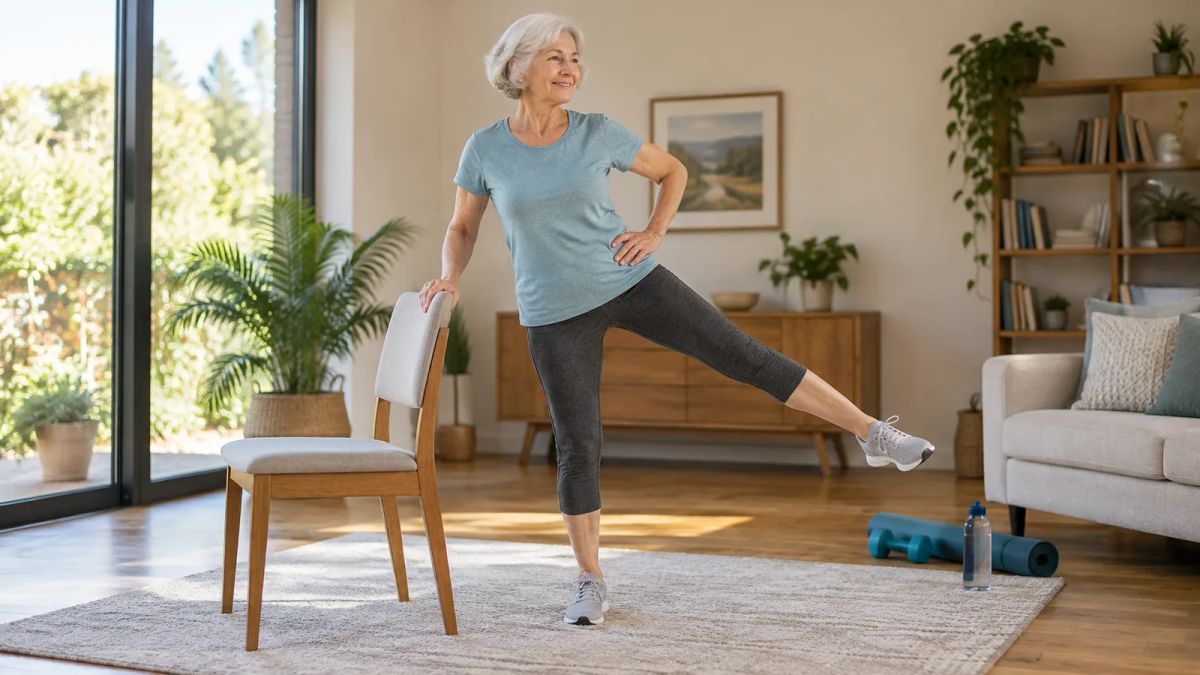
Stand tall, hold your support, and let one leg swing forward and back like a pendulum, going only as far as stays loose. Do 10 to 12, then turn side on and swing the same leg across your body and out, 10 to 12 times, before switching. Keep your torso still and let the hip do the work. This warms the front-to-back and side-to-side range you use walking.
2. Ankle rocks
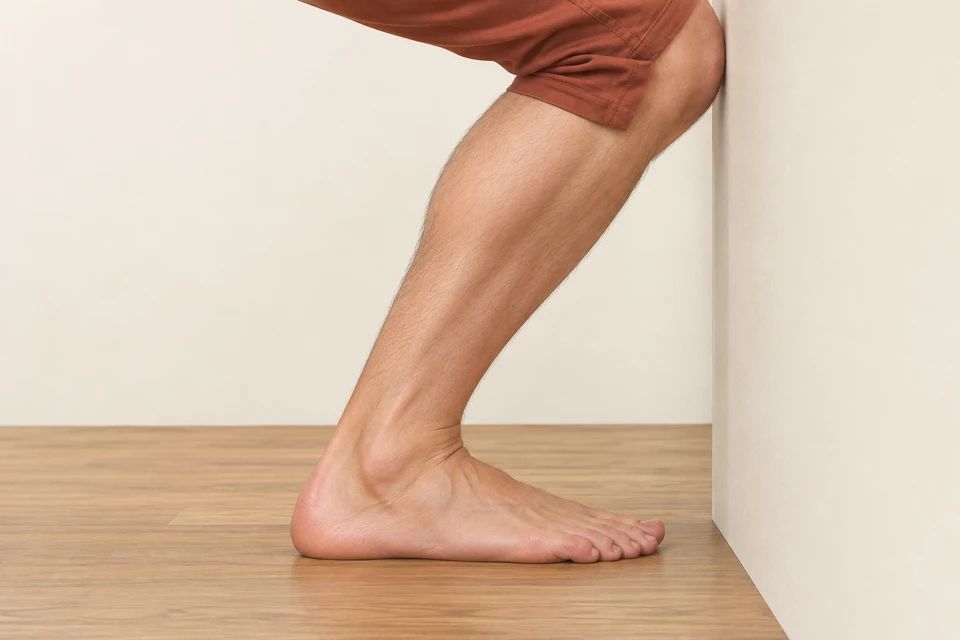
Face a wall in a short stride, front toes a few centimetres from it, heel planted. Rock your front knee forward towards the wall and back, staying at the edge of where the heel stays down. Do 10 to 15 slow rocks, then swap sides. This is the loaded ankle movement, the dorsiflexion the squat study flagged, and it trains the range your shin needs to travel over your foot.
3. Knee circles
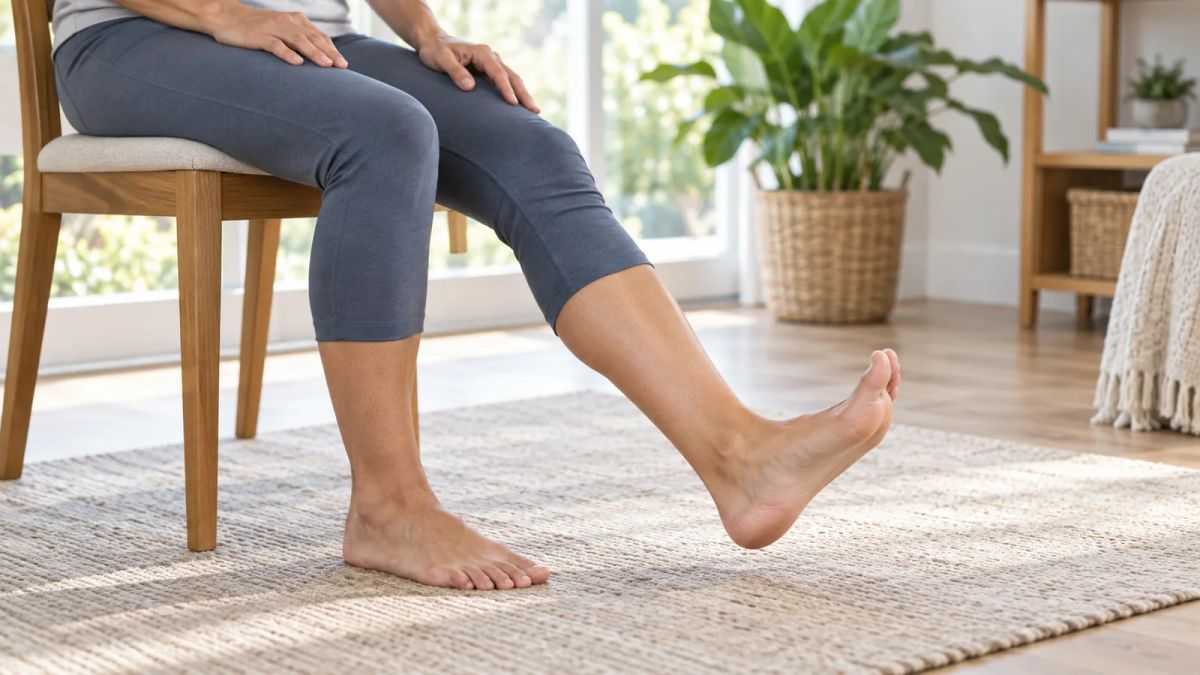
Stand with your feet together and a soft bend in both knees, hands resting on top of them. Draw slow circles with both knees together, letting the ankles and hips join in, 8 to 10 one way and 8 to 10 the other. Keep it small and gentle. This eases the knee through a little rotation and gets some fluid moving in a joint that stiffens fast when you sit.
4. Hip CARs
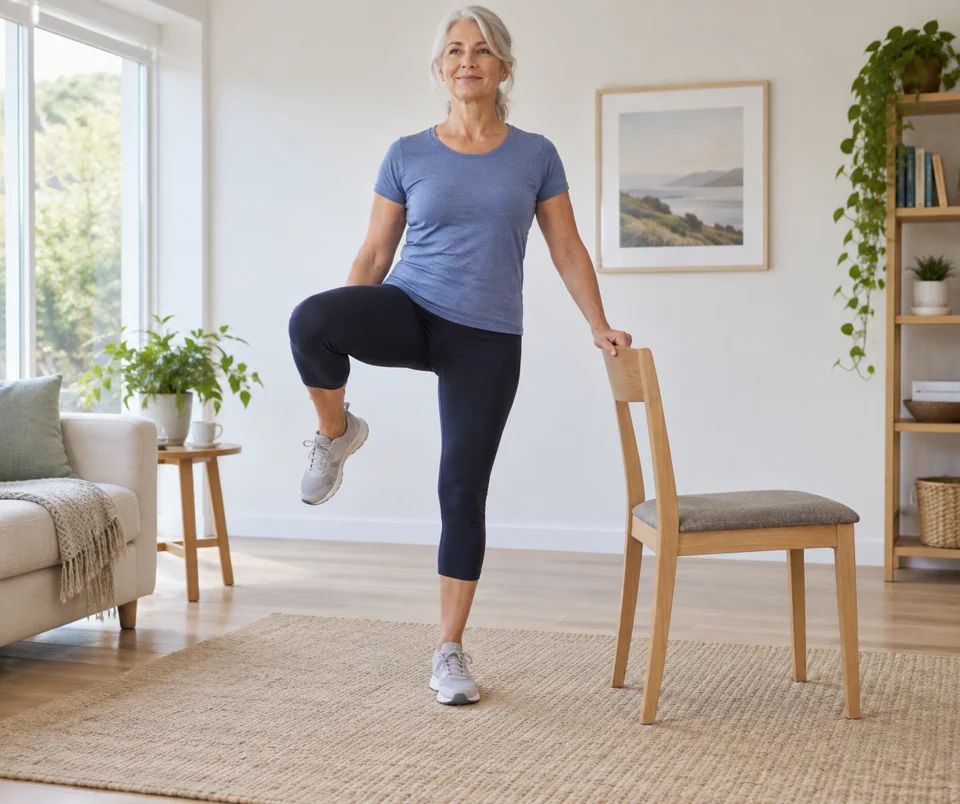
Standing tall and holding your support, lift one knee to hip height, then draw the biggest slow circle you can with that knee, out to the side, around and back, keeping the rest of your body still. Do 5 each way, then swap legs. CARs is short for controlled articular rotations, and the slow control is the whole point, taking the hip to the edges of its range under its own steam.
5. World's greatest stretch
Step into a long forward lunge with your right foot. Drop your left knee towards the floor, plant both hands inside the right foot, then reach your right arm up towards the ceiling and follow it with your eyes, opening through the chest. Come back and repeat, 4 or 5 each side. It earns its name by opening the hip, the ankle and the upper back in one move, close to the shapes your body makes in ordinary life.
6. 90/90
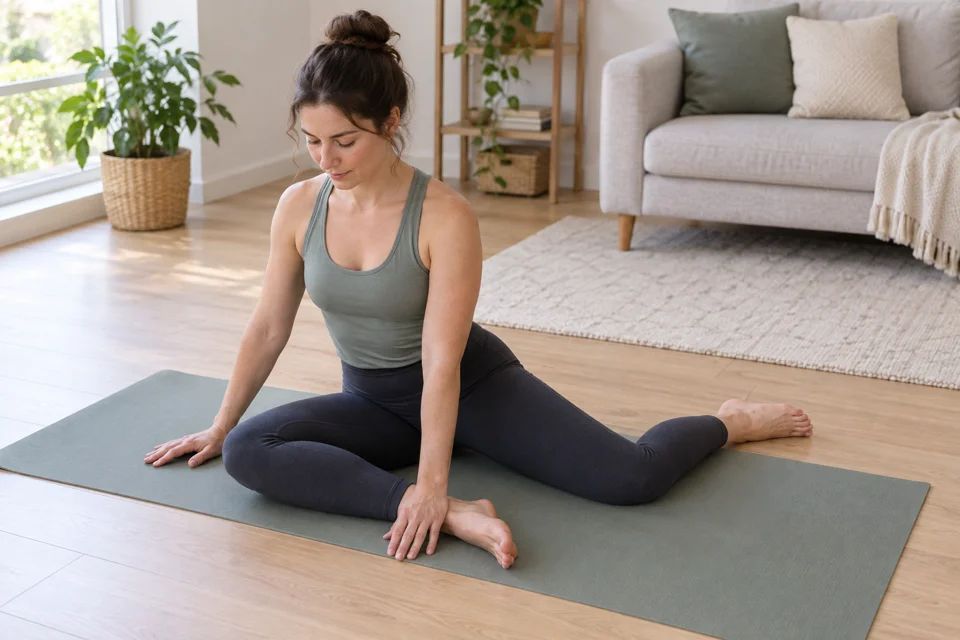
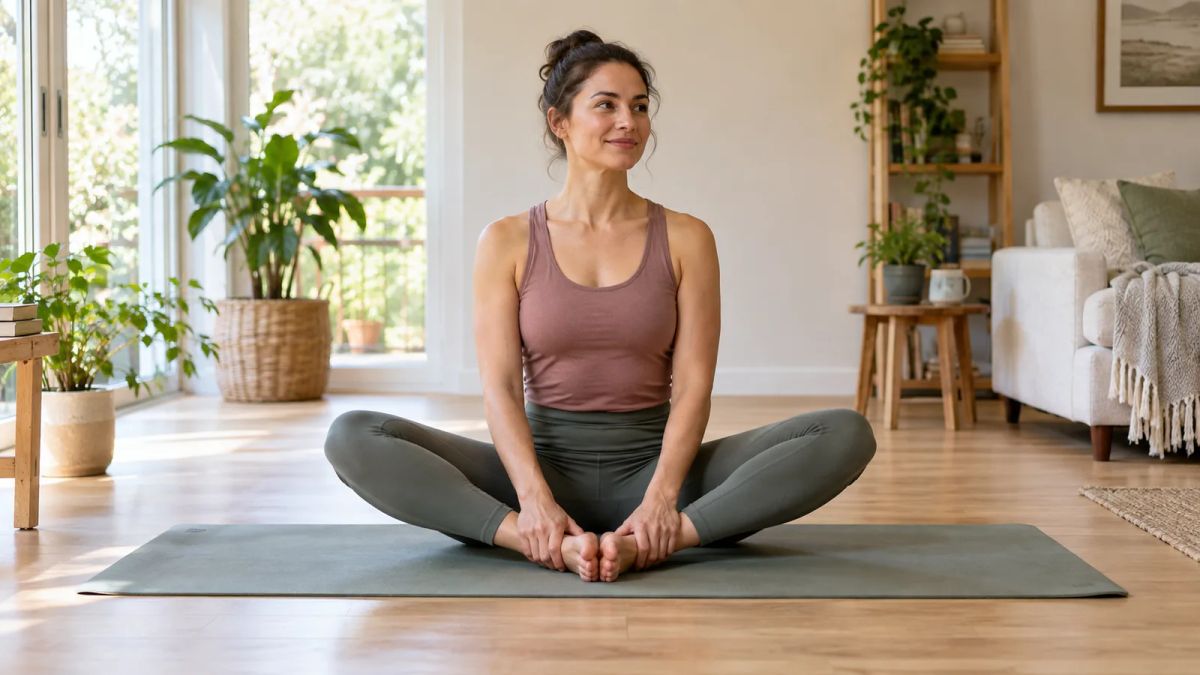
Sit on the floor with one leg in front bent at ninety degrees, shin across your body, and the other leg out to the side, also bent at ninety, shin pointing behind you. Sit tall, then hinge forward gently over the front leg until the outer hip opens, hold for around 30 seconds, and turn to set up the other way. This trains hip rotation in both directions, the movement you use turning to get out of a car.
7. Cossack squat
Stand with your feet wide and your toes turned out a little. Shift your weight over to the right, bending the right knee and sinking that hip down while the left leg stays straight, then travel across to the other side. Hold your support and go only as low as stays comfortable. Do 5 to 6 slow shifts each way. This loads one hip, knee and ankle at a time through a big side-to-side range, all three working together.
8. Deep squat hold
Stand with your feet a little wider than your hips, toes turned out slightly, and lower into a squat as far as is comfortable, holding a worktop or door frame for as much of your weight as you need. Let your hips sink, keep your heels down, and gently press your knees open with your elbows. Hold for 20 to 30 seconds, breathing into the bottom of the position, then stand. This gathers the whole routine into one shape, hips folded, knees bent, ankles flexed, the position that asks all three joints to share the load.
That's the full sequence. If twelve minutes is more than you have, drills 2, 5 and 8 touch all three joints between them.
What this routine can and can't do
Done regularly, this kind of work can help you move through ordinary days with a fuller, freer lower half and less of the stiffness that creeps in from sitting. That's the honest, everyday payoff, and it's a good one to have.
Give it time. Harvard Health is clear that becoming more flexible takes weeks to months of regular work, and that you have to keep it up to hold on to what you gain. One session leaves you looser for an hour or two. Lasting change is a slow build.
Be straight about the limits too. Mobility work isn't a treatment for a specific injury, and it won't fix a hip, knee or ankle that's been painful, catching or unstable for months. That's a physiotherapist's job. The squat and walking studies show mobility linked to better movement, and a link isn't proof that loosening one joint heads off a problem elsewhere. What the routine reliably does is keep the range you have across all three joints and, kept up, add a little to it.
Building it into your day
A routine you mean to slot in somewhere tends to evaporate. One pinned to a moment that already happens tends to stay.
The American Heart Association suggests tying a new action to a routine you already have, so it rides along with something automatic. Pick a cue you never skip and hang the legs off it. "After I put the kettle on, I do my leg swings, ankle rocks and a deep squat hold" is the kind of plan that holds, because the trigger is already there.
If you'd sooner work one joint at a time, or a stiff spot is asking for more, our hip mobility exercises and ankle mobility exercises each go deeper on their joint, and the gentler, chair-supported mobility exercises for seniors cover the whole body at an easier pace.
See the small sessions add up

Some days you'll flow through all eight drills and some days you'll manage three, and Meadow is made for that mix. It's a gentle movement and habit app for iPhone where you log the movement you do, tick off small daily habits, and note your mood and energy, and each day you show up grows a wildflower in your own meadow. A few minutes on the floor counts as movement, so the short sessions earn their flower too. There are no streaks, so a stiff day you skip resets nothing and your flowers never wilt. You can find it at Meadow.
On a rushed or low day, decide your smaller version in advance. A set of leg swings, ten ankle rocks each side and one deep squat hold still count, and a couple of minutes keeps the thread going.
If you miss a day, or a fortnight, nothing is undone. Stiffness after a gap is the result of sitting still, not a mark against you. Pick the next day, start with the leg swings, and carry on from there.
Today, choose your cue, the kettle or the end of the working day, and do your leg swings, ankle rocks and one deep squat hold while it happens. That's enough to begin.
AUTHOR
Co-founder of Meadow.
Ash is co-founder of Meadow, a habit and movement tracking app that turns small acts of self-care into a growing wildflower meadow.
Every little bit counts
Five minutes counts. So does a dance in the kitchen.
Log the movement you enjoy and the small habits that help you feel good, and watch them bloom into something you can see.
Download Meadow