When your calves feel tight and short, whether that shows up as stiff first steps in the morning or a pull when you crouch and climb stairs, a few minutes of stretching most days will loosen them. This is a plan of six calf stretches, from an ankle warm-up through standing wall holds, a step drop, a seated towel stretch and a downward dog, and it takes about ten minutes with nothing more than a wall, a step and a towel.
One detail changes how well it works. Your calf is two muscles, and you reach them with the knee held in two different positions, so the plan below does both.
Why calves get tight
Sitting is a big part of it. When you sit or drive for hours, your ankles rest in a slightly pointed position and the calf sits shortened, and do that most days for years and the muscle settles into that shorter length. The opposite of sitting causes it too. Push up your running distance, your hill walking or your step count faster than your legs are ready for, and the calves get overloaded by the repeated pushing off.
Footwear plays a part. Wearing heels most days holds the calf in a shortened position, and the physiotherapist Joey Loeb notes that this leads to a shortening of the calf muscle fibres over time. Flat, unsupportive shoes and long hours standing on hard floors add their own load.
Two smaller causes are worth knowing. Being under-hydrated can leave the calves prone to tightness and cramp, and an old ankle or Achilles problem that never fully settled will often leave the calf guarding and stiff on that side. Tight calves do more than feel stiff. They cut how far your ankle can bend, which shifts load onto the foot, knee and Achilles and can make walking and stairs feel harder than they should.
The two calf muscles, in plain terms
Your calf is made of two muscles stacked on top of each other. The gastrocnemius is the big one you can see, and it crosses both the knee and the ankle. Underneath sits the soleus, which crosses the ankle alone.
That anatomy decides how you stretch each one. Because the gastrocnemius runs above the knee, it pulls tight only when the knee is straight. The soleus does not cross the knee, so to reach it you bend the knee first, which takes the gastrocnemius off the stretch and lets the pull drop lower down the calf. As the sports injury therapist Mike Walden puts it, bending the knee reduces the involvement of the gastrocnemius, allowing a more focused stretch lower in the calf. Do a straight-knee version and a bent-knee version and you have covered both.
Work through the six stretches
Open our free printable: Your calf stretch card (PDF). Save or print it to use alongside this guide. No sign-up needed.
Warm the calf before you hold anything hard, which is what the first move is for. Each static hold should feel like a mild pull down the back of your lower leg and nothing sharper. Cleveland Clinic gives the plainest guide to depth: you should feel a gentle stretch, and if you feel pain you have gone too far.
1. Ankle pumps and circles (your warm-up)
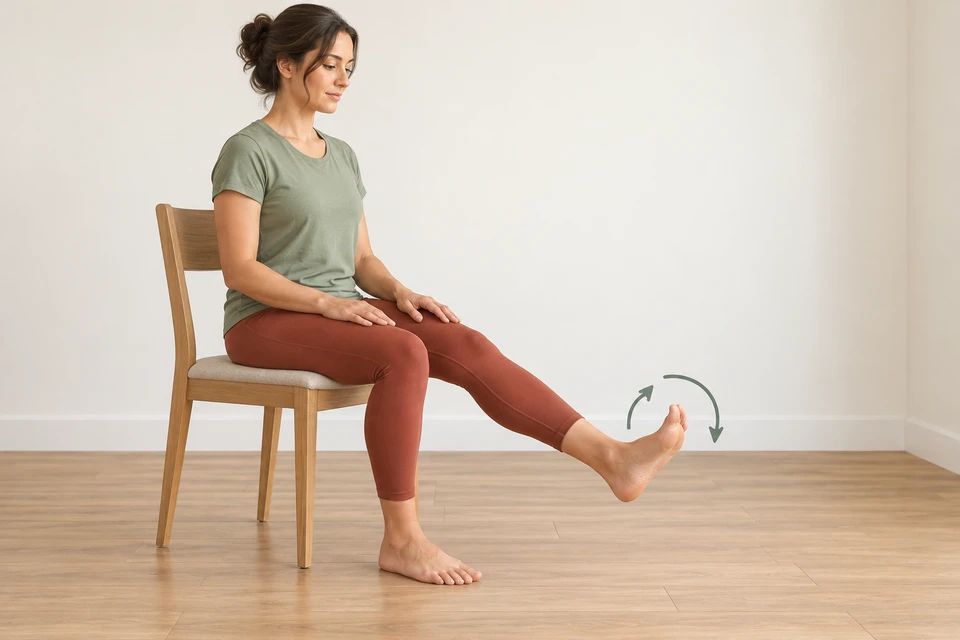
Sit or stand and point your foot away, then pull your toes back towards your shin, slowly, 15 to 20 times each foot. Then draw ten slow circles each way with each ankle. There is nothing to hold here. It moves the calf and ankle through their range and gets blood in before you ask the muscle to lengthen.
2. Standing wall stretch, straight knee
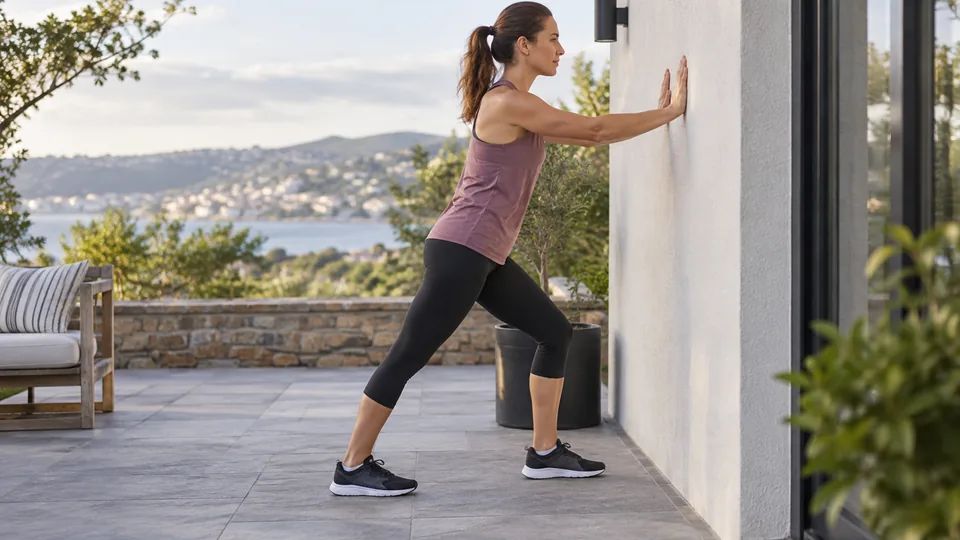
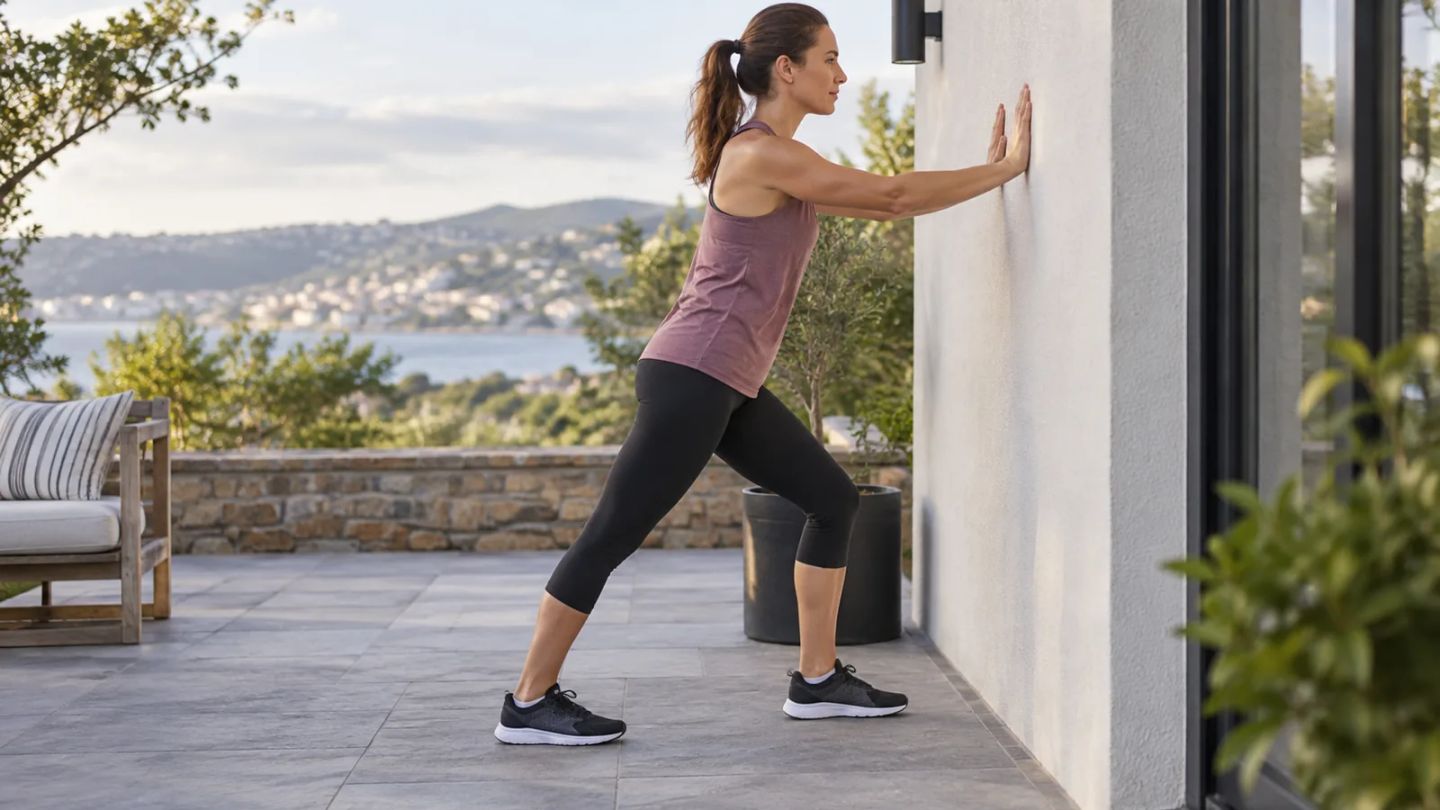
Stand facing a wall, hands on it at shoulder height. Step one foot back, keep that back leg straight with the heel pressed flat and the toes pointing at the wall, and lean your hips towards the wall until you feel the stretch high in the back calf. Hold for around 30 seconds, then swap. Do each side two or three times. This one biases the gastrocnemius.
3. Standing wall stretch, bent knee
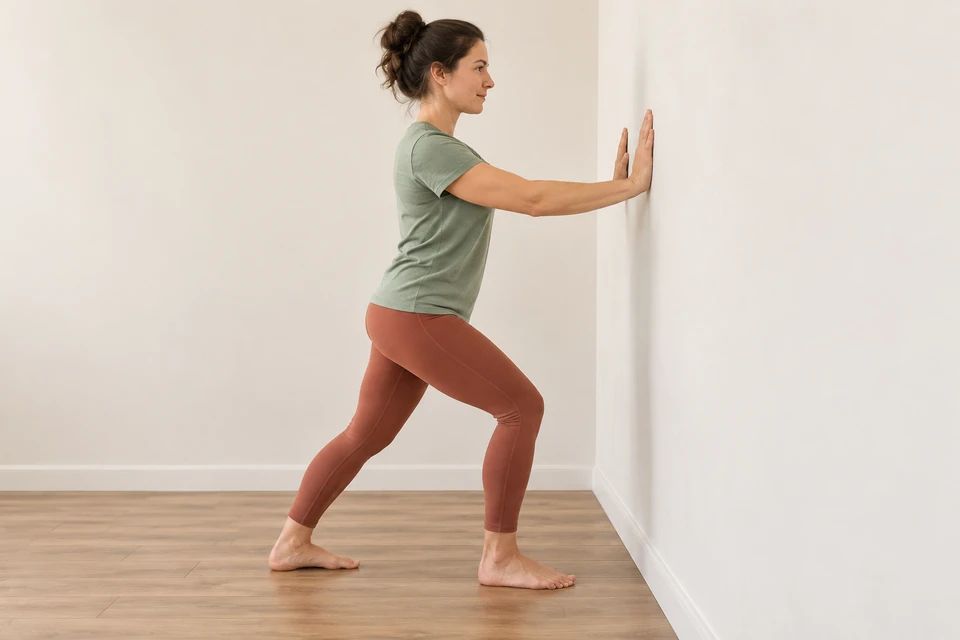
From the same position, bring your back foot in a bit closer and bend that back knee, keeping the heel down and the toes forward, then sink your hips down and forward. The pull moves lower, nearer the ankle. Hold for 30 seconds each side. This one reaches the soleus that the straight-knee version misses.
4. Step heel drop
Stand with the balls of both feet on the edge of a step and hold the rail or wall. Let your heels sink below the level of the step under their own weight until you feel the stretch through the calf and Achilles. Cleveland Clinic describes exactly this drop off a stair. Hold for 20 to 30 seconds. To bias the soleus, soften your knees a little as your heels hang.
5. Seated towel or strap stretch
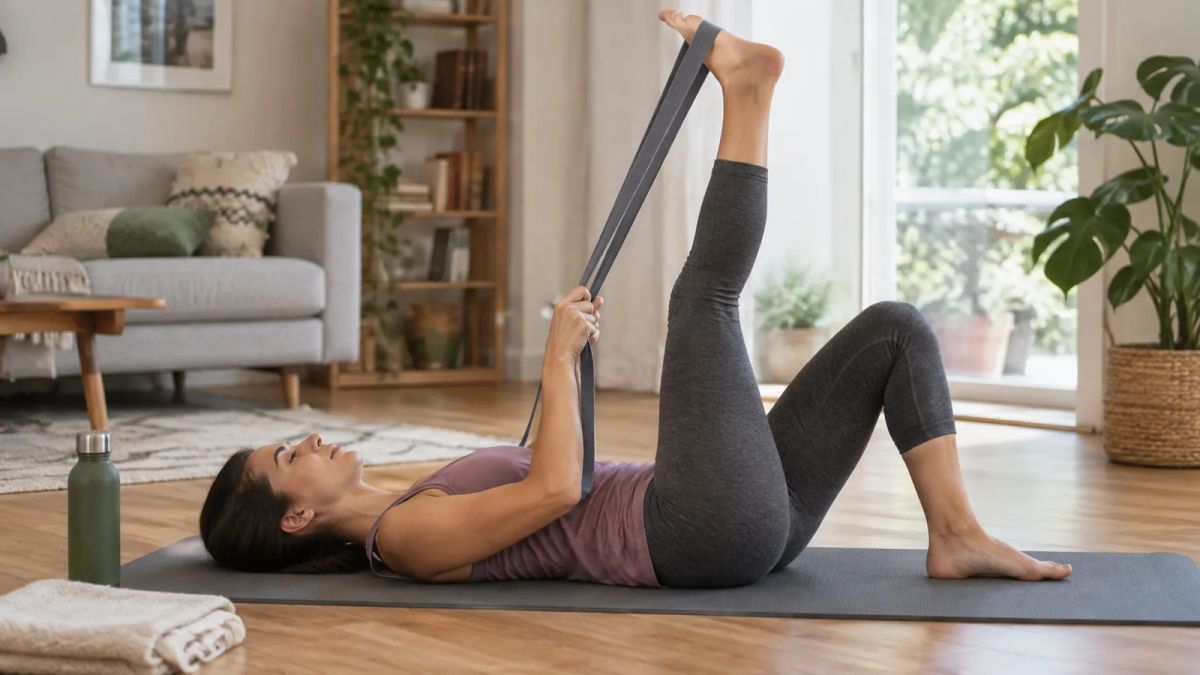
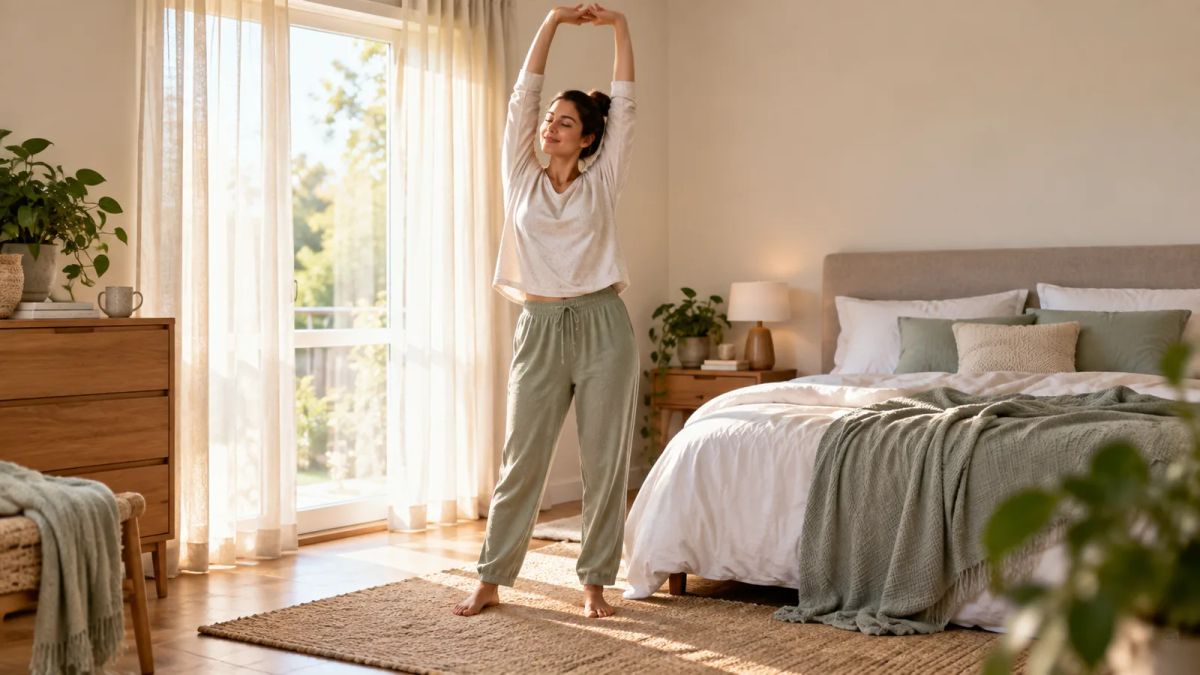
Sit on the floor with one leg straight out in front. Loop a towel, belt or strap around the ball of that foot and draw it gently towards you, keeping the knee straight and the back long, until the calf lengthens. Hold for 20 to 30 seconds each side. It is the kindest option if standing versions bother your balance, and easy to do on the bedroom floor.
6. Downward dog calf pedal
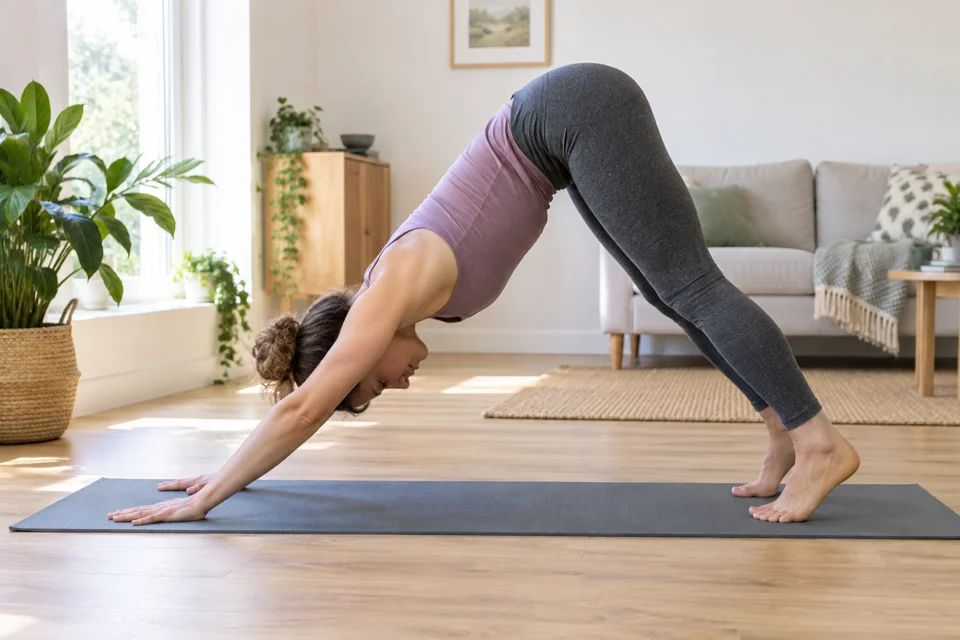
From your hands and feet with your hips pushed up towards the ceiling, bend one knee while pressing the other heel towards the floor, then swap, cycling slowly as if pedalling. After a dozen pedals, hold with both heels reaching down for 20 to 30 seconds. This works both calves at once and stretches the hamstrings and the backs of the shoulders along the way.
Here is the whole thing at a glance, so you can follow it without scrolling back:
Warm-up: Ankle pumps 15 to 20, then circles, each foot
1. Wall stretch, straight knee, 30 sec, 2 to 3 times each side
2. Wall stretch, bent knee, 30 sec each side
3. Step heel drop, 20 to 30 sec
4. Seated towel stretch, 20 to 30 sec each side
5. Downward dog pedal, then hold 20 to 30 sec
Total: about 10 minutes. Aim for 3 to 5 days a week.
What stretching your calves will and will not do
It does buy you a bit more ankle movement. When a school stretched its basketball players' calves for the season, holding the stretch and repeating it a few times a day, the stretching group's ankle bend improved over the players who did nothing. That extra range is what makes squatting, stairs and a full walking stride feel easier.
Keep your expectations honest about size and speed, though. The gains from a bout of stretching are real but small, they build over weeks of regular practice, and a lot of the looseness you feel straight after a stretch fades within the hour if you stop there. This is why it has to be a habit and not a one-off.
The same basketball study is a useful reality check on injuries. The stretching cut ankle bend stiffness but did not significantly lower the injury rate, and the researchers said their study was too small to settle that question either way. Stretching is worth doing for comfort and range. Treating it as injury-proofing is a stretch of its own.
Calf tightness and heel pain sit close together, which is worth untangling. Your calf muscles feed into the Achilles tendon, which wraps the heel and connects with the plantar fascia under the foot, so a tight calf can tug on that chain. But tight calves do not appear to start plantar fasciitis. The physiotherapist Maryke Louw, reviewing the research, found no evidence that tight calves cause plantar fasciitis and points out the link tends to run the other way, with the foot problem tightening the calf over time. If you have heel pain, calf stretches can be part of the picture, but a stretch aimed at the plantar fascia itself often does more for it.
Stretch it safely
The commonest mistake is pushing a cold, tight calf hard and chasing a pull that turns sharp. Ease into every hold, breathe, and keep it to a mild stretch you could hold in a conversation. Do not bounce at the end of the range, and if standing versions leave you wobbling, use the seated towel stretch and the wall for support.
Some calf pain is a reason to stop and get advice, not to stretch harder. A sudden sharp pain or a pop mid-stride, calf pain that is sore in one specific spot rather than generally tight, or one calf that is swollen, red or warm to the touch all deserve a word with your GP or a physiotherapist before you stretch into them. Everyday, both-sided tightness after a long sit is the kind these stretches are for.
Keep the stretch in view

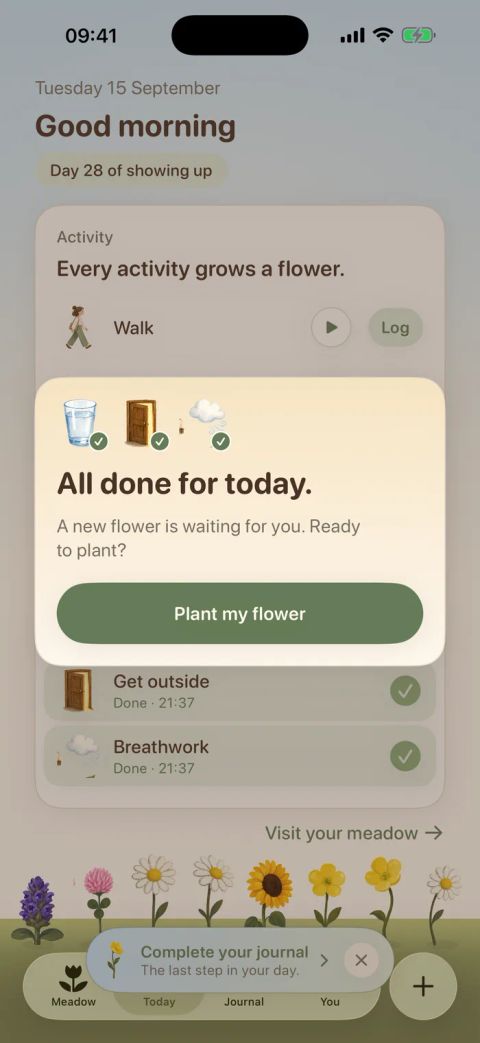
A few minutes of calf work is the sort of thing that slips your mind by mid-morning, which is where a nudge on your phone earns its place. Meadow is a habit app for iPhone from Wildcard Wellness where you log the movement you enjoy with a timer, a stretch, a walk or a little yoga, and tick off small daily habits beside it. Every day you show up grows a wildflower in your own meadow, and because it keeps no streaks, the week you forget your stretches wipes out nothing you have built. Your flowers stay put and you pick up where you left off.
If you want to build a fuller routine around this, calf stretches sit well inside a full-body stretching routine, and they pair naturally with ankle mobility exercises, since a stiff ankle and a tight calf usually turn up together. Tight calves also travel with tight hamstrings, so the stretches for hamstrings are a sensible next step once these feel easy.
On a busy day, and after a gap
Decide your shorter version now, before a rushed morning decides it for you. One straight-knee wall stretch and one bent-knee wall stretch, 30 seconds each, hits both calf muscles in under three minutes and keeps the thread going far better than skipping the day.
If you fall off for a week or a month, nothing you gained is scrubbed out. The tightness creeps back because you sat still again, not because you failed at it, and the answer is the same as ever. Pick the next quiet moment and do one wall stretch.
Right now, before you move on, stand facing a wall, step one foot back with the leg straight and the heel flat, and lean in for a slow count of thirty. Then bend that back knee and lean in again. That is both calf muscles done, and the first of your three to five sessions this week.
AUTHOR
Co-founder of Meadow.
Ash is co-founder of Meadow, a habit and movement tracking app that turns small acts of self-care into a growing wildflower meadow.
Every little bit counts
Five minutes counts. So does a dance in the kitchen.
Log the movement you enjoy and the small habits that help you feel good, and watch them bloom into something you can see.
Download Meadow