Motivation to run isn't a feeling you wait around for. It comes from setting your runs up so they're easy to start and pleasant enough that part of you looks forward to the next one.
Most people who give up running didn't run out of willpower. They went out too fast, too far, too soon, hated every minute, and decided running wasn't for them.
It usually was. The runs were built wrong.
Here's how to build runs you'll keep coming back to, including the two bits most guides skip: what to do when the motivation drops away, and how to start again after a run that falls apart.
Start with run-walk so your first runs don't punish you
The fastest way to lose your motivation is to run until you're bent over gasping on day one. Do that a few times and your brain files running under "things that hurt", and no amount of willpower argues with that.
Run-walk fixes it. You run for a short interval, walk for a short one, and repeat from the very start of the run, before you're tired. Jeff Galloway, a 1972 US Olympian, built the method while coaching everyday runners, after he noticed walk breaks kept new runners injury-free and helped them enjoy the process instead of dreading it.
The ratios are smaller than you'd think. RunnersConnect lays out sensible starting points:
- Brand-new runner: 15 to 30 seconds running, then 30 to 60 seconds walking, repeated.
- Getting comfier: 1 minute running, 1 minute walking.
- Building distance: 2 minutes running, 1 minute walking.
Walk at a proper walking pace, not a shuffle, and use a timer or an app to keep the intervals honest. Walking puts far less impact through your bones and joints than running does, which is part of why walk breaks lower the load tied to stress fractures, knee pain and plantar fasciitis. Run-walkers also tend to finish a given distance in a time close to people who run the whole way, while reporting less muscle soreness and fatigue afterwards. Less wrecked afterwards means more likely to go again.
One thing before you build up. If you have a health condition, an injury, or you've not exercised in a long while, have a quick word with your GP first, and stop if a run brings on chest pain, dizziness or breathlessness that isn't normal for you. If you're starting from scratch, our guide to how to start exercising has an easy first week you can follow.
Run slow enough to hold a conversation
Almost every new runner runs too fast. It feels like running is meant to hurt, so you push, and then you can't work out why you dread it.
Slow down until you can talk. The talk test is a well-established way to gauge effort: at an easy-to-moderate pace you can speak in short sentences without gulping for air. If you can only manage single words between gasps, you're running too hard, so ease back or drop into a walk break.
A conversational pace feels almost too easy at first. That's the point. It's the pace you can repeat three times a week without dreading it, and repeatable is what motivation is made of.
Give yourself something to look forward to
The runs you keep are the ones you half-enjoy. That's not a soft observation, it's what the research on why people stick with exercise keeps finding.
A systematic review of self-determination theory and exercise found that enjoyment-led, self-chosen reasons predicted sticking with activity over the long run, while outside pressures like changing how you look were tied more to short-lived starts. Wanting to look a certain way might get you out the door this month. Liking the run itself is what buys you the next year.
So stack a couple of small pleasures onto the run. Pick a route you like being on, a park, a river path, a loop with a good view at the halfway point. Build a playlist that lifts you. Music does measurable work here: at an easy-to-moderate effort it can cut how hard a run feels by around ten per cent and lift your mood, which turns a slog into something closer to fun.
If your drive tends to fade once the novelty wears off, our guide to exercise motivation digs into keeping it alive.
Run with other people, or find a parkrun
A run you've arranged with someone else is much harder to skip than one only you know about. Company makes the time pass too, and a bad run in good company is still a decent morning.
Parkrun is the easy on-ramp. It's a free, weekly, timed five-kilometre event you can run, jog or walk, and you can take all the walk breaks you like. In a survey of 60,000 UK parkrunners, 78.8% said it made them happier, 69.7% felt a stronger sense of community, and among people who'd been barely active when they signed up, 88.2% got more active. You don't have to be fast, and nobody minds where you finish.
If parkrun isn't your thing, a standing date with one friend does the same job. Same time, same place, someone expecting you.
Aim for a number of runs a week
A race time is a fine thing to aim at, but you don't control it on the day. Weather, sleep, a hectic week, a stiff knee, they all get a vote. What you do control is how often you lace up.
So make your main goal a number of runs, not a time on a clock. Three short runs most weeks is a target you can hit whatever your legs do on Saturday. Chasing a self-chosen process like that fits what keeps people running, where straining to hit a pace to prove something tends to burn out faster.
Write the week down in one place so it's real. Fill in these lines and you've got a plan that survives a flat day:
Runs I'm aiming for this week: ____ (a number I can hit)
My pace rule: I can talk in short sentences the whole way
My run-walk: ____ run / ____ walk, repeat
My smaller version: ____ (for a low-energy day)
My treat: ____ (a route, a podcast, a coffee after)
Here's one filled in, so you can see the shape:
Runs I'm aiming for this week: 3
My pace rule: I can talk in short sentences the whole way
My run-walk: 1 min run / 1 min walk, repeat
My smaller version: once round the block
My treat: riverside loop with my long-runs playlist
When the motivation dips and a run goes badly
You'll have flat weeks. You'll have runs where your legs feel like wet sand and you walk most of the way home. A bad run isn't a verdict on you as a runner. It's a Tuesday.
Decide your smaller version now, while you're feeling fine, because a flat evening is a terrible time to negotiate with yourself. If your run is a 5k, the smaller version might be once round the block. If it's thirty minutes, it's ten. It sounds too small to count, and that's exactly why it works, because you keep the habit alive when the honest alternative is doing nothing.
Then there's the missed run. When researchers followed people building a new habit, a single missed day made little difference to whether the habit eventually stuck, with the time to feel automatic ranging from about 18 days to well over 200. One gap doesn't undo the weeks behind it. The damage comes from the story you tell afterwards, the "well, I've blown it now" that turns one skipped run into a fortnight on the sofa.
James Clear, who wrote Atomic Habits, puts it well: the problem isn't the odd missed session, it's "the cumulative impact of never getting back on track". So make your rule "never miss twice". One skipped run is life. Two in a row is the start of not running any more. Don't wait for Monday. Take the next slot you've got and do the smaller version.
Talk to yourself the way you'd talk to a mate who'd missed a couple of runs. You wouldn't call them a failure. You'd tell them it's fine and to go again when they can. If you want more on riding out the wobbles, our guide to staying consistent with exercise covers the whole pattern.
Watch your runs add up to something
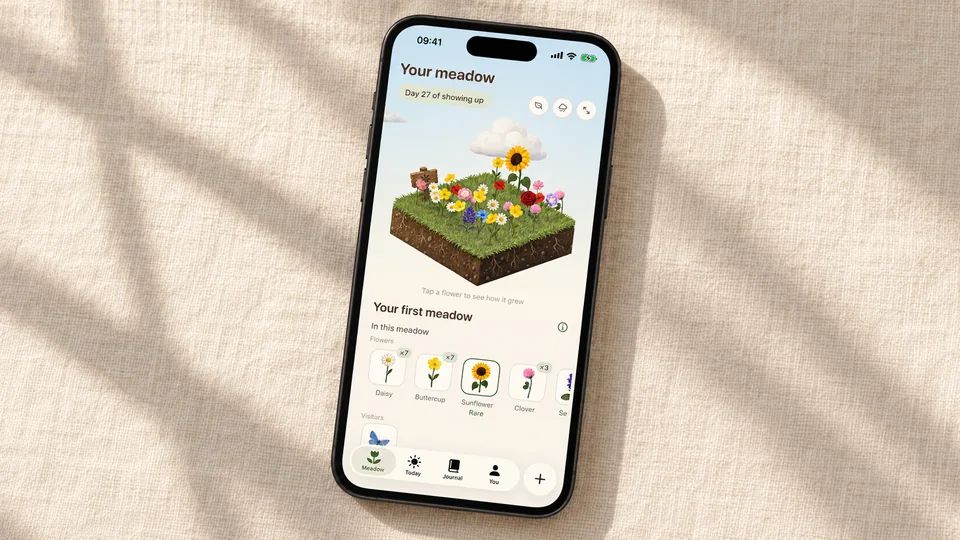
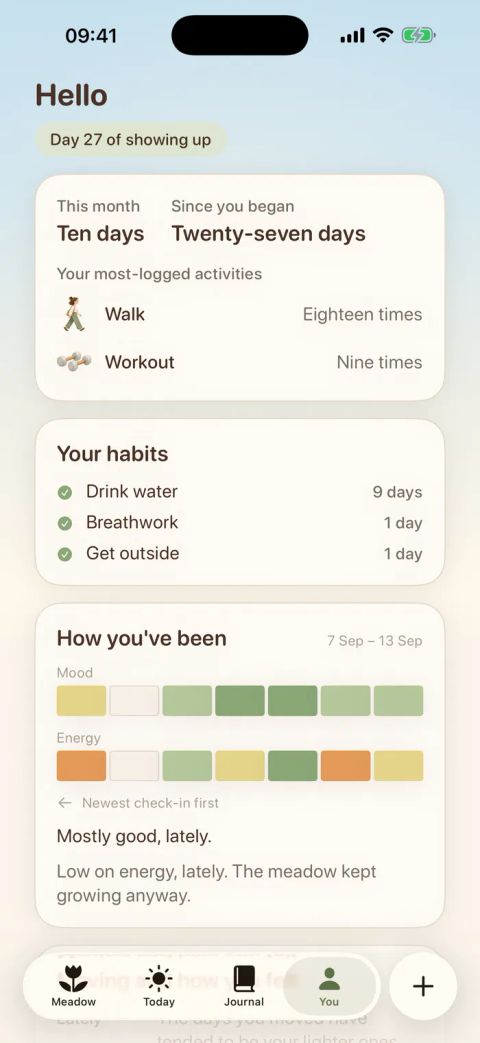
Some weeks you'll run three times and some weeks life eats the lot, and an app that scolds you for the quiet ones tends to get deleted by February. Meadow works the other way round. It's a gentle movement and habit app for iPhone where you log a run with a timer, tick off small daily habits, and note your mood and energy, and every day you show up grows a new wildflower in a meadow that's yours.
What fits running especially is the forgiveness. There are no streaks, so a rained-off run or a week away resets nothing and your flowers stay put. You pick up whenever you're ready, which is how real running weeks tend to go anyway.
Common questions
How do I get motivated to run when I don't want to? Shrink the run until the resistance goes. Tell yourself you'll do ten minutes of run-walk and you can stop after. You almost never do, and on the rare day you do stop, you've still run, which beats the nothing you'd have got from waiting to feel keen.
Why is running so hard when I'm starting out? Usually because you're going too fast. Drop to a pace where you can talk in short sentences and add walk breaks from the first minute. Most people are stunned by how much nicer running feels once they stop treating every run like a race.
How many times a week should a beginner run? Three short runs, with a rest day in between, is plenty to build the habit and gives your body time to adapt. Frequency beats length early on, so keep the runs easy and let the days themselves become the routine.
How do I stop losing motivation after a few weeks? The first buzz always fades, so change something. A new route, a fresh playlist, a friend to run with, a parkrun on Saturday. And if a week goes sideways, drop to the smaller version instead of stopping altogether.
Should I run every day? For most beginners, no. Rest days let your legs recover and cut your injury risk, and running while sore is a fast route to hating it. Alternate your runs with walking, stretching or a full rest day.
Pick your run-walk ratio and the route for your next run, put one time in the diary this week, and go and do the smaller version once, at a pace you can talk through. The motivation tends to show up once you're moving, not before.
AUTHOR
Co-founder of Meadow.
Ash is co-founder of Meadow, a habit and movement tracking app that turns small acts of self-care into a growing wildflower meadow.
See how far you've come
Your habits, moods and little wins, all in one place
Meadow keeps track of the walks, the water and the good days, so you can look back and watch your effort add up.
Download Meadow