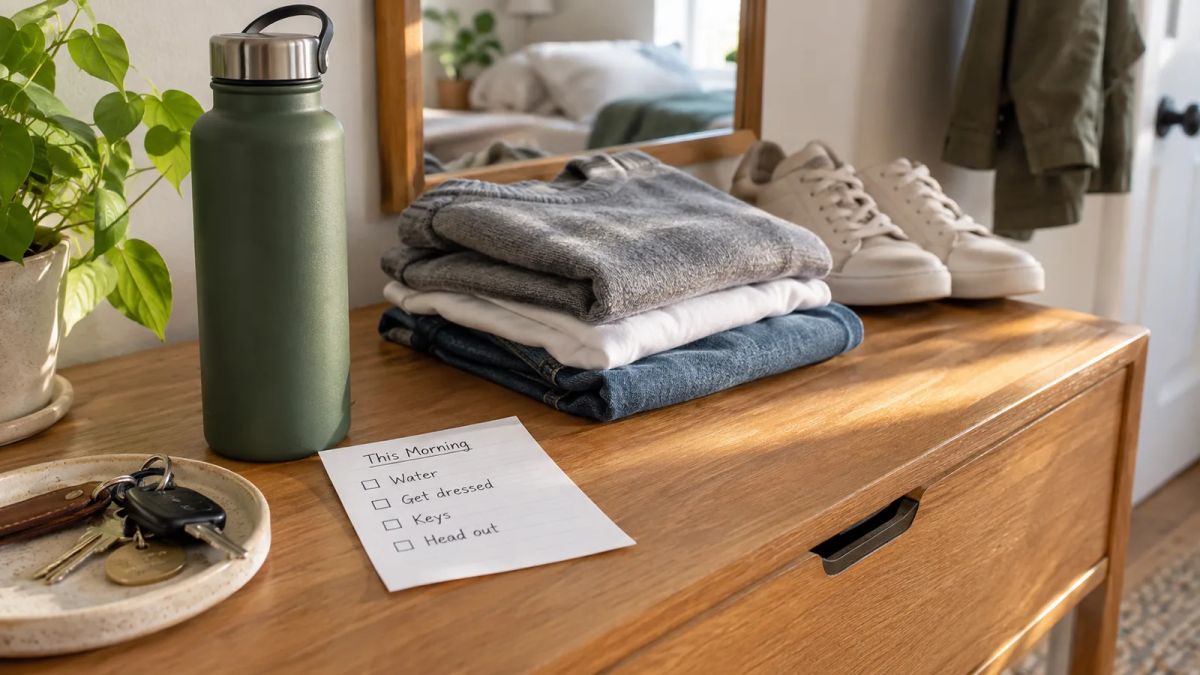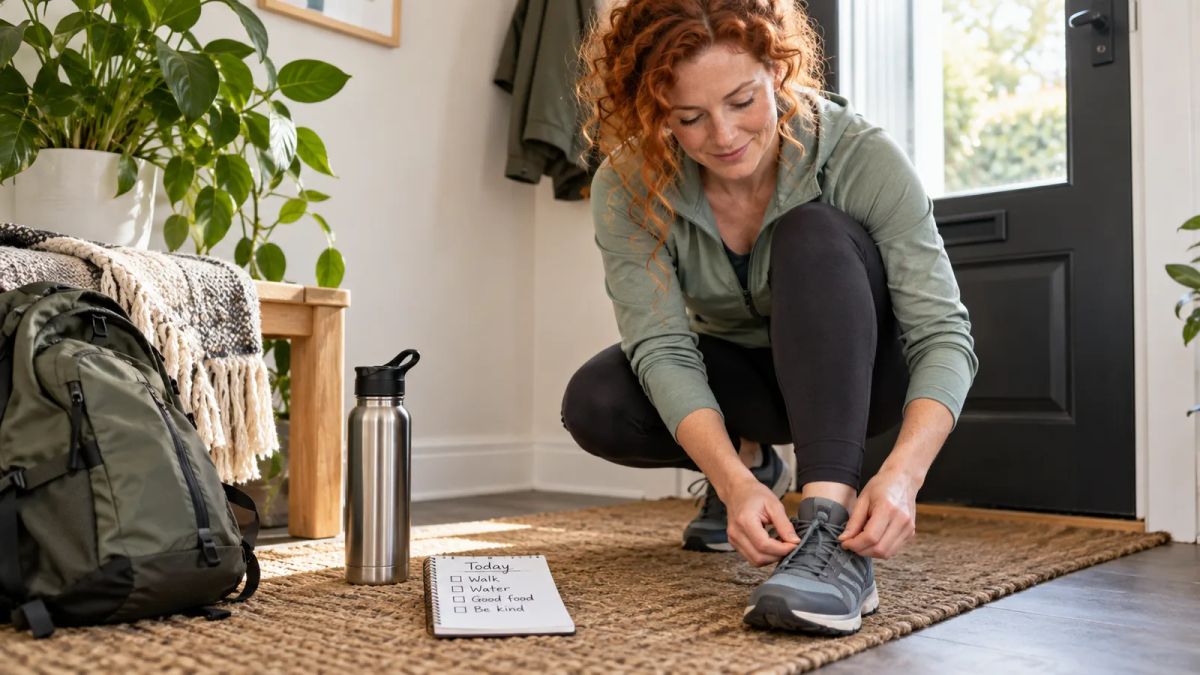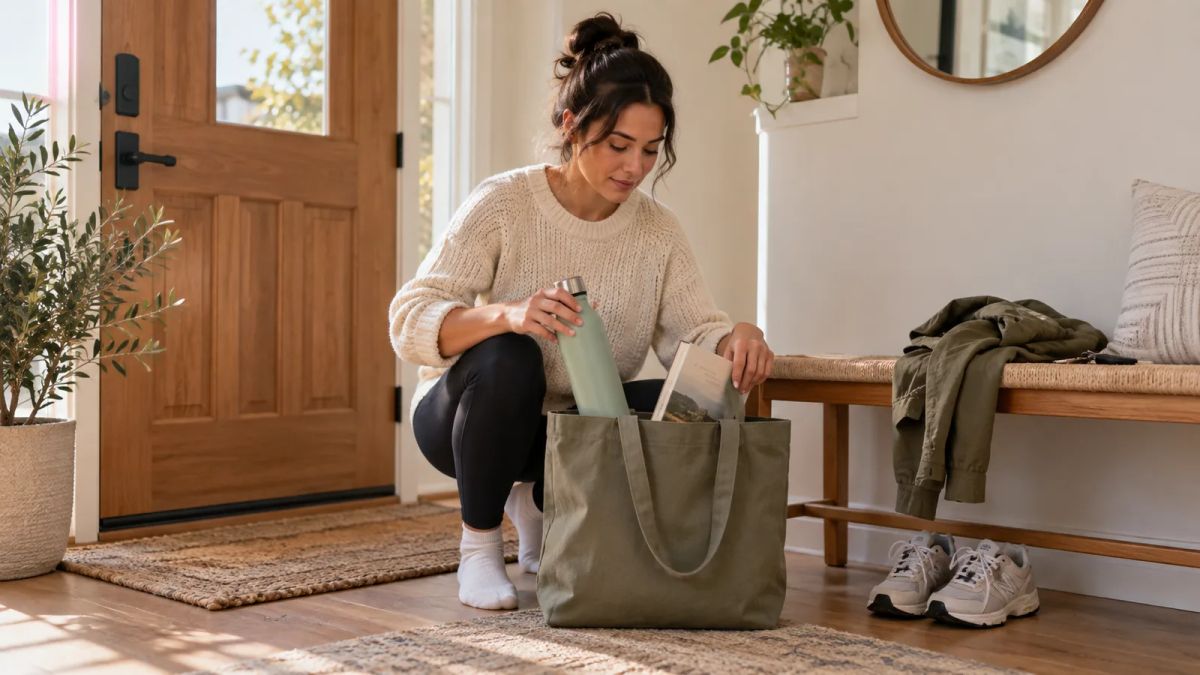
Temptation bundling is a small deal you make with yourself: you only get the thing you want while you are doing the thing you should. Save the gripping podcast for your walk, the trashy telly for the ironing, and the want drags the should along behind it.
The idea comes from Katy Milkman, a behavioural scientist at Wharton, who named it after noticing she would happily go to the gym so long as she only let herself hear the next chapter of an addictive audiobook while she was on the treadmill. She built a study around it, and it worked, though not in the tidy, permanent way most articles imply.
This guide covers what the technique is, what her research showed and where it falls down, and how to build a bundle of your own that survives a normal week.
What temptation bundling is
The move is to take an instant pleasure and a valuable but dull task and make them happen at the same moment. Not the treat as a reward after the task. The treat during the task, and only then.
The rule doing the work is the seal. Your favourite show becomes off-limits everywhere except the treadmill or the kitchen sink. That restriction is what turns a passive pleasure into a reason to start the chore, because now the only route to the next episode runs straight through the thing you keep putting off.
It leans on an old finding in psychology, Premack's principle, which says a behaviour you are likely to do can reinforce one you are not. Milkman's twist is the timing. The classic version is "finish your veg, then you get pudding". Temptation bundling is veg and pudding on the same fork.
That timing is why it suits a certain kind of task: important, recurring, easy to skip, and rarely urgent enough to force itself on you. Exercise is the obvious one. So are boring admin, tidying, batch cooking and long solo drives.
In her book How to Change, Milkman files temptation bundling under impulsivity, the pull to grab an instant reward over a bigger one later. The trick reroutes that pull: it lets your impulsive side chase the treat while your sensible side gets the walk done.
The gym-and-audiobook study
Milkman and her colleagues Julia Minson and Kevin Volpp ran a nine-week field experiment with 226 university gym members. Everyone got the same tempting audiobooks, page-turners like The Hunger Games, but access was set up three different ways.
- One group could only hear the audiobooks on iPods kept at the gym.
- A second group got the same audiobooks on their own devices, with a nudge to save them for workouts.
- A control group got a gift card and a note encouraging them to exercise.
The gym-only group visited 51% more often than the control group over the study, and 29% more often than the group merely encouraged to ration the audiobooks themselves. Locking the treat to the place mattered more than good intentions about the treat.
One detail says a lot about how it felt from the inside. When the study ended, 61% of participants chose to pay to keep their tempting audiobooks locked to the gym. They had felt the pull and wanted to keep it.
What the evidence does not promise
Here is the part the glossy write-ups skip. The effect faded.
Treatment effects declined over the weeks, and dropped sharply once Thanksgiving arrived and students scattered off campus. The bundle held the habit up while the structure around it held. When ordinary life disrupted the routine, gym attendance fell for everyone, bundlers included.
So treat this as a way to start and to lower the daily friction, not a spell that fixes a habit for good. A few honest limits are worth carrying with you.
The seal is fragile. The whole thing works because the treat is scarce. Let yourself binge the same show on the sofa and there is no reason left to touch the exercise bike, and the bundle quietly stops pulling.
Not everything bundles. If your should needs full concentration, like focused study or careful work, a gripping novel in your ears will wreck it rather than grease it. Bundling fits tasks that leave your mind free.
It is a nudge, not a cure. The research shows more of a behaviour you already had some intention to do. It will not manufacture motivation from nothing, and for anything health-related it sits alongside, not instead of, advice from your GP.
How to build your own bundle
You need two ingredients and one rule. Work through it in order.
- Pick the should. Choose one recurring task you avoid or do too little of. Keep it specific: a 20-minute walk, the weekly food shop, folding the washing.
- Pick the want. Name an instant pleasure you would gladly come back to. An audiobook series, a podcast, a particular playlist, a show, a fancy coffee.
- Make the want conditional. State the seal out loud: this pleasure only happens during that task. Nowhere else.
- Remove the leak. Delete the app from the sofa, leave the podcast queued only on your walking headphones, keep the good coffee for the library. The harder the treat is to get any other way, the stronger the pull.
- Keep the start tiny. Pair the want with the smallest honest version of the should, so a flat day still ends with the bundle intact.
Write your bundle as a single line so the rule is unmissable.
Only ________ while I ________.
Filled in, it looks like this:
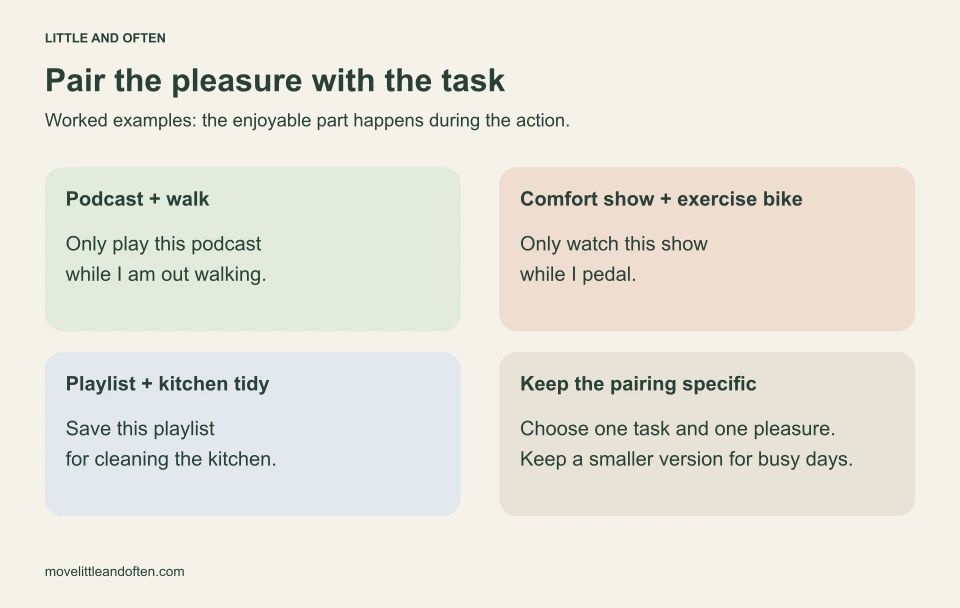
Only listen to my true-crime podcast while I'm out walking.
Only watch my comfort show while I'm on the exercise bike.
Only drink the good bakery coffee while I'm doing the weekly accounts.
A few more that people make work in ordinary life:
- Save a specific playlist for cleaning the kitchen, and play it nowhere else.
- Keep phone calls with your funniest friend for your evening walk.
- Only listen to the football phone-in while you cook the week's lunches.
One engineering student, Ronan Byrne, took the seal to its logical end. He wired his exercise bike to his laptop so Netflix only played while he pedalled hard enough, and paused the moment he slowed down. Most of us do not need to hack the hardware, but that is the mechanism in its purest form.
The version for a bad day
Decide now what the bundle looks like on a day when even the small version feels like too much. If your bundle is a 20-minute walk with a podcast, the bad-day version might be one lap of the block with the podcast on. The point is to keep the pairing alive so the treat stays tied to the task, instead of leaking back into your downtime where it loses its job.
Starting again after a gap
You will break the seal. You will watch the show on the sofa one wet Tuesday and the bundle will feel pointless for a while. That is normal, and one slip is not the end of it. Re-arm the rule at the next chance: put the treat back behind the task and start with the tiny version. The bundle is a pattern you keep resetting, not a streak you protect.
Where it fits with other habit tactics
Temptation bundling is one tool, and it gets stronger next to a few others.
The closest partner is habit stacking, where you bolt a new action onto something you already do. James Clear's formula chains all three: after an existing habit, do the thing you need, then the thing you want. So "after my morning coffee, I walk for 20 minutes, and only then do I start the podcast" gives the habit both a reliable cue and a built-in reward. If keeping any of this going is your real struggle, our guide to how to be consistent digs into that directly.
It also helps to understand the machinery underneath. Every habit runs on a cue, a routine and a reward, and temptation bundling is a way of supplying a reward that lands immediately instead of months down the line. Our piece on the habit loop breaks that cycle down.
And if a full bundle feels like a lot to set up, shrink the should first. The tiny habits approach makes the behaviour so small you can barely refuse it, which pairs neatly with a treat to get you moving.
Keep the bundled habit in view
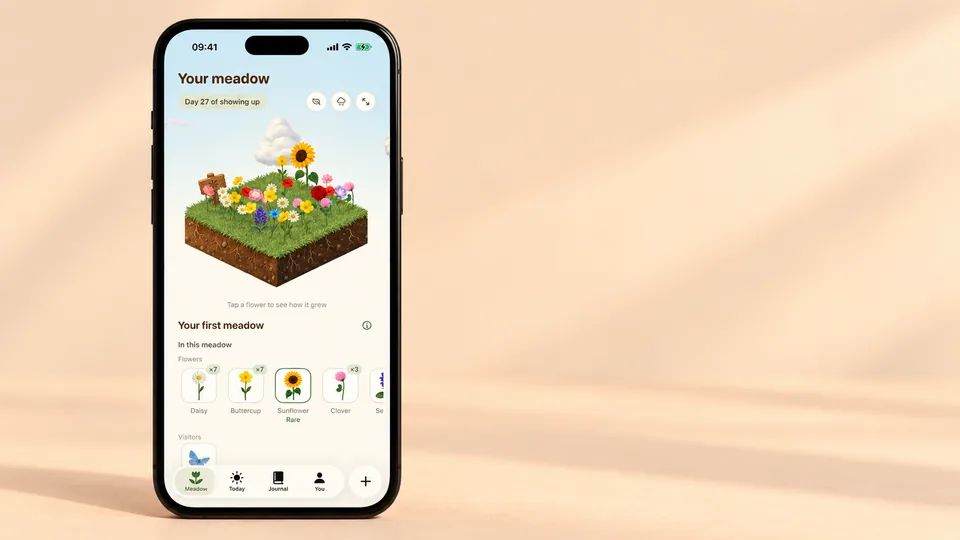
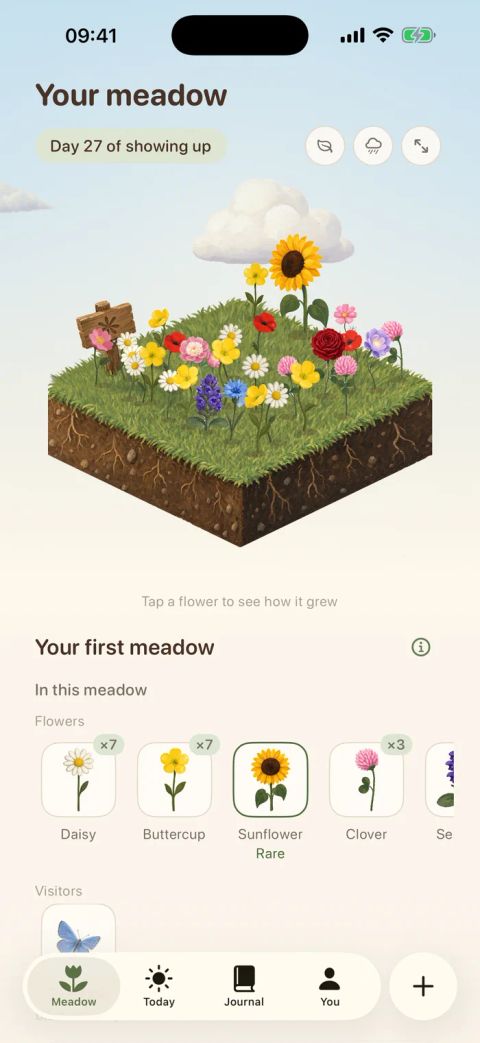
Once you have paired a walk with a podcast or a bike ride with a show, it helps to see the movement stacking up. Meadow is a gentle iPhone app from Wildcard Wellness where you log a walk or a few minutes of movement, tick off small daily habits, and note your mood and a daily win. Each day you show up grows a wildflower in a meadow that is yours alone. There are no streaks, so the week you break the seal and skip a few sessions, nothing resets and your flowers stay put, ready for you to pick the bundle back up.
Common questions
Is temptation bundling the same as rewarding myself? Not quite. A reward comes after the task and you get it whether or not you rationed it. A bundle happens during the task, and the treat is off-limits at every other time, which is the bit that pulls you in.
Does it help with weight loss? It can nudge you to move more often, which supports the effort, but the research measured gym visits, not the scales. Treat it as a way to show up more, and keep any weight goals separate.
What if I can't stop myself accessing the treat elsewhere? That is the usual failure point. Make the treat hard to reach any other way, or pick a different want that is easier to fence off.
Can I bundle more than one should? Yes, but set them up one at a time. Get a single bundle running until it feels automatic before you add another, or you will end up policing several fragile seals at once.
Pick one dull, recurring task you keep dodging, name one pleasure you would happily save for it, and write the line today: only [that treat] while I [that task]. Then move the treat out of easy reach everywhere else, so the next time you want it, the task is the only way in.
AUTHOR
Co-founder of Meadow.
Ash is co-founder of Meadow, a habit and movement tracking app that turns small acts of self-care into a growing wildflower meadow.
Little and often, with Meadow
Consistency, not intensity.
Meadow turns the movement you enjoy and the habits that help you feel good into a meadow of wildflowers. No streaks to break, and your flowers never wilt.
Download Meadow