An evening routine is a short, repeatable set of things you do before bed to help you fall asleep faster and wake up steadier. The best one starts an hour or so before your head hits the pillow, and it bends around the evening you have, not the calm one in a wellness video.
This is the how-to. Your morning has its own guide, and the two work as a pair: what you do tonight sets up how the morning routine feels tomorrow. Here we cover why the last hour is worth planning, what a few choices do to your sleep, a menu to build your own wind-down from, and how to adapt it when you work shifts or have small children who did not read the same sleep advice you did.
Why the last hour of the day is worth planning
The hour before bed is when most of us are least deliberate. The day's jobs are done, willpower is spent, and the phone is right there. So we drift into whatever is easiest, which is often the thing that keeps us wired.
A routine takes that hour off autopilot. The Sleep Foundation describes one as "a set of activities you perform in the same order, every night, in the 30 to 60 minutes before going to bed", and the point of the sameness is signalling. Repeated in the same order, those activities start to "tell your brain it is time to get ready for bed".
There is a knock-on effect the next day too. An evening that protects your sleep winds you down tonight and stacks the deck for a better start tomorrow.
None of this asks for an early night or a long list. Twenty minutes, done most nights, beats an elaborate hour you keep once a fortnight.
What a few simple choices do to your sleep
Some of the evening advice floating around is fussy and optional. These are the parts with the strongest case, worth building around.
Dim the lights and put the screens down
Bright light late in the evening works against the signal you are trying to send. Your body reads darkening light as the cue to wind down, so keeping the room lit up like noon holds that cue off.
Screens make it worse because they are close to your face and bright. The Sleep Foundation notes that phones and tablets emit blue light that "suppresses melatonin production", the hormone that rises as you get sleepy. Harvard Health's advice is to "put away electronic devices, except if used for calming music or a guided relaxation routine" and to dim the room.
You do not have to go dark and silent an hour out. Turning the big lights off, switching a lamp on, and setting the phone down across the room is enough to start the slide toward sleep. Decide in advance where the phone goes, because a half-asleep you will not choose well.
Warm up so you can cool down
A warm bath or shower in the evening is one of the more pleasant things with real evidence behind it. It sounds backwards, but the effect comes from what happens after you get out.
Researchers at the University of Texas at Austin pooled the studies and found that bathing one to two hours before bed in water of about 40 to 42.5C sped up how fast people fell asleep, by around ten minutes on average. The reason is temperature. A warm bath pulls blood out to your hands and feet, your body sheds heat, and your core temperature drops, the same downward shift that happens naturally as you head toward sleep. Their best estimate for timing was about ninety minutes before bed, so this is an early-evening move.
No bath? A warm shower does the same job. So does keeping the bedroom on the cool side, which Harvard puts at around 65 to 68F, roughly 18 to 20C.
Mind the caffeine, the alcohol and the late dinner
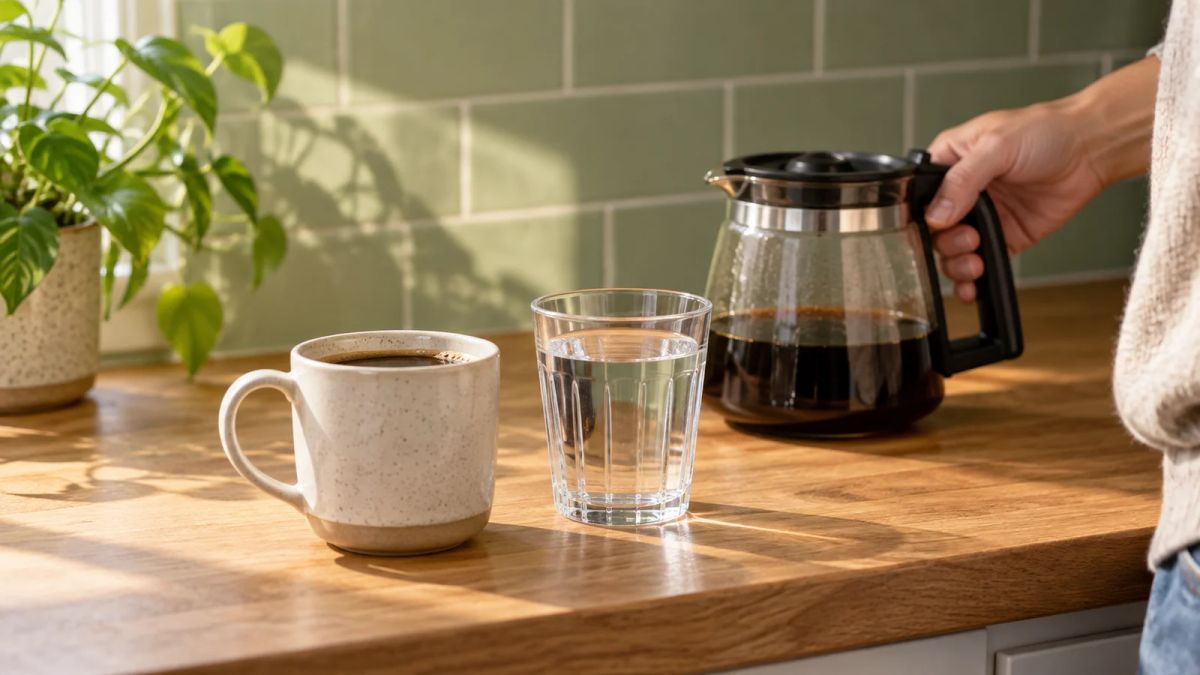
What you drink in the evening lingers longer than most people think. Caffeine is the big one. In one study, 400mg of caffeine, about two to three cups of coffee, taken six hours before bed still cut people's total sleep by more than an hour. It was a small trial of twelve regular sleepers, but the lesson holds: an afternoon coffee can quietly cost you sleep you never connect to it. If evenings are rough, pull your last caffeine back to early afternoon.
Alcohol is the sneaky one. A nightcap does make you drowsy, but Harvard warns that "after a few hours it becomes stimulating" and fragments the second half of the night.
Big late meals are the third. Harvard suggests eating your evening meal at least three hours before bed so you are not falling asleep on a full stomach. A small snack later is fine if you are hungry.
A shutdown ritual for the day's loose ends
A lot of us lie down and only then remember everything. The email we did not send, the thing we must not forget, the worry held at arm's length all day. The bed becomes the only quiet place the brain has had, so it dumps the lot.
A shutdown ritual moves that dump earlier and onto paper. A few minutes with a notebook, before you start winding down, to empty out what is rattling around.
Two prompts cover most of it:
- What is still on my mind from today?
- What are the two or three things that matter tomorrow?
Write them down and close the notebook. The point is not to solve anything tonight. It is to tell your brain the list is held somewhere other than your head, so it can stop rehearsing it at midnight. Laying out tomorrow's clothes, bag or breakfast does the same trick in physical form, and buys you a calmer start in the morning.
Gentle movement and slow breathing
The last stretch, once the lights are low and the list is parked, is for settling the body. Nothing energetic. The aim is to let go of the day's tension, not build any up.
A few easy stretches loosen a body that has been hunched at a desk or over a pushchair all day. Harvard groups this with the wind-down set: easy stretches, progressive muscle relaxation, or deep breathing. Progressive muscle relaxation is worth knowing: you tense one muscle group for a few seconds, then release it, and work up the body, which gives a busy mind something dull to do while the tension drains out.
Slow breathing does something similar and needs no props. One common pattern is to breathe in for four counts, hold for seven, and breathe out for eight, a handful of times. If counting annoys you, a long, slow out-breath on its own tips your body toward its rest state. Our breathwork guide has patterns to try if you want to make this the anchor of your evening.
Build your own wind-down: a menu to pick from
Open our free printable: Build your own wind-down (PDF). Save or print it to use alongside this guide. No sign-up needed.
There is no single correct evening routine. The one that lasts is short, made of things you like, and pinned to a cue that already happens every night. Here is a menu. Pick two or three, not the whole thing.
- Set a soft alarm for when the wind-down starts, so you are not relying on noticing the time.
- Dim the big lights and switch on a lamp.
- Put the phone on to charge, across the room.
- Warm bath or shower, ideally an hour or two before bed.
- A non-caffeinated herbal tea or a warm milky drink, if that is your thing.
- A five-minute brain dump in a notebook, plus tomorrow's top jobs.
- Lay out clothes or pack the bag for the morning.
- A few easy stretches or some slow breathing.
- Read a few pages of something undemanding in low light.
To turn a menu into a routine, tie the first step to a cue you already have. James Clear calls this habit stacking, and the shape is simple: after I do a current habit, I will do the new one. "I'll wind down earlier" evaporates. "After I load the dishwasher, I turn the big lights off" tends to happen, because the dishwasher gets loaded most nights and vague intentions do not.
Write your version down as a couple of lines. Here is a blank to fill in and a worked example.
My wind-down starts when: ________
Then I: ________, ________, ________
Tiny version, for a wrung-out night: ________
My wind-down starts when: the kids are finally asleep
Then I: put my phone on to charge in the kitchen, write tomorrow's three jobs, do five slow breaths in bed
Tiny version, for a wrung-out night: phone in the kitchen, lights off, that is all
Decide the tiny version now, while the evening is calm, so you are not negotiating with yourself at eleven o'clock. On the worst nights, one step done beats the whole routine abandoned.
Adapting it for shifts and small children
The standard advice assumes a tidy evening that ends at a fixed hour. Plenty of people do not have one. The routine still works. It moves, that is all.
If you work shifts, the anchor is not the clock, it is the run-up to whenever your sleep happens. A night-shift worker heading to bed at 9am needs the same wind-down, only shifted: darkness matters even more, so blackout curtains or an eye mask do the job the setting sun would. The NHS advice to keep your sleep and wake times roughly regular is harder on a rotating rota, so aim for consistency within each block of shifts.
If you have young children, the evening is not yours until it suddenly is, late and frayed. Fold part of your wind-down into theirs, so the dimmed lights and the calm are shared, not a second shift you do alone afterwards. And keep your own version brutally short, because a three-step routine survives a bad bedtime and a nine-step one does not. Some nights the answer is to skip straight to lying down, and that counts.
A calm way to close the day
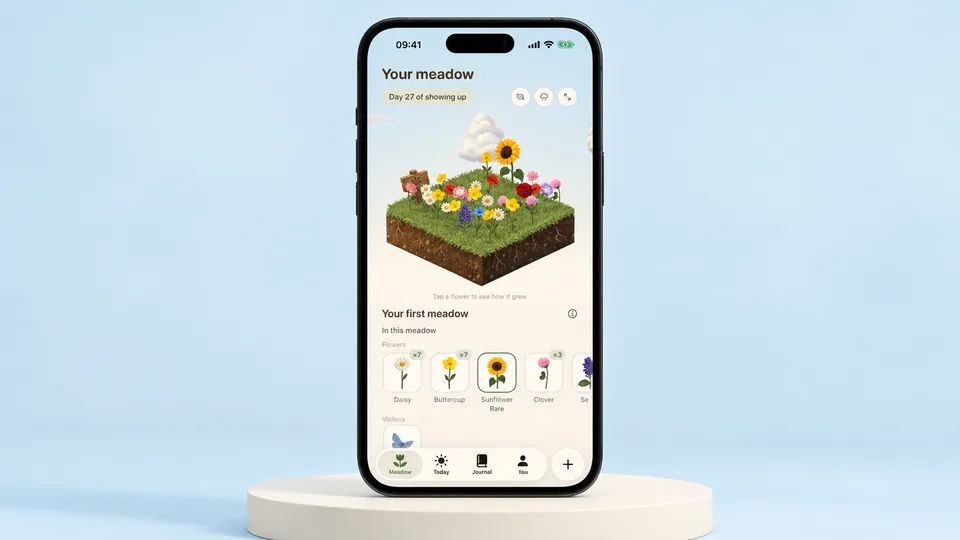
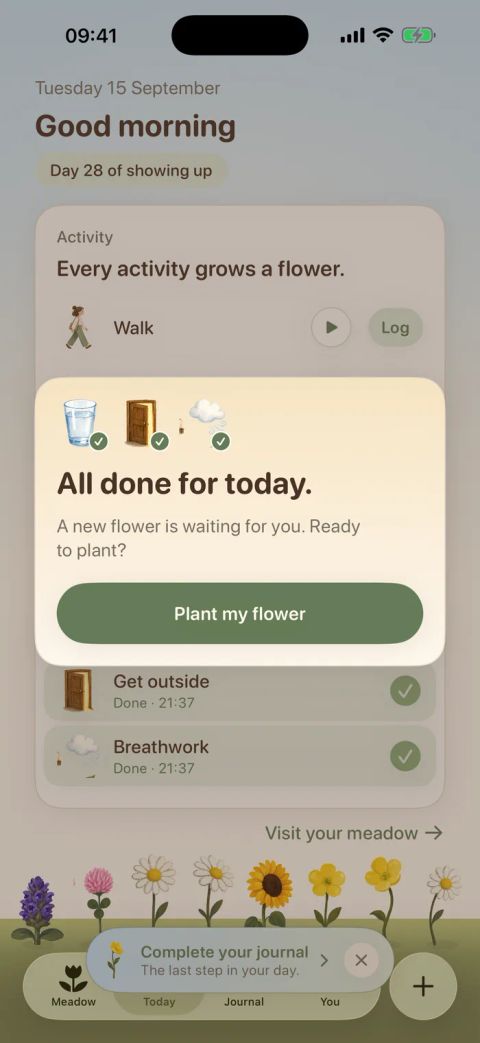
Some evenings go to plan and some collapse, and Meadow is built to meet both. It is a habit app for iPhone from Wildcard Wellness with a built-in breathwork feature, so you can take a few slow breaths as the evening winds down, alongside the wildflower meadow you have grown. You can also note your mood and energy, log any movement you managed, and jot down a daily win, which makes a natural close to the evening. Each day you show up grows a flower, and because there are no streaks, a night you fall into bed without doing a thing resets nothing.
When it slips
You will miss evenings. A late finish, a sick child, a night out that ran on. The routine bends for this, because habits do not work like streaks.
Research on how habits form found that the time an action takes to feel automatic varies widely from person to person, and that missing a single day did not stop the habit forming. So there is nothing to rebuild after one off night. You pick the routine up the next evening, in its usual spot. No double wind-down, no guilt.
If you have been sleeping badly for weeks, not nights, a routine is only part of the answer. The NHS advises that if the basics do not help, or you think you might have insomnia, it is worth speaking to a GP. Persistent poor sleep has causes a wind-down routine cannot fix on its own.
Common questions
How long before bed should it start? Thirty to sixty minutes for the calm part, and an hour or two earlier if you want the warm-bath effect. Start with whatever slice of the evening you can protect.
What should I do first? Get off screens and drop the light level. Both are quick, both are well supported, and both make the rest of the routine land better.
Is it the same as a morning routine? No. The morning is about waking your body up and setting the day's direction. The evening is about letting the day go and protecting your sleep. For the other half, the morning routine guide covers it, and there is a ready-made morning routine checklist to copy.
Do I have to give up my evening coffee or wine? Not give up, but watch the timing. Caffeine can disturb sleep six hours out, and alcohol breaks up the back half of the night, so shifting both earlier often helps more than cutting them.
What if I can only manage one thing? Put the phone in another room. It is the change most likely to protect the quiet, dark, screen-free window that everything else depends on.
Tonight, pick one cue that already happens every evening, and one small thing to do right after it. Write the two down as a sentence before you forget. That line, decided now while you are awake enough to mean it, is your evening routine, and you can grow it from there.
AUTHOR
Co-founder of Meadow.
Ash is co-founder of Meadow, a habit and movement tracking app that turns small acts of self-care into a growing wildflower meadow.
Every little bit counts
Five minutes counts. So does a dance in the kitchen.
Log the movement you enjoy and the small habits that help you feel good, and watch them bloom into something you can see.
Download Meadow