If you can't seem to stick to a routine, the routine is usually what's at fault, and not your character. Most people asking this have tried hard, often more than once, and still watched the whole thing come apart by the second week.
That pattern is common enough to treat as a clue. A routine that only holds on a calm morning with a full tank of energy was built for a day that rarely turns up.
Below are the reasons routines slip, with what to change for each. Read them as a list to hold your own week against. Most people find two or three apply at once, and loosening even one of them changes how the rest feels.
Start by ruling out willpower
Willpower gets the blame first and deserves it least. A routine's real job is to take the deciding out of your hands, so you're not leaning on motivation that comes and goes.
That works through cues. Gardner, Lally and Wardle describe a habit as an action that becomes an automatic response to a cue, learned by repeating it in the same setting until the setting itself sets it off. A routine borrows that mechanism. When one keeps collapsing, it's usually missing the parts that let a cue carry the load, so every day you're starting from willpower alone. The reasons below are mostly versions of that same gap.
The routine is too rigid to survive a normal week
One fixed time, one fixed way, no room to move. It works until the morning a child wakes early or a meeting lands at eight, and then there's no version of it left to do.
When Katy Milkman and John Beshears paid more than 2,500 Google employees to exercise, one group was rewarded for going at the same time each day and another for going whenever suited them. The flexible group built the stickier habit and kept exercising more once the payments stopped. The rigid group had practised only one way, so when that way vanished the whole thing stalled. As Milkman put it, too much rigidity is the enemy of a good habit.
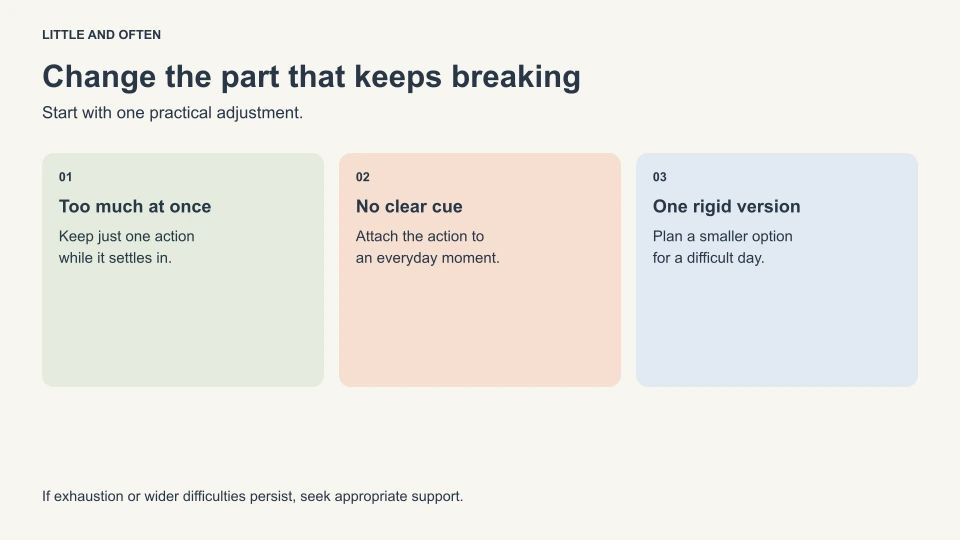
The fix is to give every part of the routine a smaller version you can drop to. A 30-minute walk shrinks to a walk to the end of the road. Twenty minutes of yoga shrinks to three stretches on the bedroom floor. Keep one or two things fixed and let the rest bend.
You took on too much at once
New wake time, new workout, new breakfast, new bedtime, all from Monday. Each new action needs attention while it's young, and attention runs out fast. Stack five and the tank is empty by mid-morning.
Start smaller than feels worth it. One action, done daily, beats five done for three days and then dropped. Pick the single thing that makes the rest easier to reach, let it settle for a week or two until it feels normal, then add the next piece. Tiny habits goes deeper on shrinking an action down until it's too small to talk yourself out of.
There's no cue to set it off
A routine floating free of your day has nothing to switch it on. You're left trying to remember it, and remembering at the right moment is the part that fails.
The habit research points to the same fix. Hang the new action off something you already do without thinking, because those moments already fire on their own. The kettle going on, the school drop-off, sitting down at your desk, all happen reliably, so you borrow their reliability for the new thing.
Write it down as an if-then line: "after I put the kettle on, I'll stretch until it boils." The cue does the remembering for you. Pick an anchor that happens every single day, not one you manage only sometimes, because a shaky anchor makes a shaky routine.
One missed day talks you into quitting
You miss a Tuesday, decide the run is broken, and quietly let the rest go. That instinct runs against how habits form. The same review found that missing the odd chance to do the behaviour didn't seriously set back the automatic feel people were building. One skipped day is a skipped day.
What does the damage is treating the miss as proof of failure and then not coming back, which turns one day into three weeks. Make restarting the default, with no catch-up owed and no punishment session. You do the next scheduled go at the next cue, and that's the whole repair. How to be consistent has more on getting going again after a gap.
It's set for the wrong time of day
A routine can be well built and still land at an hour your body fights. People differ in when they're sharp and when they flag. Research on evening types found that holding a schedule out of step with your natural timing tends to bring poorer sleep and more fatigue over time.
If your 6am workout has failed for months, the honest read might be that mornings aren't your window. Try moving it to lunchtime or early evening before deciding you can't do it at all. Put the demanding parts of the routine in the hours you already have some energy, and save the low-effort ones for when you're running down.
You're running on empty
Sometimes the routine is fine and there's nothing left to run it. Long stretches of exhaustion change what's possible. The World Health Organization describes burnout as exhaustion, cynicism and reduced effectiveness that builds from workplace stress left unmanaged, and in that state a full routine is asking a lot.
When you're this depleted, shrink the routine to one maintenance action you could do on your worst day, and count rest as part of the plan instead of a slip. If the flatness has lasted weeks and reaches most of your life, it's worth a word with your GP, because low mood and some health conditions drain the same fuel a routine needs.
When it might be about executive function
For some people the trouble with routines shows up in every corner of life and has done since childhood. Struggling to start tasks, to hold a plan, and to keep something going once the novelty wears off can point to how the brain manages attention and self-regulation. CHADD, describing executive function, notes these skills let us begin, work on and finish tasks, and that they're often affected in people with ADHD.
If that sounds like you, build with more forgiveness. Lean on structure outside your head: visible reminders, alarms, a written cue stuck where the action happens, or doing it alongside someone else. And if it's a lifelong, everywhere pattern that keeps getting in your way, a GP or a qualified clinician can talk it through properly. This is general information and not a diagnosis.
Somewhere to pick the routine back up

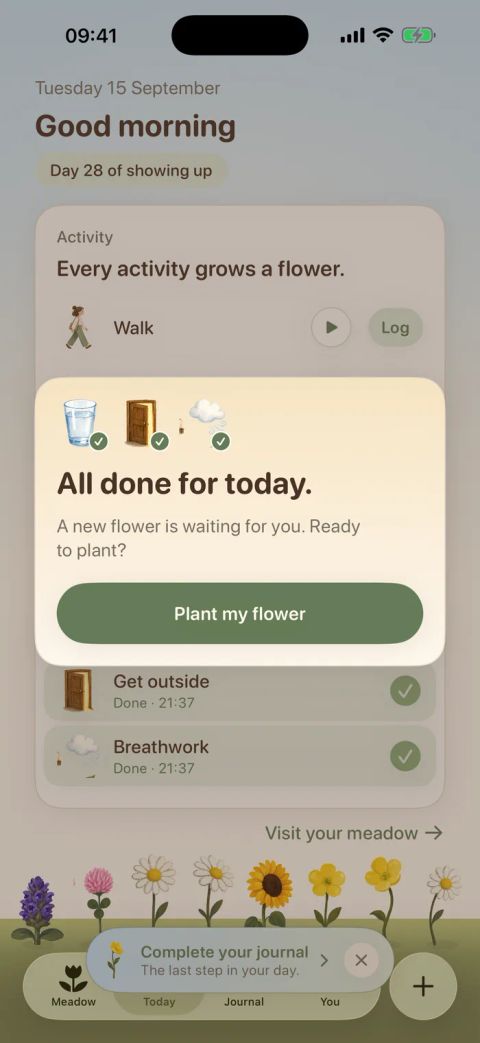
Coming back after a miss is easier when nothing is punishing you for the gap. Meadow is built around that. You log a walk or a few minutes of movement, tick off the small habits you're anchoring, and note your mood and energy, and each day you show up a wildflower blooms in a meadow that's your own. There are no streaks, so a missed Tuesday or a week away resets nothing you've grown, and you carry on whenever you're ready. You can start one over at Meadow.
Work out which one it is
Run your last failed routine past this and tick the lines that ring true.
- ☐ It only worked on a perfect day and had no smaller version for bad ones
- ☐ I started several new things in the same week
- ☐ There was no set moment or cue that triggered it
- ☐ I quit the whole thing after one or two missed days
- ☐ It was scheduled for a time my energy is usually low
- ☐ I've been exhausted or stretched thin for weeks
- ☐ I find it hard to start and keep things going across most of my life, not this routine alone
One or two ticks near the top point to a design fix from the sections above. If your ticks cluster at the bottom, go easy on yourself and treat your energy and support as the first thing to sort.
Common questions
Is it normal to not be able to stick to any routine?
Very. Most routines that fail were over-built or under-cued, and that's a design problem plenty of people hit. Rebuild around one daily cue and one small action, and see how that goes before deciding something's wrong with you.
How long should I give a new routine before it sticks?
There's no reliable single number, whatever you've read. It depends on the person and the action, so watch for the thing getting easier to start rather than counting down to a target. How to stick to a routine walks through the full build step by step, from anchor to restart rule.
Should a routine be strict or flexible?
Flexible, for most people and most goals. The research on lasting habits keeps finding that being able to adapt when life interferes builds a routine that holds better than clinging to one time and one way. Keep one or two anchors fixed and let everything else move.
How do I know if it's ADHD or a poor routine?
A poor routine tends to fail on its own terms. You can usually point to what went wrong, and a redesign helps. If the trouble turns up everywhere, in starting and finishing things across work, home and hobbies, and has since you were young, that's worth raising with a GP. The executive function section above has more.
Your one next step
Don't rebuild your whole day. Take the last routine that fell apart, find its line in the checklist above, and change that one thing. If it was over-built, cut it back to a single action on one daily cue and write the if-then sentence down: "after I ____, I'll ____." Hold it there for a week before you add anything else.
AUTHOR
Co-founder of Meadow.
Ash is co-founder of Meadow, a habit and movement tracking app that turns small acts of self-care into a growing wildflower meadow.
Every little bit counts
Five minutes counts. So does a dance in the kitchen.
Log the movement you enjoy and the small habits that help you feel good, and watch them bloom into something you can see.
Download Meadow