Tiny Habits and Atomic Habits are the two most-read systems for building habits, and they work better together than apart. BJ Fogg's Tiny Habits is about starting a behaviour when your motivation is low, and James Clear's Atomic Habits is about keeping that behaviour going and letting it grow. One hands you the first rep. The other hands you the next hundred.
Both authors sit in the same corner of behaviour science, and both agree on the thing most people get wrong: you can't run a habit on willpower alone. Where they part ways is what they ask you to do first. This is a comparison of the two methods, so you can borrow the right piece at the right moment. It's not a review of which book reads better.
The core of Fogg's tiny habits
BJ Fogg is a behaviour scientist at Stanford who spent years coaching people through small changes before writing Tiny Habits. His recipe has three parts: after I [anchor], I will [tiny behaviour], then I celebrate.
The anchor is a routine you already run every day, like making your morning coffee. The tiny behaviour is the new habit shrunk to something you could do in under thirty seconds, like two press-ups or one line in a notebook. The celebration is a flicker of good feeling straight after, a quiet "yes" or a smile, and Fogg treats it as the step that fixes the habit in place. His shorthand is that emotions create habits.
Underneath the recipe sits his behaviour model, which he writes as B=MAP. A behaviour happens when Motivation, Ability and a Prompt come together at the same time, and when a behaviour doesn't happen, at least one of the three was missing. Motivation is the shaky one. It runs high when you're fresh and low most evenings, so Fogg turns up ability instead, making the action so easy that you barely need motivation to do it. The anchor supplies the prompt.
The core of Clear's atomic habits
James Clear's Atomic Habits starts somewhere else: with the idea that small improvements compound. Get 1% better each day and the gains stack up over a year into something you could never manage in one heave. His line is that you do not rise to the level of your goals, you fall to the level of your systems, which is his case for building repeatable processes over chasing distant outcomes.
Clear organises the whole thing into four laws of behaviour change, each tied to one part of the habit loop of cue, craving, response and reward:
- Make it obvious. Set a clear cue, often by stacking the habit onto something you already do or by fixing when and where it happens.
- Make it attractive. Pair the habit with something you look forward to.
- Make it easy. Cut the friction, and use the two-minute rule so a new habit can start in under two minutes.
- Make it satisfying. Give yourself an immediate reward so your brain wants to come back.
To break a bad habit, you flip the laws: make it invisible, unattractive, difficult and unsatisfying.
His deepest idea is identity. Clear describes three layers of change: outcomes, which are what you get, processes, which are what you do, and identity, which is what you believe. Lasting change, he argues, works from the inside out, and every small action is "a vote for the type of person you wish to become". Read one page and you've cast a vote for being a reader.
Where the two methods agree
Strip away the labels and the overlap is large.
Both drop willpower as the engine. Fogg does it by shrinking the action, Clear by designing the cue and the space around it, but neither expects you to grit your teeth every morning.
Both lean on cues you already have. Fogg calls it anchoring, Clear calls it habit stacking, and the formula is nearly identical: pin the new behaviour to a routine that already runs on its own.
Both start small. Fogg's tiny behaviour and Clear's two-minute rule come from the same instinct, that the first job is to get the habit through the door before you worry about how big it is.
And both close the loop with a good feeling. Fogg's celebration and Clear's fourth law both put a hit of reward right after the action, because a behaviour that feels good gets repeated.
Where they differ

The differences are real, and they decide which method helps you more on a given day.
Their starting point is the clearest split. Fogg assumes the hard part is beginning, so he shrinks the behaviour until motivation stops being the deciding factor. Clear assumes you can already show up and spends most of his attention on what turns showing up into a system that holds.
The reward works differently too. Fogg's celebration is internal and immediate, an emotion you make in the moment for free. Clear's satisfaction is often built into the system, sometimes with an external reward or a habit you tick off. Fogg's version costs nothing and comes with you anywhere. Clear's can be engineered on purpose.
Identity is Clear's ground. He builds the whole method around who you're becoming, while Fogg keeps identity in the background and puts the mechanics first.
They also handle growth differently. Fogg's view is that once the tiny version feels easy, bigger effort tends to follow on its own. Clear gives more scaffolding for the climb, treating the two-minute version as a gateway to a fuller habit. If you're the sort who stalls at the tiny version and never grows it, Clear's structure gives you the push.
Which one suits you
Neither method is the winner. The better question is which problem you have right now.
If you can't get started at all, if the habit keeps dying before it begins, start with Fogg. Shrinking the action to something you could do on your worst day removes the excuse and puts a first rep on the board.
If you can start but the habit fades after a few weeks, lean on Clear. His four laws and identity framing are built for the long middle, when the novelty has worn off and only the system keeps you turning up.
If you're redesigning several parts of your life at once, Clear's approach scales to that better. If you're recovering from a run of failed attempts and your confidence is low, Fogg's tiny start rebuilds it one easy win at a time. And if you're picking one habit to lead the rest, the sort that tends to pull other good behaviours along with it, our guide to keystone habits is a good place to look.
How to combine them
The strongest plan borrows from both. Use Fogg to launch the habit and Clear to grow it.
Start with the tiny habits recipe to get moving, then wrap Clear's laws around it as the habit settles in. Here's the shape of a combined plan in a single line:
After I [anchor], I will [two-minute version], then I [celebrate], and each rep is a vote for [the person I'm becoming].
A worked example for someone trying to move more:
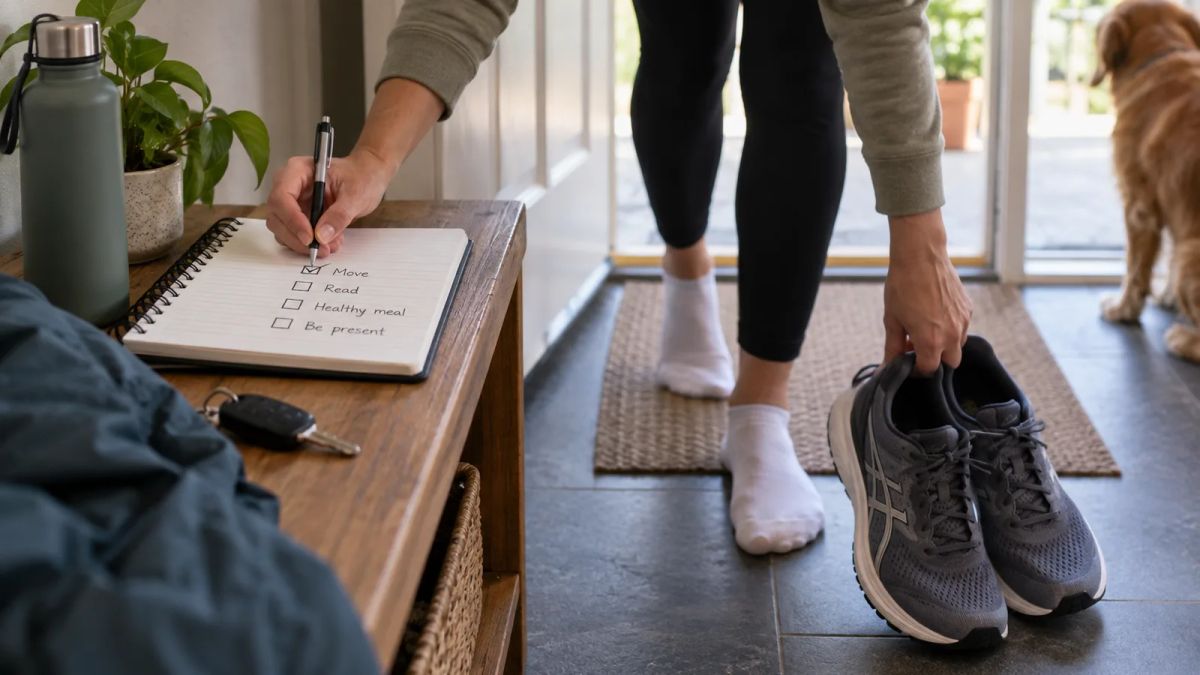
After I pour my morning coffee, I will put my walking shoes on, then I say "nice", and each rep is a vote for being someone who walks.
The shoes are the two-minute version and the tiny behaviour at once. The coffee is the obvious cue. The "nice" is both Fogg's celebration and Clear's satisfying finish. The identity line is Clear's long game, and it keeps the small action pointed at something bigger. For more on the small end of this, our guide to the tiny habits method goes deeper into anchors, sizing and celebration.
The version for a bad day
Decide now what the habit looks like on a day when even the small version feels like too much. If your habit is a short walk, the bad-day version might be stepping out of the front door and back in. Fogg's whole point is that keeping the thread unbroken beats doing it well, and Clear agrees that one missed day should never become two. Keep the floor low enough that no day is too rough to clear it.
Picking it back up after a miss
A single slip does less damage than the story you tell about it. In one study of real-world habit formation, a single missed day had little impact on how automatic the behaviour eventually became, and the time to reach that point ran from about 18 days to a predicted 254, with a median of 66. There's no clean deadline you're failing to hit. What breaks habits is the "I've blown it" spiral that turns one gap into a fortnight of nothing. If the timeline is on your mind, we go into it properly in how long it takes to build a habit.
Watch the small version add up
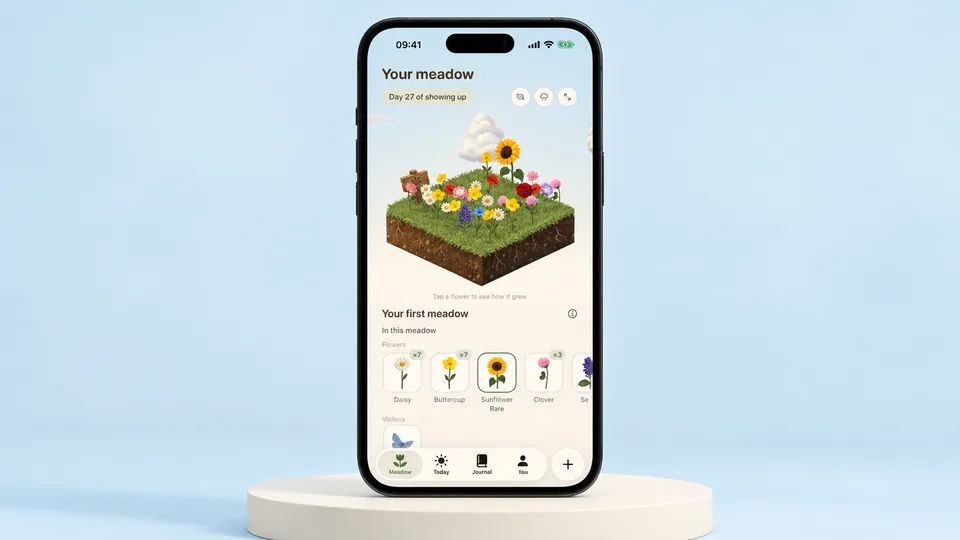
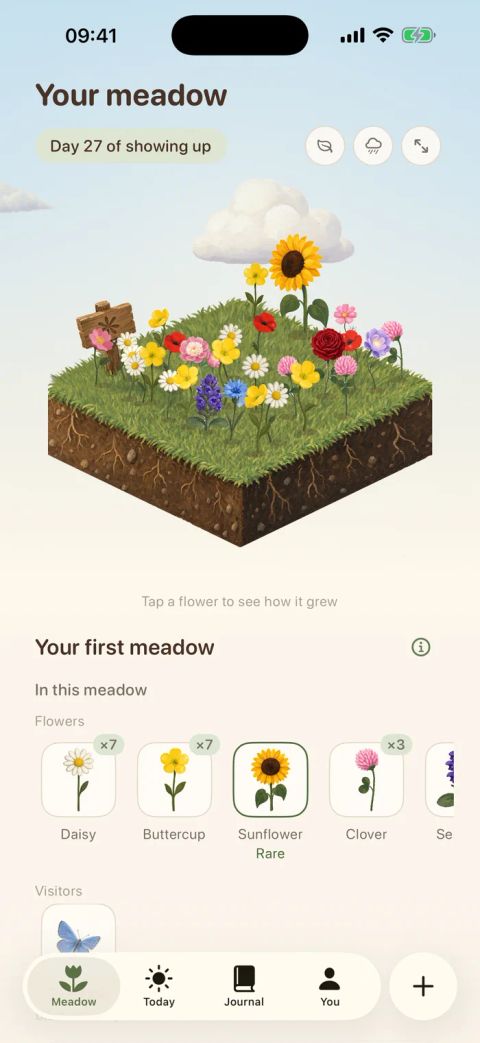
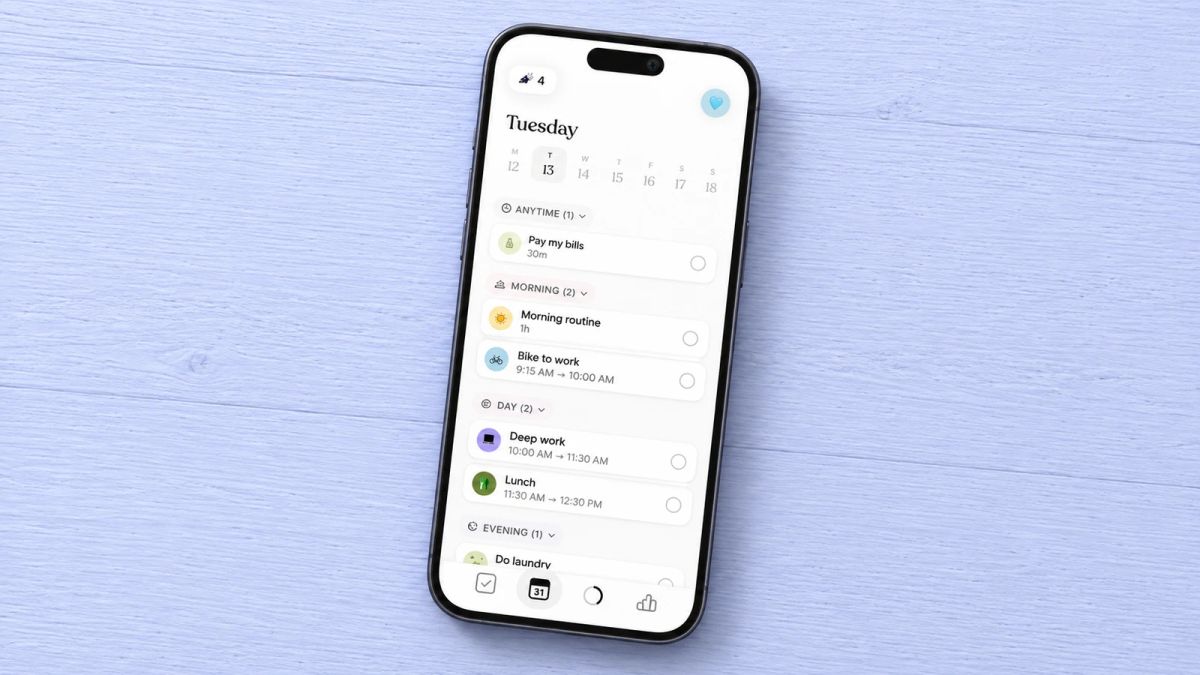
Some mornings run to plan and some fall apart, and Meadow is built for both. It's a gentle iPhone app where you tick off a small daily habit, log a little movement and note your mood, and every day you show up grows a wildflower in a meadow that's your own. It fits the combined approach here, because the tick gives you Fogg's small hit of satisfaction and the slowly filling meadow lets you see the identity Clear talks about taking shape. There are no streaks, so a missed day resets nothing and the flowers you've grown stay where they are. You can find it at Meadow.
A few common questions
Are Tiny Habits and Atomic Habits the same book? No. They're two separate books by two authors, and they reach similar conclusions from different starting points. They share a lot of the same behaviour science.
Which should I read first? If getting started is your problem, Fogg. If staying consistent is your problem, Clear. Plenty of people get the most from beginning with Fogg's tiny version and adding Clear's identity and systems once the behaviour runs by itself.
Do I have to pick one? No, and you probably shouldn't. The methods overlap enough to blend cleanly, and the combined recipe above uses both.
Is habit stacking the same as anchoring? In practice, yes. Both attach a new behaviour to an existing routine so the old habit becomes the reminder for the new one. Clear's habit stacking and Fogg's anchoring are the same move under two names.
Right now, write one line: after an everyday moment you already have, the two-minute version of the habit you want, then a small celebration. Add who it's turning you into if that helps. Something like "after my morning coffee, I put my walking shoes on, then I say nice." Start there today, and borrow the rest as you need it.
AUTHOR
Co-founder of Meadow.
Ash is co-founder of Meadow, a habit and movement tracking app that turns small acts of self-care into a growing wildflower meadow.
Little and often, with Meadow
Consistency, not intensity.
Meadow turns the movement you enjoy and the habits that help you feel good into a meadow of wildflowers. No streaks to break, and your flowers never wilt.
Download Meadow