
Feeling guilty about a rest day is one of the most common feelings in fitness, and it's also one of the most misplaced. The day off is when your body turns your recent workouts into fitness. Skip it too often and you hold your own progress back.
If you've ever laced up when you were wiped out, purely to quiet that nagging voice, you already know the pull. The voice says a day off is a day wasted. Your body says the opposite.
This is general education, not a training plan for a specific goal. If you have a health condition, you're coming back from injury, or you're new to exercise, check with your GP or a physiotherapist about what suits you.
Why a day off can feel like failing
Most of the guilt is learned, not logical. "No days off" gets printed on water bottles and stitched into gym slogans, so somewhere along the way rest starts to read as a lack of commitment. If you've come to see exercise as proof that you're disciplined, a skipped session can feel like proof of the opposite.
Habit trackers can feed it too. A long streak is satisfying to build and painful to break, so the app that once got you moving starts punishing you for a sensible night off.
There's a subtler version worth naming. Some people don't train because they want to, but to hold off a bad feeling, the unease or guilt that shows up when they don't. When that's the engine, a rest day removes the thing keeping the worry at bay, and the guilt rushes straight in.
The guilt has the biology backwards
The guilt skips over one fact. You don't get fitter during a workout. You get fitter afterwards, while you rest.
Strength work, as Harvard Health explains, causes tiny tears in muscle tissue, and muscles grow stronger as the tears knit up. That repair happens on the days off, which is why the same guidance suggests at least 48 hours between sessions for a muscle group. Train the same muscles hard again before they've mended and you interrupt the very thing you were training for.
Push on with no rest for long enough and it shows. A review of overtraining in the journal Sports Health describes a spectrum: a short block of hard training followed by proper rest can lead to a jump in fitness, while the same load with too little recovery tips into a slump that can take weeks to months to clear. Sleep and mood take a knock along with performance, and the review notes this milder overreaching is common, turning up in around 60% of elite runners at least once.
So the rest day isn't the weak link in your week. The American College of Sports Medicine puts the whole loop in one line, performance plus recovery equals peak performance potential, and suggests one to two rest days a week when training is heavy. Sports doctors at the Hospital for Special Surgery are blunter still: adequate rest is not a sign of weakness, and you need at least one complete day of rest every week.
Rest is part of the plan, not a hole in it
Try seeing the rest day as a line item you scheduled, the same as any session. It earns its place in the week.
The UK guidance is 150 minutes of moderate activity a week plus strengthening on two days, spread across four or five days. That leaves days that are lighter or off entirely, and those days belong in the week on purpose. Taking them is doing the guidance properly, not falling short of it.
If the worry is that a day off will break your momentum, tie your training to a cue you already have so it starts itself back up. The American Heart Association's advice for making a habit stick is to attach the new action to an existing routine: trainers by the door for the morning after, a class booked for Tuesday. The habit rides on the cue, so one quiet day doesn't scatter it.
It also helps to be sure a day off is the right call. If you can't tell whether you're due a break or talking yourself out of a session, our guide on how to tell if you need a rest day walks through the signals worth reading. And if you'd still like to keep moving lightly, a rest day and an active recovery day aren't the same thing, and the softer option keeps the habit ticking over while your body repairs.
The line between commitment and compulsion
For most people, rest-day guilt is a passing niggle that fades once the science lands. For some it runs deeper, and it's worth being honest about where the line sits.
Commitment bends. You can move a session, shorten it or skip it when life or your body asks, and feel yourself again by the afternoon. The compulsive version doesn't bend. The eating disorder charity Beat lists the signs to watch: exercising despite injury or illness, exercise that interrupts daily life, feeling unable to change or skip a session, and strong guilt, anxiety or low mood tied to exercise.
Researchers describe the same thing. In work on compulsive exercise, the behaviour is done to relieve the anxiety, shame and guilt that come with not exercising, not for any enjoyment in it, and "I feel guilty if I miss an exercise session" is one of the markers they use. It can also travel alongside disordered eating, especially when workouts become a way to burn off food.
None of that is a diagnosis, and seeing a little of yourself in it doesn't mean something is wrong. But if the thought of missing exercise makes you very anxious, if you train through injury or illness, or if it's crowding out other parts of your life, that's worth talking about. Beat's advice is to contact your GP if you have any concerns about your relationship with exercise, and their helpline is there for anyone affected. Reaching out early is a kindness to yourself, not an overreaction.
How to take a rest day without the guilt
A few practical moves make the day easier to accept.
- Name it in advance. Put your rest days in the week before it starts, so the day arrives as a plan you're keeping.
- Do the maths on one day. One rest day across a month of showing up changes nothing about your progress. The month is what counts.
- Feed the recovery. ACSM points to seven to nine hours of sleep a night as where a lot of the repair happens, so an earlier night does more for your fitness than a tired session would.
- Move gently if stillness bothers you. A flat walk or a slow stretch keeps you loose without loading tired muscles, and our guide to what to do on an active rest day has plenty of easy ideas.
- Watch the pattern, not the day. Over a good month you'll see the rest days sitting quietly between the sessions, doing their job.
Keep a simple plan somewhere you'll see it. A blank version first, then a filled-in example.
My rest days this week: __________ and __________
On a rest day I'm allowed to: sleep in ☐ eat a proper meal ☐ walk gently ☐ do nothing at all ☐
The reminder: one day off changes nothing over a month of showing up.
If the guilt gets loud: __________
And filled in:
My rest days this week: Wednesday and Sunday
On a rest day I'm allowed to: sleep in ☑ eat a proper meal ☑ walk gently ☐ do nothing at all ☑
The reminder: one day off changes nothing over a month of showing up.
If the guilt gets loud: ten slow minutes outside, then let it go.
Open our free Rest-day plan (PDF). Make space for rest and write a response to exercise guilt. Includes a flexible weekly plan and room to note the support you need. Save or print it; no sign-up needed.
A place where a day off still counts
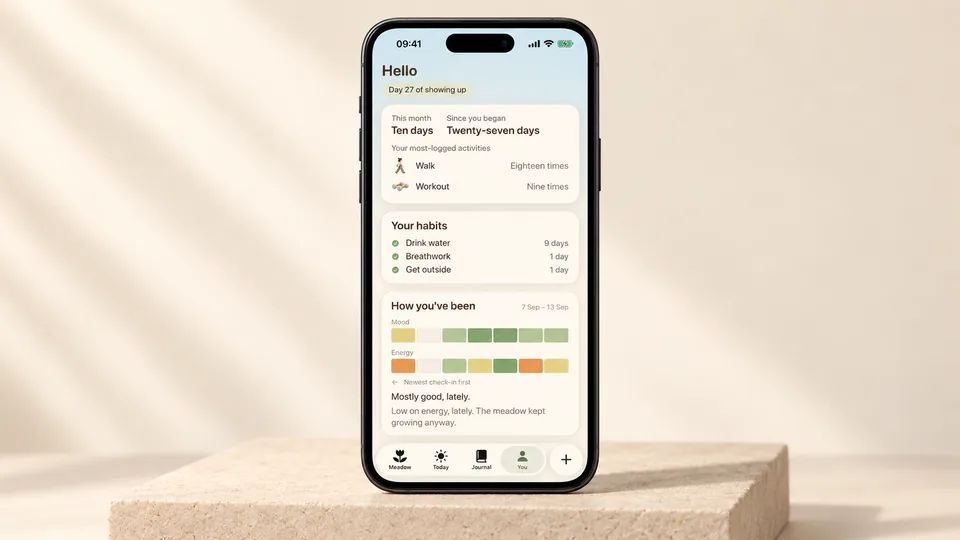
Rest-day guilt gets worse when your tracker treats the day off as a broken chain. Meadow is built the other way round. It's a movement and habit app for iPhone from Wildcard Wellness where each day you show up, logging a walk or a little movement, ticking off a small habit, noting your mood, grows a wildflower in your own meadow. There are no streaks, so a rest day, a poorly week or a fortnight away resets nothing and your flowers never wilt. A day you choose to do less leaves the meadow exactly as you left it, which takes some of the sting out of stopping. You can grow yours at Meadow.
Common questions
Will one rest day undo my progress?
No. Fitness is built over weeks and months, and a single day off sits well inside that. If anything the rest lets your recent sessions land, so you often come back a touch stronger, not weaker.
How many rest days should I take?
It depends on how hard and how often you train. Someone doing intense sessions most days needs more built-in recovery than someone taking a couple of classes a week. A common shape is one or two lighter or off days across the week, with at least one full day off as the floor.
Is it normal to feel restless or anxious on a rest day?
Fairly, yes, especially early on when the habit is new and the guilt is loud. It tends to settle as you see that the days off cost you nothing. If the anxiety is strong or hard to shift, that's a good point to check in with your GP.
What if resting makes me feel worse, not better?
Stiffness can creep in when you go still, and it usually eases once you move the next day. That's the stillness, not a sign the rest was a mistake. Genuine soreness or fatigue still hanging around after a day or two points to needing more recovery, not less.
One thing to try this week
Open your calendar and write "rest" on one day, the same way you'd write in a workout. When it comes round, keep the appointment. Sleep a little longer, eat well, walk if you fancy it, and let the guilt pass. That one booked day, kept on purpose, is how rest stops feeling like failing.
AUTHOR
Co-founder of Meadow.
Ash is co-founder of Meadow, a habit and movement tracking app that turns small acts of self-care into a growing wildflower meadow.
Little and often, with Meadow
Consistency, not intensity.
Meadow turns the movement you enjoy and the habits that help you feel good into a meadow of wildflowers. No streaks to break, and your flowers never wilt.
Download Meadow