A mood-tracking journal is a notebook or app where you record how you feel each day, usually as a colour, a number, or a short line of text. Do it for a few weeks and the single entries start to join up into a picture. That picture is the whole point. You begin to see which days tend to dip, what seems to lift you, and whether a rough patch was a one-off or something worth paying attention to.
This guide is about the formats. If you already know why you want to track and only need a layout that sticks, that's what follows: the main spreads people use on paper and on phones, how to set one up, how to keep it honest, and how to read what you've written down.
What a mood-tracking journal is
A mood-tracking journal answers one question each day: how did I feel? Some people log once, in the evening. Others check in two or three times, because a morning can look nothing like the same afternoon.
The record can be tiny. A coloured square. A number out of five. A single sentence. It can also carry more, like a note on what was going on around you, how you slept, or what you ate. A daily mood chart used in cognitive behavioural therapy asks you to rate the intensity of a feeling and jot what was happening at the time, so the mood is tied to a context and not floating on its own (Therapist Aid, Daily Mood Chart).
The version you'll keep is the one that fits the time you have. A grid of small squares suits someone who wants speed. A page with room to write suits someone who wants to think on paper. Neither is better. The best layout is the one still going in week six.
The main layouts to try
There's no single correct spread. Here are the five that come up again and again, and who each one suits.
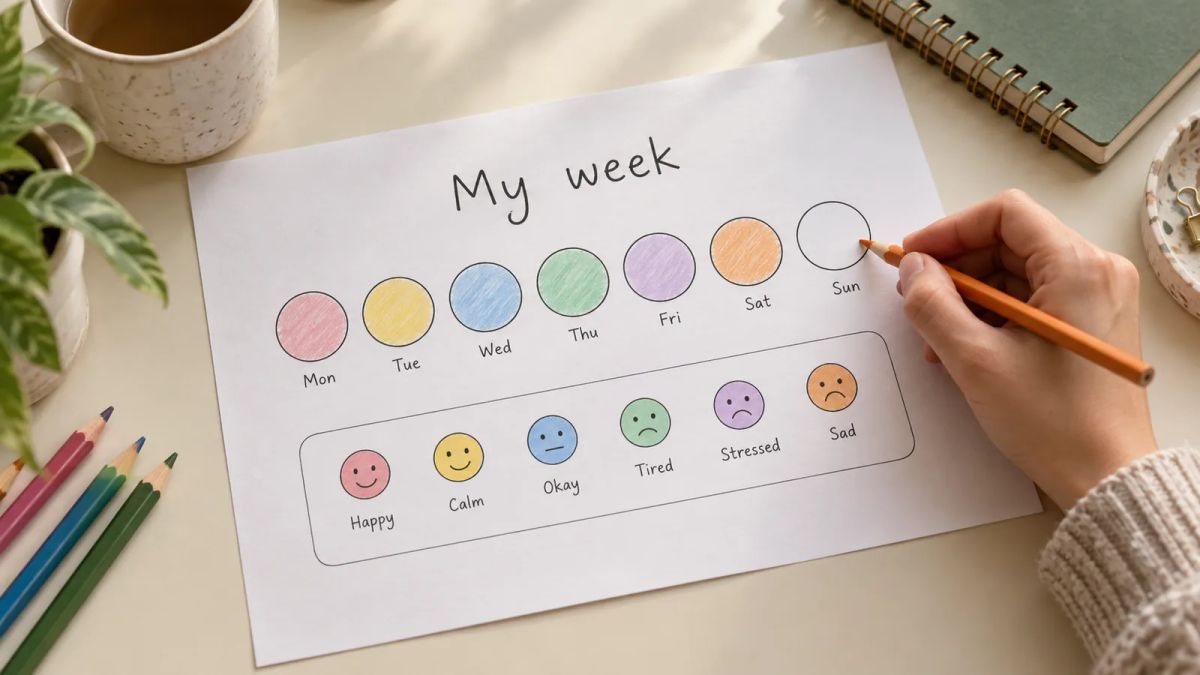
- A monthly mood grid with a colour key. You pick five to eight moods, give each a colour, and fill one square a day. By the end of the month you've got a block of colour you can read at a glance, and a run of blue squares is hard to argue with. Most trackers work best with a handful of clear states rather than twenty, so the key stays quick to use.
- A daily one-line mood log. One date, one line. You note the mood and a few words about the day, and that's it. This is the lowest-effort option and it travels well, because a single line fits in any notebook margin.
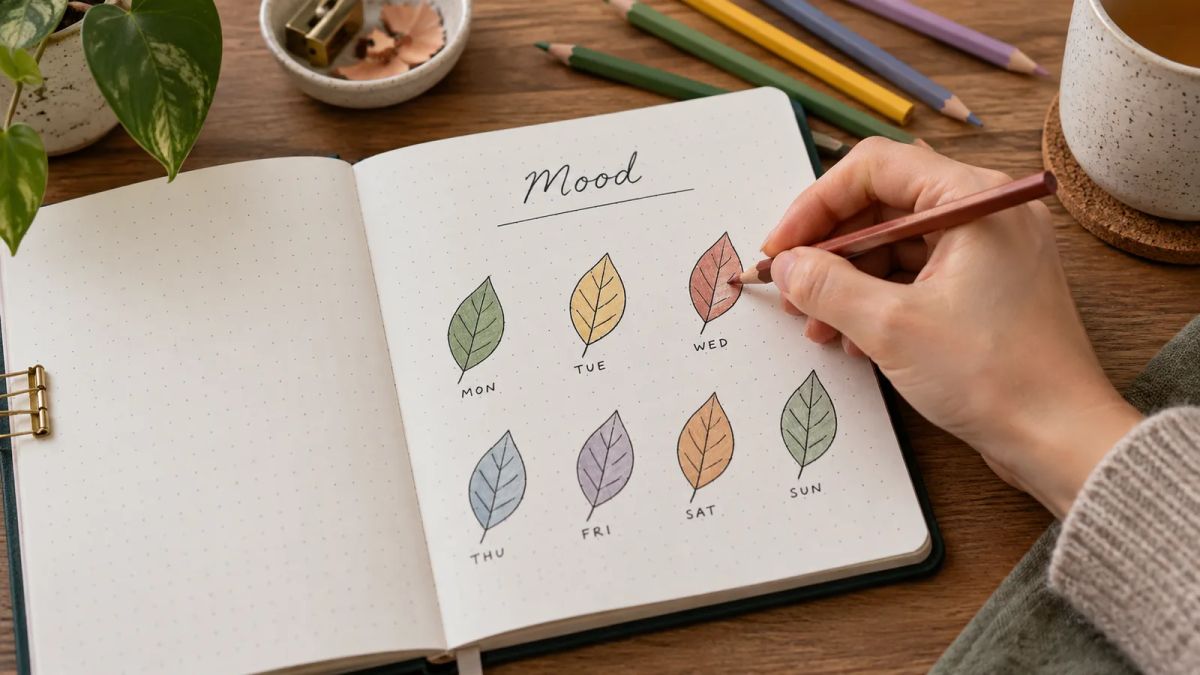
- A bullet-journal mood mandala or petal spread. Instead of a grid, you draw one shape, often a circle split into as many segments as there are days, and colour a petal a day so the month fills like a flower. It takes longer and rewards people who enjoy the drawing as much as the tracking. A therapist who designs these spreads warns that chasing a perfect, share-worthy page can tip into perfectionism, so keep the substance ahead of the styling (Lindsay Braman, mental-health bullet-journal layouts). If the drawing appeals, our bullet journal mood tracker guide walks through the setup in detail.
- A mood-and-habits tracker in one. You keep the mood record beside a few habit boxes, so sleep, movement, water, and mood share a page. The point is to lay your days next to your moods and see if they move together. More on reading that below.
- A five-point scale with room for notes. You rate the day from 1 to 5 and then write a couple of lines underneath. It's the middle ground: quicker than a full diary, richer than a coloured square, and it's close to how a therapist's mood chart works.
You don't have to commit to one. Plenty of people run a grid for the at-a-glance view and keep a line or two of notes alongside it.
Two layouts you can copy
Here's a monthly colour-key grid you can rule up in a spare few minutes. Keep the key small so it lives on the same page.
Mood key
Yellow means a good day. Green means calm or steady. Blue means low or flat. Red means anxious or wound up. Grey means numb or tired.
The grid
Number the days 1 to 31 down the left side. Leave one column beside them. Each evening, fill that day's square with the colour that fits best. One square, one colour, about ten seconds.
And here's the five-point log with notes, shown filled so you can see the shape of a real week.
Tuesday. Mood 4 out of 5. Slept badly but the lunchtime walk helped. Bit snappy by 4pm, better after food.
Wednesday. Mood 2 out of 5. Flat all morning, no clear reason. Rang a friend in the evening and it lifted a little.
Thursday. Mood 3 out of 5. Steady day. Nothing much happened, which was fine.
Copy either one straight into a notebook. The filled example does more for you than a blank template, because it shows how little you need to write for the entry to be useful.
Open our free Weekly mood journal (PDF). Record a mood, energy level and short note for seven days. A brief review helps you notice patterns without treating them as diagnoses. Save or print it; no sign-up needed.
How to set one up
You need less than you think. A pen, somewhere to write, and a moment in the day you'll reliably reach it.
- Pick your scale first. Colours, a 1-to-5 number, or a short line. Decide before you start so you're not reinventing it every night.
- Name your moods. Five to eight is the sweet spot. Write them where you can see them, because "which colour was restless again?" is how trackers quietly die.
- Tie it to something you already do. Keep the journal on the pillow, next to the kettle, or beside your toothbrush. Attaching the entry to an existing routine is the trick that carries most habits, and it works here too.
- Set the bar low. One square counts. A number with no note counts. You're building the record, and a thin entry beats a skipped one.
If you'd rather print a ready-made page than rule your own, a mood tracker printable gives you the grid and key already laid out.
Keeping it honest
A tracker only helps if it tells the truth, and there are two easy ways to lose that.
The first is backfilling. Colouring in five days on a Friday from memory turns a mood journal into a guess, because we round the past off smooth. Entries made in the moment catch the feeling better than looking back does (positivepsychology.com, Mood Charts). If you miss a day, leave it blank. A gap is data too.
The second is drift into complaining. Writing the same grievance every night, without ever asking what's underneath it, can leave you feeling worse, not better. One study found that ruminating on paper, going round and round without exploring the thought driving the feeling, lowered wellbeing (HelpGuide, Journaling for Mental Health and Wellness). So when you do write notes, aim a line at the why, not the what alone.
It also helps to log the good days as fully as the bad ones. A gratitude line beside the mood, even one word, keeps the page from becoming a record of everything that went wrong. If that appeals, our gratitude journal guide pairs neatly with a mood spread.
One more thing. This kind of journal is for noticing, not diagnosing. If your mood stays low for weeks, or the writing starts to upset you, that's a moment to talk to your GP rather than track harder.
Paper or app
Both work, and the honest answer is that it depends on where your attention already lives.
Paper is slower, and that slowness is part of the appeal. Ruling a grid or colouring a petal makes you sit with the day for a minute, and some people find the drawing itself calming. It's also private in a way a phone isn't, and there's nothing to charge. The catch is that a notebook left at home is a notebook you won't fill.
An app is always in your pocket, can nudge you at a set time, and adds up the patterns for you. The friction of finding a pen disappears. In one 12-week trial, a structured web-based journalling programme lowered anxiety and mental distress and improved wellbeing in adults with elevated anxiety, which suggests the check-in itself does some work (Smyth et al., 2018, JMIR Mental Health). The trade-off is that a phone comes with every other notification attached, so the check-in has to survive the pull of everything else on the screen.
Some people run both, roughly. A paper grid for the month on the wall, and an app for the quick evening tap when the notebook's out of reach.
A lighter daily check-in
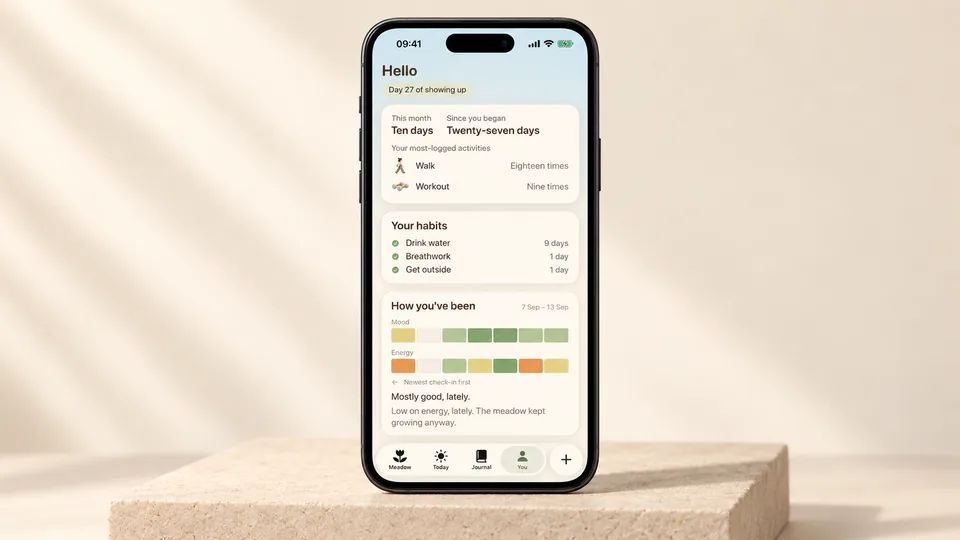
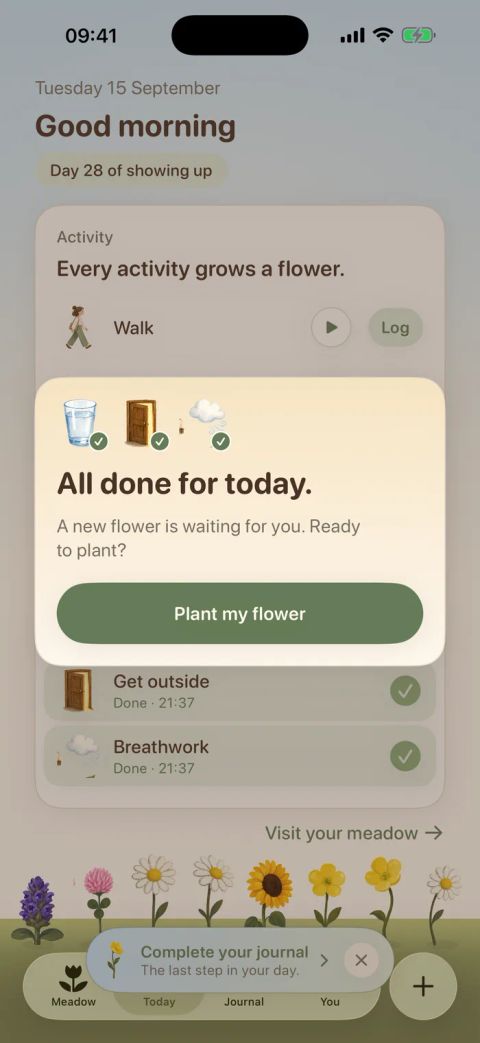
If a paper spread feels like one more thing to keep up on a busy evening, Meadow keeps the check-in to a few taps instead. You note your mood and your energy, tick off a small habit or two, and log any movement you did, and it all sits together on your phone. Each day you show up, a new wildflower blooms in a meadow that's yours alone. It's built around consistency, so there are no streaks to guard and a day you skip leaves nothing to repair. You can find it at growyourmeadow.com.
How to read the patterns
The record is only half of it. The other half is looking back and asking what the colours are telling you, and this is where a mood journal earns its keep.
Give it a month before you judge anything. A week is weather. A month starts to show climate. Once you've got a block of days, look for three things.
- Runs. Several low days in a row mean more than one bad Tuesday. A run is worth taking seriously in a way a single dip isn't.
- Company. This is where a combined mood-and-habits page pays off. Line the mood row up against sleep, movement, and how much you drank, and see what tends to travel with your better days. You're not proving that a walk caused a good mood, only noticing that they keep turning up together, which is enough to try more walks and watch what the squares do.
- Triggers. When a dip has a note attached, you get a clue. A string of red squares that all landed on deadline days, or on nights after poor sleep, points you somewhere specific.
Keep your expectations honest here. Tracking mood tends to build self-awareness, and the evidence for journaling on mood is real but modest, with the clearest gains in wellbeing and positive feeling and mixed results for low mood (systematic review of positive expressive writing, PMC). It's a tool for spotting patterns and small experiments, not a cure.
So here's the one action to take today. Rule up a seven-day grid, pick five moods and five colours, and fill tonight's square before bed. One square. That's the start of the picture, and you'll have something to read by this time next week.
AUTHOR
Co-founder of Meadow.
Ash is co-founder of Meadow, a habit and movement tracking app that turns small acts of self-care into a growing wildflower meadow.
Every little bit counts
Five minutes counts. So does a dance in the kitchen.
Log the movement you enjoy and the small habits that help you feel good, and watch them bloom into something you can see.
Download Meadow