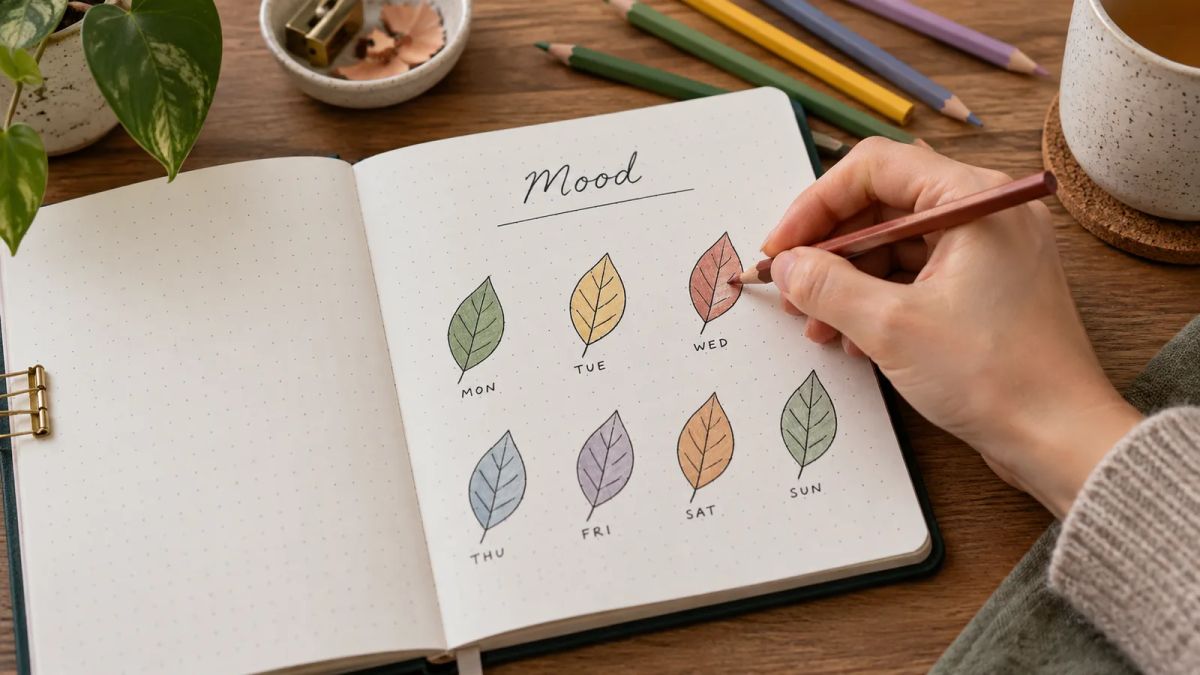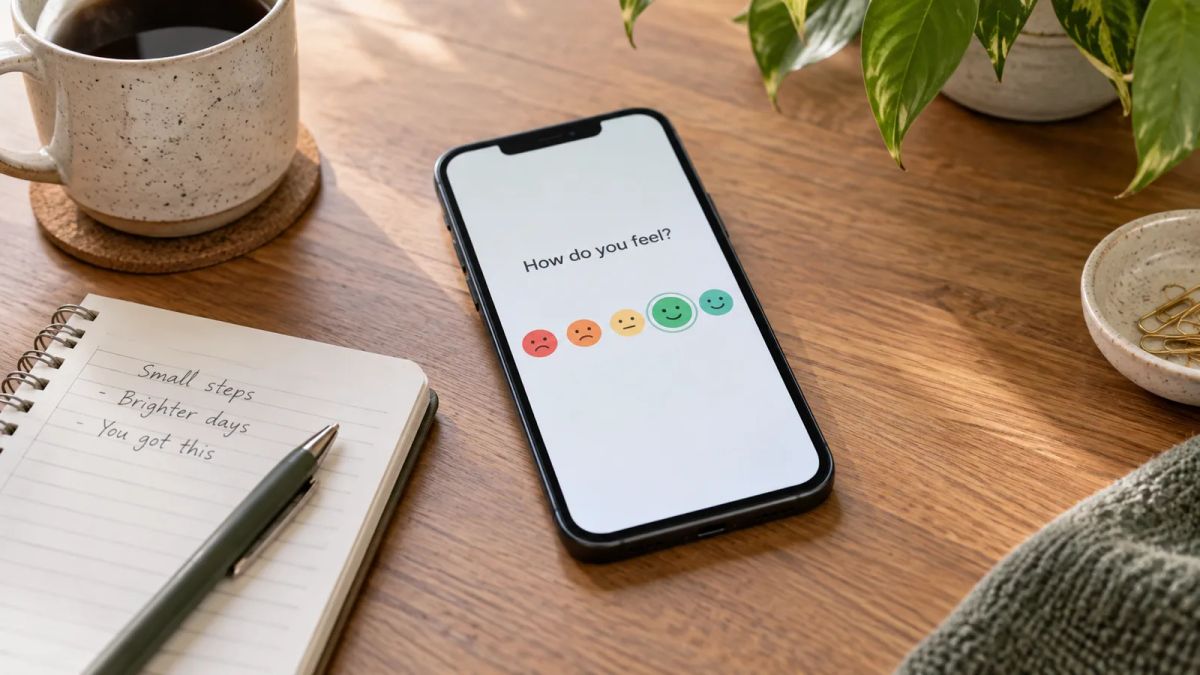
A printable mood tracker is a grid you fill in once a day to record how you felt, so the patterns you would never spot from inside a single Tuesday start to show up over weeks. Print one, keep it somewhere you will see it, and colour or number one box each evening.
That's the whole method. A month of small marks tells you what memory hides.
This guide gives you three trackers you can copy in the next minute: a monthly mood grid, a weekly mood and habit combo, and a one-line daily check-in. Each comes with a colour and number key and a filled-in example, so you can see what a real, imperfect month looks like.
What tracking your mood does for you
Writing a feeling down changes your relationship to it, and the effect has been studied.
A 2016 review in Psychological Bulletin pooled 138 studies and found that people who monitored their progress towards a goal were more likely to reach it, and that checking in more often went with doing better (Harkin and colleagues). The noticing does work on its own.
For mood in particular, a randomised trial followed 114 young people who logged their mood, stress and coping on a phone for a few weeks (Kauer and colleagues). The young people who logged their mood grew more aware of their emotions, and that rise in emotional awareness was associated with a drop in depressive symptoms. This is an association in a small study, not proof that a tracker treats depression.
Part of why it works may be the naming. The Greater Good Science Center at Berkeley describes putting a precise word to a feeling as a way to take some of the heat out of it, an idea often shortened to "name it to tame it" (Greater Good). A vague sense of "bad" is harder to do anything with than "flat and a bit lonely".
And part of it is attention. Harvard Health suggests keeping a journal and writing down how specific events made you feel, as a way to know your own emotions more clearly (Harvard Health). A tracker is that habit boiled down to a mark and a minute.
Keep the claims modest. A tracker makes patterns visible and builds the awareness that helps you respond to them. It is not therapy, and the section on limits below says more about that line.
Pick your scale before you print
The one decision that makes or breaks a tracker is how you will rate a day, so settle it first.
A number scale is the plainest. One to five, where 5 is a great day and 1 is a rough one, gives you enough shades without turning each evening into a puzzle.
A colour scale is the same idea you can read across a whole month at a glance. Choose a colour for each rating and shade the box, so a hard fortnight shows up as a band you can spot from across the room.
A word or emoji scale suits people who bristle at scoring a feeling out of five. Choose five or six feelings you tend to have, like content, tired, anxious, calm, low or wired, and mark the closest one each day.
Whichever you choose, use it the same way every day, and pair a number with a colour if you can, so the tracker still reads if you print it in black and white. Here is a key that works for all three templates below.
Mood key: 5 = great (green) · 4 = good (lime) · 3 = OK (yellow) · 2 = low (orange) · 1 = rough (red)
Three trackers you can copy right now
A monthly mood grid
This is the classic printable, and you can rule it up on any sheet of paper. Write the month at the top, add the key, then a box for each day laid out in weekly rows.
September. Mood key: 5 great (green), 4 good (lime), 3 OK (yellow), 2 low (orange), 1 rough (red)
Days 1 to 7: ☐ ☐ ☐ ☐ ☐ ☐ ☐
Days 8 to 14: ☐ ☐ ☐ ☐ ☐ ☐ ☐
Days 15 to 21: ☐ ☐ ☐ ☐ ☐ ☐ ☐
Days 22 to 28: ☐ ☐ ☐ ☐ ☐ ☐ ☐
Days 29 to 31: ☐ ☐ ☐
Each evening, write the number in the day's box, or shade it in its colour. After a month it might look like this.
September, filled in
Days 1 to 7: 3 4 4 2 5 5 4
Days 8 to 14: 3 3 2 2 4 5 4
Days 15 to 21: 4 3 3 4 4 5 4
Days 22 to 28: 2 2 3 4 4 4 3
Days 29 to 31: 4 5 4
Read down the weekends and you can see they run higher than the midweek dip around days 10 to 12. That is the sort of thing a month of marks shows and a single bad Wednesday hides.
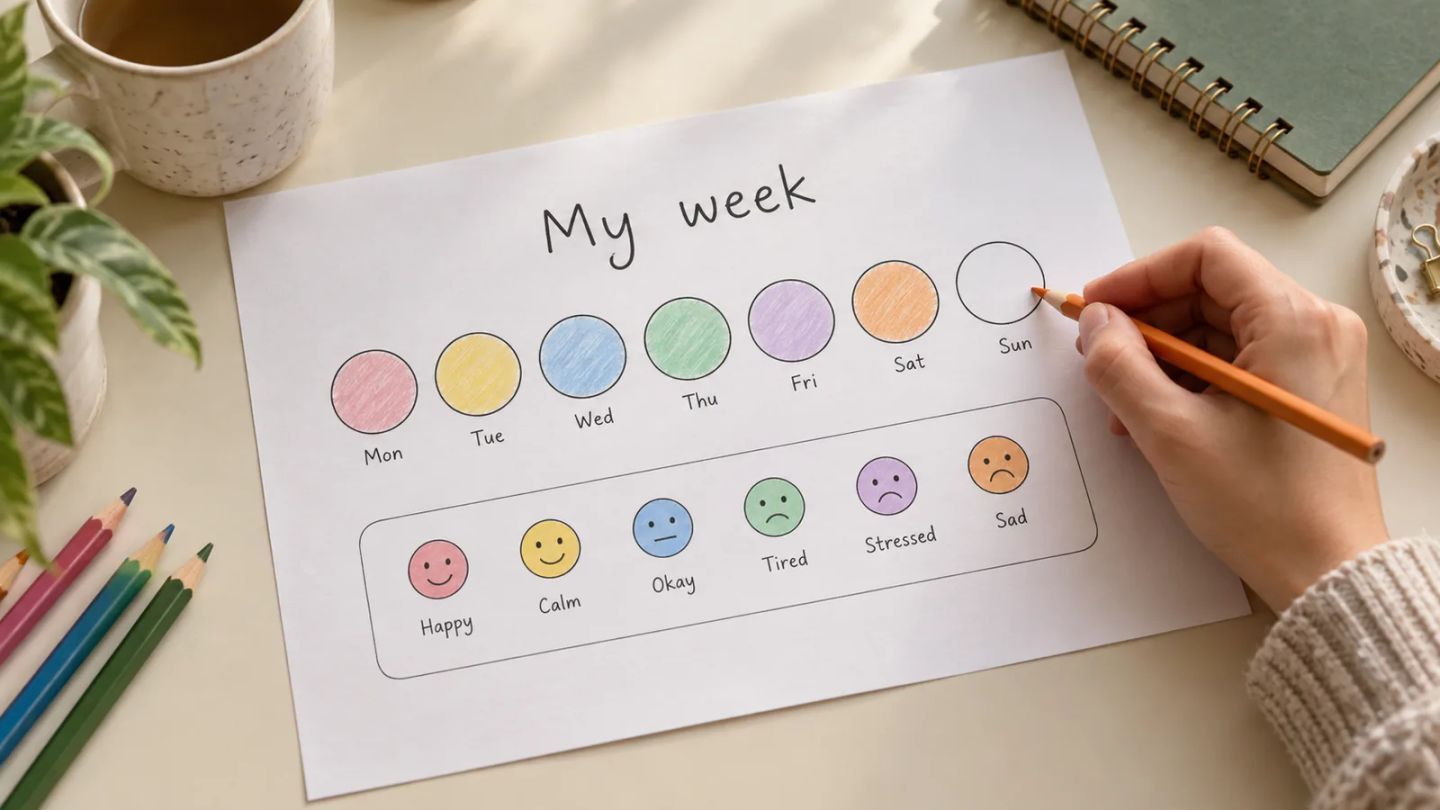
A weekly mood and habit combo
If you suspect your mood tracks with sleep, movement or getting outside, put them on the same page. Mood on the top row, a habit on each row below, one week running left to right.
Week of ____. Mood 1 to 5, then tick the habit days
Mood (1 to 5): Mon __ Tue __ Wed __ Thu __ Fri __ Sat __ Sun __
Slept 7+ hours: Mon ☐ Tue ☐ Wed ☐ Thu ☐ Fri ☐ Sat ☐ Sun ☐
Moved my body: Mon ☐ Tue ☐ Wed ☐ Thu ☐ Fri ☐ Sat ☐ Sun ☐
Got outside: Mon ☐ Tue ☐ Wed ☐ Thu ☐ Fri ☐ Sat ☐ Sun ☐
Filled in after a normal week, the links start to show.
Week of 8 September
Mood (1 to 5): Mon 3 Tue 3 Wed 2 Thu 2 Fri 4 Sat 5 Sun 4
Slept 7+ hours: Mon ☐ Tue ☐ Wed ☐ Thu ☐ Fri ✓ Sat ✓ Sun ✓
Moved my body: Mon ✓ Tue ☐ Wed ☐ Thu ☐ Fri ✓ Sat ✓ Sun ✓
Got outside: Mon ✓ Tue ✓ Wed ☐ Thu ☐ Fri ✓ Sat ✓ Sun ✓
The low patch on Wednesday and Thursday lines up with three nights under seven hours and no time outside. One week proves nothing, but a few weeks of the same shape is a strong hint about what to protect. If you want to build those habits alongside the mood log, our guide to the habit tracker covers keeping the row of ticks going.
A simple daily check-in
Some people want more than a score. This one takes a corner of a notebook and gives a little context for each day, which makes the monthly read-back richer.
Date: ____
Mood (1 to 5): __ One word for today: ______
Slept well? Y / N
One thing that helped: ____________
One thing that drained me: ____________
A filled day:
Date: 11 September
Mood (1 to 5): 2 One word for today: frazzled
Slept well? N
One thing that helped: a walk at lunch
One thing that drained me: back-to-back meetings
Those two lines at the bottom are where the insight lives. After a fortnight you can flick back and find the same drainer sitting next to every low score. If you like the decorative, journal-style version of this with hand-drawn keys and layouts, our guide to the bullet journal mood tracker has ideas for making it your own.
How to use it so it helps
Fill it in at the same point each day, ideally in the evening when the day is done but not yet a blur. Leave it three days and you are guessing, and a guessed score is worse than a blank.
Rate the whole day, not its worst moment. A single bad phone call does not turn a fine day into a 1.
Then, once a week or once a month, read it back before you change anything. Look for the pattern, not the perfect run. Do the low days cluster on certain weekdays, after poor sleep, around a particular person or task? Those repeats are the point of the whole exercise.
When you spot one, make one small change and keep tracking to see if it moves. That loop, notice then adjust, is what turns a mood tracker from a diary into a tool.
Being honest about what it can and cannot do
A mood tracker is good at a few specific things. It makes patterns visible, it builds the habit of naming how you feel, and it gives you something concrete to bring to a friend, a therapist or a GP.
It has limits worth naming too. Scoring your feelings can tip into over-analysis for some people, and a run of low numbers can start to feel like a verdict. If tracking is making you feel worse or more self-critical, it is fine to stop, or to switch to the lighter one-word version.
A tracker is not a diagnosis or a treatment. It can hint that something is off, but not tell you what, or fix it.
If your low mood, anxiety or the numbers you are seeing have been sliding for more than a couple of weeks, are getting in the way of ordinary life, or are frightening you, please speak to your GP. A tracker works best alongside that support, and the notes you have kept can make that first conversation easier.
Track how you feel on your phone
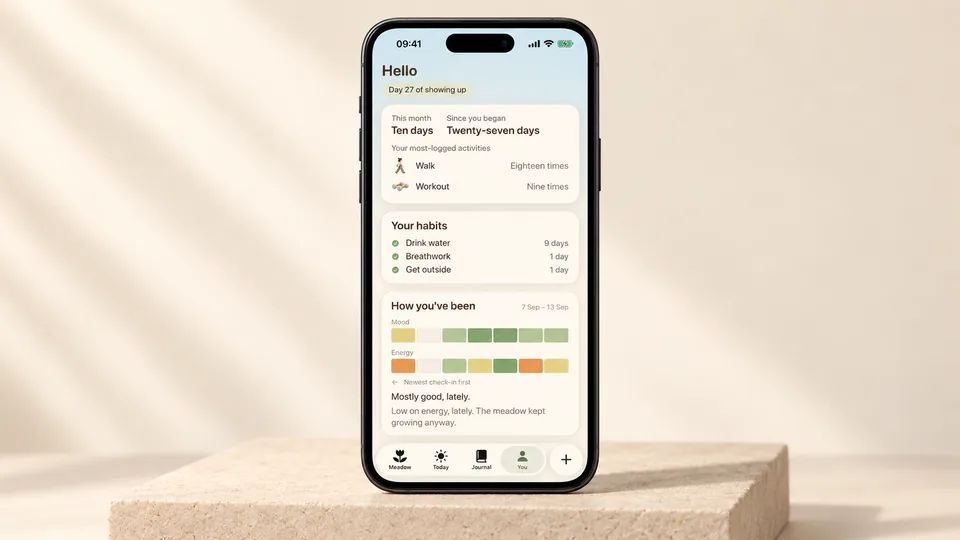
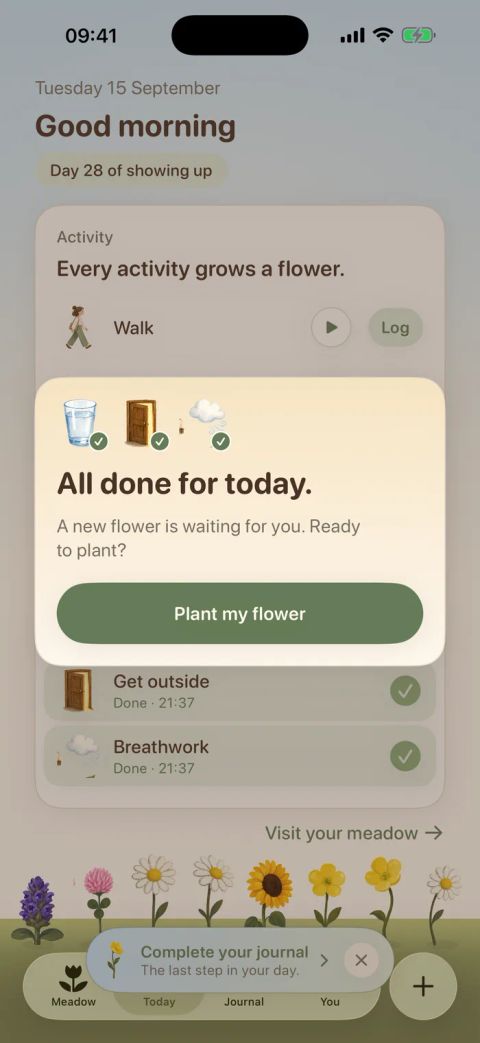
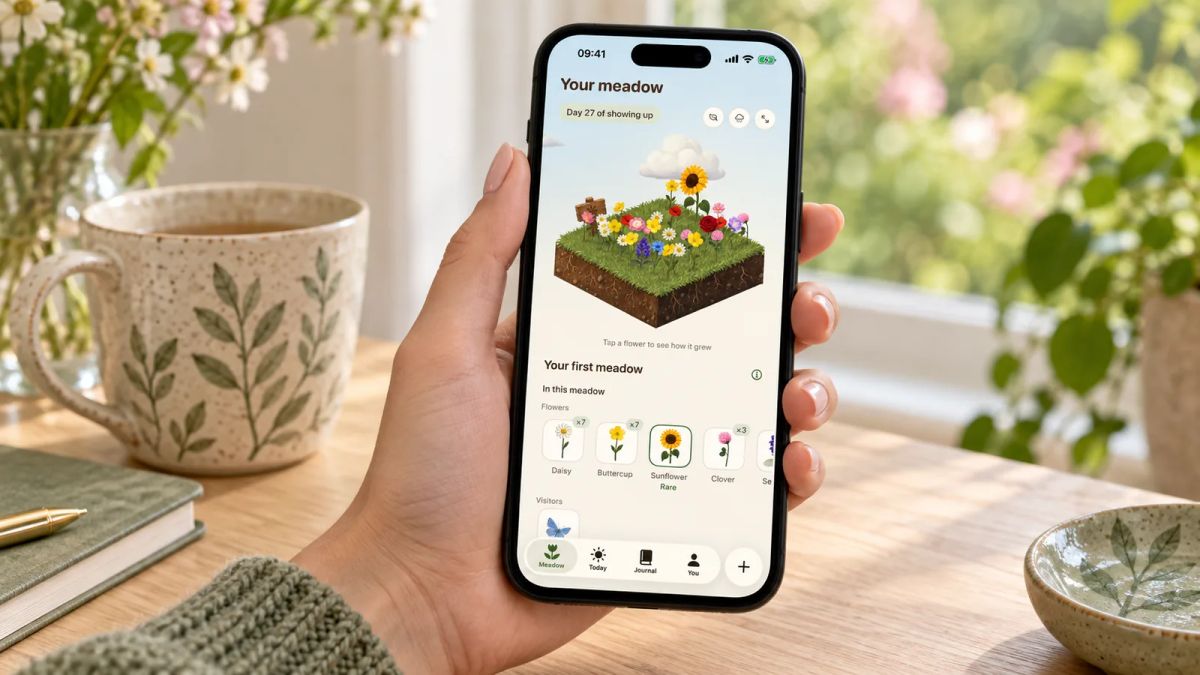
If a printable is not for you, Meadow keeps the same check-in on your phone. Each day you note your mood and energy, add a daily win and a short affirmation, and the app holds it as a gentle habit rather than a chart to keep perfect. You can also tick off small habits like drinking water or getting outside, and log a walk or a little yoga, and every day you show up grows a wildflower in your own meadow. There are no streaks, so a missed day never resets your progress or wilts your flowers. It is made for iPhone by Wildcard Wellness. Our roundup of the best mood tracker apps compares a few if you would rather scroll than print.
Making it stick
The trackers above only work if you keep filling them, so make skipping hard and restarting easy.
On a flat, busy day, drop to the smallest version. One number, nothing else. A single digit keeps the line of data going, and the data is what you are after.
And when you miss a day, or three, do not start again from scratch or bin the sheet. Research on how everyday habits form found that missing a single day made no meaningful difference to the habit taking hold (Lally and colleagues). Leave the gap, fill in today, carry on. The blank box is not a failure. It is a Tuesday you were too tired, and a good tracker is honest enough to show it.
Print or draw one of the three layouts above, add the mood key, and score today before you go to bed. One box is a tracker already started, and tomorrow's is all it asks of you next.
AUTHOR
Co-founder of Meadow.
Ash is co-founder of Meadow, a habit and movement tracking app that turns small acts of self-care into a growing wildflower meadow.
Every little bit counts
Five minutes counts. So does a dance in the kitchen.
Log the movement you enjoy and the small habits that help you feel good, and watch them bloom into something you can see.
Download Meadow