Mood tracking is the habit of noting how you feel on a regular basis, usually a quick rating and a word or two about what was going on. Keep it up for a few weeks and something useful appears: the shape of your own moods, the things that lift them, and the things that flatten them out.
It's a small record, kept by you, for you. Think of it as a note of how the days went, before a rough patch blurs them all together in memory. It doesn't diagnose anything and it won't grade your week.
This guide covers what mood tracking is, why people bother, what the research does and doesn't show, and a few plain ways to start tonight without turning your feelings into homework.
What mood tracking involves
A mood tracker can be a notebook, a note on your phone, a printed chart on the fridge or an app. What you write down stays short. A rating, a word, sometimes a colour, and often a line about sleep, food, movement or whatever else you want to keep an eye on.
That's the whole of it. You're building an honest record of how you felt, day by day, so you can look back later and see more than you'd remember.
Memory is a poor narrator. Ask someone how their month went and they'll tell you about the worst day or the last day, not the average of thirty. A tracker fills that gap with something closer to the truth.
Why people track their mood
Most people who stick with it are after one of three things.
- Patterns and triggers. When you can see a fortnight of moods in one place, the dips stop looking random. A bad Sunday every week, a flat stretch after poor sleep, a lift on the days you got outside. You can only change what you can see, and a tracker makes the invisible obvious.
- Noticing what helps. The same record shows the good stuff. A walk at lunch, a proper meal, a call with a friend, an early night. Once you know which small things reliably nudge your mood up, you can do more of them on purpose.
- A daily check-in. Some people track less for the data and more for the pause. Thirty seconds to ask "how am I today?" is a moment of attention you might not give yourself otherwise.
The American Heart Association's advice on making habits stick is to attach a new action to a routine you already have. A mood check-in rides along nicely with brushing your teeth or making the first cup of tea, so it happens without a reminder nagging you.
What the evidence does and doesn't show
Tracking your mood does something real, and it's smaller than the wellness ads suggest. Here's the honest version.
The clearest benefit is awareness. In a randomised trial of 114 young people, those who logged their mood, stress and coping on their phones for a few weeks showed a bigger rise in emotional self-awareness than a comparison group, and that rise was linked to lower depressive symptoms through an indirect path. Noticing your feelings more clearly seems to be the active ingredient.
That fits how therapists use it. A mood diary is often the first tool a cognitive behavioural therapist hands you, because it turns a vague "I felt awful all week" into "I felt awful on the two afternoons I skipped lunch and sat through back-to-back calls." Psychology Tools notes that self-monitoring works as both a way to gather information and a small intervention in itself, since the act of watching a behaviour tends to shift it.
There's wider support for the mechanism too. A meta-analysis of 138 studies found that prompting people to monitor their progress towards a goal improved how often they reached it, and the effect was stronger when they recorded the results.
Now the caveat. Tracking raises awareness. It's not a treatment. Writing down a low mood every day won't lift it on its own, and a chart can't tell you why you feel the way you do or what to do about it. Most of the promising studies are small, several are in young people, and association isn't the same as cause. Treat mood tracking as a way to see more clearly, and lean on it as a first step, not a cure.
Simple ways to track, from lightest to fuller
You don't need an elaborate system. Pick whichever of these you'll still do on a busy, low Tuesday.
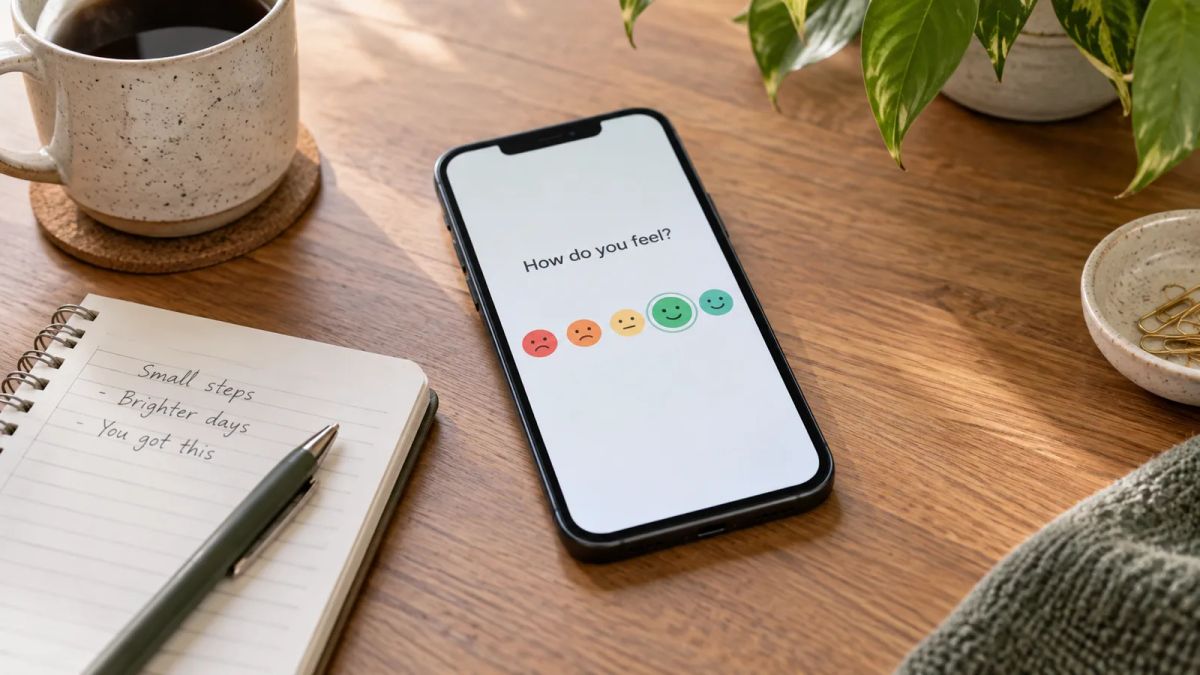
- A number. Rate today from 1 to 5, where 1 is very low and 5 is very good. That's it. One digit a day builds a line you can read in a month.
- A word. Add a single word for the feeling, and try to be specific. "Flat," "wired," "content," "frayed" tell you more than "bad" or "fine." Naming a feeling more precisely is part of what makes tracking useful.
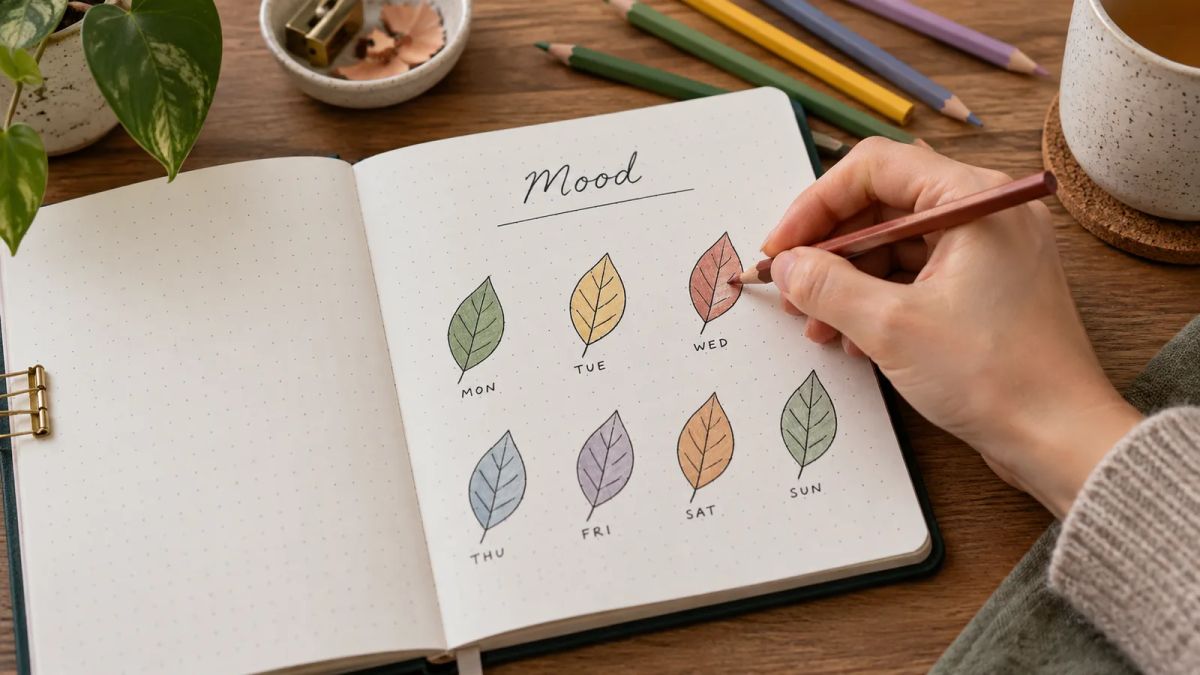
- A colour. If numbers feel clinical, colour a box instead. Blue for low, yellow for steady, green for good. A wall of colour shows a month at a glance.
- Mood plus a couple of companions. This is where patterns surface. Log your mood next to sleep, movement and energy, so you can see how they move together. If you already track other things, our guide to habits to track has more you might add.
Here's a blank daily line you can copy into a notebook or a note on your phone. One row a day is plenty.
Date: ______ Mood 1-5: ___ Word for it: __________
Slept well? Y / N Moved today? Y / N Energy 1-5: ___
One line on the day: ________________________________
And the same line filled in, so you can see how little it takes.
Date: Tue Mood 1-5: 2 Word for it: frayed
Slept well? N Moved today? N Energy 1-5: 2
One line on the day: skipped lunch, back-to-back calls, no daylight
Open our free Weekly mood journal (PDF). Record a mood, energy level and short note for seven days. A brief review helps you notice patterns without treating them as diagnoses. Save or print it; no sign-up needed.
Paper works well if you like the ritual of it, and a bullet journal gives you room to make it your own. Our walkthrough of a bullet journal mood tracker shows a few layouts if that's your thing. If your phone is where your life already lives, an app will nudge you and do the charting for you, and there's a rundown of options in our mood tracker app guide.
How often to log
Once a day is the sweet spot for most people. Same moment each time, tied to something you already do, so it doesn't rely on willpower.
Evening suits people who like to close the day off. Morning suits people who want to catch the mood they woke up in. Either is fine, as long as it's consistent enough to compare like with like.
Some people log twice, morning and night, and find their mood shifts across the day in a way that's worth knowing. Others log only when something feels off. There's no rule here.
Miss a day and nothing's ruined. A gap in the record is not a failure, and you don't need a perfect run for the patterns to show. Even three or four entries a week will tell you plenty over a month.
Reading it back without spiralling
The whole payoff comes from looking back, and this is where it can tip into overthinking if you're not careful.
Read your log at the zoom-out level, not minute by minute. Look at a week or a month in one go, not this afternoon's single number. One low day is weather. A run of low days is climate, and it's the climate you're trying to understand.
When you spot a pattern, resist the urge to solve everything. Pick one thing you can test. If your worst days keep landing on no-daylight, no-lunch afternoons, try a ten-minute walk after you eat and watch whether the next fortnight looks any different. Change one lever, give it time, then read the record again.
A tracker is there to inform you, not to judge you. If checking in starts to feel like grading yourself, or you find yourself refreshing the numbers looking for reassurance, that's a sign to loosen your grip on it, log less often, and treat the notes as observations you're curious about.
Note your mood in a tap
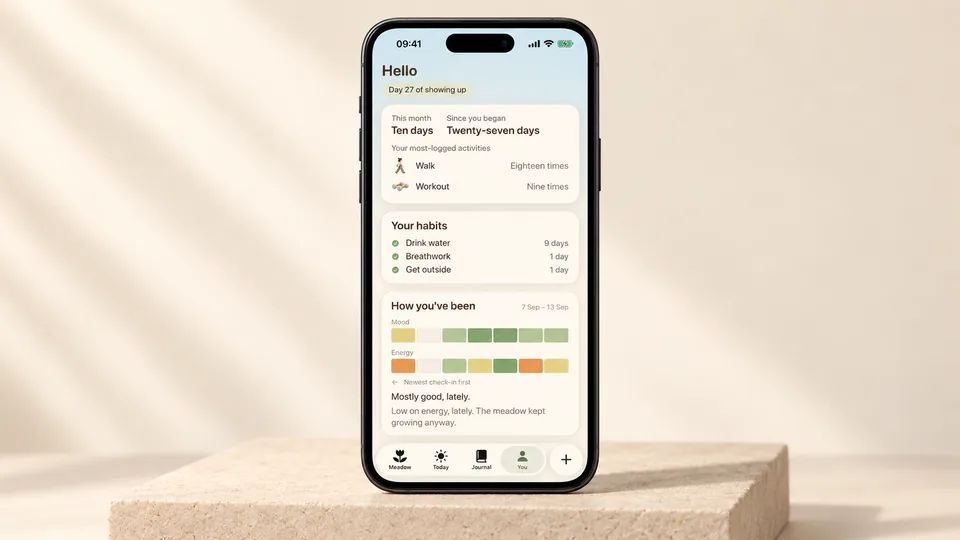
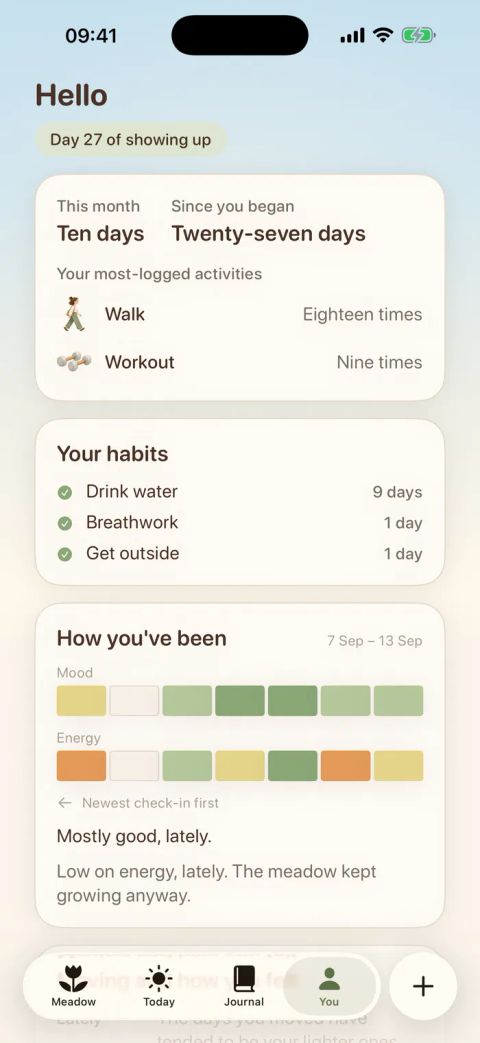
If a daily check-in is more likely to survive on your phone, Meadow keeps it to a tap. You note how you're feeling and where your energy is, jot one good thing from the day if you want to, and read a short line to start the morning. Alongside that you can log a walk or a few minutes of movement and tick off small habits like drinking water. There are no streaks, so a day you forget resets nothing, and each day you show up grows a wildflower in your own meadow. You'll find Meadow on iPhone.
A note on low mood that lingers
Mood tracking is a self-awareness tool, and it works best sitting alongside proper support, not standing in for it. A tracker can help you notice a dip early and describe it clearly, which is worth a lot in a GP appointment, and it can't diagnose or treat anything.
A low mood usually lifts after a few days. If yours has hung around for more than about two weeks, is getting in the way of daily life, or is frightening you, please talk to your GP. The NHS low mood and depression pages explain what to look for and how to get help, and there's no threshold of "bad enough" you need to reach first.
Common questions about mood tracking
What should I write down each day? As little as a number and a word. If you want more, add sleep, movement, food and one line about the day. Track what you're curious about and drop anything you never look back at.
Does mood tracking help with anxiety? It can raise your awareness of what sets anxiety off and what settles it, which is useful, and it's not a substitute for treatment. If anxiety is affecting your daily life, speak to your GP.
Can tracking make you overthink your feelings? It can, if you check the numbers constantly or use them to judge yourself. Logging once a day and reading it back weekly, not hourly, keeps it on the helpful side.
How long before I see patterns? Usually two to four weeks. A single week rarely shows much, so give it a month before you draw conclusions.
Tonight, before you put your phone down, write one number for today's mood and one word for why. That single line is your tracker, already started, and tomorrow it asks for one more.
AUTHOR
Co-founder of Meadow.
Ash is co-founder of Meadow, a habit and movement tracking app that turns small acts of self-care into a growing wildflower meadow.
See how far you've come
Your habits, moods and little wins, all in one place
Meadow keeps track of the walks, the water and the good days, so you can look back and watch your effort add up.
Download Meadow