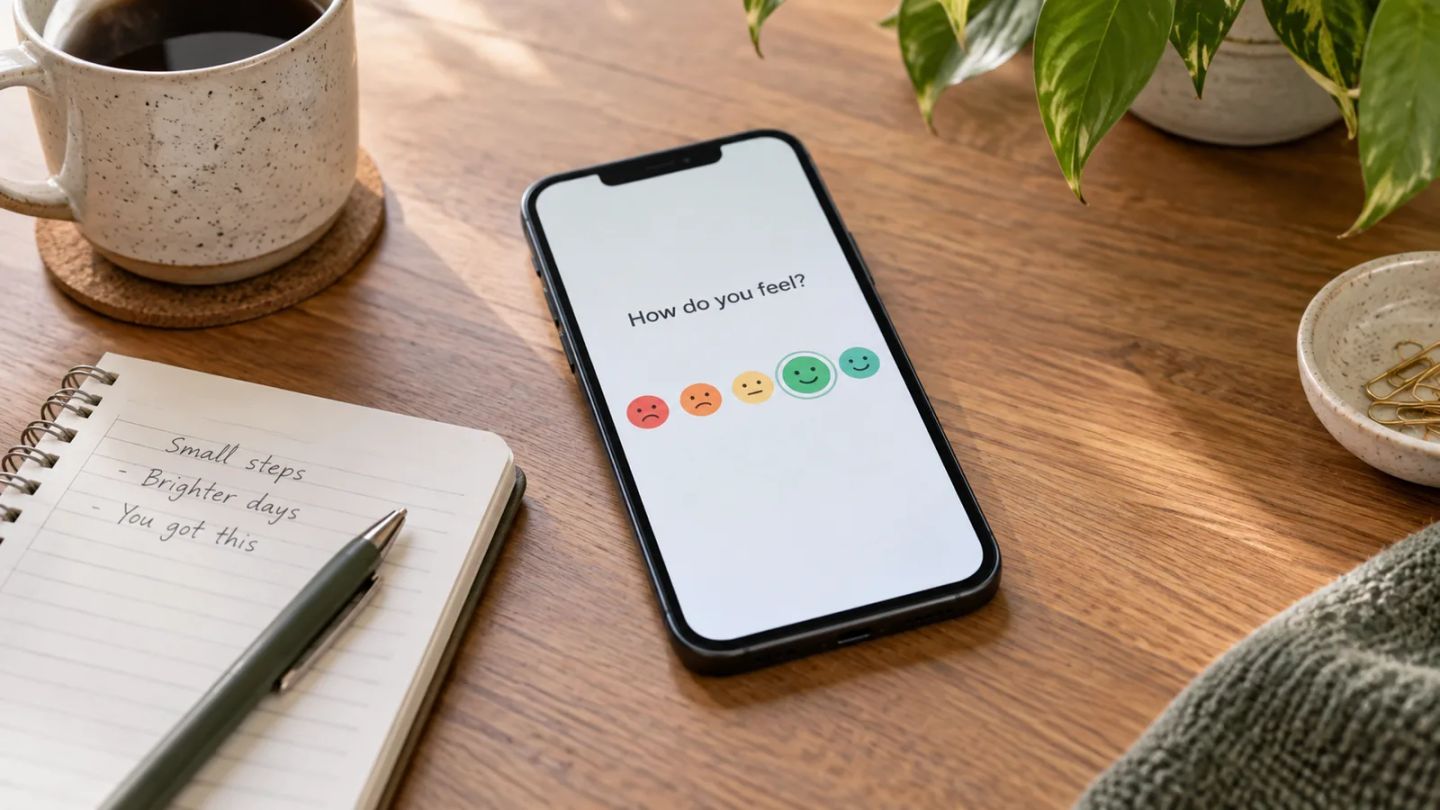
The best mood tracker app is the one you'll still open on a low, busy Tuesday, because a pattern only shows up when you log often enough to see it. The charts, the colours, the emotion wheels all come second. What counts is whether the app survives a bad week.
So this roundup is built around fit. Some people want to tap a face and move on. Some want mood sitting next to sleep, pain and medication so the connections show. Some want gentle prompts, others want data they can hand to a therapist.
Every app below is a current option you can download today, and each one comes with its platform and price spelled out, so nothing surprises you at the checkout.
One thing to say plainly first. Little and Often is run by the Meadow team, so our own app sits at the top of our own list. We've kept its description honest, including who it's wrong for, and most of the apps under it are good. Read past Meadow if it's not what you need.
1. Meadow: best for mood alongside gentle habits
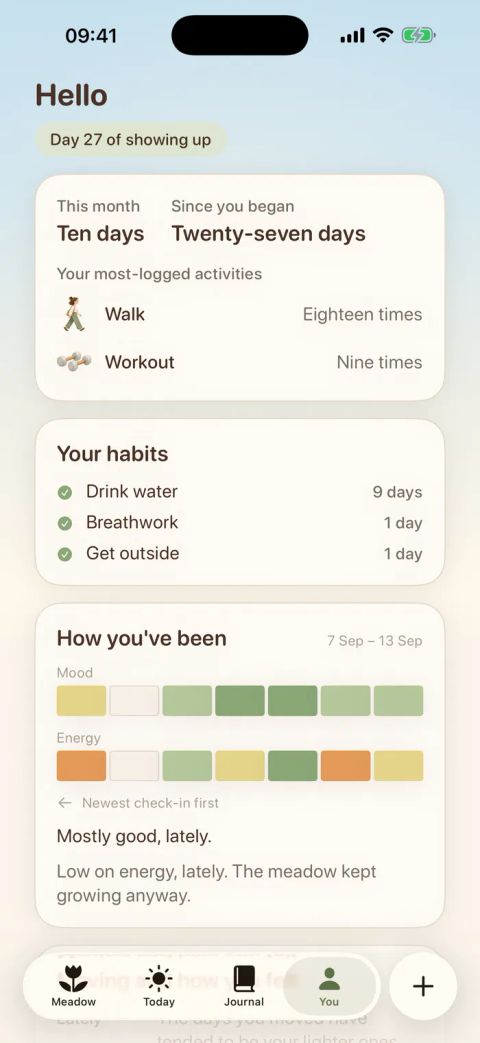
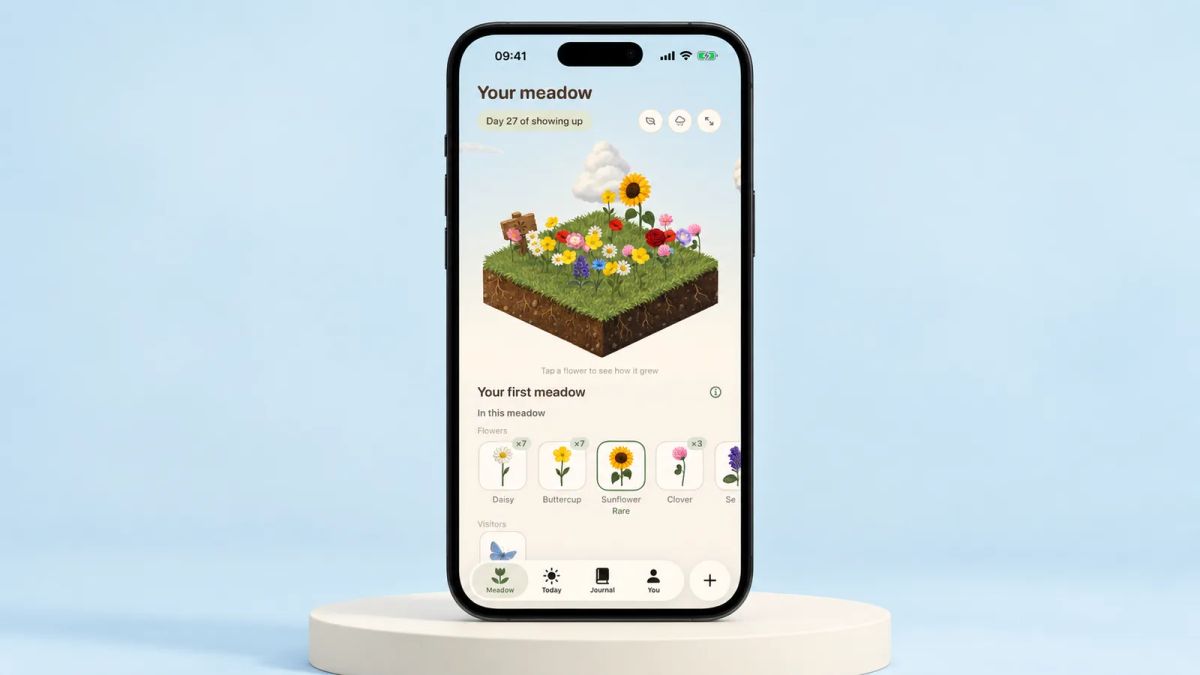
Meadow is a gentle habit tracker with a daily mood and energy check-in built in, rather than a dedicated mood-analytics app, and that difference is worth knowing before you choose. Each day you note how you are feeling, write a short journal entry about one good thing, and read a daily affirmation. Alongside that you can log the movement you enjoy with a timer, a walk, some yoga or a dance, tick off small habits like drinking water or getting outside, and practise a little breathwork.
For every day you show up a wildflower blooms in your own meadow, with rare flowers and the odd animal visitor arriving as it grows. There are no streaks, so miss a day and nothing resets and your flowers never wilt, which makes it easier to come back after a low patch. Little and Often is run by the Meadow team, and you will find Meadow on iPhone.
Best for: people who want to see mood next to daily habits and movement, in an app that stays kind on the days you miss. Not for you if: you want deep mood charts, symptom correlations or reports for a therapist, in which case keep reading.
2. Daylio: best for fast logging with no writing
Daylio is the one most people mean when they say mood tracker, with a huge user base and a design built for speed. You pick one of five mood faces, tap a few activity tags, and save, no typing required, which is why it survives busy days when a blank journal would sit ignored. Over time it turns those taps into weekly, monthly and yearly charts, plus a Year in Pixels view that shows a whole year of moods at a glance.
There is a properly usable free tier covering mood, activity and habit tracking with CSV export. Premium adds advanced statistics, more moods and icons, and full-colour PDF exports. Daylio runs on iPhone and iPad, with a matching Android app, and premium costs $4.99 a month or $35.99 a year after a seven-day free trial.
Best for: anyone who wants the lowest-effort way to log a mood and still get real charts back. Not for you if: you want guided reflection or clinical structure, where the CBT apps below do more.
3. How We Feel: best free option
How We Feel is the one to get if you want something good without paying. It is a non-profit app from The How We Feel Project, built with Yale University's Center for Emotional Intelligence and grounded in Dr Marc Brackett's research, so the emotion vocabulary is more precise than a row of smileys. You place your feeling on a colour-coded grid, add context, and the app suggests short strategies for shifting or sitting with the emotion.
Because it is donation-funded, there is no paywall and no upsell waiting three screens in. How We Feel is free with no in-app purchases and runs on iPhone.
Best for: anyone who wants to name emotions more precisely and pay nothing to do it. Not for you if: you need Android, or want habit tracking bundled in.
4. Bearable: best for mood plus physical symptoms
Bearable is the pick when your mood does not live in isolation. It lets you track mood next to sleep, pain, fatigue, energy, medication, diet and menstrual cycle, then surfaces correlations, so you can see whether poor sleep or a skipped dose lines up with a dip. For people managing a long-term condition alongside their mental health, that joined-up picture is the whole point.
There is a capable free version, and premium adds deeper reports, more correlations and historic data. Bearable runs on iPhone, iPad, Mac and Apple Watch, with an Android app too, and premium is around $6.99 a month or $34.99 a year after a free trial, with prices varying by region.
Best for: people who want to connect mood with physical symptoms and lifestyle. Not for you if: you want something quick and light, where the detail here would feel like admin.
5. Moodfit: best for CBT tools and sharing with a therapist
Moodfit is a small toolkit built around cognitive behavioural therapy. It pairs mood logging with thought records, breathwork, gratitude journalling and mental-health assessments, and it lets you export mood and medication charts to bring to an appointment. That export is why therapists often point people towards it.
You can start with a free account, and premium is a one-time payment, so there's no rolling subscription. On the Moodfit purchase page that is $35.99 for a year with no recurring billing, or a lifetime option, and discounted annual prices appear regularly. Moodfit is available on iPhone and Android.
Best for: anyone who wants practical CBT tools and clean charts to share with a professional. Not for you if: you want a two-tap log and nothing more.
6. Moodnotes: best for catching thinking traps
Moodnotes comes from clinical psychologists and designers, and it is built to improve how you think as well as record how you feel. As you log a mood it nudges you to spot common thinking traps, all-or-nothing thoughts, catastrophising, and to reframe them, drawing on CBT and positive psychology. It suits people who want a bit of coaching in the moment as they log.
Moodnotes runs on iPhone and Apple Watch and is free to download, with premium features behind a subscription that commonly sits around $29.99 a year, and prices vary by region, so check the figure on your own App Store page before you commit.
Best for: people who want their mood log to challenge unhelpful thinking. Not for you if: you want cross-platform support or a purely at-a-glance tracker.
7. Stoic: best for journaling with your mood
Stoic wraps mood tracking inside a fuller journalling practice. Daily check-ins sit alongside guided prompts, voice notes, breathing exercises and reflections drawn from Stoic philosophy, and the app charts trends across mood, sleep and writing over time. If the act of writing is what settles you, this leans into it further than the tap-and-go apps.
Stoic covers iPhone, iPad, Mac and Apple Watch and is free to start, with premium at $39.99 a year and a lifetime option, and separate add-ons for its AI features.
Best for: people who want mood tracking woven into a daily writing habit. Not for you if: you find journalling a chore, or you are not in Apple's ecosystem.
8. Finch: best for a self-care framing
Finch pairs mood check-ins with a self-care companion, a little bird you look after by doing small daily things. Morning check-ins, a mood tracker and combined insights sit under a soft, encouraging layer of pet care, which helps for readers who find plain charts cold or discouraging. The mood tracking is real, even if the pet is what gets you back in.
Finch is free to download on iPhone, with an optional Finch Plus subscription for extra features, commonly around $9.99 a month or $39.99 a year, though the price shifts and is worth checking on your own App Store page.
Best for: people who want warmth and gentle prompts around their mood log. Not for you if: you want precise data and no game layer, where Daylio or Bearable fit better.
How to choose the one for you
Start with how much you will write. If a blank page makes you close the app, a tap-based tracker like Daylio or a warm one like Finch will outlast a journalling app every time. If writing is what helps you process, Stoic or Moodnotes reward the effort.
Then think about what you want to learn. After the link between mood and your body, sleep, pain, medication? Bearable is built for that. Want to work on the thoughts underneath a mood? Moodfit and Moodnotes lean on CBT. Want to spend nothing while you find out whether tracking suits you at all? How We Feel is free and does the job well.
Here are the honest shortcuts by need:
- Fastest to log: Daylio.
- Best free: How We Feel.
- Mood plus physical symptoms: Bearable.
- CBT tools and therapist-ready charts: Moodfit.
- Reframing your thinking: Moodnotes.
- Journalling with mood: Stoic.
- Gentle and encouraging: Finch, or Meadow if you want mood tucked in beside habits.
Whichever you pick, the act of tracking has decent evidence behind it. A meta-analysis of 138 studies found that prompting people to monitor their progress towards a goal improved how often they reached it. That does not prove any single app will lift your mood, but it does mean the habit of checking in earns its place.
A note before you rely on any of these
A mood tracker can help you spot patterns and start a useful conversation, and it is not a substitute for mental-health care. If low mood, anxiety or a change you can see in your own logs is lasting more than a couple of weeks, getting in the way of daily life, or frightening you, please speak to your GP. The NHS mental health pages explain how to find talking therapies and urgent help, and an app is at its best sitting alongside that support, not standing in for it.
If you want to build the wider routine your mood sits inside, our guides to self-care ideas, gratitude journal prompts and breathwork all pair well with a daily check-in.
Tonight, before you put the phone down, download one app from this list and log today's mood once. That single entry is your tracker, already started, and tomorrow's is all it asks for next.
AUTHOR
Co-founder of Meadow.
Ash is co-founder of Meadow, a habit and movement tracking app that turns small acts of self-care into a growing wildflower meadow.
See how far you've come
Your habits, moods and little wins, all in one place
Meadow keeps track of the walks, the water and the good days, so you can look back and watch your effort add up.
Download Meadow