The habits worth tracking are the small, repeatable ones that change how you feel across an ordinary week, and the real skill is choosing two or three rather than writing down twenty. A tracker is a record of whether you did the thing you meant to do, and it only helps when the list is short enough to face on a tired Tuesday night.
This guide sorts the habits people most often want to build into seven plain categories: movement, hydration, a sleep wind-down, food, mind and mood, connection, and the household admin that quietly keeps life running. For each one you will find why it is worth the bother, an honest line on what the evidence does and does not show, and a concrete way to track it that takes a few seconds a day. At the bottom there is a template you can copy in a minute and a short method for picking your own.
One thing to settle before the list.
Start with one or two, not the whole page
The fastest way to abandon a tracker is to fill it on day one with every good intention you own. A list of ten habits is ten chances to feel like you failed before lunch.
Pick one. Two at a stretch. You can add more once the first ones run on their own, and there is no prize for carrying the longest list. The reason to keep it small is not modesty, it is arithmetic: a habit you repeat beats five you admire from a distance.
There is decent evidence that tracking helps in the first place. A 2016 review pooled 138 studies and found that people who monitored their progress towards a goal were more likely to reach it, and that checking in more often tended to help more (Harkin and colleagues). Writing the thing down does some of the work on its own. What follows is a menu, not a checklist to complete.
Movement you would do anyway
Why it matters. Adults are advised to aim for around 150 minutes of moderate activity a week plus a couple of strengthening sessions, and regular movement is linked with better sleep, steadier mood and lower risk of several long-term conditions (CDC). These are associations drawn across large groups, and how much you need varies from person to person, so treat the number as a direction rather than a target you have to hit this week.
The mistake is tracking a version of movement you dread. A daily gym hour looks impressive on the sheet and gets skipped by Wednesday.
How to track it. Use one box a day for "moved on purpose", and decide in advance what counts. A ten-minute walk counts. Ten minutes of tiny habits style stretching counts. On a flat day the box is still winnable, which is the whole point.
Hydration, without the gallon obsession
Why it matters. The NHS suggests aiming for 6 to 8 cups or glasses of fluid a day, and it counts tea, coffee and lower-fat milk, not water alone (NHS). Needs shift with heat, activity and pregnancy, so the fixed litre targets you see online are guesses dressed up as science.
How to track it. Rather than counting every sip, tick one box for "drank enough today", judged by the plain test of pale urine and not feeling parched. If you want a nudge, tie the first glass to something fixed, like the kettle going on. We go deeper in how to drink more water.
A wind-down before sleep
Why it matters. You cannot force yourself asleep, so tracking hours slept tends to breed anxiety rather than rest. The part you can shape is the run-up. Sleep experts describe a wind-down as a set of calming activities done in the same order in the 30 to 60 minutes before bed, kept consistent even at weekends, with screens put away early because their light pushes your brain to stay awake (Sleep Foundation).
How to track it. Tick the ritual, not the outcome. One box for "phone down, lights low by [time]". Reading a few pages, a warm shower or slow breathing all fit inside it.
If poor sleep drags on for weeks, that is worth a word with your GP rather than another app.
Food, one honest tick
Why it matters. Most eating advice collapses under the weight of its own detail. A single fair habit tends to survive where a full food log does not. The 5 A Day guidance is a reasonable anchor: 80g of fruit or veg is a portion, and frozen, tinned and cooked all count (NHS).
How to track it. Pick something you can tick without a debate. "A vegetable with lunch" is clearer than "eat healthily", which no honest person can score. A vague habit is an unusable one.
Mind and mood
Why it matters. A mood you name is a mood you can learn from. Noting how you felt turns a foggy sense of a bad week into a pattern you can read, and the same monitoring effect that helps with goals applies here (Harkin and colleagues). Over a month you may spot that the low days follow short nights, or that the good ones follow a walk.
How to track it. One word a day is plenty. Flat, fine, frayed, good. A small box for "two minutes of quiet" or a gratitude line sits well beside it.
This is a record for noticing, not a diagnosis. If your mood stays low for more than a couple of weeks, please talk to your GP.
Connection
Why it matters. Relationships are easy to let slide because nothing breaks when you do, at least not at first. Harvard Health notes that strong social ties are linked with better long-term health and even longevity, on a scale it compares to sleep and diet (Harvard Health). This is an association drawn from population studies, not a promise about any one friendship, but the direction is steady enough to act on.
How to track it. A box for "reached out to someone", meaning a text, a call or a coffee. It stops a good intention from dissolving into a busy week.
The admin that clears your head
Why it matters. The small chores you avoid, the unopened post, the budget you will not look at, sit in the back of your mind and hum. Clearing one a day rarely feels dramatic, and it takes a low background stress out of circulation. This one is common sense more than clinical research, so hold it lightly and keep it useful.
How to track it. A single "one small task" box, done for five minutes. Open the letter, check the account, book the appointment. The aim is to stop the pile growing, not to become a productivity machine.
How to choose yours
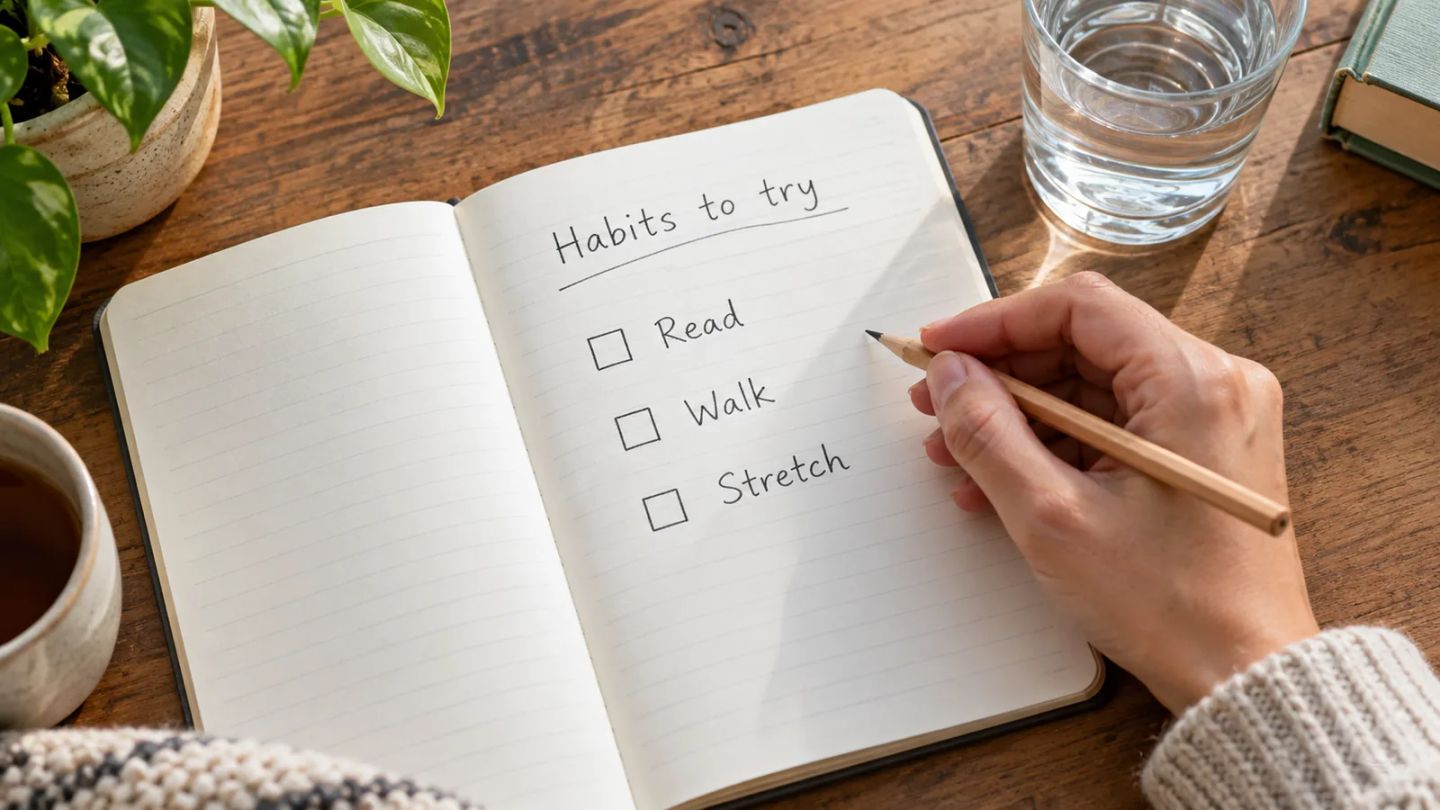
Seven categories, and you are picking one or two. Here is how to narrow it without agonising.
Start with the area that would change your week the most. If afternoons flatten you, sleep or movement earns the first slot. If you feel scattered and out of touch, mood or connection might.
Then apply three filters most guides skip.
- Time. Can the smallest honest version be done in two minutes on your worst day? If not, shrink it until it can.
- Energy. Does it survive a bad night, a deadline, a poorly child? A habit that needs a good mood to happen is not a habit, it is a treat.
- Money. Does it cost anything to keep? Walking, water, a wind-down and a mood word are all free, which matters if a paid app or a gym would quietly become another reason to quit.
Once you have your one or two, anchor each to something already fixed in your day, the pattern of "after I do X, I will do Y". After the kettle clicks, one minute of stretches. After I brush my teeth, phone on charge across the room. An existing routine is a steadier reminder than any alert. Our guide to setting up a habit tracker walks through the formats, from a scrap of paper to a spreadsheet.
Meadow, without the streak
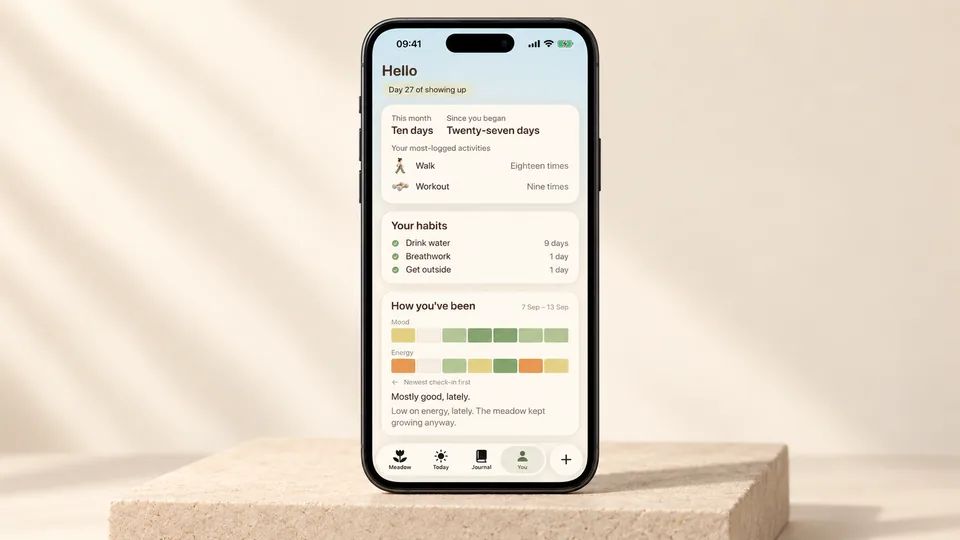
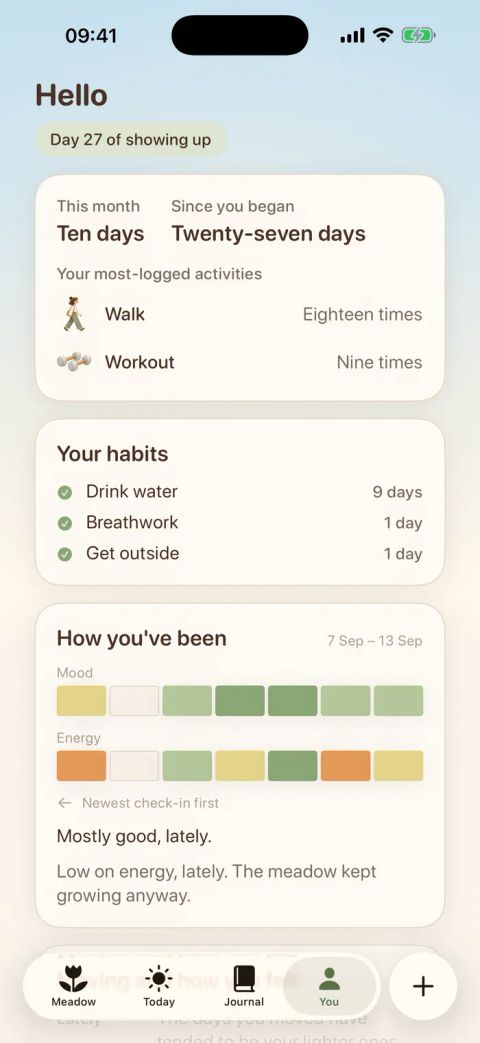
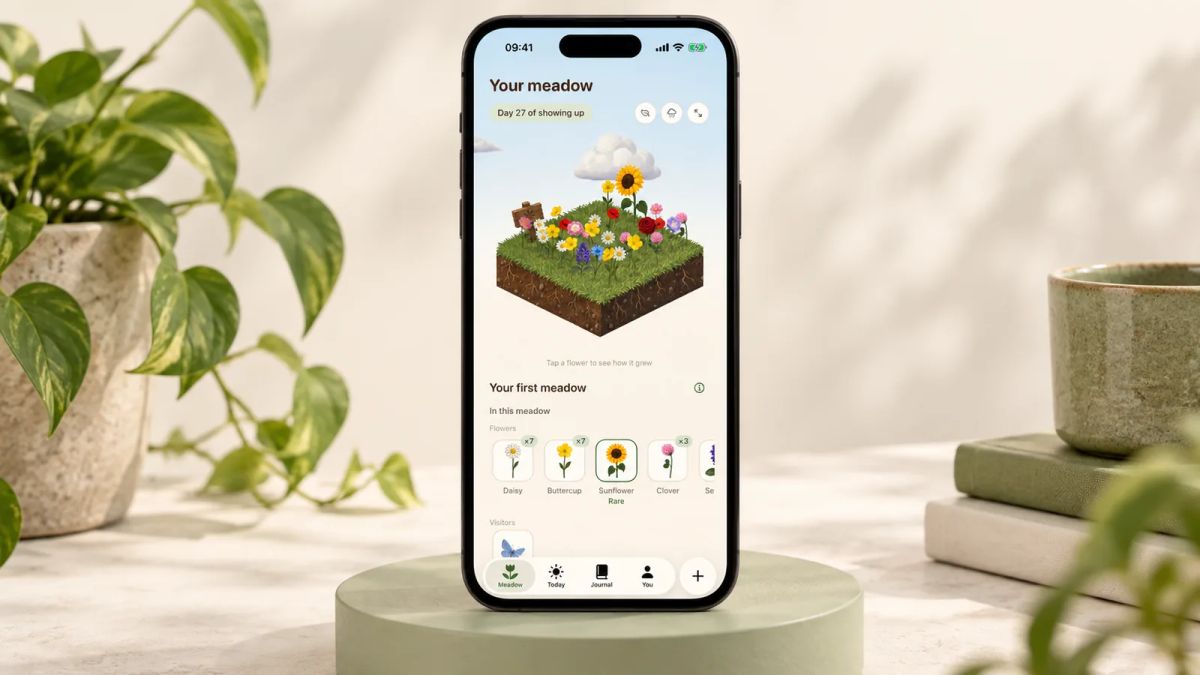
Another app worth checking out is Meadow, because it drops the one feature that turns tracking into pressure. Instead of a streak you dread breaking, each day you show up grows a wildflower in your own meadow, and a missed day never resets anything and never makes your flowers wilt. You log a walk, a little yoga or a few minutes of movement, tick off small habits like drinking water or getting outside, and note your mood, a daily win and an affirmation as you go. It is a gentle habit tracker for iPhone, made by Wildcard Wellness, and costs $39.99 a year or $9.99 a month after a seven-day free trial. If you want the wider field, we compared several options in the best habit tracker app for iPhone.
A tracker you can copy right now
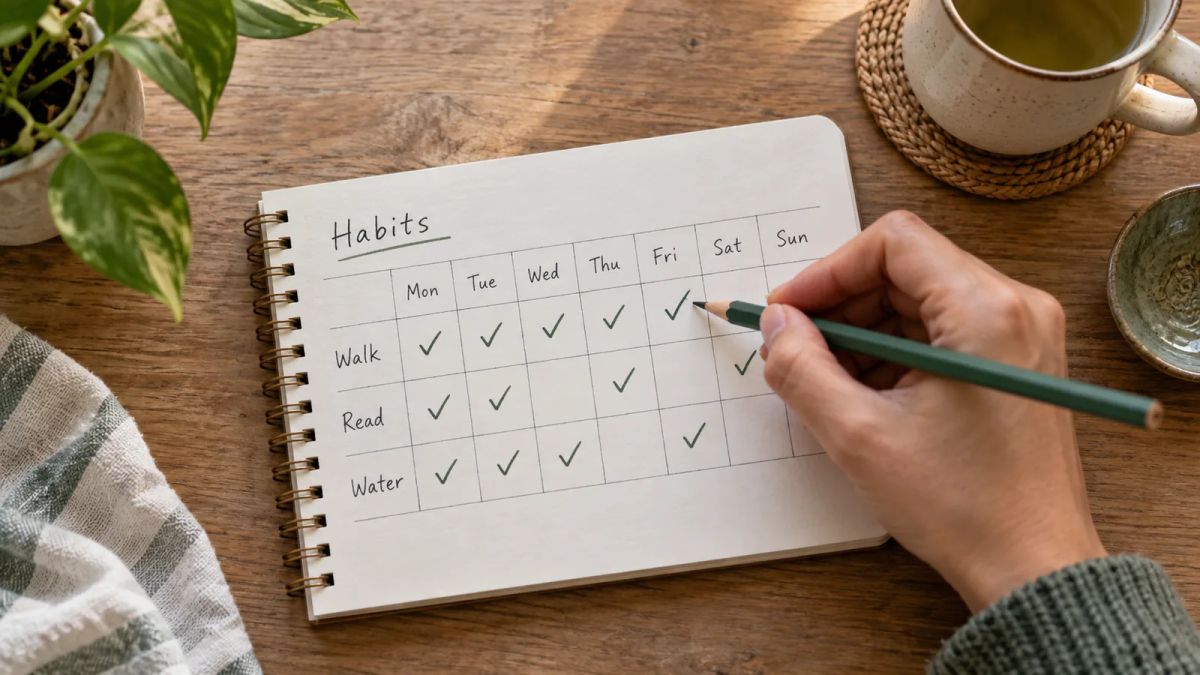
Here is a weekly layout you can recreate on paper or in a notes app in about a minute. Write the habit, its cue and its smaller version on one line, then a box for each day.
Habit: Moved on purpose Cue: after lunch Smaller version: a walk to the end of the road
Mon ☐ Tue ☐ Wed ☐ Thu ☐ Fri ☐ Sat ☐ Sun ☐
Add a second row if you have a second habit, and stop there for now.
Habit: Phone down, lights low Cue: after the 10pm alarm Smaller version: phone on charge across the room
Mon ☐ Tue ☐ Wed ☐ Thu ☐ Fri ☐ Sat ☐ Sun ☐
Filled in after a real, imperfect week, it might look like this, with a tick for the full habit and a dot for the smaller version you fell back on.
Habit: Moved on purpose Cue: after lunch
Mon ✓ Tue ✓ Wed • Thu ✓ Fri ✗ Sat ✓ Sun ✓
The dot on Wednesday is the day you were flat and walked to the corner rather than not at all, and the single ✗ on Friday is one data point in a good week, not a verdict on you. A record kept that honest is the one that tells you where the habit strains.
When you miss a day
You will miss days. What decides whether the habit survives is the day after, and the popular fear of breaking a chain does real harm here.
The research is reassuring. In a study following people forming everyday habits, missing a single opportunity made no meaningful dent in the process (Lally and colleagues). One skipped day is a rounding error. The risk is the story you tell yourself afterwards, the one where a blank square means you have blown it and may as well stop.
A useful rule is to never miss twice. One day off is life. Two in a row is the start of a different habit. So you let the gap go without the lecture and you show up the next day, even for the two-minute version. This is why Meadow keeps your flowers whatever you miss, because the fear of falling behind is usually what does the damage.
A few common questions
How many habits should I track at once? One to three while you are starting. Add more only once the first ones happen without thought.
Daily or weekly? Track daily habits daily and less frequent ones, like a big shop or a longer walk, on a weekly line. Do not force a monthly task into a daily grid, or the blank boxes will nag at you for no reason.
What if I forget to tick it? Mark the box soon after you do the habit, while it is fresh. A guessed record is worse than none, because you stop trusting it. If ticking itself becomes a chore, strip the tracker back to a date and a single box.
Choose one habit from the list above, shrink it to a two-minute version, and draw a seven-box row for it before you close this page. Then tick tomorrow.
See how far you've come
Your habits, moods and little wins, all in one place
Meadow keeps track of the walks, the water and the good days, so you can look back and watch your effort add up.
Join the Meadow waitlist