There are more ways to track your mood than there are moods, and the best one is the one you'll fill in on a tired Tuesday. This is a menu of eight, from a thirty-second scribble to a colouring page you'll want to sit with, so you can pick the style that fits your week.
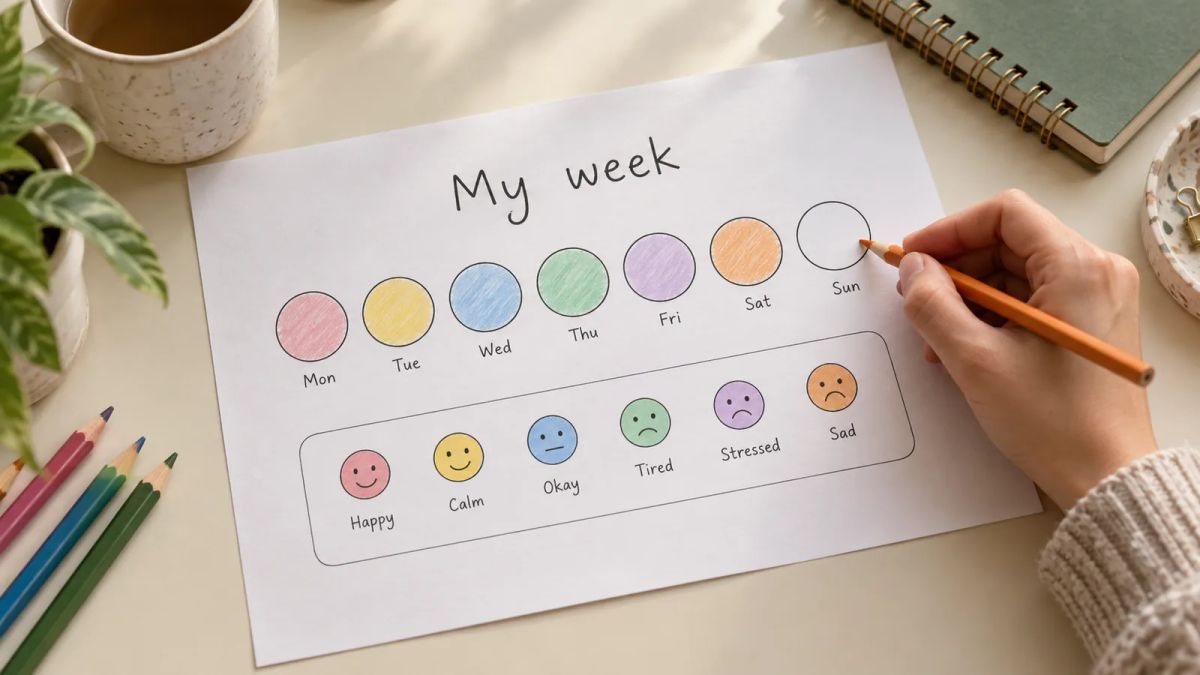
Pick one to start. You can swap later, and plenty of people run two at once, a quick daily mark and a slower monthly picture. First, settle on a mood key, a small set of feelings, each with a colour or a symbol, that you'll reuse across whichever layout you land on.
A mood key to borrow
🟦 Great 🟩 Good 🟨 Okay 🟧 Low 🟥 Rough ⬜ Not logged
Keep it to around five feelings plus a blank box for days you skip. Swap the words for calm, anxious, flat or content if those fit your days better. A key you can hold in your head is one you'll keep using.
Eight mood tracker ideas to pick from
1. A five-point scale with a word
Give the day a number from 1 to 5, then add one word for why. "3, deadline." "5, saw Mum." That is the whole entry, and it takes about as long as sending a text.
Reach for this if you are starting out, or coming back after a prettier tracker fizzled. It asks almost nothing on a flat evening, which is when most trackers get abandoned. Keep the word to one. The number holds the level and the word catches the cause, so after a few weeks you can scan the page and notice which words keep turning up beside the low numbers.
2. A monthly grid with an emoji key
Draw a numbered box for every day of the month and colour each one in, or drop in a small face, using your key. A finished month reads at a glance, a bright stretch here, a dip there, all on one page.
The grid is the workhorse and it suits people who want to see the shape of a whole month at once. Copy this blank version for the days in your month:
Mood key: 🟦 Great 🟩 Good 🟨 Okay 🟧 Low 🟥 Rough ⬜ Not logged
1 ⬜ 2 ⬜ 3 ⬜ 4 ⬜ 5 ⬜ 6 ⬜ 7 ⬜
8 ⬜ 9 ⬜ 10 ⬜ 11 ⬜ 12 ⬜ 13 ⬜ 14 ⬜
15 ⬜ 16 ⬜ 17 ⬜ 18 ⬜ 19 ⬜ 20 ⬜ 21 ⬜
22 ⬜ 23 ⬜ 24 ⬜ 25 ⬜ 26 ⬜ 27 ⬜ 28 ⬜
29 ⬜ 30 ⬜ 31 ⬜
Filled in for a first week, it might read 🟩 🟨 🟦 🟧 🟩 🟥 🟨, which you can take in without thinking. Draw the whole blank grid once, at the start of the month, so the daily job shrinks to a single box. If you keep a notebook, our bullet journal mood tracker layouts show three ways to draw one by hand.
3. Year in pixels
The grid stretched across a whole year. Twelve columns, one per month, thirty-one rows for the days, a wall of small squares you colour one at a time. By December you are looking at your whole year as a piece of colour.
This one is for the long-haul tracker who wants to see winter and summer side by side and catch the slow seasonal patterns a single month hides. Keep the key on the same page and forgive the gaps. A year with a few blank squares still tells you plenty, and chasing a perfect grid is the fastest way to give up on one.
4. A colour-in mood mandala or flower
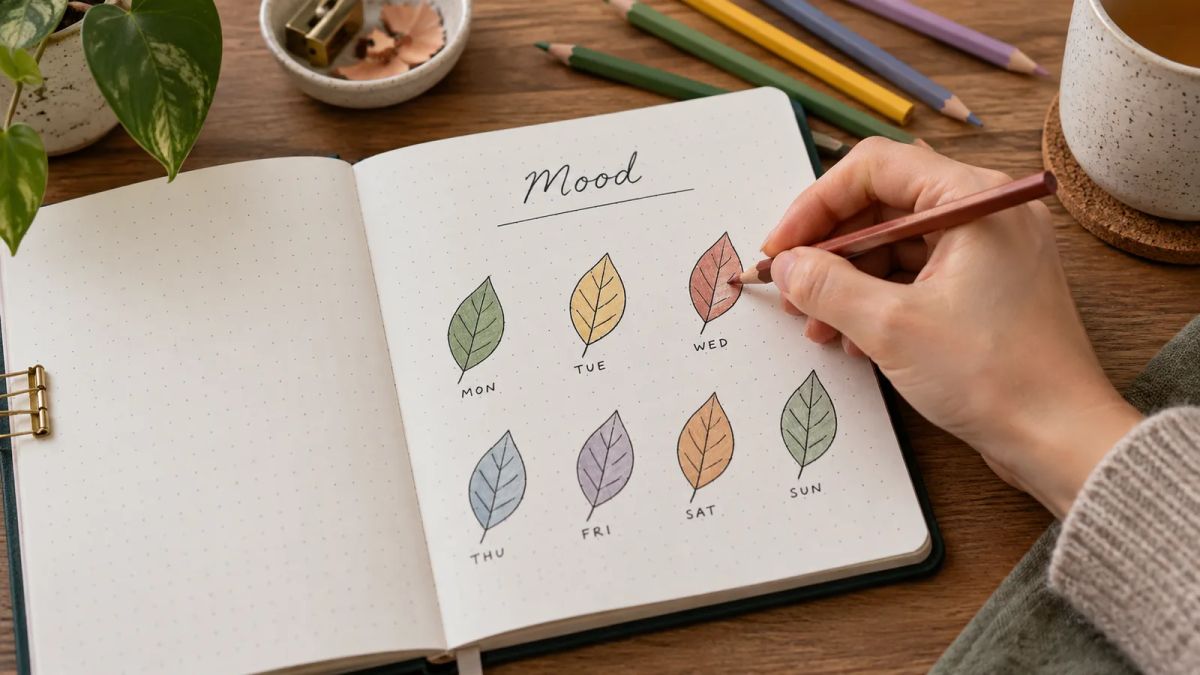
Instead of boxes, you fill a shape. A mandala turns the month into rings, day one at the centre and each day a segment further out, so the finished page looks like a coloured flower and the colouring itself is calming. A flower version works the same way, one petal or one leaf a day.
Choose this if the making of the page is part of the appeal, a small ritual with a pen instead of a form to complete. You do not need a compass or a steady hand.
- Draw a small circle in the middle of the page, then a ring around it, then another, until you have as many rings as there are days this month. Rough circles are fine.
- Slice the whole thing into wedges, six or eight, like a cake.
- Each day, colour one segment of the next ring out, working from the centre towards the edge, using your usual key.
- Write the key beside it so you can read the page back in a month.
The trade is a slower daily mark for a page that feels good to fill, the whole point for people who want tracking to be a wind-down.
5. A mood-and-weather log
Note your mood and the weather in the same row, day after day. A cloud, a sun, a rain symbol next to your colour, nothing more. Over a season you can see whether grey skies and grey days tend to travel together.
This suits anyone who suspects daylight and weather nudge how they feel, which for a lot of us they quietly do. Keep it to two marks a day so it stays light:
Day Mood Sky
Mon 🟨 ☁️
Tue 🟩 ☀️
Wed 🟧 🌧️
Thu 🟦 ☀️
Fri 🟩 ⛅
Resist reading too much into a single week. A tracker can show your low colours clustering on the wet days, and that hunch is worth having, but weather is one thread among many and a rainy Wednesday is allowed to be a good one.
6. A habit-and-mood combined tracker
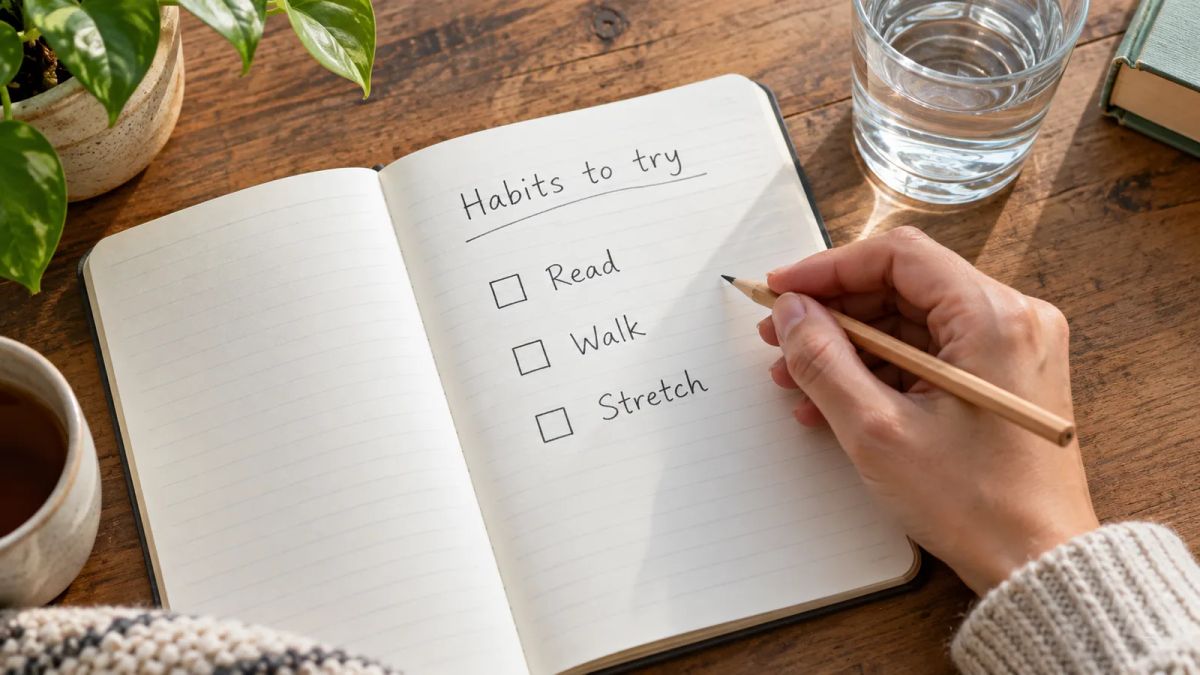
Put your mood next to two or three small habits, so you can see whether the days you move, drink water or get outside are also the days you feel a bit brighter. It will not prove one caused the other, though the pairing is often where a useful hunch starts.
Reach for this if you already track a habit or two and want to know how they sit with your mood. Copy this weekly block:
Day Mood Move Water Outside
Mon ⬜ ☐ ☐ ☐
Tue ⬜ ☐ ☐ ☐
Wed ⬜ ☐ ☐ ☐
Thu ⬜ ☐ ☐ ☐
Fri ⬜ ☐ ☐ ☐
Sat ⬜ ☐ ☐ ☐
Sun ⬜ ☐ ☐ ☐
Filled in, a week might open 🟨 with two boxes ticked, then 🟩 with all three, then a 🟧 day where nothing got done. Three days and a pattern is already whispering. Swap the three habits for the ones you care about, and if you are stuck, our list of habits to track gives you plenty to choose from. Keep it to three habits at most, because a row with ten boxes is a row you will start skipping.
7. A jar of coloured beads
A tracker you can feel. Keep an empty jar and a bowl of coloured beads, one colour per mood, and drop a bead in at the end of each day. The jar fills slowly, and after a month you are looking at your feelings as a little drift of colour rather than a page of ink.
This is for people who like something in their hands, and it works nicely for children or a whole household with a shared jar on the shelf. No drawing, no notebook to lose. Keep the jar somewhere you pass every evening, next to the kettle or the toothbrush, so the bead joins a route you already walk.
8. One line a day
Skip the colours and write a single sentence about the day, mood tucked inside the words. "Frazzled but the walk helped." "Quiet, good quiet." A short line holds more of a day than a symbol can, and reading a month of them back is its own small pleasure.
Choose this if you would rather write than draw, or if a colour has never felt like enough. Cap yourself at one line, no more, so a tired night still gets logged.
A few example lines
Mon. Slow start, found my feet by lunch.
Tue. Snappy. Not enough sleep, I think.
Wed. Easy day. Sun out, nowhere to be.
If you would rather not draw or rule anything at all, a ready-made sheet does the setup for you. Our mood tracker printable gives you a grid and a key you can print tonight.
Open our free Weekly mood journal (PDF). Record a mood, energy level and short note for seven days. A brief review helps you notice patterns without treating them as diagnoses. Save or print it; no sign-up needed.
What tracking your mood can and can't do
The pretty page is not the point. The use lives in two small acts underneath any of these layouts, naming how you feel and seeing those names line up over time.
Naming does more than you'd expect. A summary from the Greater Good Science Center at Berkeley points to research where putting a word to a strong, unpleasant feeling took some of the heat out of it, with brain scans showing calmer activity in the areas tied to distress. The same summary is careful about the edges. Naming helps most with intense feelings, and for mild ones a label can sometimes make them louder. A colour or a word a day is a light version of that, so treat it as a nudge to notice, not a cure.
Seeing the pattern is the other half. A study of mood-tracking apps and the people who use them found people track partly to raise their own awareness and partly to work out what shapes their mood, the sleep, the people, the weeks that ran too hard. Paper does the same job. In a small trial of online journaling, 70 medically anxious adults who wrote for fifteen minutes a few days a week reported less anxiety and distress after a month than those who did not, though the authors called it preliminary and studied worried patients, not the general public.
Be clear about the limit, though. A mood tracker is a wellbeing habit, not a treatment. Reviewing mindfulness and related practices, the NCCIH notes that even well-studied wellbeing tools help many people yet leave some feeling worse, and warns against using them to put off care that is needed. The same caution fits a colouring page. If watching your own low days up close starts to pull your mood down further, ease off the tracking, don't track harder.
A mood check-in that survives a busy week
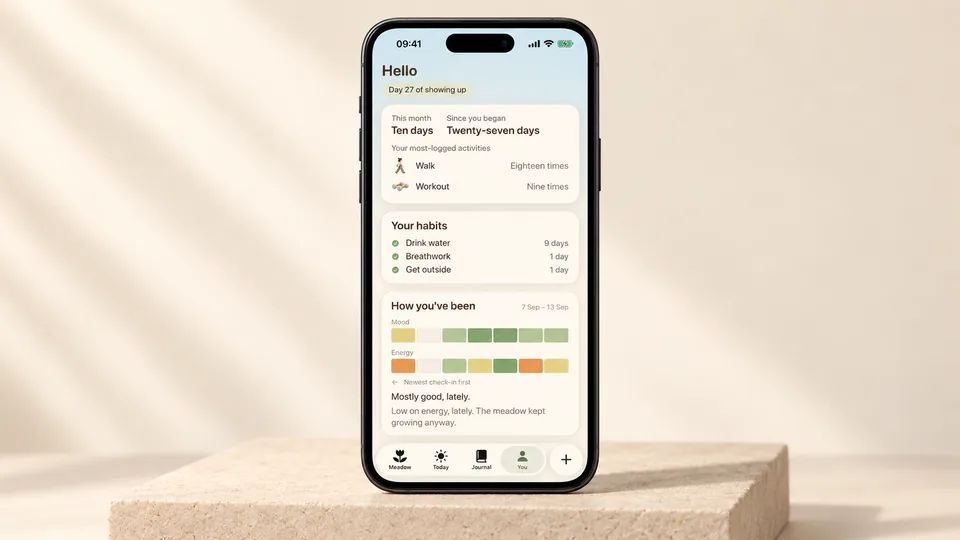
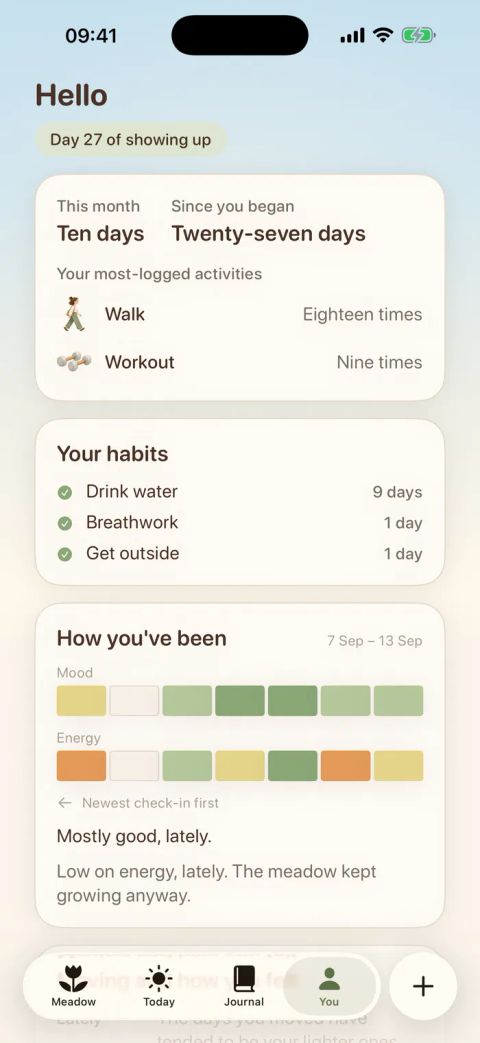
If a notebook feels like one more thing to lose, Meadow keeps the check-in on your phone. It is a gentle movement and habit app for iPhone, and each day you note your mood and energy, jot down one good thing, and tick off small habits like a walk or a glass of water. Every day you show up grows a wildflower in your own patch, so the record of how you have been builds into something you want to look at. There are no streaks, so a missed day resets nothing and the flowers stay put until you come back.
Making it stick, whichever you pick
Choosing a layout is the easy part. Remembering to fill it in, night after night, is where most mood trackers quietly stop after a fortnight, and the way through is to lean less on willpower and more on a cue that already happens.
On making habits stick, the American Heart Association suggests hooking a new action onto a routine you already have. "After I get into bed, I log today" works because bed happens anyway. Keep the tracker and a pen where that routine lands, and the whole thing takes ten seconds. The checking-in earns its keep, as well. A meta-analysis of 138 studies found that prompting people to monitor their progress towards a goal made them more likely to reach it, and monitoring more often helped more.
Decide your smaller version now, while you feel okay, so a hard day doesn't end the whole thing. On a night when even choosing a colour is too much, let a single dot mean "logged, feeling low" and leave it there. A rough mark keeps the thread alive.
You will miss days. When you do, log the next one and skip the urge to fill in the gaps, because a mood you cannot remember is not worth inventing. Research on how habits form found one missed day did not undo people's progress, and that the time it takes for something to feel automatic varies a lot from person to person. There is no streak to guard and no magic number of days to hit. There is only the next mark.
When to look for more support
A mood tracker sits alongside the ordinary work of looking after yourself, next to sleep, daylight and a bit of movement. It is a good way to catch a pattern and a poor stand-in for care when things are hard in a way a colouring page cannot reach. If low mood or anxiety carries on for weeks, gets in the way of daily life, or your own pages start to worry you, speak to your GP. The NHS mental health pages explain how to find talking therapies and urgent help.
Tonight, do the thirty-second version. Give today a number from 1 to 5 and one word for why, on whatever paper is nearest. That single mark is the habit, already started.
AUTHOR
Co-founder of Meadow.
Ash is co-founder of Meadow, a habit and movement tracking app that turns small acts of self-care into a growing wildflower meadow.
See how far you've come
Your habits, moods and little wins, all in one place
Meadow keeps track of the walks, the water and the good days, so you can look back and watch your effort add up.
Download Meadow