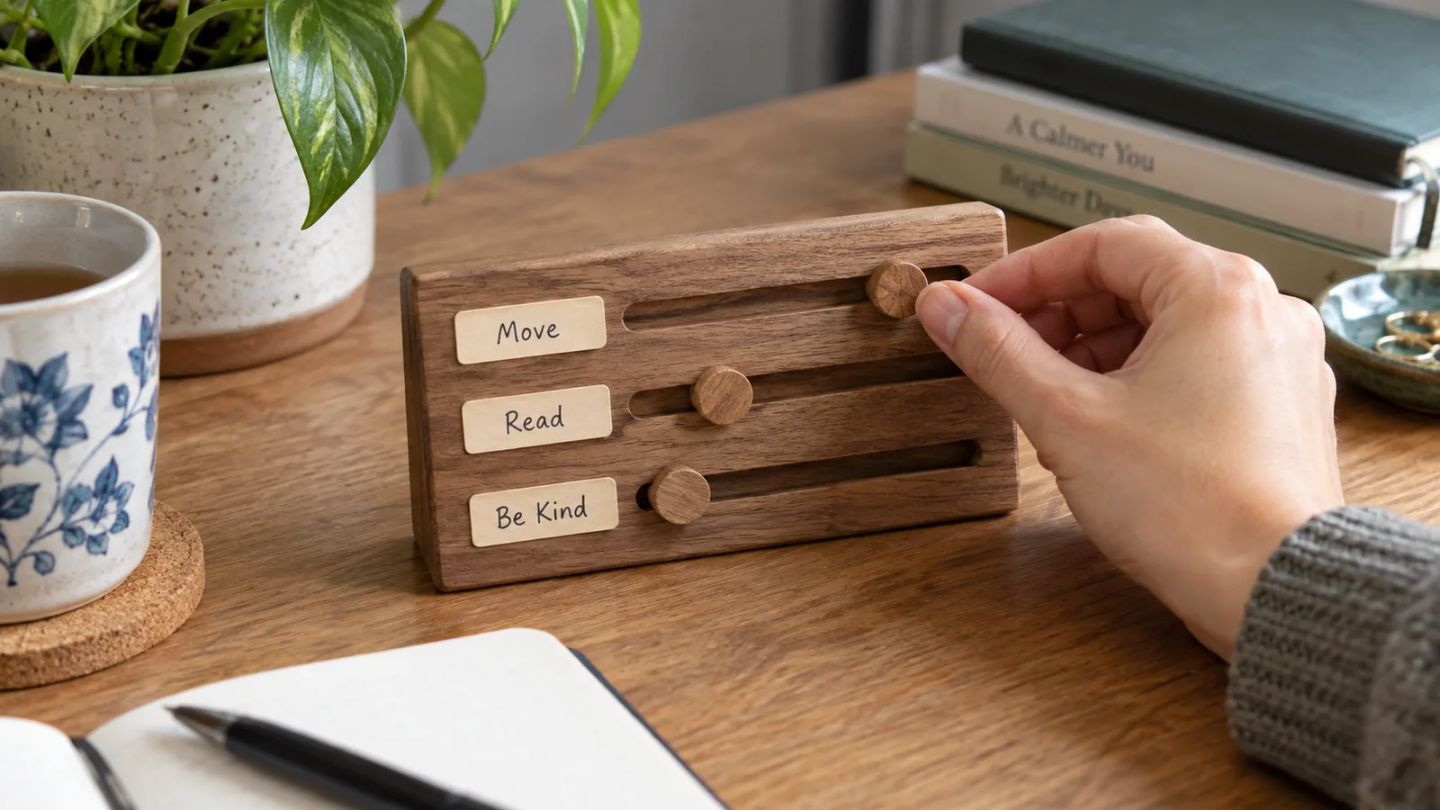
A physical habit tracker is a paper or hands-on record of whether you did the thing you meant to do today, marked by hand instead of tapped into an app. You cross off a square on a wall calendar, colour a dot in a notebook, or drop a marble in a jar, and for a lot of people that small physical act sticks in a way a phone notification never does.
The pull is that you can see it and touch it. No login, no buzz, no other app one swipe away.
This guide covers why paper beats an app for some people, five layouts you can copy tonight, how to set one up and keep the marks honest, and the cases where an app is the better call.
Why paper can beat an app
The best tracker is the one you'll look at without being nagged, and paper has a few quiet advantages there.
It's satisfying to mark. James Clear, who wrote Atomic Habits, puts it plainly: marking an X on the calendar or crossing a thing off a list feels good, and that small hit of completion is part of what pulls you back the next day (James Clear). A pen makes a mark you can feel. A tap does not.
It sits in the room, not behind a lock screen. A calendar on the fridge or a notebook by the kettle puts the record where the habit happens, in your eye-line whether you go looking for it or not. An app has to remind you it's there, and you'll learn to swipe that reminder away.
There's no phone attached, either. Opening an app means opening the thing that also holds your messages, your email and everything else after a minute of your attention. If you're trying to spend less time on the screen, a tracker that lives on paper keeps the habit off it.
Writing by hand may do a little more in your head, too. A 2024 study using high-density EEG found that handwriting produced far more widespread brain connectivity than typing, in the theta and alpha patterns tied to memory and learning (Van der Weel and Van der Meer, Frontiers in Psychology). It was a small study of 36 students writing single words, not people keeping habit trackers, so hold it loosely. The drift of it fits what people say, though, that a mark made by hand feels more like a thing you did.
And the plain act of noticing has been measured. A 2016 review pooled 138 studies and found that people who monitored their progress towards a goal were more likely to reach it, and that checking in more often tended to help more (Harkin and colleagues). Paper or app, the monitoring is doing the work. Paper makes it harder to ignore.
Five layouts to try
There's no correct format. Pick the one you'll enjoy filling in, because the enjoyment is what carries it past the second week.
Open our free Physical Habit Tracker Pack (PDF). All five layouts are included. Save or print the pages you want; no sign-up needed.
The monthly grid
This is the workhorse. Days across the top, one or two habits down the side, a box to tick for each. It reads at a glance and it's the easiest to keep going.
Copy this onto paper or into a notes app. Write the habit and its cue on the line, then a box for each day.
Habit: Ten-minute walk Cue: after lunch
1 ☐ 2 ☐ 3 ☐ 4 ☐ 5 ☐ 6 ☐ 7 ☐ 8 ☐ 9 ☐ 10 ☐
11 ☐ 12 ☐ 13 ☐ 14 ☐ 15 ☐ 16 ☐ 17 ☐ 18 ☐ 19 ☐ 20 ☐
21 ☐ 22 ☐ 23 ☐ 24 ☐ 25 ☐ 26 ☐ 27 ☐ 28 ☐ 29 ☐ 30 ☐
To rule up a whole year on one page, use a habit down the side and the months along the top, or draw a big grid of small squares. It's the same idea at a longer range. Our broader walkthrough of how to set up a habit tracker goes through the formats from a scrap of paper up to a spreadsheet.
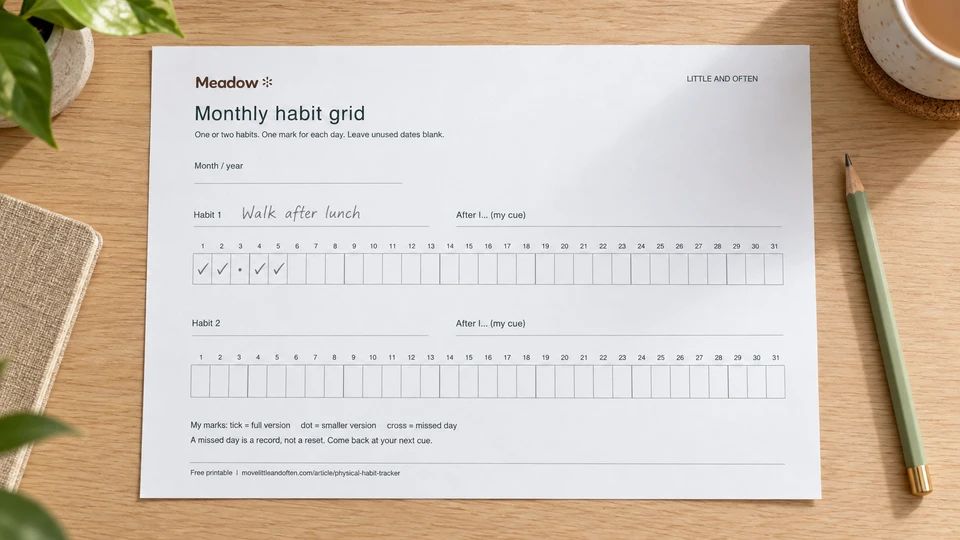
Open our free Monthly Habit Grid (PDF). Print this layout to start your own tracker.
The don't-break-the-chain calendar
Get a wall calendar that shows the year on one page, and each day you do the habit, mark that date with a fat red cross. After a few days you've got a chain of crosses, and the job becomes keeping it going. This is the trick a young comedian says Jerry Seinfeld gave him for writing jokes, and James Clear wrote it up as the Seinfeld strategy (James Clear). The growing line of red does the nagging for you.
One honest warning. A long chain is motivating right up until you break it, and then the fear of having ruined a perfect run can talk you into quitting altogether. If that's you, treat the chain as a nice-to-have and not the point, and read the section below on missing a day before you start.
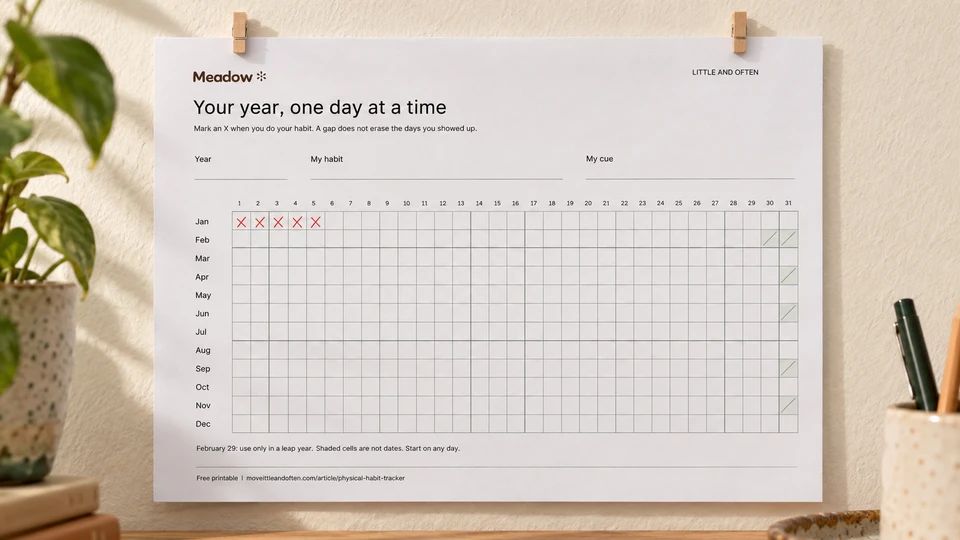
Open our free Yearly Chain Calendar (PDF). Print this layout to start your own tracker.
The dot or bullet-journal tracker
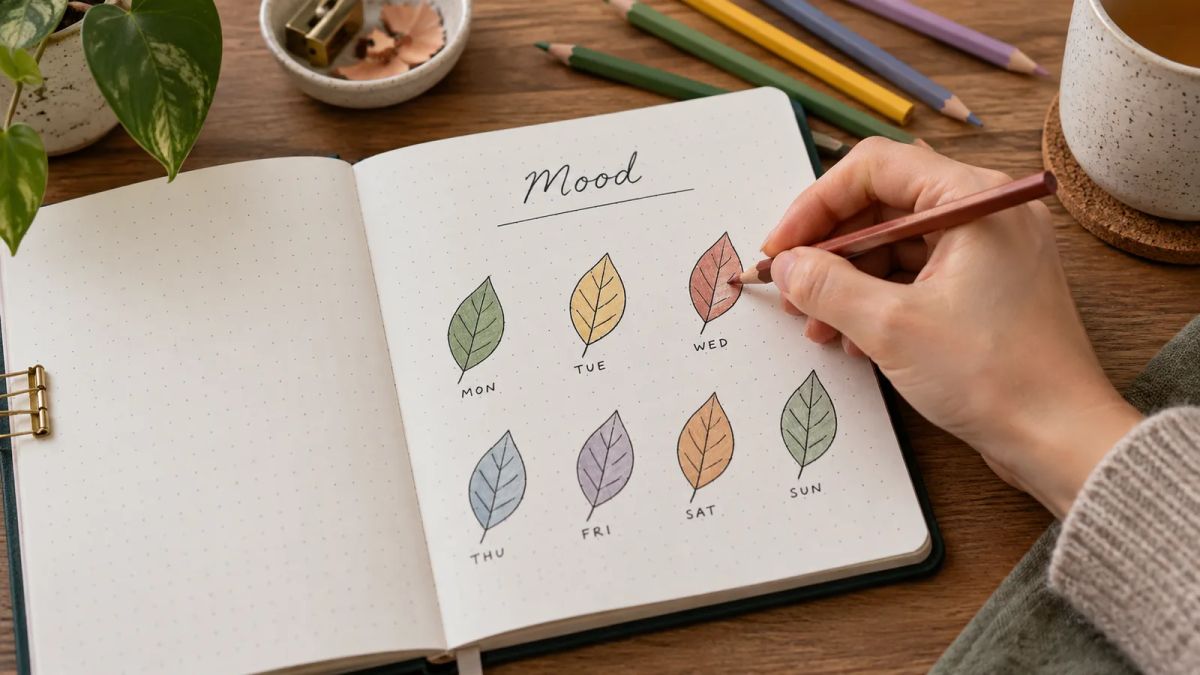
If you keep a notebook already, a habit tracker fits neatly beside your week. Draw a row of small circles for the days, fill one in each time you do the habit, and you can colour-code them or jot a word about why a day went sideways. It's slower to set up and more pleasant to fill in, which suits people who want the tracker to be a small ritual and not a form. For layouts and a mood scale you can copy, our guide to the bullet journal mood tracker walks through three of them.
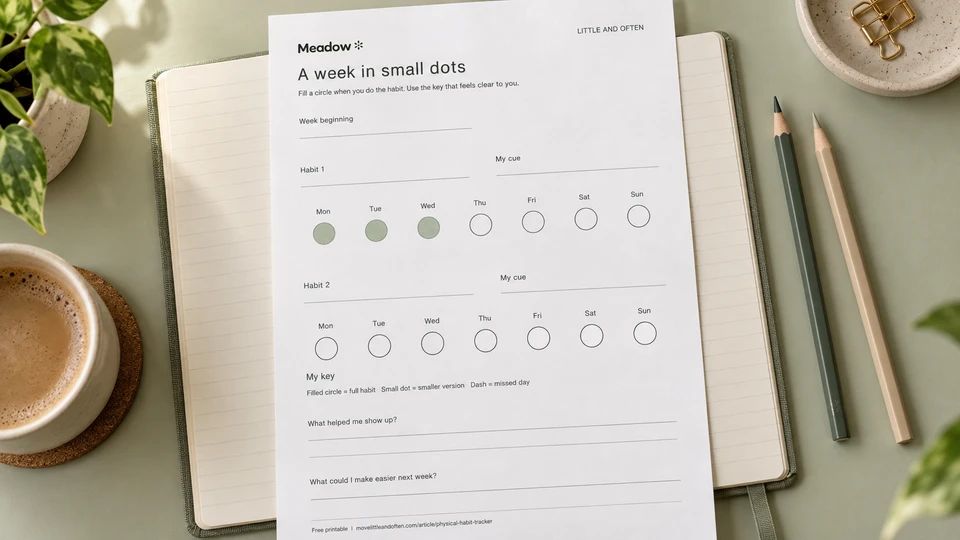
Open our free Weekly Dot Tracker (PDF). Print this layout to start your own tracker.
The wall or fridge chart
A big sheet stuck somewhere you can't avoid it, a bathroom mirror or the side of the fridge, works well for a habit the whole house is in on. Kids' reading, a family water goal, a stretch before bed. Everyone can see it, everyone can mark it, and the visibility is the feature. A whiteboard does the same job and wipes clean each month.
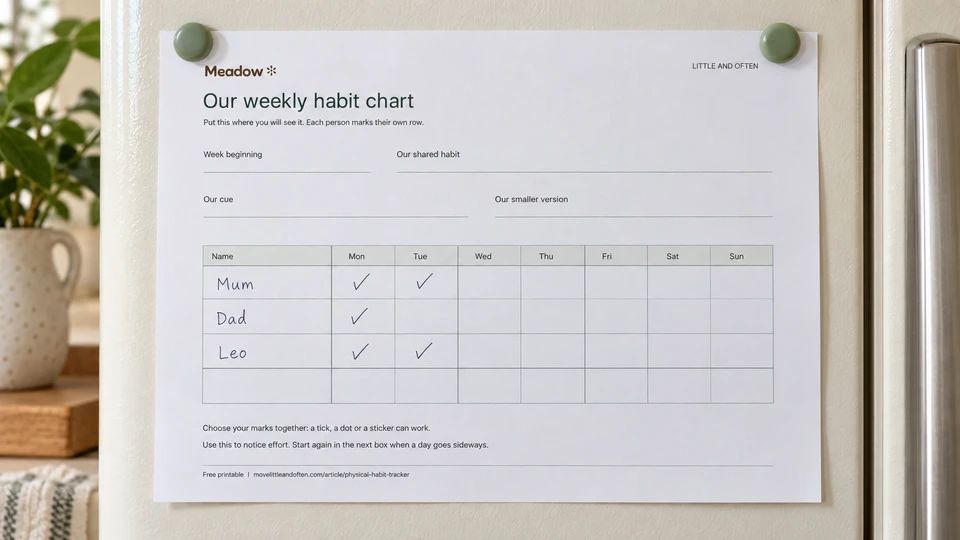
Open our free Weekly Fridge Chart (PDF). Print this layout to start your own tracker.
The jar and marble method
Fill one jar with marbles, coins or dried beans, and keep an empty jar beside it. Every day you do the habit, move one across. Over a month you get to watch the "done" jar fill and the other empty, and the clink is a small reward you can hear. It's the most tactile of the lot and a good pick for a habit you'd rather feel than read, or for a child who can't yet read a grid. Two glasses and a handful of dried chickpeas will do.
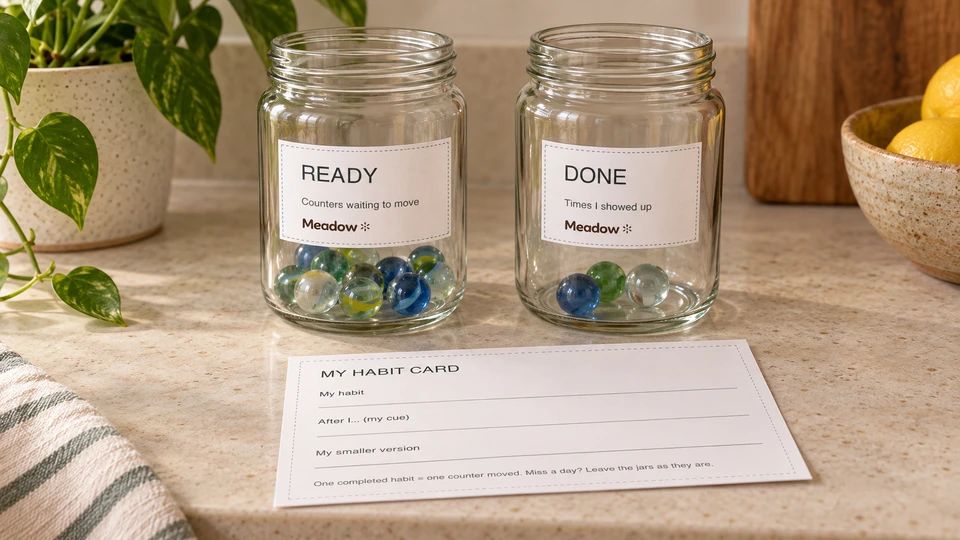
Open our free Jar Labels and Habit Card (PDF). Print and cut out the two jar labels and your habit card.
How to set one up and keep it honest
A pretty tracker that lies to you is worse than no tracker, because you stop trusting it. A few habits keep it useful.
- Pick one habit, two at a stretch. Ten habits is ten chances to feel like you failed by breakfast. You can add more once the first ones run on their own, and if you're stuck on what to put down, our guide to habits to track sorts the usual options into plain categories.
- Shrink the habit until it's almost too small to skip, and name a cue that already happens. "After I put the kettle on, one minute of stretches" beats a vague plan to stretch more. Tying a new action to a routine you already have makes it easier to remember (American Heart Association).
- Mark the box soon after you do the habit, while it's fresh. Leave it till bedtime and you're guessing, and a guessed record is the one you learn to ignore.
- Use marks that tell the truth. A tick for the full habit, a dot for the smaller version you fell back on, a cross for a clean miss. That way a hard week still reads true.
Decide your smaller version now, before a bad day arrives. On a flat evening the walk becomes a lap of the garden, the ten pages become one, and the dot in the box keeps the thread alive. A tracker with a few dots and crosses that you kept for three months beats a spotless one you abandoned in week two.
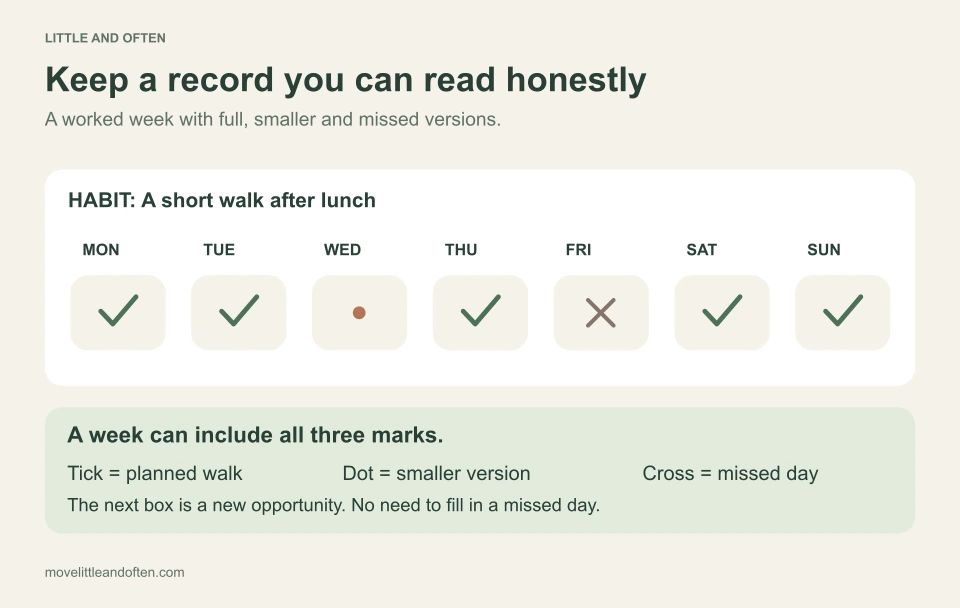
Here's what an honest week might look like once you're using dots and crosses.
Habit: Ten-minute walk Cue: after lunch
Mon ✓ Tue ✓ Wed • Thu ✓ Fri ✗ Sat ✓ Sun ✓
The dot on Wednesday is the day you were shattered and walked to the corner instead of not at all. The cross on Friday is one data point in a good week, not a verdict on you. Read it back once a week, look for the pattern and not the perfect run, and move the cue if a certain day keeps going blank.
When you miss a day
You'll miss days. What decides whether the habit survives is the day after, not the gap itself.
The research is reassuring here. In a study following people forming everyday habits, missing a single opportunity barely dented the process, and the time it took for a behaviour to feel automatic varied hugely from person to person (Lally and colleagues). One skipped day is a rounding error. There's no magic number of days to hit, whatever the 21-day figure you've heard.
A useful rule, again from James Clear, is to never miss twice. One day off is life. Two in a row is the start of a different habit. So you let the gap go without the lecture, and you show up the next day for the two-minute version if that's all you've got. This is exactly where the don't-break-the-chain calendar can bite, so if you use one, let a broken chain be a shrug and not a reason to bin the whole sheet.
A gentler option if analog isn't for you
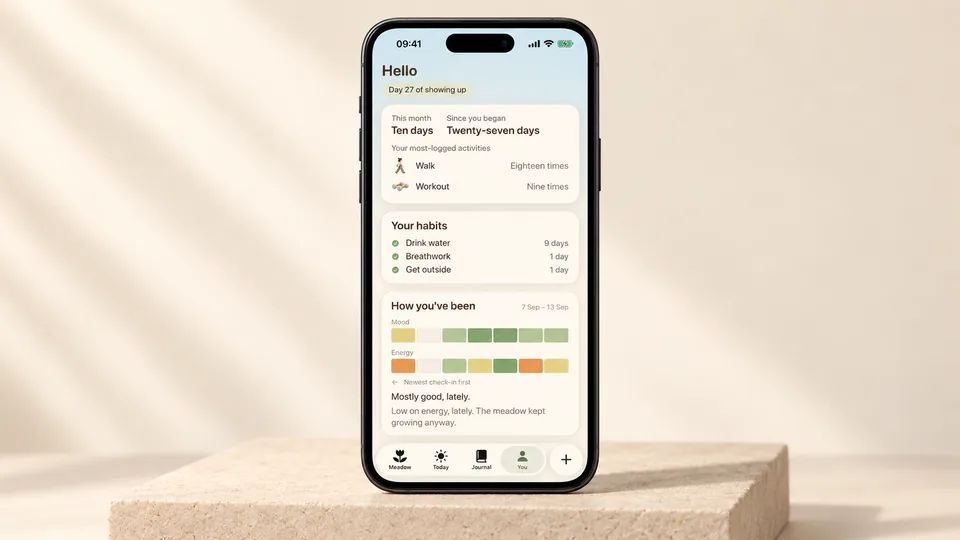
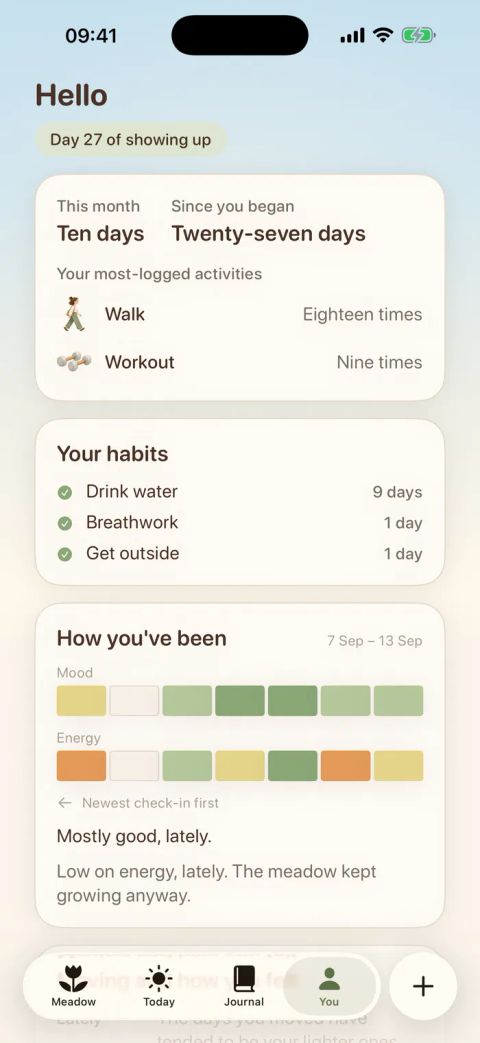
Some people love the paper and some will lose the notebook by the second week, and if you're the second kind, Meadow keeps the tracking on your phone where it's harder to misplace. It's a gentle movement and habit app for iPhone. You tick off small habits like a walk, water or a few minutes of yoga, note your mood and energy, and every day you show up grows a wildflower in your own patch, with rare blooms and little animal visitors turning up as it fills in. There are no streaks, so a missed day resets nothing and your flowers never wilt, which takes the sting out of the very thing a paper chain punishes.
When an app suits you better
Paper isn't the honest answer for everyone. An app earns its place in a few clear cases.
You forget unless something buzzes. Paper can't tap you on the shoulder, so if the habit keeps slipping your mind, a reminder on your phone solves the one problem that sinks most habits.
You're out and about when the habit happens. A tracker on the fridge is no use for a lunchtime walk across town. An app rides along in your pocket and gets marked on the spot.
You like the numbers. If you enjoy seeing totals, completion rates and a run of history tot themselves up, an app does that arithmetic for you, and paper never will.
You want it private. A chart on the wall tells the room what you're working on. An app keeps it to yourself.
For most simple, home-based habits, a scrap of paper does the job at no cost. Keep the format only as clever as the habit needs.
Draw a seven-box row for one habit, write its cue on the line, and stick it where you'll see it before you close this page. Then mark tomorrow.
AUTHOR
Co-founder of Meadow.
Ash is co-founder of Meadow, a habit and movement tracking app that turns small acts of self-care into a growing wildflower meadow.
See how far you've come
Your habits, moods and little wins, all in one place
Meadow keeps track of the walks, the water and the good days, so you can look back and watch your effort add up.
Download Meadow