You mean to go for the walk, start the stretches, drink more water, and then the day happens and you don't. Wanting to do something and doing it turn out to be two separate skills, and the space between them has a name: the intention-action gap.
Researchers have measured it. Across studies of health behaviours like exercise, condom use and cancer screening, people turned their good intentions into action only about 53% of the time (Gollwitzer & Sheeran, 2006). So if you keep falling short of your own plans, you're running into something ordinary and well documented, not a personal flaw.
The encouraging part is that the gap responds to a handful of changes. None of them rely on wanting it more.
Meaning to do it isn't the thing that gets it done
Psychologists Paschal Sheeran and Thomas Webb spent a whole paper untangling why. When experiments manage to boost people's intentions, their behaviour moves only a small to medium amount (Sheeran & Webb, 2016). The people responsible for most of the gap are what they call inclined abstainers: those who fully intend to act, and then don't.
That's a useful thing to know about yourself. The problem usually isn't the wanting. It's everything between the wanting and the doing.
Where follow-through tends to break down
A few patterns come up again and again.
Your plan is vague. "Exercise more" or "meditate daily" gives your brain nothing to grab. Specific goals get acted on more often than "do your best" ones (Sheeran & Webb, 2016), because a fuzzy plan leaves every decision for later, when you're tired and the sofa is right there.
You're relying on motivation. Motivation is a feeling, and feelings move. We tend to value what's in front of us now over what's good for us later, which is why you can feel certain at bedtime and flat by morning. James Clear describes this as the pull of the present self against the future self.
There's too much friction. If the mat lives in the cupboard, the trainers are upstairs, and the app needs three taps to open, each small barrier is one more place to stop.
Nobody's watching. When no one will ever know whether you did it, the only thing holding the plan up is you, on a hard day.
And for some people, getting started is harder at the wiring level. Executive function is the set of mental steps involved in beginning a task and staying with it, and when those run differently, as they do with ADHD, it can be hard to organise or finish a task even when you want to (CDC). If that sounds like you, the fixes below still help, and it's worth a conversation with your GP too.
Make a plan your brain can act on
The best-tested fix is almost embarrassingly small: decide in advance when and where. Researchers call these implementation intentions, or if-then plans, and they take the shape "If situation Y happens, then I will do X" (Gollwitzer & Sheeran, 2006).
Across 94 studies, people who made an if-then plan were far more likely to follow through than people who only held a goal in mind (Gollwitzer & Sheeran, 2006). Naming the cue does the work your motivation was supposed to do. When the moment arrives, the decision is already made.
A clear, specific goal is easier to act on than a fuzzy one, which is the groundwork our guide to how to set goals lays out.
The easiest cue is something you already do. The American Heart Association suggests attaching a new action to an existing routine, so it rides along on a habit that's already automatic. After I pour my morning coffee, I'll do five squats. After I brush my teeth, I'll take my vitamins.
Shrink the first step until it's almost silly
Most of us plan the version of the habit we'd do on our best day. Thirty minutes of yoga. A proper walk. Then the best day doesn't come, and the whole thing feels like too much to start.
So make the first step tiny. Put your shoes on. Unroll the mat. Fill the glass. The point is to lower the cost of starting, because the hardest part is usually the beginning, not the middle. As one researcher quoted by James Clear put it, being in the middle of the work is less painful than being in the middle of putting it off.
Once you've started, you can carry on if you feel like it. And if you stop after two minutes, that still counts. A two-minute version done today beats a thirty-minute version you keep postponing. If you want the full approach, our guide to tiny habits goes deeper.
Clear the path before you need it
Motivation shows up unreliably, so set things up while you have it. Leave the trainers by the door. Fill the water bottle the night before. Put the book on your pillow. Every step you remove in advance is a step you won't have to fight through later, when you have less in the tank.
The reverse works too. Add friction to whatever you're trying to do less of. Want to reach for your phone less in the evening? Leave it charging in another room.
Give the plan someone to answer to
Keeping track of how you're doing has a real effect. A review of 138 studies found that monitoring your progress towards a goal makes you more likely to reach it, and the effect is stronger when you write down what you find or share it with someone (Harkin et al., 2016).
That's what a simple check-in gives you. It can be a tick on a paper calendar, a text to a friend, or a standing Tuesday walk with a neighbour who'll notice if you're not there. Building self-discipline is mostly a matter of setting up small outside supports like these, so you don't have to carry the whole thing on willpower alone.
Let the small wins show somewhere
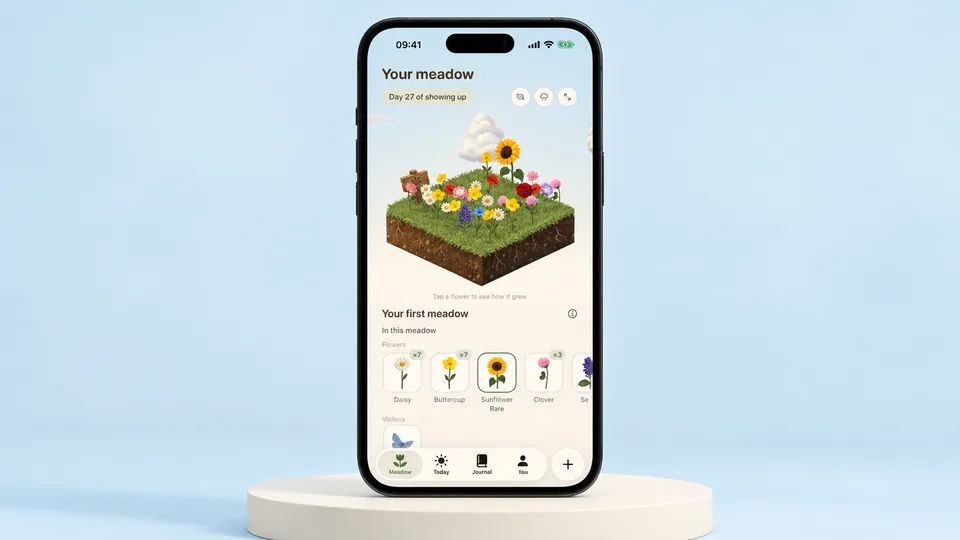
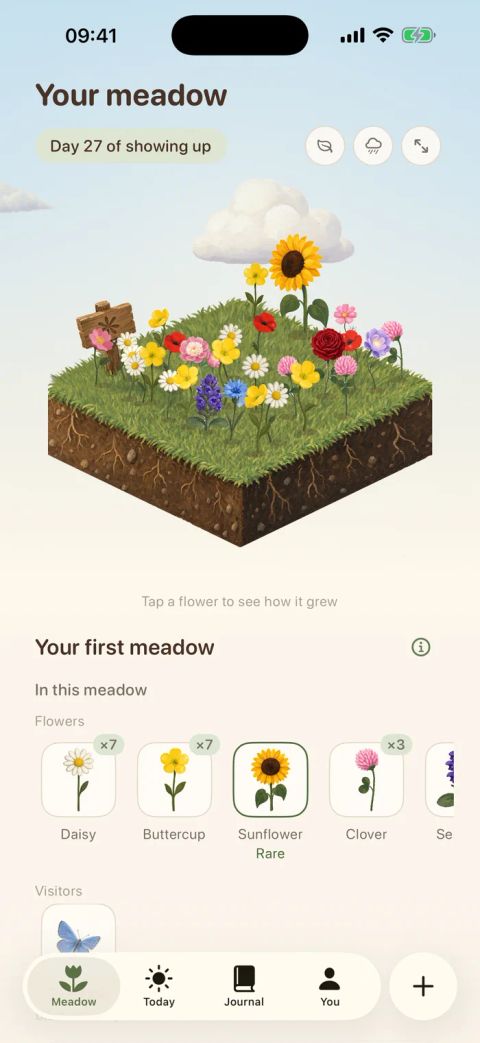
Some days you'll do the thing and some days you won't, and a tracker that punishes the off days tends to get deleted after the first miss. Meadow takes a softer line. It's a gentle movement and habit app for iPhone where each day you show up, by logging a walk or a few minutes of movement or ticking off a small habit, a new wildflower blooms in a meadow that's yours. There are no streaks to break. Miss a day, a week or a month and nothing resets and your flowers stay put, so a plan that slipped is easy to pick back up. You can note your mood and energy while you're there, which turns the kind of check-in the research keeps pointing to into something you might look forward to. Have a look at Meadow.
When you miss, don't make it worse
You will miss. Everyone does. What decides whether a plan survives is what you do the day after.
Here's the reassuring finding from research on how habits form: missing a single opportunity doesn't undo your progress (Lally et al., 2010). One skipped day is a data point, and it doesn't cancel the days you did show up.
The instinct is to scold yourself back on track. It backfires. People who respond to a slip with harsh self-criticism procrastinate more and make less progress, while treating yourself with some kindness after a lapse is linked to less stress and a better chance of carrying on (Sirois, 2013). Forgiving the miss is what lets you start again tomorrow. Staying consistent over months rests far more on how you handle the off days than on how good the good days are, which is the heart of how to be consistent.
Say the plainer version to yourself. I missed yesterday. I'm doing the two-minute version today.
A one-page plan you can fill in
Write this out for one habit and keep it somewhere you'll see it. Here's the blank version:
When I [something I already do every day], I will [the tiny first step].
If [the usual obstacle] comes up, then I'll [an even smaller backup].
My cue: ______ First step, shrunk to two minutes: ______
And here's one filled in:
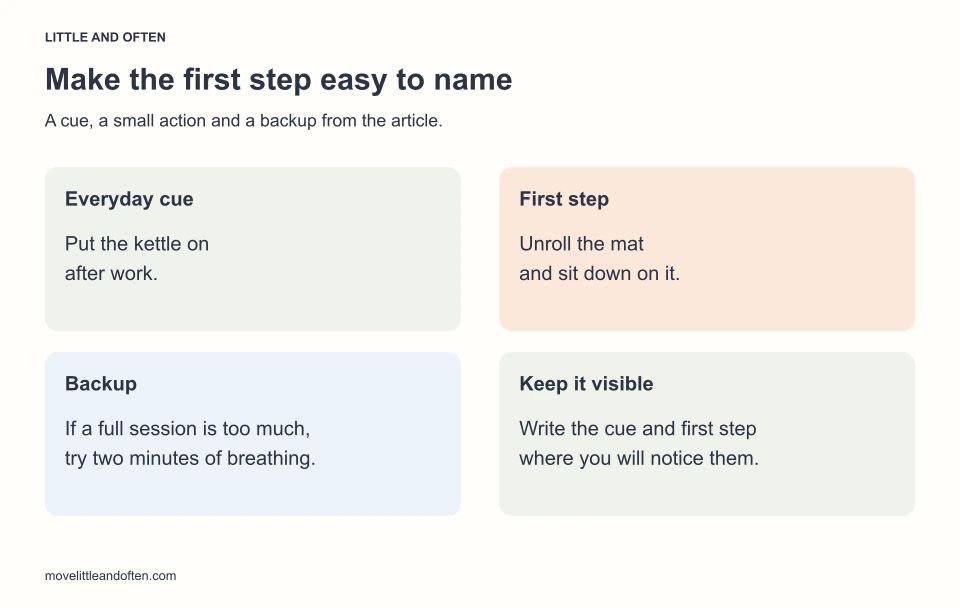
When I put the kettle on after work, I will unroll the mat and sit down on it.
If I'm too tired for a full session, then I'll do two minutes of breathing and call it done.
My cue: putting the kettle on First step, shrunk to two minutes: sitting on the mat
That's the whole method on one line. A cue you already have, a first step small enough that you can't talk yourself out of it, and a backup for the bad days.
Common questions
Why do I start things and never finish them?
Starting and finishing pull on different skills. You can be brilliant at the flurry of a new plan and still lose it a week later, because keeping something going asks for cues and reminders that a burst of enthusiasm doesn't provide. Build the cue into your day, shrink the step, and the finishing gets easier.
Isn't this about willpower?
Usually not. The research points at plans that are too vague, too big, or built on motivation that comes and goes, not at a character flaw (Sheeran & Webb, 2016). People with plenty of willpower still act on their intentions only about half the time. Fixing the setup gets you further than trying to feel more disciplined.
How long before it feels automatic?
It varies a lot from one person and one habit to the next, so there's no single number worth promising. In one well-known study, the time it took for an action to feel automatic ranged widely between people (Lally et al., 2010). The useful move is to stop counting days and keep turning up, because it tends to get easier over time, not overnight.
What if I keep missing?
Missing is information. Look at when the misses happen and adjust the plan, not your opinion of yourself. If evenings never work, move it to the morning. If the step still feels heavy, halve it. And if getting started feels close to impossible across many parts of your life, that can be worth raising with your GP.
Start here
Pick one thing you keep meaning to do. Write a single if-then line for it right now, using a cue that already happens every day, and shrink the first step to something you could finish in two minutes. That's the whole plan for today.
AUTHOR
Co-founder of Meadow.
Ash is co-founder of Meadow, a habit and movement tracking app that turns small acts of self-care into a growing wildflower meadow.
Little and often, with Meadow
Consistency, not intensity.
Meadow turns the movement you enjoy and the habits that help you feel good into a meadow of wildflowers. No streaks to break, and your flowers never wilt.
Download Meadow