Building willpower has less to do with growing an inner reserve of grit than with arranging your days so you spend less of it. The people who look disciplined are rarely fighting harder than you are. They have set things up so the pull to do the wrong thing turns up less often, and they keep a few tactics ready for the moments a choice can't be dodged.
That cuts against the popular picture of willpower as a muscle you build with reps, where resisting biscuits this morning leaves you somehow stronger tonight.
This guide covers what the evidence says about training willpower directly, and the moves that make the willpower you already have go further: designing your surroundings, turning repeat choices into rules, planning the hard moment in advance, protecting your sleep and the stress that follows a bad night, and starting far smaller than feels worthwhile. If you want the fuller theory underneath all of it, our guide to self-discipline sits alongside this one.
Can you train willpower like a muscle?
Sort of, but not the way the gym metaphor implies. In 2017 Malte Friese and colleagues pooled 33 studies of self-control training and found only a small effect, around g = 0.30, that shrank once they corrected for publication bias to somewhere between 0.13 and 0.24. Their Bayesian analysis fit a null result better than a real one. Sitting around resisting things to bulk up a general willpower muscle is a weak bet.
What does move the needle is narrower and more interesting. You get good at the exact thing you practise, and you build habits that carry the action so you don't have to.
Brian Galla and Angela Duckworth put numbers to this across six studies of 2,274 people. Those with better self-control leaned on beneficial habits more than on effortful restraint, and reported fewer battles with temptation, not more. Their exercise, study and sleep routines ran on autopilot, so there was less to resist in the first place.
The target, then, is not a bigger tank. It's to become someone who reaches for the tank less often. Everything below is how.
Make the good choice the one already in front of you
The strongest lever you have is the room, not your resolve. Cut the number of steps between you and the thing you want to do, and add steps in front of the thing you don't.
Want to move in the morning? Put your trainers by the door and your kit out the night before. Want to stop scrolling in bed? Charge the phone in the kitchen and buy a cheap alarm clock. Want fewer biscuits at your desk? Keep them in a cupboard you have to stand up and walk to. Every extra obstacle in front of a bad habit, and every one you remove from a good one, is a decision your tired future self no longer has to win.
James Clear makes a related point about killing off choices entirely. He describes building rituals so routine they stop needing a decision, and cutting the number of options in front of you so following through takes no debate. A fixed order becomes the thing you do, not the thing you talk yourself into.
Turn repeat choices into rules
Willpower gets worn down by negotiation. Every time you ask "should I today?" you open an argument you might lose. A rule closes it.
Compare "I'll try to cut back on wine" with "I don't drink on weeknights." The first is a fresh decision every evening, tired, with a glass in reach. The second is settled, so there's nothing to weigh up at seven on a Tuesday. Write your rule so a stranger could check whether you kept it. "Walk after lunch" beats "be more active." "Phone away by ten" beats "less screen time." The sharper the edge, the fewer arguments you'll have with yourself. We go deeper on this in our guide to self-discipline.
Plan for the moment it gets hard
Here is the tactic most willpower advice skips, and it has the best evidence behind it. Instead of a vague goal like "exercise more", you decide in advance exactly when, where and how you'll act, and you write it as an if-then plan: if this situation happens, then I do this specific thing. Psychologists call these implementation intentions.
The point is that the plan fires on its own when the moment arrives, so you don't have to notice, decide and act all at once while your resolve is low. A review of randomised trials on physical activity found that if-then plans produced a modest but real increase in how much people moved, with an effect around 0.25 when the plan was reinforced. The effect is small and no magic trick. Even so, it's a free habit of thought that stacks with everything else here.
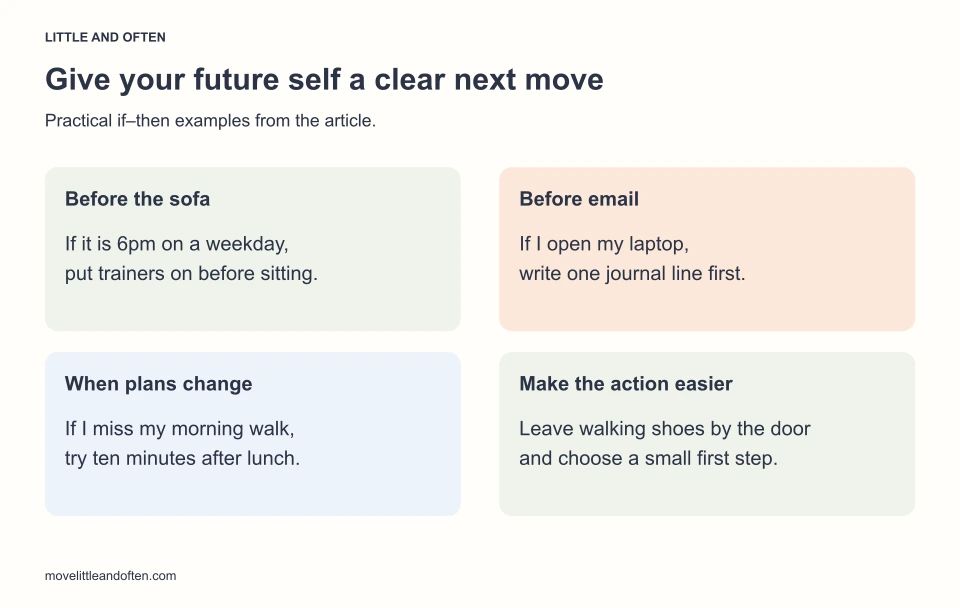
The trick is to name the obstacle, not the aspiration. Think about what usually derails you, then write the plan for that exact fork. You can sketch a whole set on a scrap of paper in two minutes:
If ________ (the moment or the obstacle), then I ________ (the exact action).
Filled in, a few might read like this:
If it's 6pm on a weekday, then I put my trainers on before I sit down on the sofa.
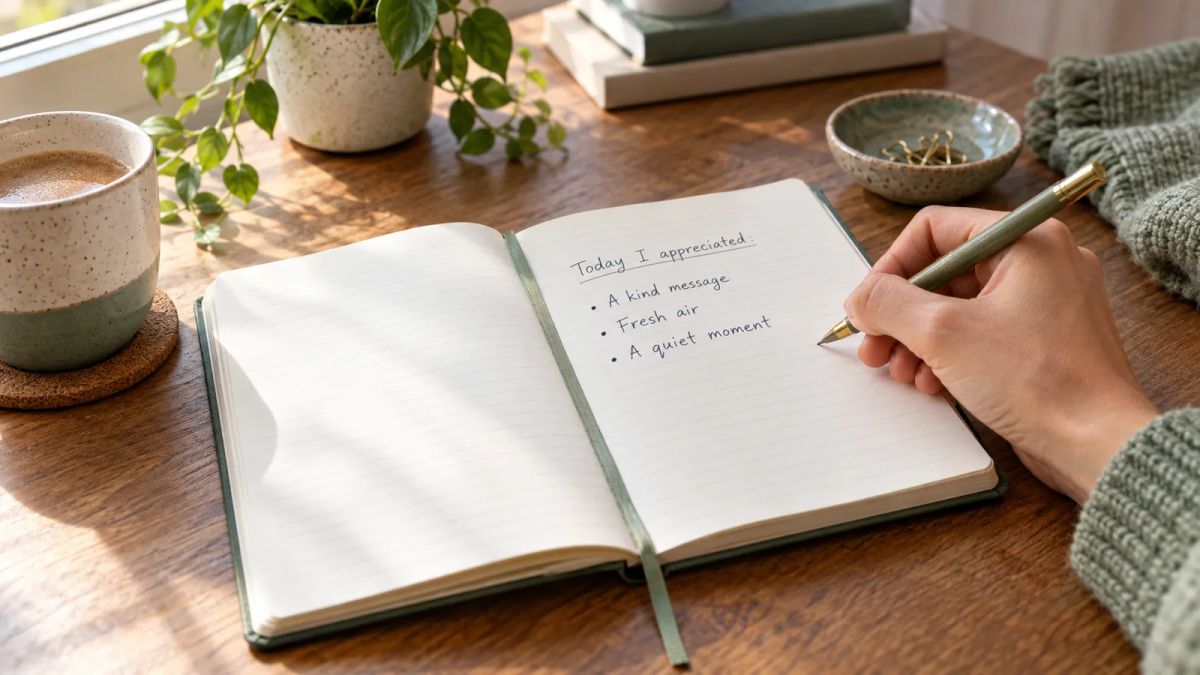
If I open my laptop in the morning, then I write one line in my journal before email.
If the pub is suggested on a weeknight, then I order a soft drink first.
If I miss my morning walk, then I take a ten-minute one after lunch instead.
That last one matters. A good if-then set includes a recovery line, so a missed start has a built-in next move and doesn't become a write-off day.
Bundle the dull thing with something you enjoy
If a task keeps losing to something more tempting, stop pitting them against each other and pair them up. Katherine Milkman and colleagues tested this at a gym: some members could only listen to a gripping audiobook while they were there. Over the study, those people turned up to the gym far more often than a control group, with visits up by around half at the peak. Milkman calls it temptation bundling, coupling a want with a should.
You can borrow the move for almost anything. Save a podcast you love for the walk. Only watch your comfort series while you fold the washing or on the exercise bike. Let yourself have the nice coffee at the desk where the boring admin lives. The enjoyable thing pulls you towards the useful one, and neither feels like a fight.
Protect your sleep, and the stress that follows a bad night
Willpower gets thin when you're exhausted, and no amount of resolve fixes a sleep debt. If you keep losing the same battle every evening, the first honest question is often whether you're tired or stretched too far, not whether you're weak.
What's interesting is why poor sleep hits your self-control. Garrett Hisler and colleagues tracked 211 students over a month, roughly 5,500 daily reports, and found that stress did most of the work. In their words, "sleep loss made the day more stressful, and being stressed then led people to have a harder time controlling themselves". Stress accounted for nearly half the link between a short night and a low-control day. Bear in mind this is a diary study, so it shows a pattern over time, not a clean cause.
Stress deserves attention in its own right, because it pushes you towards the quick reward. Reviews of the brain's decision circuits show that stress disrupts the prefrontal regions you rely on for planning and control, tilting choices towards whatever pays off now.
Two things follow. Guard your sleep as if it were part of the plan, because it is. And on the days you're running short, treat stress as the thing to manage, not your character: postpone a demanding decision, take five minutes to breathe, ask for help, and expect willpower to be scarce so you lean on your rules and your environment instead. If a low mood or poor sleep keeps dragging on, it's worth a word with your GP.
Start smaller than feels worth it, then let it grow
The most common reason a new habit collapses is that people build it for their best days, and their best days aren't most days.
Shrink the action until it's almost too small to skip. Not a workout but one set. Not thirty minutes of reading but one page. Not a run but your trainers on and out the front door. A version this small survives a rushed, flat, unmotivated evening, and those are exactly the conditions a habit has to live through to last. On the days you have more in you it grows on its own, but the official target stays tiny, so a bad day still ends with the box ticked. Our guide to tiny habits walks through the method in full, and how to be consistent covers keeping it going once you've started.
Keep the ambition for the size of the goal and the patience for the size of the daily step.
Make showing up the easy option

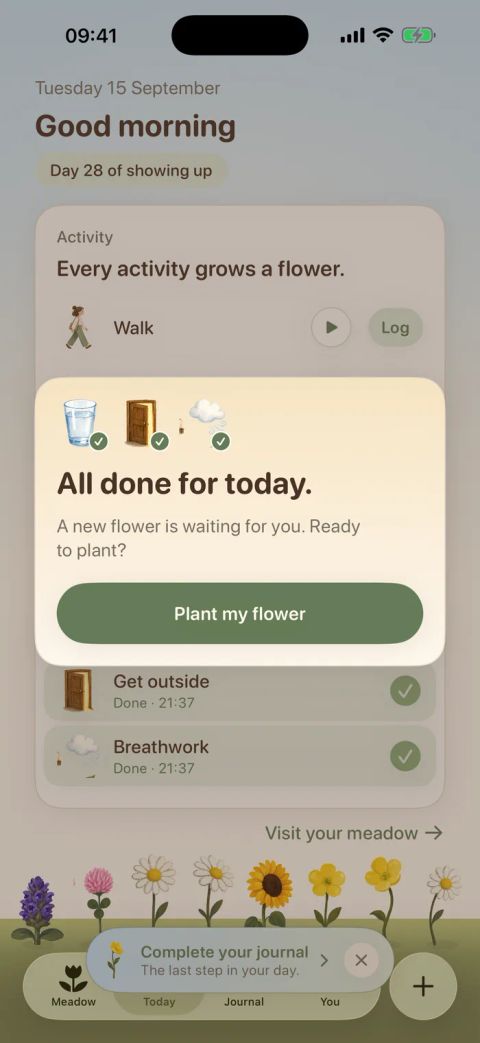
When the next action is already in front of you and a miss costs nothing, willpower has far less to do. That's the idea behind Meadow, an iPhone app from Wildcard Wellness. You log a little movement or tick off a small habit, and each day you show up grows a new wildflower in a meadow that's yours, with a quick note on your mood and energy if you fancy one. There are no streaks, so a missed day resets nothing and the flowers you've already grown stay put, which takes the all-or-nothing pressure off a slip and makes the practice simple to come back to. You can try it at Meadow.
Common questions
Is willpower something you're born with? Partly, but the parts that produce disciplined behaviour, the habits and the setups, are learnable. Training raw willpower directly has a weak track record, while building a specific habit and shaping your surroundings works for most people.
How long until it gets easier? There's no honest fixed number, and anyone quoting a tidy figure like 21 days is guessing. A simple daily action settles in far sooner than a demanding one. Judge yourself on whether you're still turning up, not on whether it feels automatic yet.
Why do I lose it every evening? Because by night you're usually more tired, hungrier and more negotiated-with than you were at nine in the morning. The fix is less about trying harder at 9pm and more about moving the hard choices earlier, or removing them, so evening-you has less to decide.
What's the difference between willpower and a habit? Willpower is the effort you spend forcing an action when you'd rather not. A habit is that same action running without the effort. The whole game is converting the first into the second, which is why the tactics that shrink an action or tie it to a cue beat the ones that ask you to grit your teeth. Fighting an existing bad habit is the same process in reverse.
Pick one thing you keep meaning to do, and write a single if-then line for it: if [a moment that happens every day], then I [the smallest honest version of the action]. Then change one thing in the room to make that action easier. That's the whole method, and it's small enough to set up before you close this page.
AUTHOR
Co-founder of Meadow.
Ash is co-founder of Meadow, a habit and movement tracking app that turns small acts of self-care into a growing wildflower meadow.
Every little bit counts
Five minutes counts. So does a dance in the kitchen.
Log the movement you enjoy and the small habits that help you feel good, and watch them bloom into something you can see.
Download Meadow