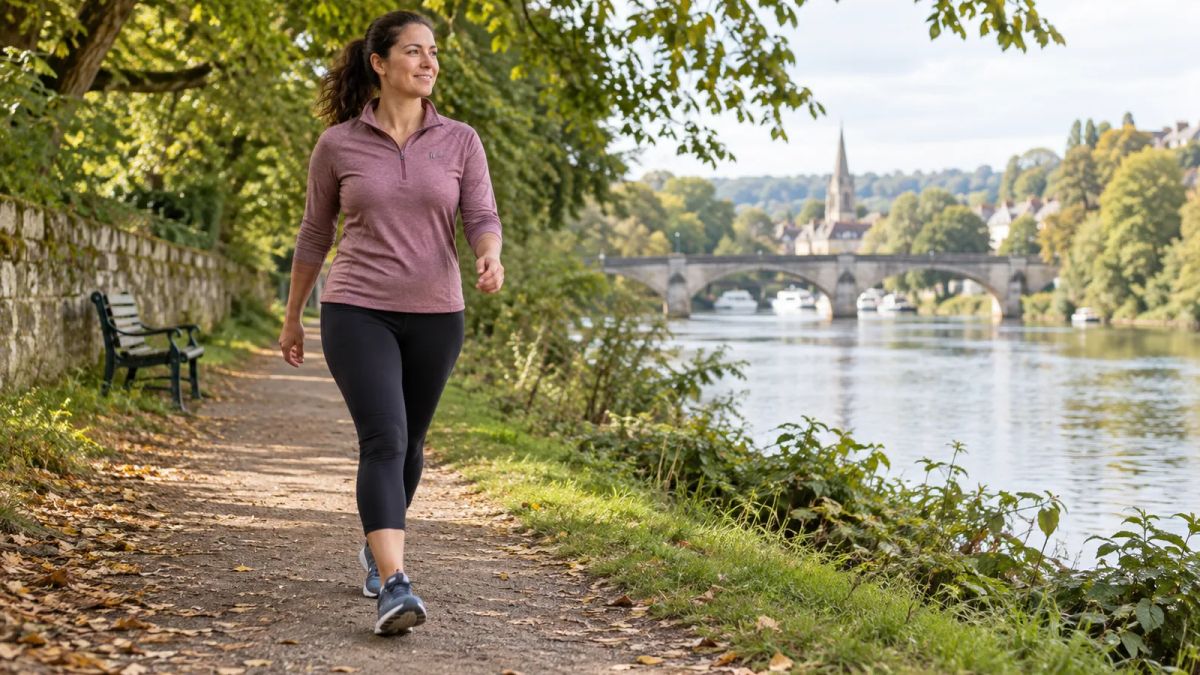
Identity-based habits start with a different question. Instead of asking what you want to achieve, you ask who you want to become, and then you treat each small action as a piece of evidence that you are already that kind of person. James Clear popularised the idea in Atomic Habits, and the line that stuck was this: every action you take is a vote for the type of person you wish to become.
It sounds like a mindset trick. It works more like a nudge on the steering wheel.
Most goals aim at a result and hope the behaviour follows. Identity-based habits point the other way. You decide the person, and the behaviour becomes the thing that person would obviously do.
Three ways to aim a habit
Clear splits any change into three layers, like the rings of an onion. Getting the order right is most of the work.
- Outcome goals are about what you get. Lose half a stone. Read twelve books. Run a 10k. This is where most plans begin and end.
- Process goals are about what you do. Walk after dinner. Keep a book by the bed. Follow a training plan.
- Identity goals are about who you believe you are. A walker. A reader. A runner.
An outcome goal can carry you for a few weeks on willpower. The trouble is that once you hit the number, or miss it, the reason to keep going disappears. A person chasing "lose half a stone" has no reason to walk once the scales tip. A person who has decided "I'm a walker" walks in January and walks again in July, because that is what walkers do.
The useful move is to flip the usual order. Start with the identity, let it choose the processes, and let the outcomes turn up later as a side effect.
Why each action counts as a vote
The voting picture is the part that makes this stick. Every time you do the small thing, you cast one vote for being the person who does it. No single vote settles anything. A missed day is one vote the other way, not a lost election. What decides the result is the running tally over weeks and months.
That framing takes the pressure off any one day. You don't need a clean sweep to become a runner. You need most of your recent votes to say runner. As Clear puts it, you don't need a unanimous vote to win an election, only a majority.
It also changes what a small habit is for. Two minutes of stretching looks trivial as a workout. As a vote, it does real work, because it hands your brain a bit of proof that you're the kind of person who stretches. The proof is the point, more than the sweat.
There's some grounding behind the picture
The neat metaphor sits on top of a real pattern that psychologists have poked at for decades.
Back in the 1960s, Daryl Bem proposed self-perception theory, the idea that we work out our own attitudes partly by watching what we do. When your internal signals are faint or mixed, you read your own behaviour the way an outsider would and draw a conclusion from it. Catch yourself walking every morning and a quiet inference forms: I must be someone who walks. Behaviour feeds belief, as much as belief feeds behaviour.
Exercise is where this shows up most clearly. In a 2024 study of college students, how strongly people identified as exercisers tracked closely with how active they were, with a correlation of 0.47 between exercise identity and physical activity. The researchers describe exercise identity as the degree to which someone sees themselves as an exerciser, built out of past behaviour and steering future behaviour. Seeing yourself as active and being active tend to travel together, each feeding the other.
None of this proves that reciting an identity makes you into it. What it suggests is that the loop between doing and believing is real, so stacking up small actions is a sensible way to shift how you see yourself.
How to put it to work
Here is the practical version, in order.
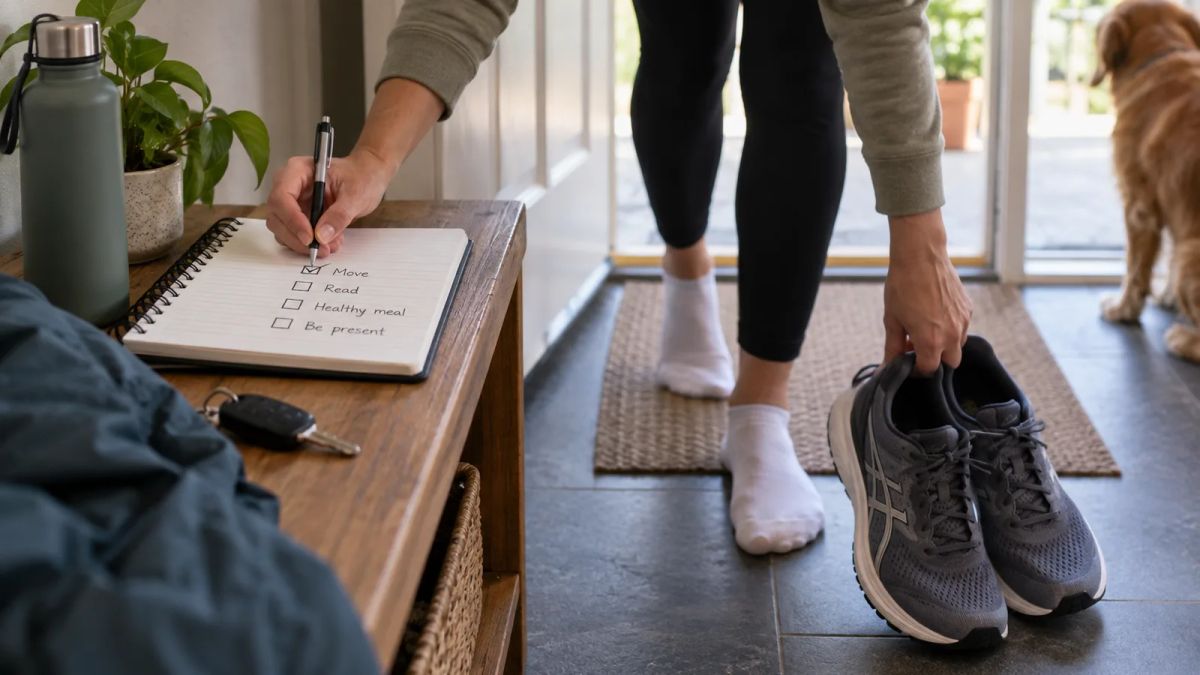
- Name the person, not the prize. Finish the sentence "I'm the kind of person who…" with something you can do often. "I'm someone who moves daily" beats "I want to lose weight", because you can prove the first one before lunch.
- Pick the smallest action that would prove it. One that survives a bad day. For a mover, that's a short walk or a single stretch, not an hour at the gym.
- Bolt it to something you already do. The American Heart Association's advice on making habits stick is to attach a new action to an existing routine, so the old habit becomes the cue. After the kettle goes on, you walk to the end of the road.
- Mark the vote so you can see it. A tick on a calendar counts. A meta-analysis of 138 studies found that keeping an eye on your progress improved how often people reached their goals, so the tick pulls its weight rather than decorating the fridge.
Run one identity through those four lines and it turns from a slogan into a plan.
The person I want to become: __________
A small action that proves it today: __________
The cue it follows: __________
How I'll mark the vote: __________
Filled in for "I'm someone who moves daily", it might read like this.
The person I want to become: someone who moves every day
A small action that proves it today: a walk to the end of the road and back
The cue it follows: putting the kettle on for my first cup of tea
How I'll mark the vote: a tick on the calendar by the door
Four short lines, and the vague wish to "get fitter" now has a name, a size and a place to live.
Open our free Small-habit experiment (PDF). Choose an identity, a small action and a cue, then review a week of attempts. Includes a worked example and space to adjust your plan. Save or print it; no sign-up needed.
On hard days, shrink the vote
The point of a vote is that it counts, not that it impresses anyone. On a flat day the walk to the end of the road becomes stepping out the front door and back, and the stretch becomes ten seconds on the mat. A tiny vote still says walker. A skipped day says nothing at all, which is worse, because the tally stops moving.
Decide your bad-day version now, while you're feeling capable, so the choice is already made when you're not.
After a miss, cast the next vote
You will miss days. Everyone does. The mistake that costs you is not the gap, it's the story you tell about it, the "I've blown it now" that turns one skipped evening into a fortnight off. One vote against doesn't flip the result. Keep the earlier ticks where you can see them, drop the guilt, and cast the next vote at the next chance. Our guide to staying consistent goes deeper on getting back on after a break.
Where the metaphor stops
Honesty check, because this idea gets oversold. "Cast a vote for your identity" is a helpful picture, not a measured mechanism. Nobody has counted the exact votes that tip you from "trying to walk" to "a walker", and the number would differ for every person and every habit anyway.
Identity change is slow and uneven. In the best-known real-world study of habit formation, people took a median of 66 days to reach their peak of automatic behaviour, but the spread ran from 18 days to well over 200. Believing you're "a runner" after three runs would be wishful. The belief tends to arrive quietly, some way behind the behaviour, once the evidence has piled up enough to be hard to argue with.
Treat the framing as a good way to point yourself in a direction and keep showing up. Don't treat it as a switch you flip by saying the right words in the mirror.
How this differs from tiny habits and the four laws
If you've read around habit building, you'll have met a few frameworks that look related. They answer different questions.
Tiny habits and BJ Fogg's work are about the size of the action. Make the first step so small it can't fail, then let it grow. Our guide to tiny habits covers that properly. Clear's four laws of behaviour change are about the mechanics of the habit loop, the cue, craving, response and reward, and how to steer each one.
Identity-based habits sit underneath both. They're about the aim, the who, not the how. You can borrow a tiny first step and the four laws to build the habit, and still let identity decide which habit is worth building in the first place. The small action does the work. The identity gives it a reason to keep happening after the novelty wears off.
A place to watch the votes add up
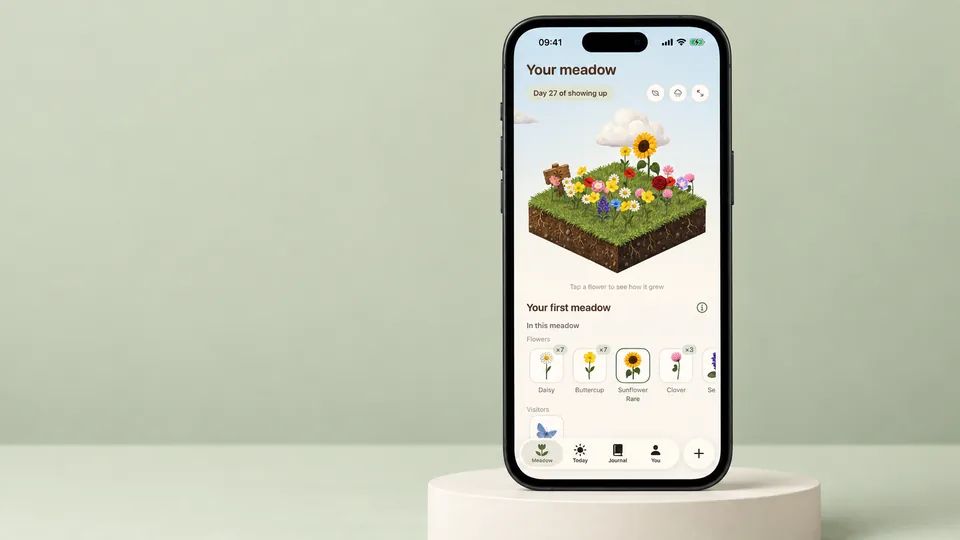
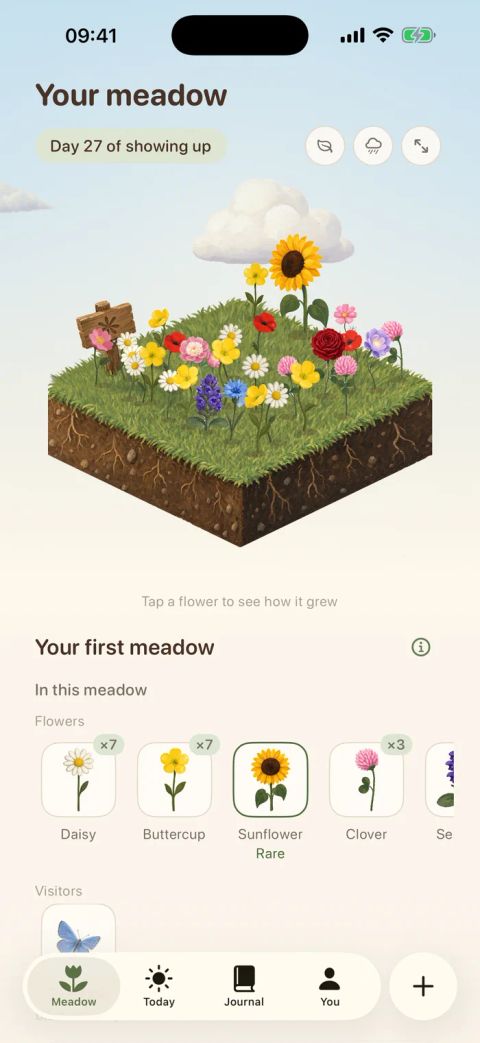
Marking each vote is easier when you can see the pile grow, which is where a phone earns its keep. Meadow turns every day you show up into a wildflower in your own meadow. You log a walk or a few minutes of movement, tick off a small habit, and note your mood and energy, and the meadow fills in over time as the evidence of who you're becoming. It's built for consistency, so there are no streaks to break and a missed day wilts nothing you've grown. The garden becomes a running tally of votes you can see at a glance.
Frequently asked questions
What are identity-based habits?
They're habits you build by starting with who you want to become and letting small daily actions act as proof of that identity. Instead of "I want to run a marathon", you decide "I'm a runner" and let each run cast a vote for it. James Clear set out the idea in Atomic Habits.
What's the difference between outcome, process and identity goals?
Outcome goals are about the result you want, like losing weight. Process goals are about the actions, like walking daily. Identity goals are about the person you believe you are, like being a walker. Clear argues the identity layer is the one that keeps a habit going once the initial push fades.
Is there any science behind identity-based habits?
The exact "voting" metaphor is Clear's own framing, not a tested law. It lines up with older work, though. Daryl Bem's self-perception theory holds that we infer our attitudes from our own behaviour, and studies of exercise identity find that seeing yourself as active and being active are strongly linked.
How long does it take to feel like a new person?
There's no fixed number. Habit research found an average of about 66 days to reach automatic behaviour, with a range from under three weeks to over 200 days depending on the person and the habit. The belief usually lags behind the behaviour, so keep going before you expect to feel it.
What if I miss a day?
One miss is a single vote against, not a lost election. Keep your earlier ticks, skip the guilt, and cast the next vote at the next opportunity. The running tally is what shapes the identity, not any one day.
One thing to do today
Write one sentence: "I'm the kind of person who ______," and fill the blank with something you could prove in two minutes. Then do that two-minute thing once, today, and mark it. That single tick is your first vote. You're not trying to become a new person by tonight. You're opening the ballot and putting one in the box.
AUTHOR
Co-founder of Meadow.
Ash is co-founder of Meadow, a habit and movement tracking app that turns small acts of self-care into a growing wildflower meadow.
Little and often, with Meadow
Consistency, not intensity.
Meadow turns the movement you enjoy and the habits that help you feel good into a meadow of wildflowers. No streaks to break, and your flowers never wilt.
Download Meadow