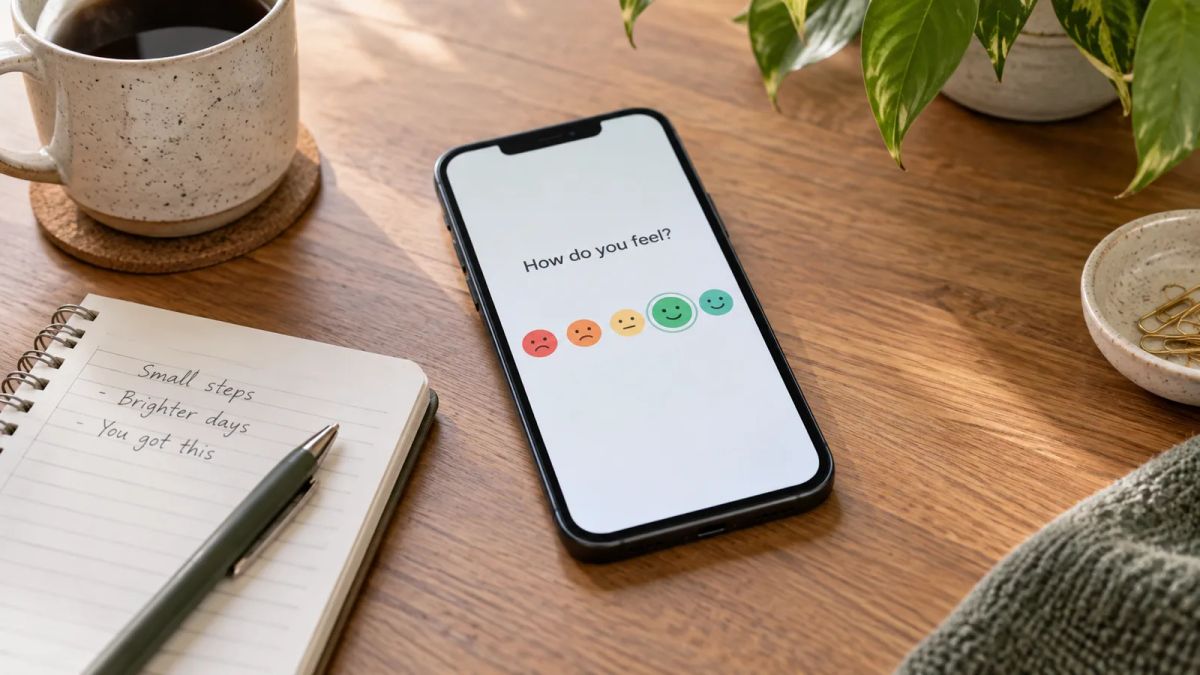
Tracking your energy means giving each part of the day a quick score, then noticing what lifts it and what flattens it. A mood log tells you how you felt. An energy log tells you what you had to spend, and where it went.
Most of us plan as though energy is flat. We slot the hard task into whatever gap the calendar leaves, then wonder why the 3pm version of it takes twice as long. Your capacity moves through the day in a fairly predictable shape, and once you can see that shape, you can stop fighting it.
This is a small habit. A number a few times a day, a note on sleep, food, movement and mood, and a week or two of patience. That's the whole thing.
Why energy is worth tracking on its own
Mood and energy often move together, but they aren't the same thing. You can feel content and completely wiped out. You can feel anxious and wired. In the Health, Aging and Body Composition study of 2,529 older adults, researchers found that among people who reported higher energy, 40% also reported unusual tiredness in the past month, which is odd if the two sit at opposite ends of one scale. The authors argue that energy and fatigue have different biology and are best measured as separate things.
So a mood tracker can miss the thing that shapes your day. A mood tracker app is built for the emotional side, and it does that well. An energy log answers a different question: when do I have something in the tank, and when am I running on fumes? Log how you feel and you learn about your emotional weather. Log what you've got to spend and you learn when to attempt the hard things and when to ease off.
The act of tracking earns its place, too. A meta-analysis of 138 studies found that prompting people to monitor their progress towards a goal made them more likely to reach it, and the effect was larger when they physically recorded what they noticed. Watching a number is a mild form of paying attention, and attention is where most change begins.
How to track energy without turning it into a chore
Keep it light or you won't keep it. Give your energy a 1 to 5 score at a few fixed points: mid-morning, after lunch, and late afternoon. Add an evening reading if you can manage it. One is empty, five is sharp and ready, three is fine.
Next to each score, jot the four things most likely to explain it: how you slept, what you ate, whether you moved, and your mood. A few words will do. "Slept badly, skipped breakfast, short walk, a bit flat" tells you everything you need.
Here's a filled day so you can see the shape it takes:
Energy log, Tuesday
Mid-morning (9am): 4/5. Slept 7 hrs, proper breakfast, walked to the station, calm.
After lunch (2pm): 2/5. Big sandwich, three calls back to back, foggy.
Late afternoon (5pm): 3/5. Cup of tea, ten minutes outside, steadier.
Evening (9pm): 3/5. Light dinner, no screens, relaxed.
And a blank one to copy:
Energy log, blank
Mid-morning: __/5. Sleep, food, movement, mood:
After lunch: __/5. Sleep, food, movement, mood:
Late afternoon: __/5. Sleep, food, movement, mood:
Evening: __/5. Sleep, food, movement, mood:
Open our free Energy tracking log (PDF). Use a reusable daily check-in and a two-week overview to record energy at regular times. Includes space for context and one practical adjustment. Save or print it; no sign-up needed.
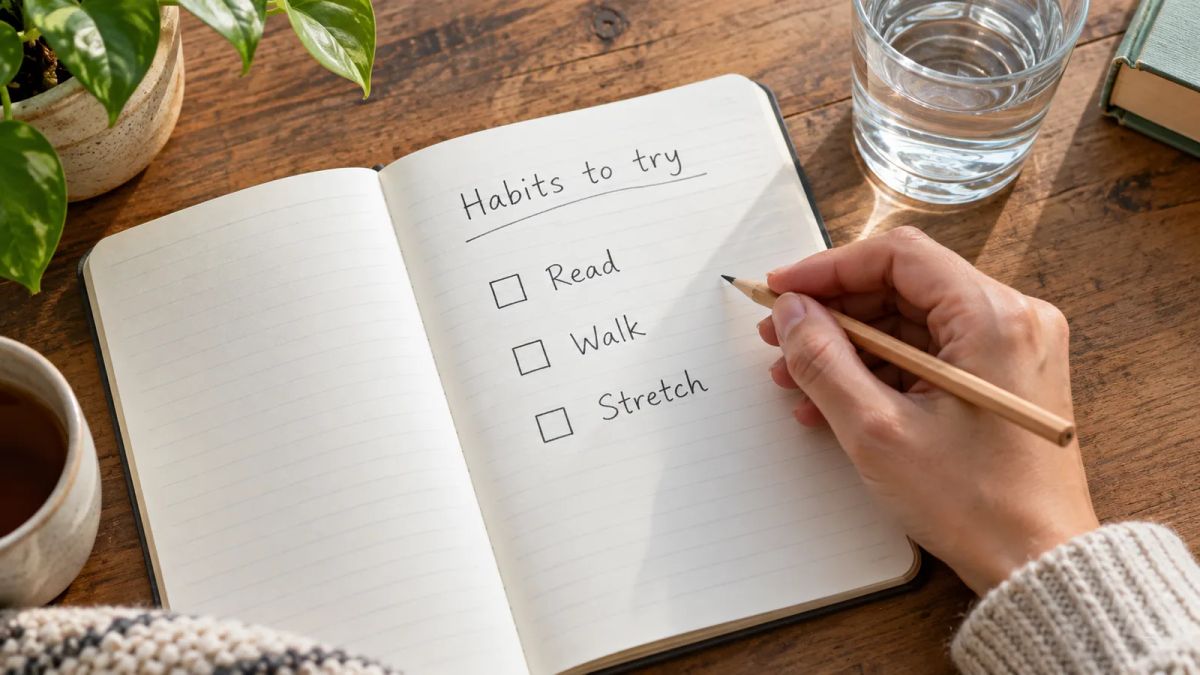
Set a couple of phone alarms for the first week so the readings don't slip your mind. Paper, notes app, spreadsheet, whatever you'll open without groaning. Give it two or three weeks before you read anything into it, because one bad night tells you nothing and a fortnight tells you a lot. Energy is one of several things worth keeping an eye on, and if you want ideas for the rest, our list of habits to track is a good start.
What to look for once you have a fortnight of scores
Line up two weeks of numbers and a shape appears. Most people are looking at four things.
Your daily curve comes first. Alertness rises and falls on a circadian rhythm, the roughly 24-hour clock that also governs body temperature and the melatonin that makes you sleepy at night. As the Sleep Foundation puts it, this internal cycle decides how sleepy or alert you feel across the day. For a lot of people that shows up as a strong late-morning window and a second, smaller lift in the early evening.
Then there's the post-lunch dip. That heavy feeling around 2pm to 4pm is real, and it isn't only the sandwich. Researchers describe the early-afternoon dip as a circadian effect, present even when people haven't eaten, when the body's daytime alertness can't fully hold back the pressure to sleep. A big lunch can deepen it, but the dip turns up either way.
Your chronotype is the third thing. Some people wake sharp and fade by evening. Others take hours to warm up and do their best work after dark. This leaning towards morning or evening is your chronotype, and the Sleep Foundation notes it has a strong genetic component and stays fairly fixed, even though a strict schedule can nudge your rhythm. If your log shows you're useless before 10am, that may be who you are, not a failure of discipline.
Last, look for shorter waves inside the day. On top of the big curve, attention seems to pulse in cycles of roughly 90 minutes, an idea Nathaniel Kleitman called the basic rest-activity cycle. The waking version of it is still debated, but plenty of people notice they can focus hard for about an hour and a half before the wheels come off. If you keep hitting a wall mid-task, that's worth respecting.
Around all of that sits the personal stuff the averages can't give you. Your log will show what drains you and what restores you: which meetings leave you hollow, whether a walk resets you, how much a poor night costs you the next day. That last column, the one tracking sleep, food, movement and mood, is where your own patterns live.
Turning the pattern into a plan
The point of the whole exercise is to stop scheduling blind. Once you can see your peaks and dips, you can match the work to the tank.
- Guard your best window for the hardest thing. Whatever your log calls a 4 or 5, put the demanding, thinky work there and defend it. Push email and admin somewhere else.
- Give the dip easy jobs or a proper break. The 2pm trough is a poor time for a big decision and a fine time for tidying up, routine tasks, or ten minutes outside.
- Use movement as a lever. The NHS points out that even a single 15-minute walk can give your energy a lift, and doing it regularly does more. A short walk in the slump often beats another coffee.
- Eat for a steadier line. Long gaps let energy sag, so the NHS suggests regular meals and healthy snacks every three to four hours in place of one big meal. Watch how the heavy lunch shows up in your afternoon scores.
- Mind the caffeine clock. Coffee helps in the moment, but its effects can last up to seven hours and eat into your sleep, which taxes tomorrow's energy. That 4pm cup can be the reason the next day opens at a 2.
You won't remake your whole calendar, and you don't need to. Protecting one peak block and stopping the daily fight against one predictable dip is enough to feel the difference within a week. Because sleep is the biggest lever on next-day energy, if your scores keep starting low it's worth working on your sleep habits before anything else.
A place to note mood and energy together
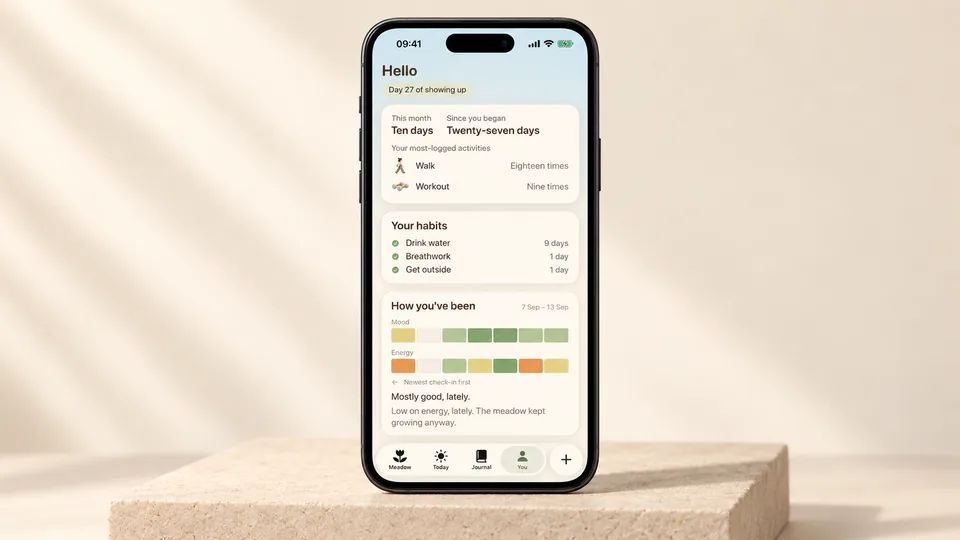
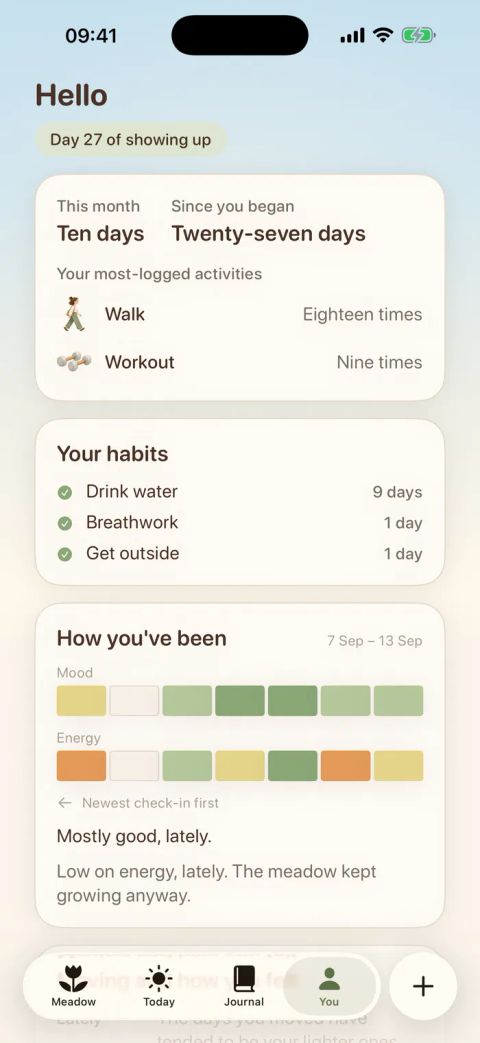
If you'd sooner keep the check-in on your phone, Meadow lets you note both your mood and your energy each day, side by side, so you can watch how they move together over a week. Around that you can log the movement you enjoy with a timer, tick off small habits like getting outside or drinking water, and write down one good thing from the day. Every day you show up grows a wildflower in your own meadow, and there are no streaks, so a flat, forgotten day resets nothing you've built. You'll find Meadow on iPhone.
When low energy is worth a word with your GP
Tracking is for spotting patterns, not for diagnosing yourself. Most dips trace back to sleep, stress, food or doing too much, and a log helps you see which one. If your energy is low most days for weeks, if rest and a decent night's sleep don't touch it, or if the tiredness feels heavier than the week seems to warrant, see a GP. The NHS describes a tiredness that isn't relieved by rest as a reason to get checked for an underlying cause. Your log is a handy thing to bring, because "I've felt like a 2 by lunchtime every day for a month" is far easier to act on than "I'm tired".
Tonight, before bed, write down two numbers: how your energy was this morning and how it is now, out of five. That's the habit, already started. Tomorrow, add one more reading after lunch, and let the pattern build from there.
AUTHOR
Co-founder of Meadow.
Ash is co-founder of Meadow, a habit and movement tracking app that turns small acts of self-care into a growing wildflower meadow.
See how far you've come
Your habits, moods and little wins, all in one place
Meadow keeps track of the walks, the water and the good days, so you can look back and watch your effort add up.
Download Meadow