Healthy sleep habits come down to a few small choices you repeat until they run themselves: a wake-up time you keep, light early and dark late, and an hour that lets you slow down. You build them one at a time, not in a single heroic Sunday, and a good night starts to look after itself.
If you have tried to fix your sleep before and given up, it was probably because you changed six things at once and none of them survived to Wednesday. Sleep hygiene is the ordinary name for these habits, and none of it is exotic. The work is picking one, tying it to something you already do, and letting it hold before you add the next.
This guide covers the habits with the strongest case behind them. A consistent wake time. Morning light and dim evenings. Caffeine and alcohol timing. A wind-down you will repeat, and a bedroom set up for sleep. It also sorts what helps from the advice that sounds right and does nothing.
Pick a wake-up time and keep it
The habit that does the most work is a wake-up time you hold to, weekends included. The Sleep Foundation puts it plainly: pick a wake-up time and try to stick with it, even on weekends. Waking at roughly the same hour steadies your body clock, so falling asleep at night gets easier without you willing it to happen.
Regularity earns its place. In a study of 60,977 UK Biobank participants who wore activity trackers, people with the most regular sleep timing had a 20 to 48% lower risk of dying over the follow-up period than those with the most irregular timing, and regularity predicted that risk better than how many hours people slept. That is an association from observational data, not proof that a fixed alarm adds years, but it points hard towards keeping your timing steady.
Duration counts too. The CDC recommends seven or more hours a night for adults, with similar ranges into older age, and links short sleep with a higher risk of type 2 diabetes, heart disease and stroke. Here is the catch. You cannot force sleep, only the routine around it. So start with the end you can control, which is the alarm, and let a steady morning pull your nights into line over a week or two.
Get light early, dim it late
Your body clock takes its strongest cue from light. Morning daylight tells it the day has started and sets the timer for feeling sleepy about fifteen hours later, which is why the Sleep Foundation suggests you take in daylight by getting outside or opening up windows soon after you wake.
There is science under this. When researchers gave adolescents with late bedtimes bright light on weekend mornings, two and a half hours of it advanced their body clock by about an hour, measured by when their melatonin began to rise. That trial was small and ran in teenagers, so the exact figures will not map onto everyone, but the direction is well established. Light in the morning nudges your clock earlier, and a short walk or a coffee by a window is an easy way to get it.
The evening is the mirror image of the morning. Turn the big lights down, and put the screens away. The Sleep Foundation suggests you disconnect for 30 minutes to an hour (or more) before going to bed. Deciding in advance where the phone charges, out of reach, makes that easier than negotiating with yourself at eleven at night.
Time your caffeine and your last drink
Caffeine outstays its welcome. It sits in your system for hours, so a mid-afternoon coffee is still working when you are trying to drop off. The NHS advises not drinking tea, coffee or alcohol at least six hours before bed. If your evenings are restless, pulling your last coffee back to lunchtime is one of the simpler experiments worth running.
Alcohol is the one people read wrong. A drink makes you drowsy, so it feels like it helps you sleep. Harvard Health warns that after a few hours it becomes stimulating and breaks up the back half of the night, which is why a couple of glasses can leave you wide awake at 3am. You do not have to give it up to sleep better. Shifting it earlier and lighter tends to do more than cutting it out.
Big late meals belong in the same bracket. Harvard suggests eating your evening meal at least three hours before bed so you are not trying to sleep on a full stomach. A small snack later is fine if hunger is keeping you up.
Build a wind-down you'll repeat
Your brain has no off switch, so give it a slope instead. A wind-down is a short, same-ish set of things you do in the last half hour before bed, and the sameness is the working part. Done in the same order most nights, it starts to tell your body that sleep is coming.
Keep it to things you like and can manage when you are tired. A few easy stretches. Some slow breathing. A few pages of an undemanding book in low light. Harvard groups the useful ones together: easy stretches, progressive muscle relaxation, or deep breathing. None of it needs to be long. Twenty minutes done most nights beats an elaborate hour you keep once a fortnight.
If you want the full version, we have a separate guide to building an evening routine that covers the wind-down in more depth, including how to bend it around shift work or small children.
Set the room up for sleep
A bedroom that is dark, quiet and cool does you a favour every night once it is set, without any daily effort. Temperature is the part people overlook. Harvard Health puts the sweet spot at around 65 to 68F, roughly 18 to 20C, and the Sleep Foundation lands in the same range. That is cooler than most people keep the house.
For light and noise, the Sleep Foundation suggests blackout curtains or a sleep mask, plus a fan or white noise if your street or your household will not settle. These are set-and-forget changes. You make them once and they pay out every night, which is the opposite of the habits that need daily attention.
What helps, and what only sounds like it does
Plenty of sleep advice is fussy, optional or wrong. A few worth naming:
- "A nightcap helps you sleep." It helps you fall asleep and then wrecks the rest of the night, going by the Harvard point above. Drowsy is not the same as rested.
- "Everyone needs eight hours." The CDC's figure is seven or more, and the right amount varies from person to person. Judge it by how you feel and function in the day, not by a round number on the clock.
- "I'll catch up at the weekend." A long Sunday lie-in feels good but drags your clock later, so Monday night is harder again. Some catch-up after a rough week does no harm, and a fixed-ish wake time serves you better than a weekly boom and bust.
- "Lying there trying will work eventually." Staying in bed wide awake teaches your brain to link the bed with being awake. If you are still up after twenty minutes or so, get out of bed, do something dull in low light, and go back when you feel sleepy.
- "Naps ruin your night." A short early one does not. The Sleep Foundation puts the best nap at around 20 minutes in the early afternoon. It is the long, late naps that borrow from tonight.
Build these gradually, one at a time
Open our free printable: One sleep habit at a time (PDF). Save or print it to use alongside this guide. No sign-up needed.
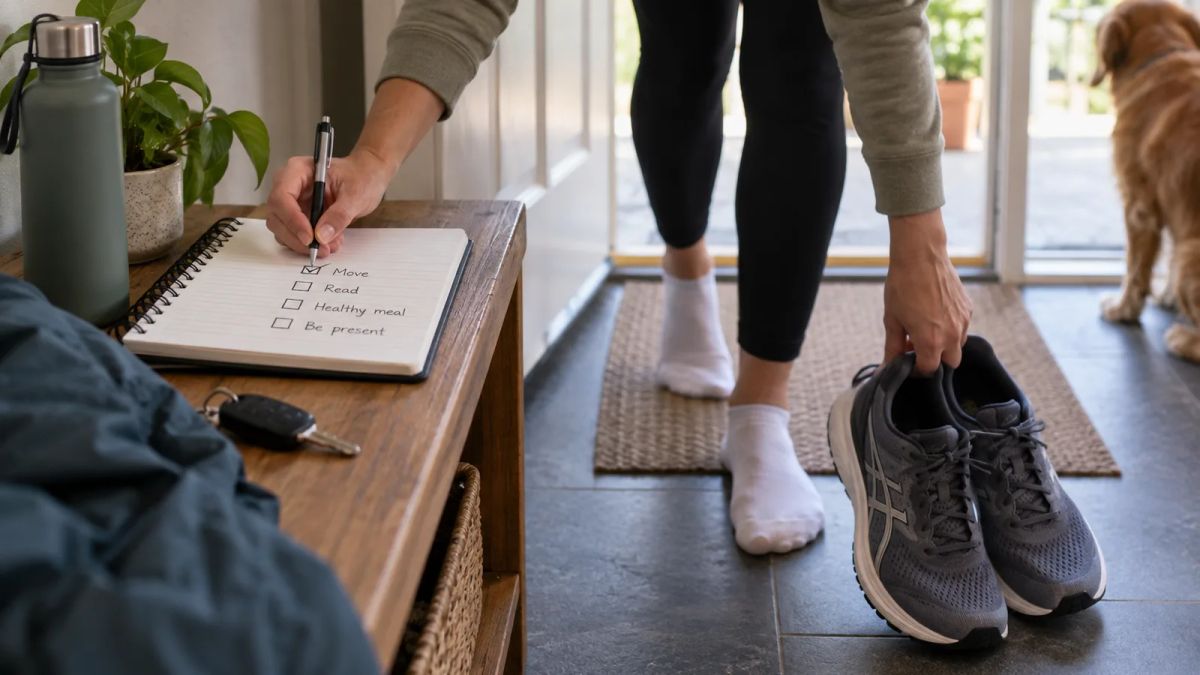
You do not fix your sleep in a night, and you do not have to. Pick one habit from this guide, tie it to something you already do, and let it hold before you add the next. James Clear calls the tie-in habit stacking, with a plain formula: after a current habit, do the new one. "After I make the morning coffee, I drink it by the window." "After the ten o'clock news, the phone goes on to charge in the kitchen." Your existing routine does the remembering.
Write your first one down as a single sentence. Here is a blank to fill in and a worked example.
The habit I'm starting: ________
After I ________ (something I already do), I will ________ (the small sleep habit).
My tiny version, for a rough day: ________
The habit I'm starting: a fixed wake-up time.
After I hear the 6:45 alarm, I will get up and open the curtains instead of snoozing.
My tiny version, for a rough day: up within fifteen minutes of the alarm, curtains open, and that counts.
This is the same approach we use for any healthy habit, and it is why a wake-up time is such a good first choice for sleep. You anchor it to your existing alarm, hold it for a week or two, then layer in morning light or an earlier last coffee once the first one runs itself. If the start of the day is where you want to begin, the morning routine guide picks up from the moment you wake.
A place to practise the wind-down

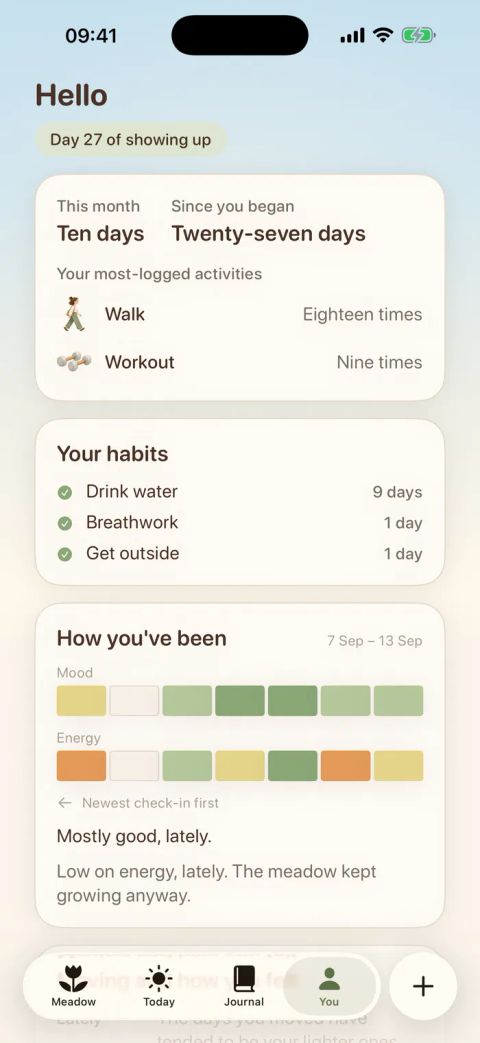
To make a wind-down easier to come back to, Meadow gives it somewhere to live on your phone. It is a gentle habit app for iPhone with a built-in breathwork feature, so a few slow breaths become part of the evening, practised alongside a wildflower meadow you have grown. You can also log any movement from the day, tick off small habits like getting outside for morning light, and note your mood and energy. Each day you show up grows a flower, and because there are no streaks, a late night when you skip the lot resets nothing. You can find it at Meadow.
When it slips, and when to see a GP
You will have bad nights and off weeks. A holiday, a new baby, a stretch of stress. None of it undoes the habits, because sleep habits do not run on streaks. Research on how habits form found that missing a single day did not stop a habit forming, and that the time to feel automatic varied a lot from one person to the next. So there is nothing to rebuild after one broken night. You pick the wake-up time back up the next morning and carry on.
There is a line, though, where habits are not the whole answer. If you have been sleeping badly for weeks rather than nights, or you think you might have insomnia, the NHS advises you speak to a GP. Persistent poor sleep can have causes that no amount of sleep hygiene will settle on its own, and it is worth getting looked at.
Frequently asked questions
If I only change one thing, what should it be?
A wake-up time you keep every day, weekends included. It steadies your body clock, and it is the part of sleep you can decide and control, unlike the moment you drop off.
How long before I notice a difference?
Give a change a week or two of consistency before you judge it. Habits take different lengths of time to feel automatic from one person to the next, so go by whether nights are getting easier, not by a date on the calendar.
How much sleep do I need?
The CDC recommends seven or more hours a night for adults. The exact figure varies between people, so use how alert you are during the day as your guide rather than a fixed target.
Is it bad to lie in at the weekend?
A big lie-in pushes your clock later and makes the next night harder. A modest recovery after a poor week is fine, but a wake time that stays roughly constant beats a large weekend swing.
Should I get up if I can't sleep?
Yes, if you have been awake a while. Staying in bed frustrated trains your brain to associate the bed with being awake. Get up, do something quiet and boring in dim light, and return when you feel sleepy.
One thing to do now
Set one wake-up time you can keep seven days a week, and put the alarm across the room so getting up means standing up. Hold it for a fortnight before you change anything else. A steady morning is the hinge the rest of your sleep swings on, and it is the one part you can decide tonight.
AUTHOR
Co-founder of Meadow.
Ash is co-founder of Meadow, a habit and movement tracking app that turns small acts of self-care into a growing wildflower meadow.
See how far you've come
Your habits, moods and little wins, all in one place
Meadow keeps track of the walks, the water and the good days, so you can look back and watch your effort add up.
Download Meadow