Most January fitness plans die in February for one plain reason. They're built for the fired-up version of you, and that version doesn't show up on a dark, cold Tuesday. Build the plan for your tired self instead and it survives the week your motivation drops, which is the week that decides everything.
So this is a guide to keeping a fitness resolution past January. Start smaller than you want to, pick a behaviour to repeat instead of a number on the scales, hook each session onto something you already do, plan for the flat days and dark mornings before they land, and treat a missed week as a pause rather than the end.
None of that asks for more willpower. It asks for a lower bar and a little planning.
Why January fitness resolutions collapse by February
Strava, which tracks its members' workouts, looked at hundreds of millions of activity logs and found a clear slump in the second week of January. It named the low point Quitters' Day, the day its members were most likely to stop turning up. The gym is rammed on the second of January and half empty by the middle of the month.
This isn't a character flaw. Two things stack up against you.
The first is size. A resolution shaped on New Year's Day tends to be enormous, because on New Year's Day a huge plan feels doable. Five gym sessions a week, a run every morning, a whole new diet on top. The plan runs on motivation, and motivation is the one input you can't count on.
The second is the season. January hands you the worst possible conditions for a new habit. It's dark at seven, it's cold, your legs are sore from an overambitious first session, and the gym is full of everyone else's resolutions. The plan meets reality in the flattest, busiest month of the year.
There's a gap here worth naming. Intending to exercise and doing it are two different problems. The American College of Sports Medicine points to research where, of the people who said they meant to exercise within the next three hours, only about 16% did. A large chunk were what the researchers call "inclined abstainers", people who fully intend to move and then don't. Wanting it was never the missing piece.
Start smaller than your motivation tells you
On the first of January your motivation is at its peak, which is the worst moment to decide how big your plan should be. Everything feels light, so you sign up for the version of yourself who trains six days a week, and you build a plan that only that person can keep.
Size the plan for your worst week, not your best day. The ACSM's steer is blunt: it's better to plan something small and get it done than to plan something elaborate and fail, because people follow through far more often on lower-intensity activities. A twenty-minute walk you'll take beats an hour at the gym you'll skip.
The health guidance backs the small version too. The CDC says some activity is better than none and that you can break the week's movement into smaller chunks, so three ten-minute walks in a day still count towards the 150 weekly minutes it recommends. You don't need a spare hour. You need ten minutes and a pair of trainers by the door.
One safety note before you push the pace. If you've been inactive for a long time, or you have a health condition or an injury, have a word with your GP before you start, and stop if exercise brings on chest pain, dizziness or unusual breathlessness.
Make your goal a behaviour you can repeat
"Lose a stone by March" is an outcome. It tells you nothing to do on Monday morning, and the scales move slowly and unevenly, so you can train hard for three weeks and still feel like you're losing. A behaviour goal names the action instead: "walk briskly three mornings a week." You either did it or you didn't, and you know the answer by eight o'clock.
There's decent evidence this framing sticks better. In a study of more than a thousand people setting New Year's resolutions, 55% still counted themselves successful a year on, and those who set an approach goal, something to move towards, did better than those chasing an avoidance goal, something to cut out, at 58.9% against 47.1%. "Walk after work" points at an action you can start. "Stop being unfit" points at a version of yourself you have to police.
If losing weight is the whole point of your January, keep the behaviour in front and let the result trail behind it. A movement habit you can hold all year does more for your weight than a strict target you drop in the second week. For turning a vague aim into something you can act on, our guide to how to set goals walks through the difference.
Anchor each session to something you already do
A workout with no fixed slot slides to a "later" that never arrives. Give it a home by hooking it onto something that already happens in your day without you thinking about it. The American Heart Association's advice for a new habit is to attach it to an existing routine, so the old routine becomes the reminder and you're not relying on a fresh burst of resolve to prompt you.
Pick an event, not a clock time. A few that hold up in January:
- After I drop the kids at school, I'll walk for fifteen minutes.
- After my morning coffee, I'll do ten minutes of the workout I like.
- After I shut the laptop for the day, I'll change and go straight out.
"After I drop the kids at school" survives a morning that starts an hour late. "At 7am" breaks the first time your morning slips, which in January is most mornings. There's more on making movement repeatable in our guide to staying consistent with exercise.
Plan for the motivation dip and the dark mornings
The new year does give you a real push, and it's worth knowing why so you don't lean on it too hard. Researchers call it the fresh-start effect: people are more likely to chase a goal right after a landmark like the first of January, because the date puts a little distance between you and the version of you who didn't manage it last year.
Here's the catch. The push is real but short, and it fades right around the second week of January, which is Quitters' Day by another name. So use the January energy to set things up while it's high, then let the small size and the anchor carry the habit once the buzz is gone.
Practically, that means deciding now what a bad day looks like, before the bad day turns up. Lay your kit out the night before so a dark morning is one less decision. Keep an indoor fallback for the mornings it's icy or bucketing down, a home workout or a walk round the shops. And set a smaller version for flat days, so a day you can't face the full session still ends with the thread unbroken.
Fill these four lines in once and you've got a plan that holds through a grim week:
My movement: ________ (something I'd half look forward to)
My cue: after I ________ (a moment I already have every day)
My smallest version: ________ (doable on a dark, flat morning)
My bad-weather fallback: ________ (something I can do indoors)
Here's one filled in, so you can see the shape:
My movement: a brisk walk with a podcast
My cue: after I drop the kids at school
My smallest version: ten minutes round the block
My bad-weather fallback: a walking workout in the living room
A place the habit survives a quiet week
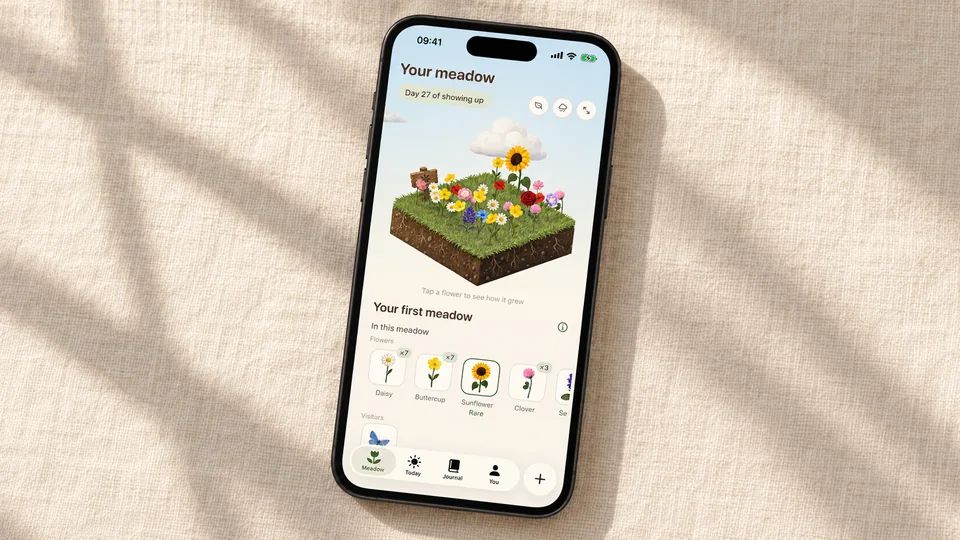
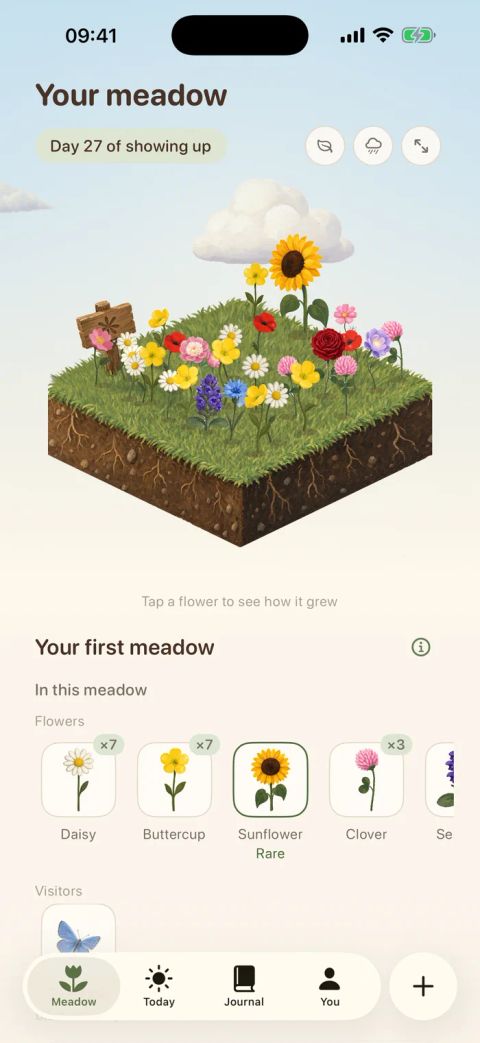
Some January weeks you'll move most days, and some the weather and the dark will win, and an app that scolds you for the quiet weeks tends to get deleted by February. Meadow works the other way round. It's a gentle movement and habit app for iPhone from Wildcard Wellness, where you log a walk or a few minutes of exercise with a timer, tick off a small daily habit, and note your mood and energy, and every day you show up grows a new wildflower in a meadow that's your own.
The part that fits a new-year plan is what happens when you miss. There are no streaks, so a rained-off morning or a skipped week resets nothing and your flowers never wilt. You pick up whenever you're ready, which is how real January weeks tend to go.
Keep a record you'll look at
A tick a day does two quiet jobs. It gives you a small hit of "done" in the moment, and over the weeks it shows you a pattern you can't see from inside a single day. This isn't busywork. A meta-analysis of 138 studies found that prompting people to monitor their progress towards a goal improved how often they reached it.
Use whatever sits where the workout happens and takes two seconds. A cross on the wall calendar by the kettle, a note on your phone, a line in a diary. The best record is the one you'll still be looking at in March.
Forgive the missed week, because there will be one
You'll miss a session. A cold, a work crisis, a week where the alarm wins. This is normal, and it's not the failure it feels like at six on a dark morning.
The research is reassuring here. When people were tracked while building a new daily habit, a single missed day made little difference to how automatic the behaviour eventually became, and the time people took to get there ranged from about three weeks to the better part of a year. One gap doesn't undo the weeks behind it, and there's no fixed deadline you're failing to hit.
The damage is rarely the missed session. It's the "well, I've blown January now" that turns one skipped walk into a fortnight on the sofa. So make the rule "never miss twice". One skipped day is life. Two in a row is the start of the old pattern, the one where you don't move any more.
Be as kind to yourself as you'd be to a friend who'd missed a couple of runs. You wouldn't call them a failure. You'd tell them it's fine, go again tomorrow. That tone is what keeps you close enough to pick it back up, and a harsh telling-off mostly makes you want to hide from the whole thing.
Common questions
When do most people give up on their fitness resolution? Around the second Friday of January, the slump Strava named Quitters' Day. Knowing it's coming is half the battle, because you can plan your smaller version for exactly the week your motivation dips.
How many days a week should I start with? Two or three short sessions. That's often enough to build a rhythm and light enough that you can repeat it in a bad week. Add days once the ones you have feel automatic.
Should I set a weight-loss goal at all? You can hold it as a direction, but do the daily work at the level of the behaviour. "Three walks a week" is something you can act on this morning. "Lose two stone" isn't.
Is January a bad time to start? No, the fresh-start feeling makes beginning easier. Any day works too, so there's no reason to wait. If you're reading this in February, today works as well as any first of January.
What if I've already fallen off? Start again at the next ordinary chance, tomorrow morning or your next lunch break, with the smallest version. Don't hold out for the next Monday. For a wider reset across sleep, food and mind as well as movement, our guide to new year habits has a menu to pick from.
Write your plan as one sentence now, before the motivation fades: after a moment you already have every day, one small piece of movement. Something like "after my morning coffee, ten minutes of a workout I like." Then do the smallest version once, today, while it's still January in your head.
AUTHOR
Co-founder of Meadow.
Ash is co-founder of Meadow, a habit and movement tracking app that turns small acts of self-care into a growing wildflower meadow.
Little and often, with Meadow
Consistency, not intensity.
Meadow turns the movement you enjoy and the habits that help you feel good into a meadow of wildflowers. No streaks to break, and your flowers never wilt.
Download Meadow