Staying consistent with exercise comes from making movement easy to repeat, not from training hard for a fortnight and burning out. A short workout you do four times most weeks does far more for you than a heroic plan you abandon by the end of the month.
The people who stay active for years rarely have more willpower than you. They've made moving small, tied it to a fixed moment in the day, picked something they don't dread, and stopped treating one missed week as proof they've failed.
Here's how to build that setup, including the two parts most guides skip: what to do on a low-motivation day, and how to come back after a break.
Why a modest routine beats a punishing one
There's decent evidence that repetition, not effort, is what turns exercise into a habit. Navin Kaushal and Ryan Rhodes followed 111 new gym members for twelve weeks and found that exercising at least four times a week for six weeks was the minimum that made going feel closer to automatic. What predicted a habit taking hold was consistency, keeping sessions simple, a comfortable place to train, and enjoying the activity. Their advice to trainers was to keep exercise fun and simple and focus on consistency.
Notice what isn't on that list. Intensity.
A gruelling session leaves you sore and reluctant, which makes the next one less likely, and the next one is the whole game. Aim for something you could repeat tomorrow, not something that wipes you out for three days. Consistency is a numbers game played over months, and you win it by turning up often, not by turning up hard. The general version of this design works for any habit, and we walk through it in how to be consistent.
Anchor your workout to a moment you already have
A workout with no fixed slot slides to a "later" that never comes. Give it a home by hooking it onto something that already happens every day without you thinking about it.
This is one of the better-supported ideas in the field. A meta-analysis of 14 studies found that doing your activity in a consistent context, at a similar time, in the same place, or after the same daily event, was linked to a stronger exercise habit. The pull was small but real, and consistent timing and slotting the workout into the same point in your routine came out among the strongest cues. The American Heart Association gives the same steer in plainer words: attach the new action to a routine you already have, so an existing cue does the reminding.
Pick an event, not a clock time. Some that hold up well:
- After I pour my morning coffee, I'll put my kit on and walk.
- After I drop the kids at school, I'll do my ten minutes.
- After I close the laptop for the day, I'll stretch and do a short set.
"After my morning coffee" survives a day that starts an hour late. "At 7am" breaks the moment your morning slips. Choose something that happens without fail and leaves a natural gap right after it, and where you can, keep the same time, the same route or the same corner of the room, so the whole scene becomes the nudge.
Choose movement you'll look forward to
The activity you pick decides more about your consistency than any schedule does. A swim you enjoy beats a run you dread, because you'll come back to the one that doesn't feel like a punishment.
Research on why people keep exercising backs this up. A systematic review of self-determination theory and exercise found that more self-directed, enjoyment-led reasons predicted sticking with activity over the long run, while outside pressures like hitting a number or changing how you look were tied more to short-lived starts. Chasing a goal on the scales can get you moving this week. Liking the thing is what buys you the months.
So the useful question isn't which workout burns the most calories. It's which one you'd choose on a free evening. A dance class you laugh through, a walk with a good podcast, a strength session that leaves you feeling capable. Start there, and if you want more on keeping that drive alive when the novelty fades, our guide to exercise motivation goes deeper.
Lower the bar, then start with two minutes
The classic mistake is building your routine for your best days, and your best days aren't most days. So shrink the starting version until it's almost too small to skip.
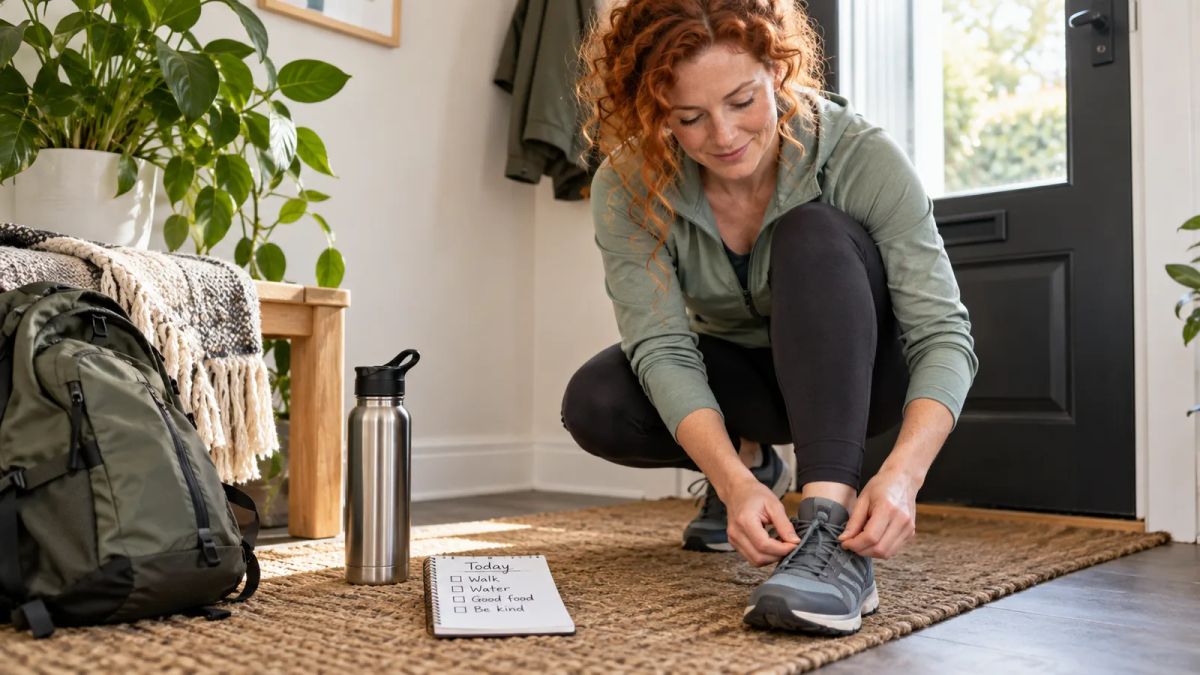
Not an hour at the gym but ten minutes round the block. Not a full workout but your trainers on and out the door. The trick is to make the beginning so light it stops being a decision you have to win. Tell yourself you're doing two minutes. Once you've started, more often follows on its own, and on the days it doesn't, you've still moved and kept the thread going.
Keep the official target small even when you could do more. The day you decide success means the full hour, you rebuild the wall you knocked down, and the first hard evening sends you back to nothing. The health guidance agrees that small counts: the CDC says any amount of moderate activity brings some benefit and that you can break the week's activity into short chunks, like three ten-minute walks in a day. If you're coming back from a long gap, our guide to how to start exercising has a gentle first week you can copy.
One safety note before you push on. If you have a health condition, an injury, or you've been inactive for a long time, it's worth a word with your GP before you start, and stop if activity brings on chest pain, dizziness or unusual breathlessness.
Have a plan for busy weeks and flat days
You will hit weeks where the sessions you planned collide with a deadline, a cold, or a child who won't sleep. Consistency isn't a spotless run. It's a pattern you keep returning to, and the people who last are the ones who've already decided what a bad day looks like before it arrives.
Decide your smallest version now, while you're thinking clearly. If your workout is a thirty-minute walk, the flat-day version might be once round the block. If it's a gym session, it might be ten minutes of the exercises you like best. It sounds almost too small to bother with, and that's what makes it work, because you keep the thread unbroken when the alternative is dropping the lot.
It helps to treat the session like an appointment you've already made. Put it in the diary, protect the slot, and when the week gets loud, drop to the smaller version instead of cancelling. Fill in these four lines once and you've got a plan that survives a low-energy Tuesday:
My movement: ________ (something I'd half-look forward to)
My cue: after I ________ (a moment I already have every day)
My smallest version: ________ (doable on a flat day)
Days I'm aiming for: ____ a week
Here's one filled in, so you can see the shape:
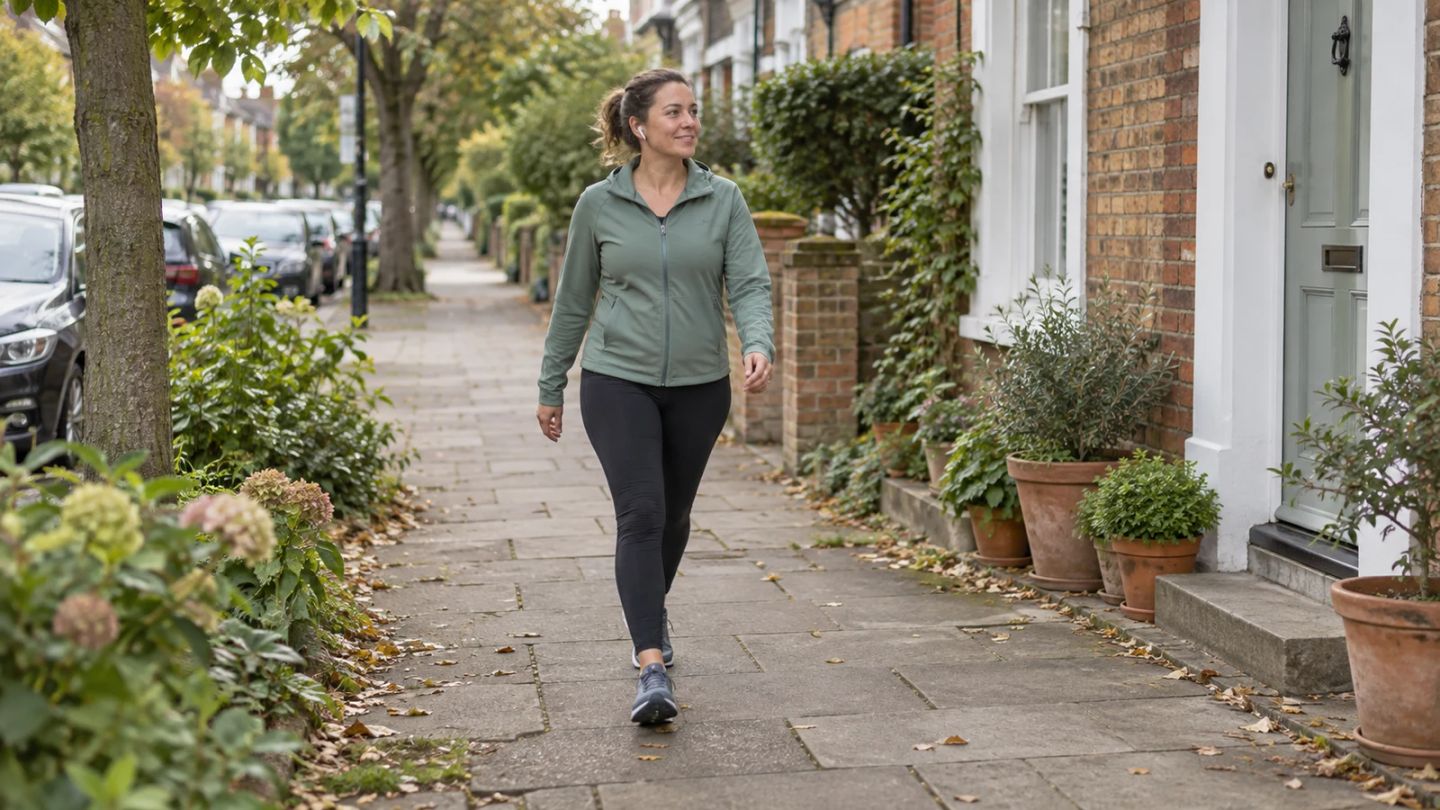
My movement: a brisk walk with a podcast
My cue: after I drop the kids at school
My smallest version: once round the block
Days I'm aiming for: 4 a week

Keep a simple record and let it build who you are
A tick a day does two quiet jobs. It gives you a small hit of "done" in the moment, and over weeks it shows you a pattern you can't see from inside a single day.
This isn't busywork. A meta-analysis of 138 studies found that prompting people to monitor their progress towards a goal improved how often they reached it. Watching the thing is part of doing the thing. Keep the record dead simple: a wall calendar by the kettle, a note on your phone, a line in a diary, whatever takes two seconds and sits where the workout happens.
There's a deeper reason to keep count, too. James Clear, who wrote Atomic Habits, argues that the sturdiest habits are tied to who you believe you are, and that every action is a vote for the type of person you want to become. Each session you log is one more vote for "I'm someone who moves". Once that starts to feel true, you're not forcing the behaviour any more, you're acting like yourself.
One caution on tracking. A long streak counter feels great until you miss once, and a broken number can wipe out weeks of goodwill in an evening. You want a record that shows what you've built, not one that punishes a single blank day.
See each session turn into something

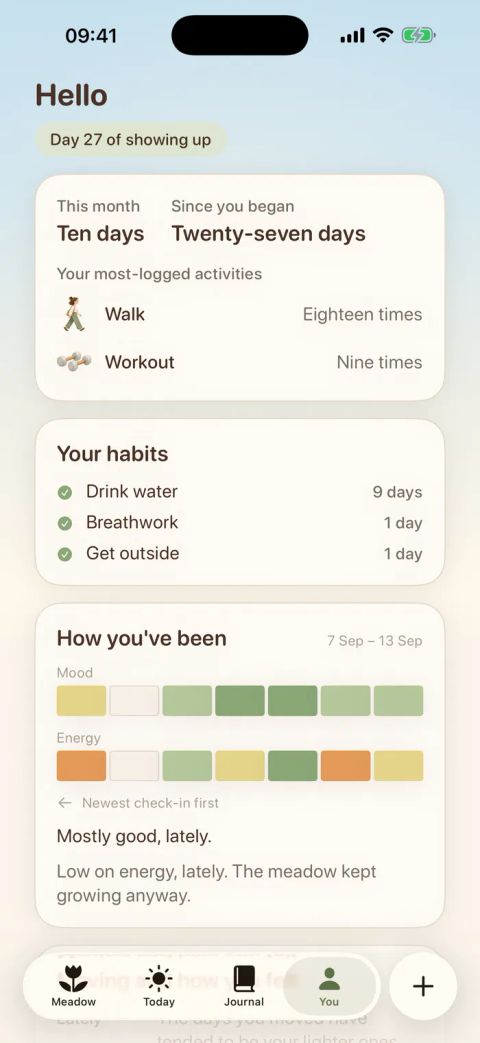
Some weeks you'll move most days, and some you'll barely move at all, and an app that scolds you for the quiet weeks tends to get deleted. Meadow works the other way. It's a gentle movement and habit app for iPhone from Wildcard Wellness, where you log a walk or a few minutes of exercise with a timer, tick off small daily habits, and note your mood and energy, and every day you show up grows a new wildflower in a meadow that's your own.
The part that fits this article is what happens when you miss. There are no streaks, so a rained-off run or a skipped week resets nothing and your flowers never wilt. You pick up whenever you're ready, which suits the way real exercise weeks tend to go.
Coming back after a break, without the guilt
The break isn't the problem. The story you tell yourself about the break is.
When people were followed while building a new daily habit, a single missed day made little difference to how automatic the behaviour eventually became. One gap doesn't undo the weeks behind it. What does the damage is the "I've ruined it now" that turns a skipped session into a fortnight on the sofa. As Clear puts it, the harm isn't the individual missed workout, it's "the cumulative impact of never getting back on track".
So make the rule "never miss twice". One skipped day is life. Two in a row is the start of a new pattern, the one where you don't move any more. Don't wait for Monday or the first of the month, because those are excuses dressed up as fresh starts. Take the next chance you get, whether that's tomorrow morning or your next lunch break, and do the smallest version.
Be as kind to yourself about it as you'd be to a friend who'd missed a couple of runs. You wouldn't call them a failure. You'd tell them it's fine, life happens, go again tomorrow. That tone is what keeps you in a state where you can pick it back up, where a harsh telling-off mostly makes you want to hide from the whole thing.
Common questions
How long until exercise becomes a habit? Longer than the "21 days" you'll see quoted, and it varies a lot. The gym study above put the minimum near six weeks of going four times a week, and other habit research found a wide spread from a few weeks to several months. Judge yourself on whether you're still turning up, not on whether it feels effortless yet.
How many days a week should I aim for? Enough to build rhythm without wearing yourself out, which for most people starting out means three or four short sessions. That's frequent enough for the habit to settle and light enough to repeat. You can always add length once the days themselves are locked in.
Why do I keep falling off after a few weeks? Usually the routine is too big or badly placed. The early buzz of a new plan fades, and if the version you're left with needs energy you don't have, it collapses. Shrink the session, move it behind a more reliable cue, and pick an activity you'd choose anyway.
Is it better to exercise in the morning? The best time is the one you'll keep. Morning suits people whose evenings fill up and derail good intentions. If your mornings are chaos and your evenings are calm, train then. A consistent time helps the habit stick, so the winning slot is whichever one you can defend day after day.
What if I can only manage five minutes? Five minutes counts. It keeps the identity alive, it often turns into more once you've begun, and it beats the nothing you get from holding out for a free hour that never comes.
Pick your activity, your cue and your smallest version, and write the one sentence that holds it together: after [something you do every day], I'll [the small workout]. Then do the smallest version once, today, before the motivation has a chance to fade.
AUTHOR
Co-founder of Meadow.
Ash is co-founder of Meadow, a habit and movement tracking app that turns small acts of self-care into a growing wildflower meadow.
See how far you've come
Your habits, moods and little wins, all in one place
Meadow keeps track of the walks, the water and the good days, so you can look back and watch your effort add up.
Download Meadow