Fitness goals tend to break because they're built around a number you don't control and a version of yourself you're not yet. "Lose a stone", "run a 10k", "get toned" all point at a finish line and say nothing about what to do on Tuesday. The goals that hold up start from where you are today, name a small action you can repeat, and survive a flat week without falling apart.
Here's the shape of a fitness goal that sticks. Start honest about your current baseline. Pick a behaviour you'll do most weeks, not a result you're chasing. Make it specific enough to act on and easy enough to track. Build in a way to step it up and a way to rest. Then expect to change it as you go, because the first version is rarely the right one.
This guide walks through each of those in order, with beginner-sized examples you can copy. For the general version of goal setting beyond fitness, our guide to how to set goals covers if-then plans and the WOOP method in more depth.
Start from where you are, not where you wish you were
Most goals are set for the person you'd like to be, and that person can already run 5k and trains four times a week. You can't. Not yet. A goal aimed at them is a goal you fail at from day one.
Take an honest reading first. How many days did you move last week? How long could you walk before you wanted to stop? Those numbers are your starting line, and there's no wrong answer, only a real one.
The national guidelines make a useful destination, not a starting block. The CDC recommends adults get 150 minutes of moderate activity a week plus muscle-strengthening on two or more days, and the American College of Sports Medicine sets a similar target. If you're doing almost nothing now, that's where you're heading over months, not what you commit to on Monday.
One health note before you set anything. If you've been inactive for a long time, you're pregnant, or you have a heart condition, joint problem or any ongoing illness, have a quick word with your GP before you ramp up.
Pick a behaviour goal, not a number
Split your goal in two. The outcome is the result you're after: a weight, a waist size, a parkrun time. The behaviour goal, often called a process goal, is the thing you do to get there: three walks a week, two short strength sessions, ten minutes of mobility most mornings.
You control the behaviour. You only rent the outcome. Your weight answers to sleep, stress, hormones and a dozen things that aren't your effort this week, so hanging your whole plan on it sets you up to feel like a failure on the weeks it doesn't move. James Clear puts the split cleanly in his guide to goal setting: goals set your direction, systems make the progress. The number points the way. The weekly behaviour is what gets you there.
There's a quieter reward in behaviour goals too. Hitting a target you set builds the belief that you'll hit the next one. A 12-week study tracking people's step goals found that those who met their weekly goal were more than four times as likely to feel confident about the following week, and that confidence fed back into doing it. A goal small enough to hit most weeks keeps that loop turning. A goal you miss most weeks turns it against you.
Keep the outcome as your compass and forget it on ordinary days. Point your attention at the behaviour, because that's the only part today can move.
Make it specific and easy to track
"Exercise more" gives you nowhere to stand. There's no way to know what to do this evening and no way to tell whether you did it.
Decades of research back the fix. Edwin Locke and Gary Latham spent 35 years testing what a good goal looks like, and the finding holds steady: specific, challenging goals produce better performance than vague or easy ones, because a clear target tells you where to put the effort. "Do my best" sounds keen and lands nowhere. "Two 20-minute walks and one strength session this week" tells you exactly what to book into your days.
A goal you can track is a goal you can check off, so build the measure in from the start. Count sessions, not feelings. Beginner-sized versions might look like this:
- Walk for 20 minutes three times this week.
- Do two 15-minute strength sessions, following a beginner video.
- Stretch for five minutes after I get out of bed on weekdays.
Each one names the action, roughly how long, and how often. At the end of the week you can say yes or no to it, which is the whole point. If you want help getting the first sessions into your calendar, how to start exercising covers picking something you'll come back to.
Build in a way to step it up
A goal that never changes stops working once your body catches up to it. The plan needs a next rung.
Progression can be small. Add five minutes to the walk. Add a fourth session once three feels routine. Swap the beginner video for the next level. The trick is to move the target with you rather than leaving it fixed while you outgrow it. A four-month trial comparing step goals found that people given goals that adjusted gradually to their own progress kept up their activity better than people held to a flat 10,000-step target, who tended to drift off as the fixed number stopped fitting them.
Aim to nudge up only when the current level feels comfortable two or three weeks running. If a step-up leaves you dreading the session, drop back a rung. There's no medal for skipping levels, and the smaller target you'll come back to beats the ambitious one you quietly abandon.
Build rest into the plan
New exercisers often plan every session and none of the recovery, then wonder why week three hurts. Rest is part of the programme, not a gap in it. Muscles rebuild between sessions, not during them, and a body that never gets a break gets injured or fed up.
Leave a day between strength sessions for the same muscles, and keep at least one properly easy day a week. If a niggle turns into a pain, stop and let it settle before you go again. The guidelines ask for strengthening on two days, not seven, and the days off are what let the two good days count.
Recovery also protects the habit. A week that's all-out every day is a week you can't repeat, and fitness is built by repeating weeks.
Write it down and keep count
A goal in your head is a goal you'll forget by Thursday. Writing it down and marking each session done does real work on whether you follow through. A 2023 review of behaviour-change research found that self-monitoring and feedback increased how well people stuck to physical activity over the following months, with the strongest results when progress was recorded somewhere you'd see it.
The method barely matters. A tick on the kitchen calendar, a note in your phone, a line in a diary. Pick whatever you'll pass every day and use it. Seeing three ticks by Wednesday is a small push to earn the fourth.
See the week's sessions add up
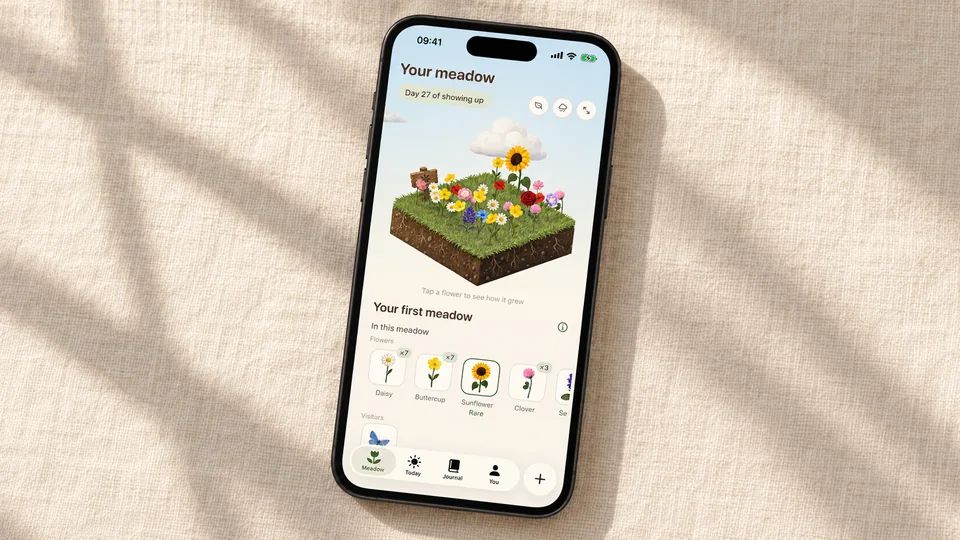
When the goal lives on your phone, showing up gets easier to notice. Meadow is a gentle iPhone app from Wildcard Wellness built for exactly this: you log a walk, a short workout or a few minutes of stretching, and each day you move grows a new wildflower in a meadow that's yours. You can tick off small habits and jot your mood and energy alongside it. There are no streaks, so a rained-off day or a skipped session resets nothing, and the flowers you've already grown stay put. That takes the all-or-nothing edge off the weeks you only manage two sessions out of three. You can try it at Meadow.
A fitness-goal template you can fill in now
You can set a whole goal on a scrap of paper in two minutes. Fill in the blanks, stick it where you'll see it, and you've made the decisions while you're fresh:
Where I am now: ________
The outcome I'm heading towards: ________
My behaviour goal this week: ________ times, for ________ minutes
When and where: after ________ , I'll ________
How I'll track it: ________
My rest day: ________
Bad-week version: ________
Filled in, it might read like this:
Where I am now: I walk the dog most days, no other exercise
The outcome I'm heading towards: Climb the stairs at work without getting out of breath
My behaviour goal this week: 3 times, for 25 minutes
When and where: after I drop the kids at school, I'll walk a brisk loop of the park
How I'll track it: tick on the calendar by the kettle
My rest day: Sunday, no plans
Bad-week version: one 10-minute walk, and that still counts

Expect to adjust it
The first goal you set is a best guess, and best guesses need editing. Building in a review is what keeps a goal alive long enough to work.
Once a week, ask three plain questions. Did I hit the behaviour most days? If not, was it too big, or was the timing wrong? What one change would make next week easier? If a target feels trivial, nudge it up. If you keep missing, shrink it or move it to a time of day that has a real gap in it. Changing the goal isn't quitting on it. It's steering.
And when you miss, which you will, don't wait for Monday or the first of the month to start again. Those clean lines are usually excuses in a nice outfit. Look at what got in the way, tweak the plan for it, and go again at the next chance. For keeping the run going through the flat spells, how to stay consistent with exercise is worth a read.
Common questions
How many fitness goals should I have at once? One behaviour goal, maybe two. Trying to overhaul your cardio, strength, flexibility and diet from the same Monday spreads you thin and most of it collapses by week two. Get one action running until it's close to automatic, then add the next.
How do I set a goal as a total beginner? Start smaller than feels worth it. Two 15-minute walks a week is a real goal if you're starting from none, and it's one you'll hit, which is the point. Add more once showing up feels normal.
Should my goal be about the outcome or the behaviour? Both, with different jobs. Let the outcome, like a weight or a finish time, set your direction. Run your weeks on the behaviour, because the number of sessions you did is the only part you control. Track the behaviour and let the outcome follow.
Are SMART goals enough on their own? The specific and measurable parts of SMART are useful for sharpening a fuzzy intention into a real action. But a rigid measurable target isn't always the best fit, especially for something you're still learning, where a looser goal like "see how far I can walk today" can take the pressure off and work well too.
How fast should I progress? Slowly enough that you don't dread the next session. Step up when the current level feels comfortable for two or three weeks, and drop back a rung if a jump leaves you sore or reluctant.
What if I miss a whole week? Nothing's broken. A missed week is data, not a verdict. Look at what filled the time, set a smaller behaviour goal for the coming week, and begin at the next chance instead of waiting for a fresh Monday.
Pick one behaviour goal right now and write a single line for it: this week I'll [action] [number] times, after [something you already do most days]. Name the day you'll rest, and the smaller version you'll do on a bad week. That's the setup, and it's small enough to finish before you close this page.
AUTHOR
Co-founder of Meadow.
Ash is co-founder of Meadow, a habit and movement tracking app that turns small acts of self-care into a growing wildflower meadow.
See how far you've come
Your habits, moods and little wins, all in one place
Meadow keeps track of the walks, the water and the good days, so you can look back and watch your effort add up.
Download Meadow