Restarting a lapsed habit works best when you shrink it right down, forgive the gap without a lecture, and hook it back onto a cue that comes round every day. You don't begin from zero, because the weeks you already put in didn't vanish the moment you missed a few days.
Most people do the reverse. They wait for Monday, promise a bigger comeback than the original habit ever was, and carry a lump of guilt that makes the whole thing easier to dodge. That's how a three-day gap turns into a three-month one.
This is a guide to the calm version. It covers why habits lapse in the first place, why a lapse leaves your progress mostly intact, and a five-step restart you can run today, with a plan you can copy onto paper.
Why habits lapse in the first place
Habits break for dull, human reasons. A cold. A deadline week. A holiday that scrambles your routine. A bad run of sleep. A house move that quietly removes the cue you were leaning on. The habit didn't collapse because you're weak. It lost its slot in the day.
That last one catches people out. If your walk was pinned to a lunch break and your job changes your lunch, the walk has nowhere to happen anymore. The behaviour was fine. The scaffolding around it moved.
The other common cause is a habit that was too big to begin with. A version built for your best days can't survive your worst ones, so the first hard week knocks it over. When that happens the fix isn't more resolve. It's a smaller habit and a firmer cue, both of which come later in this guide.
Why a lapse doesn't wipe out your progress
Here's the part the guilt hides from you. Missing a few days does very little to a habit you've been building.
When Phillippa Lally's team followed 96 people forming a new habit, a single missed day had little impact on how automatic the behaviour eventually became, whether it happened early on or deep into the study. The same research found the time to reach an automatic habit ran from about 18 days to a projected 254, with wide variation between people. There's no tidy schedule you can fall permanently behind on, and one gap doesn't reset the clock.
So the damage from a lapse isn't the lost days. It's the story you tell afterwards. "I've blown it now" is what turns a skipped Tuesday into a fortnight of nothing, and that spiral is worth naming before it grabs you. Our guide to don't break the chain looks at how a broken streak talks people into quitting, and how to defuse it.
Picture your progress as a path you've been treading through long grass. Skip a few days and the grass springs up a little. Walk it again and it flattens fast, faster than the first time you cut it. You're not starting a new path. You're stepping back onto one that's still there.
Step 1: Forgive the gap before you do anything else
The instinct after falling off is to give yourself a hard time, on the theory that a good telling-off keeps you honest. It does the opposite.
Researchers tracked first-year students across two sets of exams and found that the ones who forgave themselves for procrastinating before the first exam went on to procrastinate less before the second. Forgiveness worked by cutting the negative feeling attached to the slip. Guilt keeps you circling the failure, and while you're circling it you can't move on to the work in front of you.
You don't have to stage a big emotional moment. A plain sentence does it. "I missed a week, that's normal, I'm picking it back up today." Say it, mean it, and let the gap be the exception it was. Being kind to yourself here isn't going soft on yourself. It's clearing the feeling that keeps you stuck so you can start again.
Step 2: Shrink the comeback right down
The strongest urge on a restart is to make up for lost time. You'll want the comeback to be bigger than the original, a punishment run that squares the debt. Resist it. A big first day burns the small amount of momentum you have and sets a bar you'll miss again tomorrow.
Make the restart tiny instead. Smaller than the habit was before the gap. Not a 5k but a walk to the end of the road. Not a full workout but one set. Not thirty minutes of reading but a single page. The point of a tiny first rep is to prove the path is still there, not to reach the finish line.
This is the same logic behind behavioural activation, a technique used in therapy for low mood. It runs on the idea that action comes before motivation, not the other way round. You don't wait to feel like it and then act. You take a small, manageable action, and the motivation shows up afterwards, once you're moving. Waiting to feel ready is how people stay stopped for months.
For the full method of shrinking a habit until it's almost too small to skip, see our guide to tiny habits. On a restart, tiny is exactly what you want.
Step 3: Re-anchor it to a cue
A habit with no fixed moment drifts back to "later", which is where it went to die the first time. Give it a slot again by hooking it onto something you already do every single day.
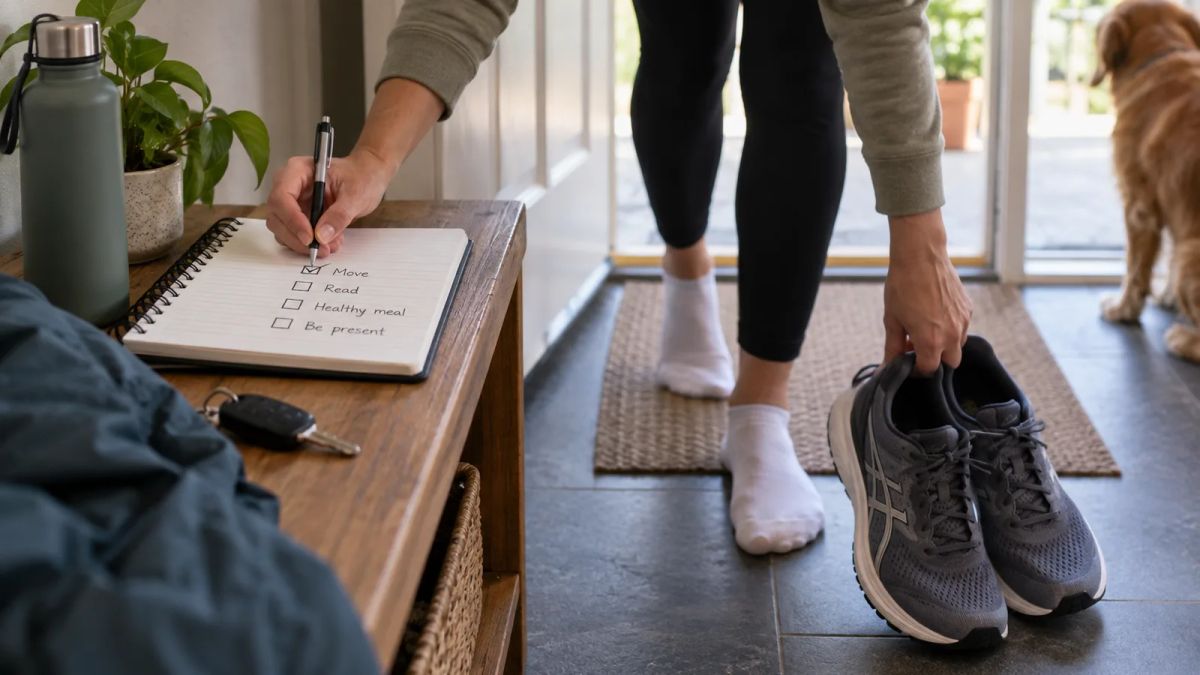
The American Heart Association's advice for making habits stick is to attach the new action to an established routine, so a cue you can't miss does the reminding for you. After I pour my morning coffee, I'll do my stretch. After I sit down at my desk, I'll write one line. After I brush my teeth, I'll lay out tomorrow's kit.
If the old cue is what broke, this is your chance to pick a sturdier one. Choose an event, not a clock time. "After lunch" survives a day that starts late, while "at 1pm" snaps the moment your schedule shifts. Pick the anchor that happens whatever kind of day you're having, and let it carry the habit back into your routine.
Step 4: Borrow a fresh start, but don't wait for one
There's a reason a new week or a new month feels like a natural place to begin again. Researchers call it the fresh start effect. Across a set of field studies, Dai, Milkman and Riis found that gym visits, diet searches and goal commitments all rose right after temporal landmarks like the start of a week, a month, a new year or a birthday. These moments seem to file your past slip-ups under "the old me" and give the fresh attempt a clean page.
You can use that pull. A Monday restart or a first-of-the-month restart borrows real motivation, so if one is close, lean on it.
The trap is treating the landmark as a gate you have to reach before you're allowed to begin. Waiting until Monday hands you five free days of not doing the thing, and by Monday the guilt has grown. So make your own landmark. The next meal, the next morning, the next time your anchor comes round is a fresh start you can name and use right now. Tonight can be day one as easily as Monday can.
Step 5: Never miss twice
Once you're back, the rule that keeps you back is a small one from James Clear. Instead of aiming never to miss, aim to never miss twice.
Missing one day is an accident that happens to everyone. Missing two in a row is the start of the old pattern reasserting itself. As Clear puts it, the trouble isn't the single missed session, it's "the cumulative impact of never getting back on track." So a gap is allowed. A second gap straight after it is the thing to head off.
On a day when even the tiny version feels like too much, do a token version and still count it. One squat. One page. One slow breath. Clear's own examples are that blunt, and they work because they keep you off the all-or-nothing cliff. You kept the thread. Tomorrow you pick the real habit back up.
Your restart plan
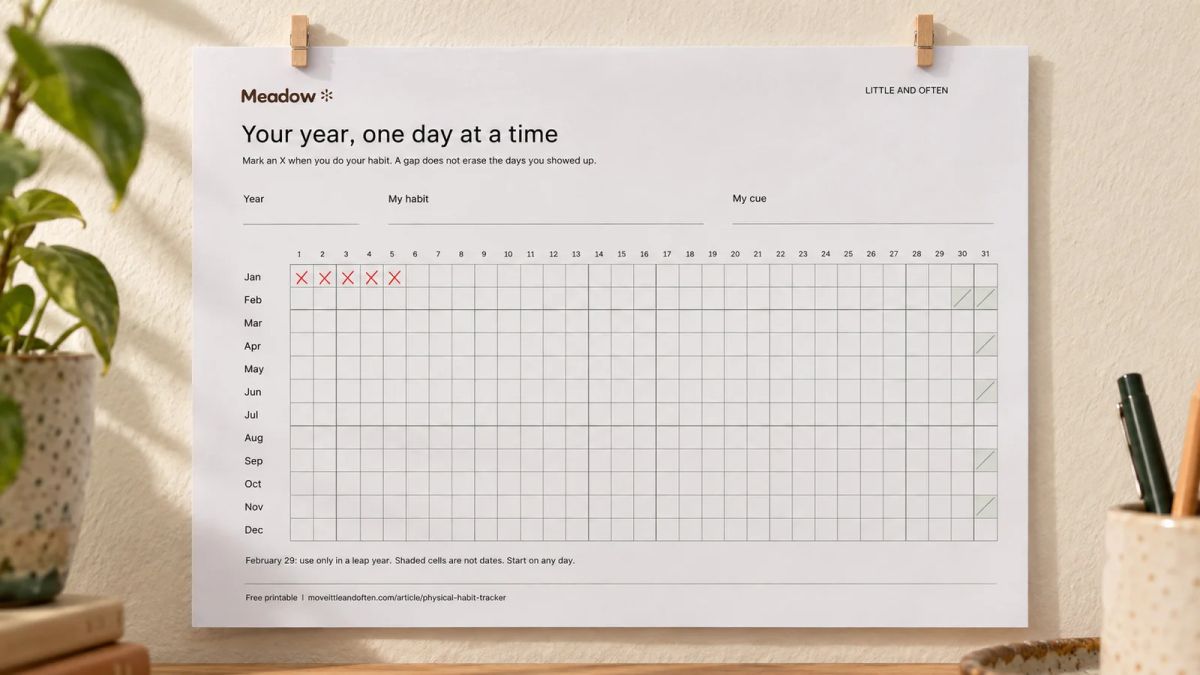
Write this down where the habit is going to happen. It takes the five steps and turns them into a few lines you can fill in tonight. Keep the comeback action smaller than the habit was, and pick an anchor that shows up every day.
The habit I'm restarting: ________________________
My tiny comeback version (smaller than before): ________________________
My cue (after I ________, I will do it): ________________________
My fresh start (name a day or a moment, today counts): ________________________
My rule: never miss twice. Miss one day, back the next.
Filled in, it might read like this.
The habit I'm restarting: a daily walk
My tiny comeback version (smaller than before): ten minutes, once round the block
My cue (after I ________, I will do it): after I finish lunch
My fresh start (name a day or a moment, today counts): this evening, after dinner
My rule: never miss twice. Miss one day, back the next.
That's the whole thing. One small action, one reliable cue, a start point you don't have to wait for, and a rule that stops a single miss from becoming ten.
Open our free Habit restart plan (PDF). Choose a manageable comeback action, a reliable cue and a next opportunity. Use the review space to adjust after a break without catching up. Save or print it; no sign-up needed.
A tracker that lets you pick up where you left off
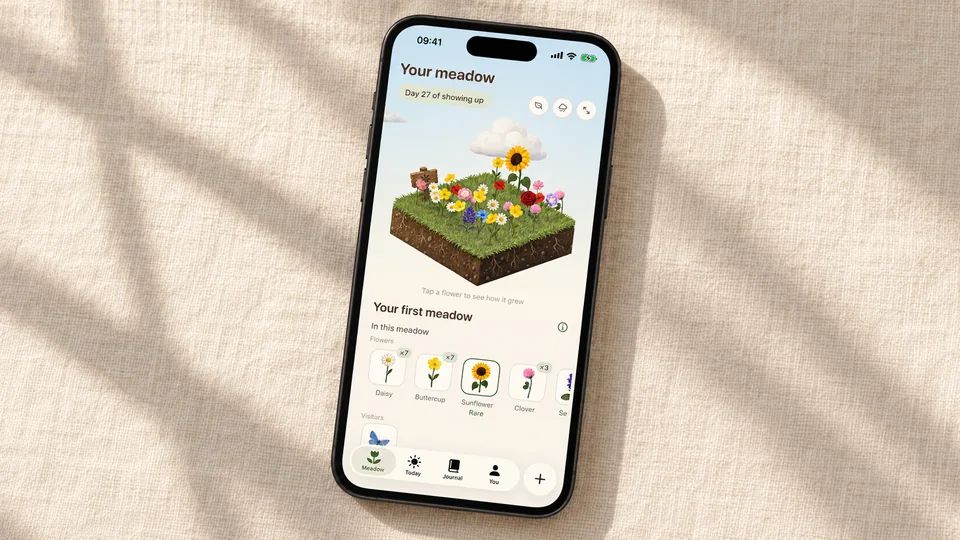
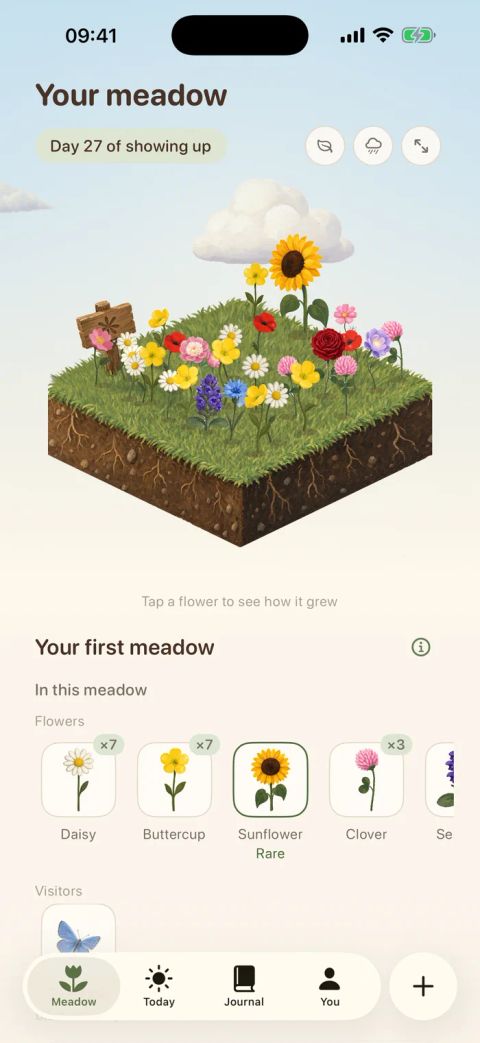
Some weeks hold together and some fall apart, and a habit app that punishes the messy ones tends to get deleted around week three. Meadow is built the other way. It's a movement and habit app for iPhone from Wildcard Wellness, where each day you show up, by logging a walk or a few minutes of yoga or ticking off a small habit, a new wildflower blooms in a meadow that's yours.
The part that fits a restart is what happens when you're away. There are no streaks, so a gap of a day, a week or a month resets nothing. Your flowers never wilt while you're gone, and the meadow is waiting exactly as you left it. You pick the habit back up whenever you're ready and carry on growing it, no penalty and no clean-slate pressure. You can note your mood and energy and jot down a daily win too.
A few common questions
Do I have to start over from day one? No. A short gap does little to a forming habit, and the practice you built before it still counts. You're stepping back onto a path that's already worn, so it flattens quickly.
How long until it feels automatic again? Usually less time than the first go, since the behaviour isn't brand new to you. It varies a lot between people and habits, so judge yourself on whether you're turning up, not on whether it's clicked yet. Our guide to being consistent goes deeper on making a routine hold.
I keep restarting the same habit and dropping it. What's wrong? The habit is probably still too big or badly anchored. Shrink it further and move it behind a cue that fires every day without fail. A habit you keep abandoning is a design problem, not a willpower one.
Should I restart several habits at once? Start with one. Get it running under its own steam, then add the next. A big all-at-once relaunch splits your attention and tends to end with none of them sticking.
Pick the one habit you've fallen off, and write the first two lines of the plan above: the tiny comeback version, and the cue you'll hook it to. Then do that tiny version once today, before the day is out. That single rep is the restart.
AUTHOR
Co-founder of Meadow.
Ash is co-founder of Meadow, a habit and movement tracking app that turns small acts of self-care into a growing wildflower meadow.
Little and often, with Meadow
Consistency, not intensity.
Meadow turns the movement you enjoy and the habits that help you feel good into a meadow of wildflowers. No streaks to break, and your flowers never wilt.
Download Meadow