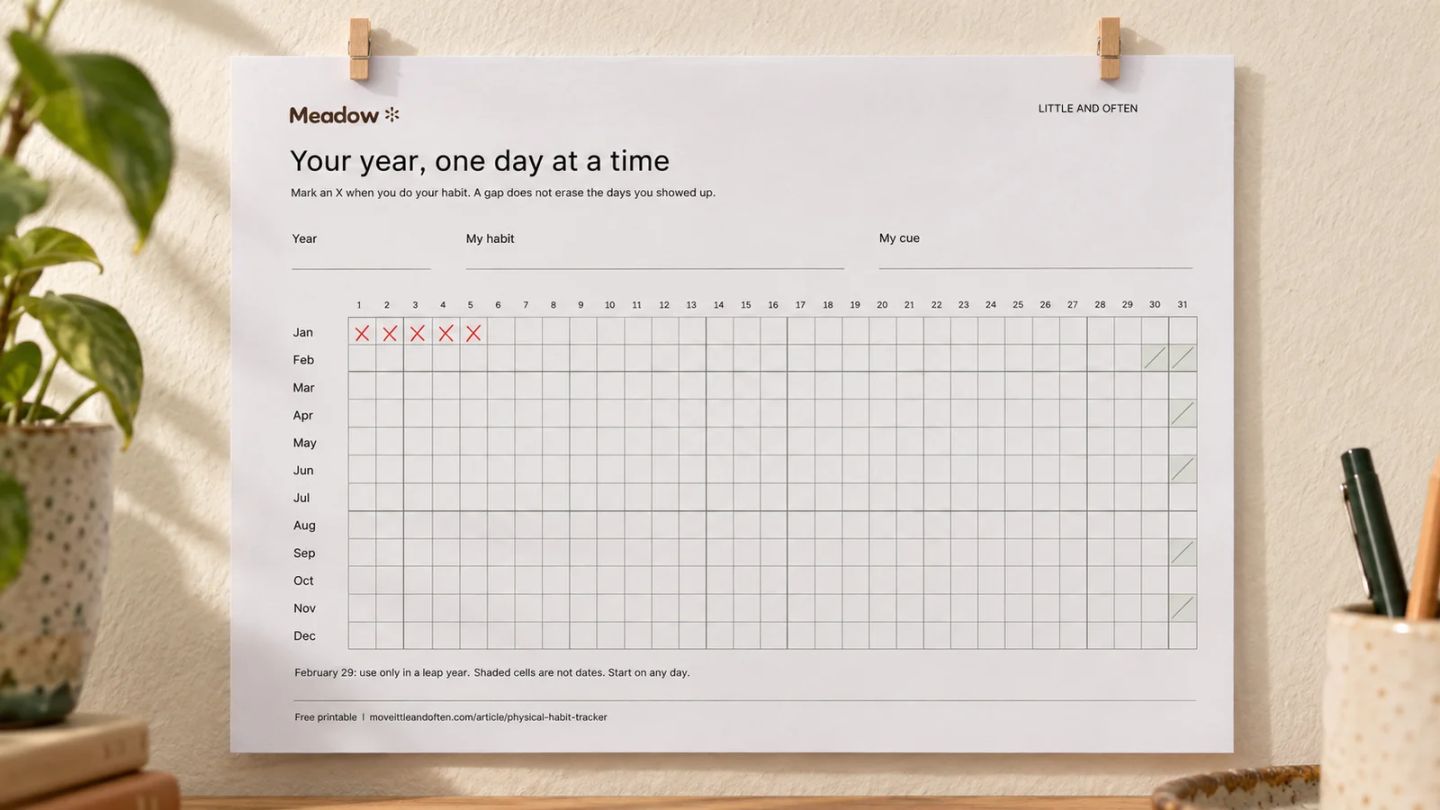
The don't-break-the-chain method is a way to build a habit by marking an X on a calendar every day you do the thing, until the X's join into a chain you won't want to snap. You pick one small action, do it daily, mark the day, and let the growing run of marks pull you back tomorrow.
It's one of the oldest tricks in habit-building, and one of the easiest to get wrong.
Used well, a chain gives you a reason to show up on the days you'd rather not. Used badly, it hands you an excuse to quit the first time life gets in the way. This is a guide to the first version, with an honest look at how the second one traps people and how to sidestep it.
Where the idea came from
The method usually gets called the Seinfeld strategy, and that name does a lot of heavy lifting.
The story comes from James Clear, who recounts how a young comedian named Brad Isaac cornered Jerry Seinfeld backstage and asked for advice. Seinfeld told him to get a big wall calendar and a red marker, and to put a fat red X over every day he wrote new material. "After a few days you'll have a chain," and from then on the job is plain: "Your only job is to not break the chain."
That's the whole idea. It's a good one, and it spread fast through productivity blogs in the 2000s.
Worth keeping in mind, though: the tale rests entirely on one comedian's memory of a backstage chat, passed along secondhand. Seinfeld never wrote it up as a method of his own. So treat his name on it as a nickname more than a claim to the invention, and take the rule itself on its merits.
How the method works
You need a calendar you'll see every day and something to mark it with. That's it. No app required, though plenty exist.
- Pick one action, and keep it small. Write for ten minutes, do five press-ups, read a page. Small enough that a bad day can't stop you.
- Do it today. Only once you've done it do you get to mark the day.
- Put a big X on the calendar, or a tick, or a colour in the box.
- Do the same tomorrow, and the day after, so the marks line up into a chain.
- Keep the chain going. Once it's a week long, then a fortnight, the run itself becomes the thing you're protecting.
Here's a blank tracker you can copy onto paper or a whiteboard. One box per day, one line per week.
My daily action: ______________________
The rule: do the action, then mark the box
Week 1 ☐ ☐ ☐ ☐ ☐ ☐ ☐
Week 2 ☐ ☐ ☐ ☐ ☐ ☐ ☐
Week 3 ☐ ☐ ☐ ☐ ☐ ☐ ☐
Week 4 ☐ ☐ ☐ ☐ ☐ ☐ ☐
Filled in after a few weeks, it might look like this.
My daily action: ten minutes of stretching before bed
The rule: do the action, then mark the box
Week 1 ☒ ☒ ☒ ☒ ☐ ☒ ☒
Week 2 ☒ ☒ ☒ ☒ ☒ ☒ ☒
Week 3 ☒ ☒ ☒ ☒ ☒ ☒ ☒
The one empty box in week one is the point of the next few sections, so keep it in view.
Why the chain pulls you along
A chain works on you in two ways at once, and both are backed by more than a comedian's word.
The first is that you can see your progress. Watching a run of days build up is a form of tracking, and tracking your progress toward a goal tends to make you more likely to reach it. A meta-analysis by Harkin and colleagues, pulling together 138 studies, found that prompting people to monitor their progress reliably improved their odds of hitting the goal. The calendar turns an invisible effort into something you can point at.
The second is that you don't want to lose it. Once you've got twenty days in a row, that chain is something you own, and losing it stings. Behavioural scientists call this loss aversion. As The Decision Lab puts it, "the emotional impact of a loss is felt more intensely than the joy of an equivalent gain," roughly twice as strongly in Kahneman and Tversky's original work. A long chain flips the daily question from "do I feel like it?" to "am I willing to throw this away?"
James Clear likes the method for a third reason, which is that it takes your mood out of the decision. It's "not about how you feel, how inspired you are, or how brilliant your work is that day," he writes. What's left is keeping the chain alive. On a flat day you don't have to feel motivated. You only have to turn up.
The trap nobody mentions
Everything that makes a chain powerful is aimed at one moment, and it all points the wrong way the second you miss a day.
Say you're forty days in and you miss one. The chain is broken. That same loss aversion that got you off the sofa for a month now tells you the thing you were protecting is gone, so why bother. The count resets to zero, and starting again from nothing feels far harder than protecting forty.
This is a real and studied pattern. In addiction and dieting research it's known as the abstinence violation effect, or more plainly the "what the hell effect". Psychology Today describes it as the moment someone slips and "perceives it as evidence of personal failure, leading to increased feelings of guilt, shame, and hopelessness". One missed day gets read as proof you were never going to manage it, and the whole project goes in the bin.
The cruel bit is that the missed day did almost nothing on its own.
When Phillippa Lally's team followed people building a new habit, a single skipped day barely dented their progress. As the British Psychological Society reported, "a single missed day had little impact on later automaticity gains, either early in the study or later on." The same study found the time to reach an automatic habit ran from 18 days to a projected 254, with wide variation between people, so there's no neat schedule you can fall behind. The chain says one break ruins everything. The evidence says it doesn't.
So the danger isn't the missed day. It's what the broken chain talks you into doing next.
Never miss twice
The fix is a small change to the rule, and it comes from James Clear.
Instead of "never break the chain", the rule becomes never miss twice. Miss Monday, fine, that happens to everyone. Your only job is to be back on Tuesday. In Clear's words, "Missing once is an accident. Missing twice is the start of a new habit."
That one line pulls the sting out of a broken chain. A single gap is a normal part of a long run, not a failure that wipes the slate. Two gaps in a row is the thing to watch, because that's where the old pattern starts to reassert itself.
If you like the chain, keep it, but write "never miss twice" at the top of the calendar so a stray empty box can't send the whole thing over a cliff. Our guide to how to be consistent goes deeper into building that kind of resilience into a routine.
How to use a chain kindly
A chain is a tool, and you can file down its sharp edge before it cuts you. A few adjustments help.
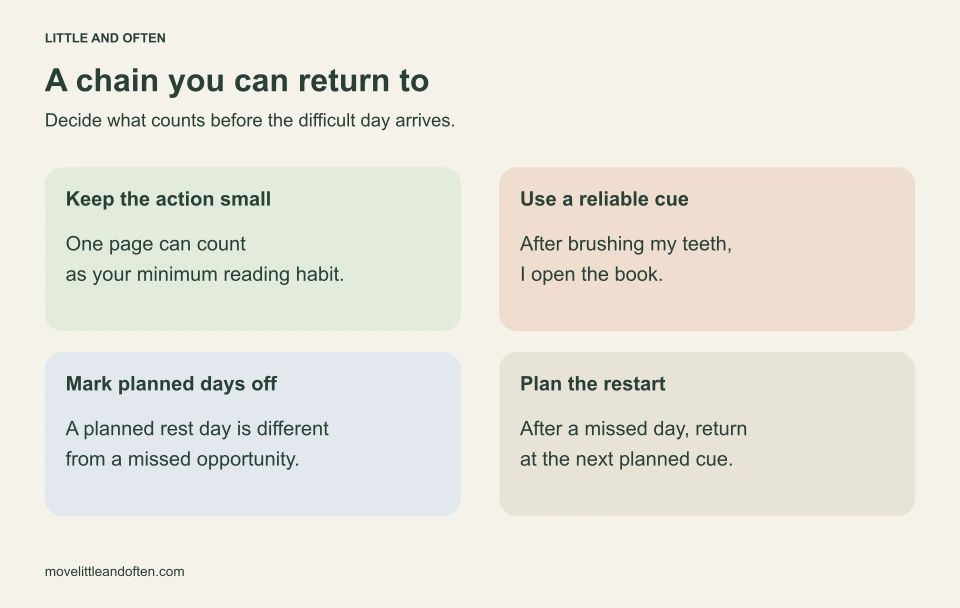
- Make the daily action small enough to survive your worst day. If you can do it while tired, ill or busy, the chain holds through the weeks that would otherwise break it.
- Anchor it to something you already do. The American Heart Association suggests attaching a new behaviour to an existing routine, so "after I brush my teeth" beats "at some point in the evening".
- Keep a minimum version for hard days. One press-up still counts. One page still counts. A tiny effort keeps the chain alive and keeps you out of the all-or-nothing corner.
- Plan the restart before you need it. Decide now that a missed day means you go again tomorrow, no drama, no starting-Monday. The decision's easier to make when you're not sitting in the guilt.
- Build in days off if the habit needs them. A rest day you scheduled isn't a broken chain. Mark it as planned and the run continues.
If a paper calendar isn't your thing, a dedicated tracker can hold the chain for you and nudge you at the right time. Our roundup of the physical habit tracker options covers the wall charts and cards worth using, and if you want to understand the machinery underneath all this, the habit loop explains why a cue, an action and a reward turn into something automatic.
A tracker that forgives a missed day

The chain works right up to the moment it snaps, and that snap is where most people fall off. Meadow keeps the good part of the idea and drops the risky part.
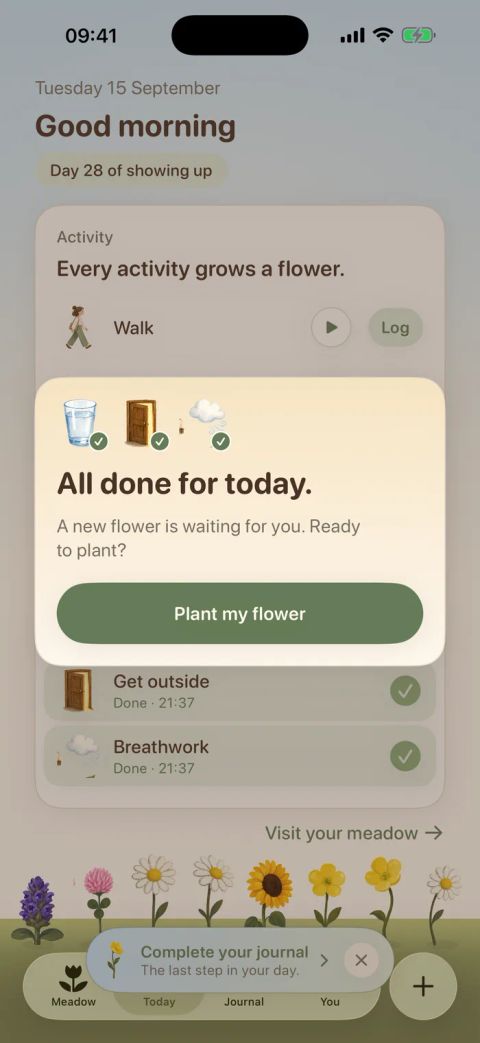
It's a gentle movement and habit app for iPhone from Wildcard Wellness. You log a walk or a few minutes of yoga, tick off small daily habits, and note your mood and energy, and each day you show up a new wildflower blooms in a meadow that's yours alone. That gives you the same visible progress a chain does, something you can watch build day by day. The difference is there are no streaks to break. Miss a day, a week or a month and nothing resets, your flowers never wilt, and you pick up whenever you're ready. It's built for turning up often over turning up perfectly.
Frequently asked questions
What is the don't break the chain method?
It's a habit trick where you do a chosen action every day and mark each day on a calendar. The marks form a chain, and the aim is to keep the run of days unbroken, which gives you a reason to show up even when motivation is low.
Did Jerry Seinfeld invent it?
Probably not in any strict sense. The story that attaches his name to it comes secondhand, from a comedian recounting a backstage conversation, and Seinfeld never set it out as a method himself. The rule is useful whoever first said it.
What should I do if I break the chain?
Start the next day, not next Monday. Swap the goal from "never break the chain" to "never miss twice", so one gap is an accident and your only task is to avoid a second one in a row. A single missed day does very little to a forming habit.
Does missing one day ruin a habit?
No. In Phillippa Lally's habit research, one missed day had little effect on how automatic the behaviour eventually became. What does more damage is the decision to abandon the whole thing after that one miss.
Is the don't break the chain method good for everyone?
It suits people who find a visible streak motivating. If a broken chain tends to make you give up entirely, a no-streak approach that counts every day you show up without punishing a gap will likely serve you better.
One thing to do today
Pick one small action and start a chain today, and before you mark the first box, write "never miss twice" at the top of the calendar. That single note is the difference between a chain that carries you for months and one that snaps the first busy week and takes your motivation with it. Do the action, mark the day, and let a missed box in the future be a shrug, not the end of the whole thing.
AUTHOR
Co-founder of Meadow.
Ash is co-founder of Meadow, a habit and movement tracking app that turns small acts of self-care into a growing wildflower meadow.
Every little bit counts
Five minutes counts. So does a dance in the kitchen.
Log the movement you enjoy and the small habits that help you feel good, and watch them bloom into something you can see.
Download Meadow