Discipline and consistency get treated as two separate virtues, one about force of will and one about routine. In practice they're two halves of one move. Discipline is the decision you make once, ahead of time, while you're clear-headed and a bit ambitious. Consistency is what happens when that decision runs on a cue and repeats until you no longer have to make it.
Put the two together and the effort drops. You spend a little discipline setting things up, then consistency does the day-to-day work for you.
Most advice pushes you the other way. It tells you to want it more, to summon discipline fresh each morning and grind out the streak. That holds until the first tired Tuesday. This guide covers what discipline amounts to once you drop the gritted-teeth version, why consistency comes from cues and systems instead of mood, and how to wire the two together, including the parts that get skipped: the small version for hard days, and how to restart after you slip.
How discipline and consistency feed each other
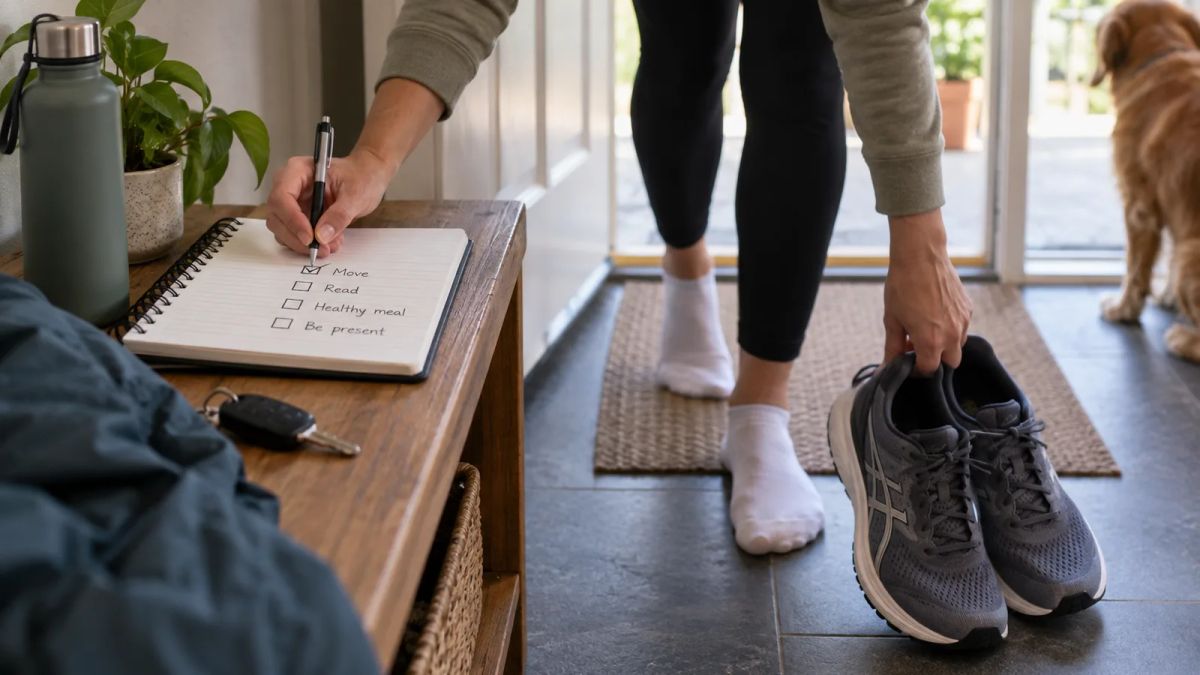
Take a single habit, say a short walk after lunch. The discipline part is everything you settle in advance. You decide the walk happens, you decide when, you put your shoes by the door, you agree with yourself that a wet day still counts as one lap. None of that needs willpower in the moment, because you're doing it up front, once.
The consistency part is the walk turning up in the same slot day after day until it stops feeling like a choice. Each repeat wears the groove a little deeper. After enough goes, lunch ending is the thing that gets you up, not a pep talk.
Discipline builds the track and consistency is the train running on it. Lean only on discipline and you're laying fresh track every morning, which is exhausting. Lean only on consistency without setting anything up and there's no track to run on. You need the one to create the other.
Discipline is mostly setup, done in advance
The picture of the disciplined person as someone white-knuckling their way past every temptation turns out to be wrong. People who score high on self-control report fewer struggles with temptation, not more.
In a set of six studies, Brian Galla and Angela Duckworth found that people with better self-control leaned on beneficial habits rather than effortful resistance, and that those habits were what linked self-control to good outcomes. Their good behaviours ran on autopilot, so there was less to resist to begin with. The discipline had already been spent, earlier, on building the routine.
It helps to be sceptical of the old willpower-as-fuel-tank idea while you're at it. The famous version, called ego depletion, came from a 1998 experiment suggesting that resisting one temptation leaves you weaker at the next. When 23 labs re-ran it with about 2,000 people under agreed rules, the pooled effect came out close to zero. The debate isn't fully settled, and some researchers think it holds for some people and not others, possibly driven by what you believe about your own willpower. Either way, planning your life around a draining meter is a weak bet. Make the hard calls once, when you're fresh, and let the setup carry them.
Consistency runs on cues you can't miss
Motivation is the least reliable thing you own. It's high when you're rested and inspired, gone by the end of a long day, which is exactly when most habits are meant to happen.
What keeps a behaviour going instead is the cue. Strong habits are set off by the situation around them. In two studies of daily life, David Neal, Wendy Wood and colleagues found that well-worn habits were triggered by context cues like location and the preceding action, and were relatively unaffected by people's current goals. The kettle boiling, sitting down at your desk, the front door closing behind you, these do the prompting once a habit is established, without you deciding anything.
That's the reason systems beat willpower for consistency. A system is a small action tied to a reliable cue, so it fires on the cue instead of on how you feel. Your job is to build the cue-and-action pair a few times on purpose. After that the cue takes over the reminding.
Design the space so the good choice is the easy one
The strongest tactics change your surroundings so the pull is weaker before it arrives. Duckworth and colleagues call these situational strategies. In two studies of nearly 20,000 teenagers preparing for exams, those who used at least one such strategy did more practice and scored higher, while relying on willpower alone predicted less. The effect per strategy was modest, but it stacked, and it came from design, not grit.
Decide these once and they keep paying off. Each one is a choice your future self no longer has to win.
- Want to move in the morning? Lay your kit out the night before and put your trainers by the door.
- Want to drink more water? Fill a bottle and leave it where you sit, not two rooms away in the kitchen.
- Want to stop scrolling in bed? Charge the phone in another room and buy a cheap alarm clock.
- Want to snack less at your desk? Keep the biscuits in a cupboard you have to stand up and walk to.
Start smaller than feels worth it
The most common reason a run collapses is that people build the habit for their best days, and their best days aren't most days.
Shrink the action until it's almost too small to skip. Not a workout but one set. Not thirty minutes of reading but one page. Not a run but your trainers on and out the door. A version this small survives a rushed, flat, unmotivated evening, and those are the conditions a habit has to live through to last. On the days you've got more in you it grows by itself, but the official target stays tiny, so a bad day still ends with the box ticked. Our guide to tiny habits has the full method.
Keep the ambition for the size of the goal and the patience for the size of the daily step.
Anchor the new action to one you already have
A habit with no fixed moment drifts to a vague "later" that never comes. Bolt it onto something that already happens every day without you thinking. The American Heart Association's advice for making habits stick is to attach the new behaviour to an established routine, so a cue you can't miss does the reminding.
The sentence to fill in is: after I [something I already do], I will [the new thing]. After I pour my morning coffee, I'll take my vitamins. After I sit down at my desk, I'll write one line in my journal. Pick an event, not a clock time, because "after my morning tea" survives a day that starts late, while "at 8am" breaks the moment your morning slips.
Track it lightly
A tick a day does two small jobs. It gives you a hit of "done" in the moment, and over weeks it shows the pattern you're building on days you can't feel any progress. Keep it dead simple, a line in a notebook or a mark on a calendar by the kettle, something that takes two seconds where the action happens.
Here's a plan you can copy onto a scrap of paper. The top half is the discipline part, decided once. The bottom row is the consistency part, ticked daily.
Goal: ________
Tiny daily action: ________
After I ________ , I will ________
One thing I'll make easier: ________
Bad-day version: ________
Mon ☐ Tue ☐ Wed ☐ Thu ☐ Fri ☐ Sat ☐ Sun ☐
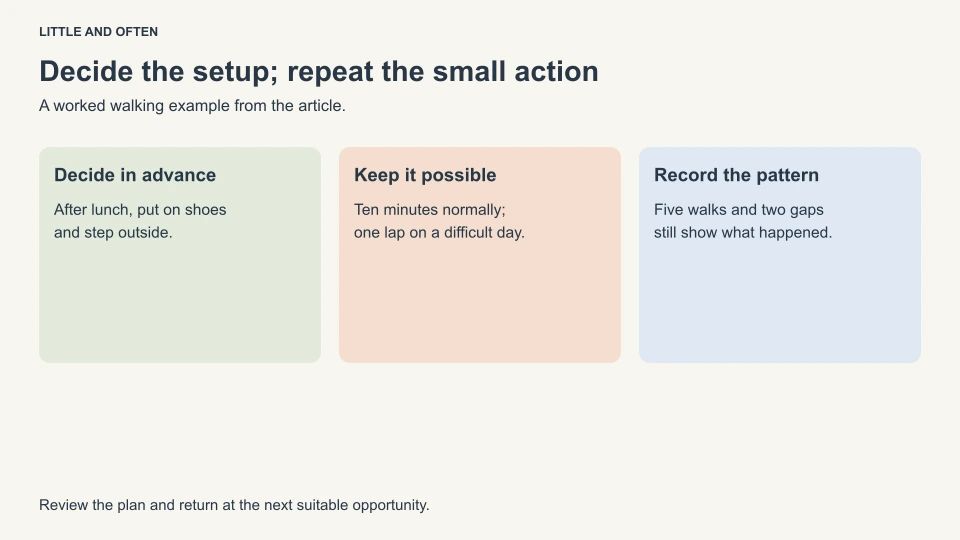
Filled in, it might read like this:
Goal: Move most days
Tiny daily action: A ten-minute walk
After I finish lunch , I will put my shoes on and step outside
One thing I'll make easier: Shoes by the door, work laptop shut
Bad-day version: One lap of the block
Mon ☑ Tue ☑ Wed ☐ Thu ☑ Fri ☑ Sat ☐ Sun ☑
Two missed days there, five kept, and the habit lives on. That's a good week.
Forgive the slip so one miss doesn't end the run
You will miss days. A cold, a bad night, a work crisis, a birthday. What decides whether a single gap becomes a fortnight of nothing is the story you tell yourself after.
The research is calm about it. In a real-world study of how habits form, Phillippa Lally and colleagues tracked people over 12 weeks and found that missing a single opportunity had no meaningful effect on the habit taking hold. The same study found that the time to reach automatic behaviour varied enormously from person to person, so there's no tidy number of days to hit and no clock you're failing against. One skipped walk doesn't undo the weeks behind it.
The rule worth holding is to never miss twice. One gap is an accident. Two in a row is the start of a new pattern, the one where you don't do the thing. Don't wait for Monday or the first of the month, because those clean lines are excuses in disguise. The next chance is the next meal, the next morning, the next time your anchor comes round.
A place to keep discipline and consistency in one spot

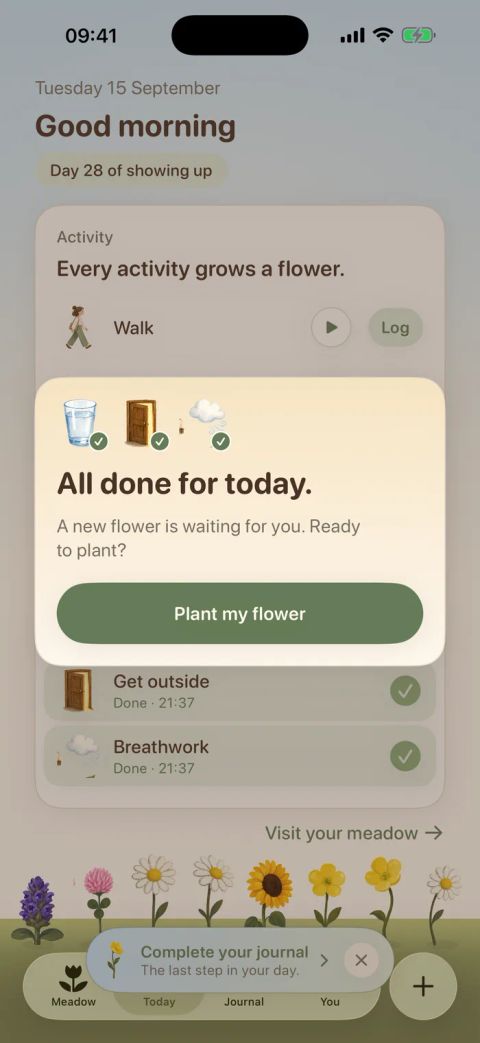
Some weeks go to plan and some don't, and it helps to have somewhere the setup and the daily tick live together. Meadow is a gentle iPhone app from Wildcard Wellness built around that idea. You tick off a small habit or log a little movement, note your mood and energy if you fancy, and each day you show up grows a new wildflower in a meadow that's yours. Because there are no streaks, a missed day resets nothing and the flowers you've grown stay put, which is the never-miss-twice habit made easy to come back to.
Common questions
Which comes first, discipline or consistency? Discipline, by a nose. You use a small burst of it to set the thing up, to pick the action, the cue and the easy version. Consistency is the payoff that follows once the setup starts running on its own.
Do I need more willpower to be consistent? Usually less than you'd think. Consistency comes from a small action on a reliable cue, not from a bigger reserve of willpower. If you keep skipping a habit, that's a sign it's too big or badly placed, not that you're weak. Shrink it or move it behind a steadier anchor.
How long until it feels automatic? Longer than the "21 days" you'll see quoted, and it varies a lot between people and between habits. Judge yourself on whether you're still turning up, not on whether it's clicked yet. Our guides to self-discipline and how to be consistent go deeper on each half.
What if I've already fallen off? The record you built before the gap still counts, and the next rep is available right now. Falling off and climbing back on is the normal shape of this, not proof you've done it wrong.
Pick one goal and write a single line for it: after [something you already do every day], I will [the smallest honest version of the action]. Then change one thing in the room to make that action easier. The first line is the discipline, the daily repeat is the consistency, and the whole thing is small enough to set up before you close this page.
AUTHOR
Co-founder of Meadow.
Ash is co-founder of Meadow, a habit and movement tracking app that turns small acts of self-care into a growing wildflower meadow.
Every little bit counts
Five minutes counts. So does a dance in the kitchen.
Log the movement you enjoy and the small habits that help you feel good, and watch them bloom into something you can see.
Download Meadow