There is no set number of miles you have to walk in a day, and no distance your body treats as a pass mark. What research links to better health is the total amount you move and how much effort it takes, and a mile is only a rough way of measuring either of those. The distance worth aiming for is the one you can repeat on an ordinary week, not a figure printed under a photo of a mountain trail.
Miles are still a handy way to picture a walk, especially if you already think in terms of the shop, the school gates, or a friend's front door. So it helps to know how distance, steps and the official activity guidance line up, and then how to land on a distance that survives a busy week.
Steps and miles, roughly translated
If you count steps, you can turn them into miles with a rough rule. Most estimates put a mile at around 2,000 steps, rising to about 2,500 for many people, and the figure varies from one person to the next.
Stride length is the main reason. A taller person covers more ground with each step and reaches a mile in fewer of them, while a shorter person takes more steps for the same distance. Your pace nudges it too, because a slower amble tends to mean shorter steps and a higher count.
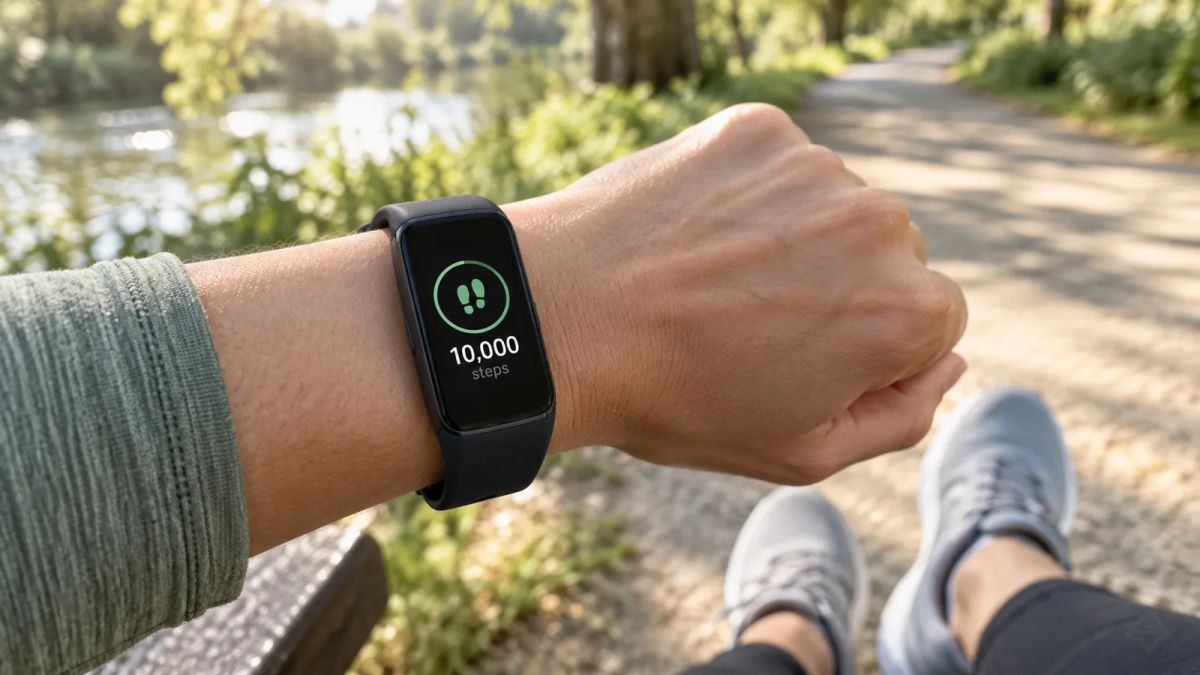
So if your phone reads 5,000 steps, you have covered somewhere in the region of two to two and a half miles. Ten thousand steps lands nearer four to five. These are ballpark figures, not precise measurements, and the step targets themselves are a subject of their own. We cover those in our guides to how many steps a day and 10,000 steps a day, so here the distance is the point.
If you want a conversion that fits you rather than an average, it takes about ten minutes to work out:
- Pick a stretch you can measure, such as a lap of a park or a road you can check on a map.
- Note your step counter, walk the stretch at your normal pace, and note it again.
- Divide the distance in metres by the steps you took to get your stride length, or simpler still, walk a measured mile and read the total.
- Use that number from then on instead of a generic 2,000.
Why no single mileage holds up
Distance is a proxy, and the things it stands in for do not point at one tidy answer. When researchers look at walking and health, they tend to measure either the total volume of movement or the time spent at a certain effort, not the miles on a map.
The largest pooled analysis of daily steps and death, led by Amanda Paluch and drawing on 15 studies of nearly 50,000 people, found that people who walked more had a lower risk of dying early than those who walked least. The benefit rose with more steps and then levelled off at roughly 6,000 to 8,000 steps a day for adults over 60, and around 8,000 to 10,000 for younger adults. In rough miles, that is somewhere between three and five. This is an association rather than proof that walking alone caused the difference, and the plateau means piling on extra miles beyond that point showed little added benefit for longevity.
The amount of activity a body needs also differs from person to person. The CDC notes that the exact amount of physical activity needed to stay a healthy weight varies greatly between individuals, which is another reason a one-size mileage falls apart. Your height, your baseline fitness, your health and the terrain all change what a given distance asks of you.
More is not always better, either. A Healthline review of walking ten miles a day points out that very high daily distances take three to four hours and raise the risk of overuse injuries such as shin splints and knee pain, without adding much once you are already active. A distance you can hold week after week beats a heroic one you abandon by Thursday.
How miles fit the 150-minute guidance
UK guidance is built around time and effort, which is why it never hands you a mileage. The NHS recommends that adults aged 19 to 64 aim for at least 150 minutes of moderate activity a week, or 75 minutes of vigorous activity, plus strengthening work on two or more days.
Brisk walking counts as moderate activity. The NHS describes a brisk pace as one where you can still talk but cannot sing, and puts it at about three miles an hour. At that speed, 150 minutes a week comes out at roughly seven and a half miles across the week, or a little over a mile a day if you walk daily.
You do not have to reach that in one push. A brisk 10-minute walk counts towards the weekly total on its own, so three short walks can do the same work as one long one. Splitting the distance often makes it far easier to fit around a job and a home.
Worth keeping in mind: the effort of a walk changes what it gives you. Two miles round the shops and two miles at a pace that leaves you slightly breathless read the same on a map but are not the same walk. Pace is one lever, total distance is another, and both matter more than any single mileage. For more on what regular walking does for the body, our guide to the benefits of walking goes further. Adults aged 65 and over have their own NHS guidance, which keeps the focus on regular movement across the week rather than a set distance.
Choosing a distance that fits your day
Rather than starting from a number, start from your day. Look at where a walk could sit without a fight: the length of a lunch break, the trip to collect someone, the loop you can manage before dark. Work out roughly how far that is, in miles or minutes, and let that be your starting distance.
A half-mile walk to the postbox and back is a real walk. So is a slow ten minutes around the block with a pram, or a lap of the ward corridor on a bad-weather day.
The distance that fits a shift worker's odd hours, or a carer who cannot be out for long, or a budget that rules out the bus to a nicer route, is the distance worth choosing. A target you cannot reach on a normal week is no more virtuous than a shorter one you keep.
If you are coming back to activity after a long gap, or you have a health condition or any concerns about walking, it is worth speaking to your GP before you build up, because no general distance can account for your particular situation. Once you have a starting point, increase it gradually and give a distance a week or two before you decide whether to stretch it.
Smaller on hard days, and picking it back up
Some days the distance you picked will be too much, and shrinking it on purpose beats skipping it. If your usual walk is a mile, go to the end of the road and back. If even that is too much, step outside for two minutes.
A short walk keeps the habit alive in a way a missed one does not, and it protects the routine for the day the distance feels easy again.
Missing a day, or a week, is not the habit broken. How long a walk takes to feel automatic varies a great deal between people, and one gap does not undo the progress you have made. Pick the next realistic slot and take the walk you can manage that day, at whatever distance fits.
Common questions about walking distance
Is a mile a day enough?
For someone doing little at the moment, a daily mile is a solid start and lines up with a good chunk of the 150-minute weekly target if you walk it briskly. It may not reach the step range associated with the biggest longevity benefit on its own, but a mile you keep beats a longer distance you drop.
Is two miles a day a good goal?
Two brisk miles a day, walked most days, puts you comfortably past the weekly 150 minutes and near the lower end of the step range linked with lower mortality risk. It is a realistic, repeatable goal for many people, which matters more than the exact figure.
How many miles is 10,000 steps?
Around four to five miles for most people, depending on stride length and pace. If weight is your focus, distance is only part of the picture and diet does most of the work, as our guide to walking for weight loss explains.
Keeping honest track of the walks you take
Marking each walk gives you something real to look back on, which tends to help more than aiming for the same mileage every day. A tick on a wall calendar does the job, and so does a note on your phone. The trick is to record the walk you took, not the one you meant to take.
Meadow, without the streak

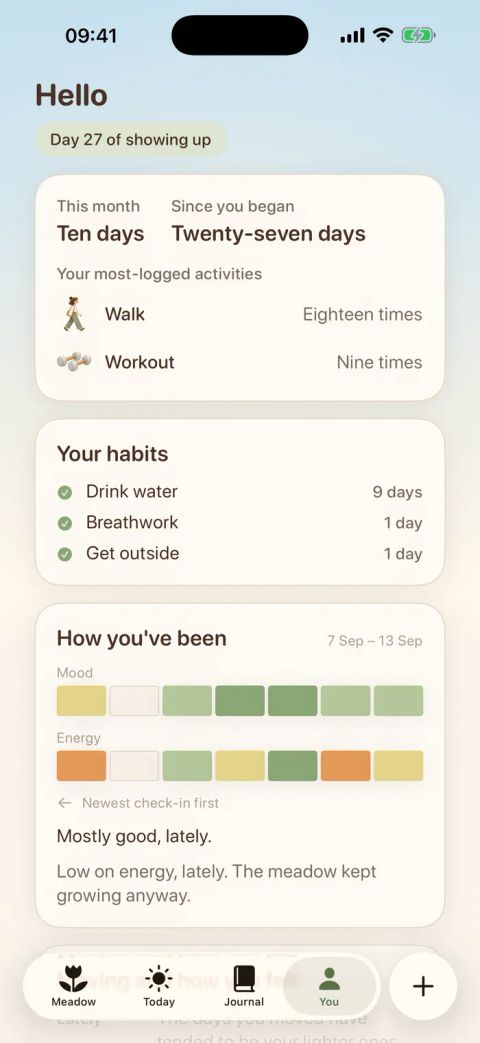
Another app worth checking out is Meadow, because it treats a walking habit as something that grows over weeks rather than a run of perfect days. Made by Wildcard Wellness for iPhone, it lets you log movement you enjoy, from a walk to a little yoga, tick off small daily habits, and note your mood, a daily win and an affirmation. Every day you show up grows a wildflower, and rare flowers and small animal visitors turn up over time. There are no streaks, so a missed day resets nothing and your flowers never wilt, which suits a habit measured in miles that add up quietly. It costs $39.99 a year or $9.99 a month after a seven-day free trial.
For tomorrow, pick one walk and one distance you are confident you can cover, decide when and where it happens, and leave the number there. A mile if a mile fits, less if it does not. The distance that repeats is the one worth having.
See how far you've come
Your habits, moods and little wins, all in one place
Meadow keeps track of the walks, the water and the good days, so you can look back and watch your effort add up.
Join the Meadow waitlist