The average person walks somewhere between one and a half and two and a half miles a day. Most of that happens without any planning, in trips to the kitchen, the car park, the office and back again.
That figure comes from turning step counts into distance. Researchers can measure how many steps people take far more easily than how far they walk, so the honest route to a mileage runs through steps. The common rule is about 2,000 steps to a mile, which puts the global average of roughly 5,000 steps a day at around two and a half miles.
Steps are the sturdier number, though, and the conversion to miles wobbles from one body to the next. So it helps to see where the average steps come from, how far that is in miles, and how much the figure shifts once you split people by country, age and the work they do.
Where the average comes from
The biggest picture we have of everyday walking comes from a Stanford study that read step data from the phones in people's pockets. It covered 717,527 people across 111 countries and found a global average of about 5,000 steps a day. At 2,000 steps to a mile, that's around two and a half miles.
A US pedometer study puts the American figure a little lower. Adults there averaged 5,117 steps a day, close to two and a half miles, with men on about 5,340 and women on about 4,912. The phone study landed lower still for the US, at 4,774 steps, a shade under two and a half miles. Different tools count slightly differently, which is part of why any single mileage is a range and not a point.
That makes "two miles a day" a fair shorthand for a typical adult, as long as you hold it loosely.
How steps turn into miles, and why it wobbles

The 2,000-steps rule is an average built on an average. It assumes a stride of somewhere between 2.1 and 2.5 feet and a comfortable pace, and the underlying figures from a 2007 study in an American College of Sports Medicine journal ranged from about 1,900 to 2,300 steps for a mile of walking, depending on speed and height.
Stride length is the main reason two people can walk the same mile and log different counts. A taller person covers more ground per step and reaches a mile in fewer of them. Pace nudges it too, since a slow amble means shorter steps and a higher tally for the same distance.
The mileage you read off a step count is a decent estimate, not a survey measurement. If you want a conversion that fits your own legs, walk a route you can measure on a map at your normal pace, note the steps, and divide the distance by them. We go deeper into that in our guide to how many miles should you walk a day.
It changes a lot by country
The global average hides big gaps between countries. In the phone study, Hong Kong came top at 6,880 steps a day, about three and a half miles, followed by China at 6,189, near three miles. At the other end, Indonesia averaged 3,513 steps, closer to one and three quarter miles.
Other datasets put Japan around 7,168 steps, roughly three and a half miles, and the UK near 5,444, a touch over two and a half. The Stanford researchers also found that a country's average step count told you less about its obesity rate than its "activity inequality", the gap between its most and least active people. Where that gap was wide, obesity ran higher.
The "average person", then, walks a different distance depending on which country you stand them in, and the spread runs from under two miles to about three and a half.
And by age, sex and job
Within any one country, the average splits again. Men walk a little more than women on the pedometer numbers above, though the gap is small, a few hundred steps or roughly a fifth of a mile.
Age pulls harder. Daily steps tend to hold up through the twenties and thirties and then slide, with the fall steepening after 75. An older adult averaging 3,000 to 4,000 steps is covering more like one and a half to two miles, and that's a normal shift, not a personal failing.
Work decides a surprising amount of it. A review of step counts across jobs found office and call-centre staff among the least active, at roughly 3,600 steps during work hours, while postal delivery workers topped the list at about 16,100 steps a day, close to eight miles. Whether your day involves a chair or a round sets your baseline before you choose to move at all.
How the average compares to the advice
Here the descriptive number and the healthy number part ways. The typical two-and-a-bit miles a day sits below where the health benefits of walking start to level off for most people.
Work led by I-Min Lee at Harvard found the benefits climbing well before 10,000 steps, with 7,500 steps giving the same lower risk of early death as 10,000. Later research put the plateau at about 6,000 to 8,000 steps a day for people over 60, and 8,000 to 10,000 for younger adults. In miles, that band runs from roughly three to five.
A global average near 5,000 steps, then, lands under the lower edge of that range for younger adults and at the bottom of it for older ones. The average person walks a fair way, and a bit more would likely do most of them good. We cover the target side of this in how many steps a day.
Distance is only half the story, though. UK guidance skips mileage and asks adults aged 19 to 64 for at least 150 minutes of moderate activity a week, plus strengthening on two days. A lot of the average person's daily miles are gentle, incidental steps rather than brisk ones, and effort counts for something a step total cannot see. The CDC makes a similar point from the other direction, noting that the amount of activity a body needs varies greatly from person to person.
Seeing your own miles add up

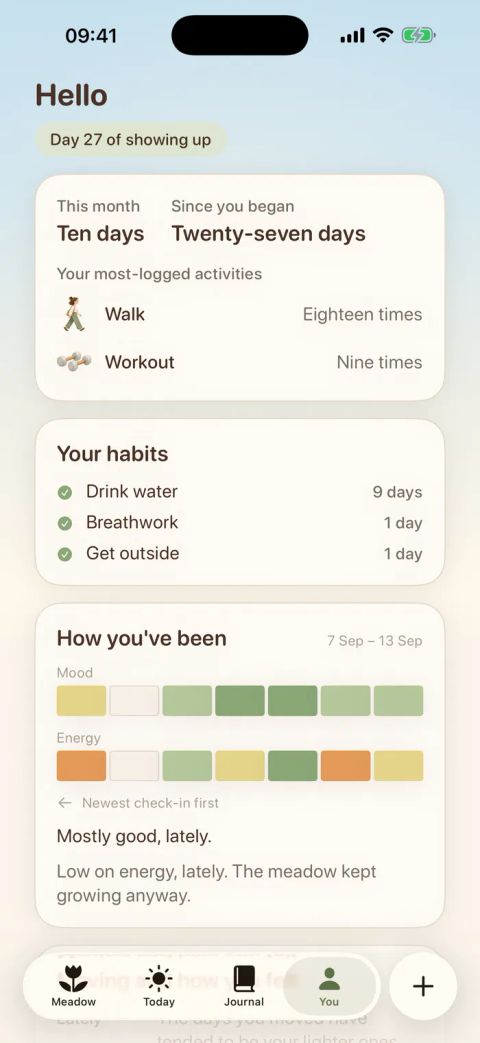
If you'd rather know your own figure than the average, the quickest way is to watch it across an ordinary week and see where you land. Meadow gives that a gentler home than a running step tally. It's a movement app for iPhone where you log a walk with a timer, tick off small daily habits, and note your mood and energy, and each day you show up grows a wildflower in a meadow that fills out over time. There are no streaks, so a quiet day near the average resets nothing, which suits a walking habit you're trying to nudge up slowly.
Common questions
Is walking 2 miles a day enough?
For general health, two brisk miles a day, walked most days, gets you close to the UK's 150 weekly minutes and into the lower part of the step range linked with a lower risk of early death. For a fairly inactive person that's a solid amount. If your two miles are slow, incidental steps, adding some brisk walking gives you more than the distance alone suggests.
How many miles is 10,000 steps?
About five miles for most people, give or take, depending on stride length and pace. That's roughly double the daily distance the average adult covers.
Which country walks the most?
In the Stanford phone study, Hong Kong had the highest average at 6,880 steps a day, around three and a half miles, with China and several European countries not far behind. The lowest averages were in Indonesia, Saudi Arabia and Malaysia.
Do these averages count all my walking?
Mostly the incidental kind. The big step studies record whatever your phone or pedometer picks up across a normal day, so the average includes the walking you never think of as exercise, from the supermarket aisle to the trip to the bus. Planned walks sit on top of that.
Moving from average to a little above it
The average is a description, not a target, and the useful move is to start from your own week instead of the global figure. Check your typical daily steps or miles for a few ordinary days, then aim for a modest step up, a loop round the block after lunch or one stop earlier off the bus.
If a gap breaks the run, the walking still counts when you pick it back up, and one missed day does not undo the progress you've made. For the wider case for making those miles a habit, our guide to the benefits of walking goes further. Pick one walk you can repeat this week, and let the average take care of itself.
AUTHOR
Co-founder of Meadow.
Ash is co-founder of Meadow, a habit and movement tracking app that turns small acts of self-care into a growing wildflower meadow.
See how far you've come
Your habits, moods and little wins, all in one place
Meadow keeps track of the walks, the water and the good days, so you can look back and watch your effort add up.
Download Meadow