The Behaviour Change Wheel is a tool for working out why a behaviour isn't happening and what to do about it, built around a small model called COM-B. COM-B says any behaviour needs three things at once: the capability to do it, the opportunity to do it, and the motivation to do it. Take one of those away and the behaviour stalls, no matter how hard you push on the others.
It came out of health-psychology research rather than a self-help book. Susan Michie, Maartje van Stralen and Robert West at University College London published it in 2011, after reviewing 19 existing frameworks and pulling the useful parts into one. Public-health teams and clinicians use it to design interventions. You can use a stripped-down version on yourself.
Here's the whole thing in plain English: what the three parts mean, how to spot which one is missing when a habit won't stick, and what to change once you know.
What COM-B stands for
COM-B is short for Capability, Opportunity, Motivation and Behaviour. The first three drive the last one. Each of the three splits in two, which sounds fussy but turns out to be the useful bit, because it tells you where to look.
Capability is whether you can do the thing. Physical capability is the body side: strength, stamina, the coordination to get through it. Psychological capability is the head side: knowing how, being able to plan it, having the focus to follow through. If you've never been shown how to do a press-up safely, that's a psychological-capability gap, not laziness.
Opportunity is whether the world around you allows it. Physical opportunity is time, space, kit, access, the shape of your day. Social opportunity is the softer stuff: what people around you treat as normal, whether anyone else does it, whether it fits in. A lunchtime walk needs a gap in the diary (physical) and a workplace where stepping out at noon doesn't feel odd (social).
Motivation is whether you want to, in the moment that counts. Reflective motivation is the deliberate part: your goals, plans and beliefs about whether it's worth it. Automatic motivation is the fast part: habits, urges, how you feel right then. You can fully intend to run and still feel your automatic motivation vote hard for the sofa at 6pm.
For a behaviour to happen, all three have to clear the bar at the same time. That's the whole engine. The wheel is what you bolt on once you know which part is failing.
Diagnose before you fix: a worked example
Say someone wants to exercise and it keeps not happening. The usual response is to pile on more motivation. Read a pep-talk, set a big goal, feel guilty. If motivation wasn't the problem, none of that lands.
COM-B asks you to check all three before you choose a response. Run our imagined person through it.
- Capability. Can they physically do a short walk or a beginner workout? Yes. Do they know what to do when they start? Not quite, they freeze at "so what now". That's a psychological-capability gap.
- Opportunity. Is there a slot in the day and a place to do it? The evenings are chaos and there's no obvious moment. That's a physical-opportunity gap.
- Motivation. Do they want to be fitter? Yes, clearly, in a reflective sense. Do they feel the pull in the actual moment? No, by evening they're flat. Reflective motivation is fine, automatic is weak.
Now the fix writes itself, and it isn't "want it more". Give them a simple named routine so they know what to do (capability). Anchor it to a moment that already exists, like a ten-minute walk straight after the school run, so it stops competing with a chaotic evening (opportunity). And make the first version small enough that low automatic motivation can still clear it (motivation). Three targeted changes beat one loud one.
That's the point of the model. It stops you throwing the wrong solution at a problem, which is how most good intentions die.
The wheel: turning a diagnosis into a response
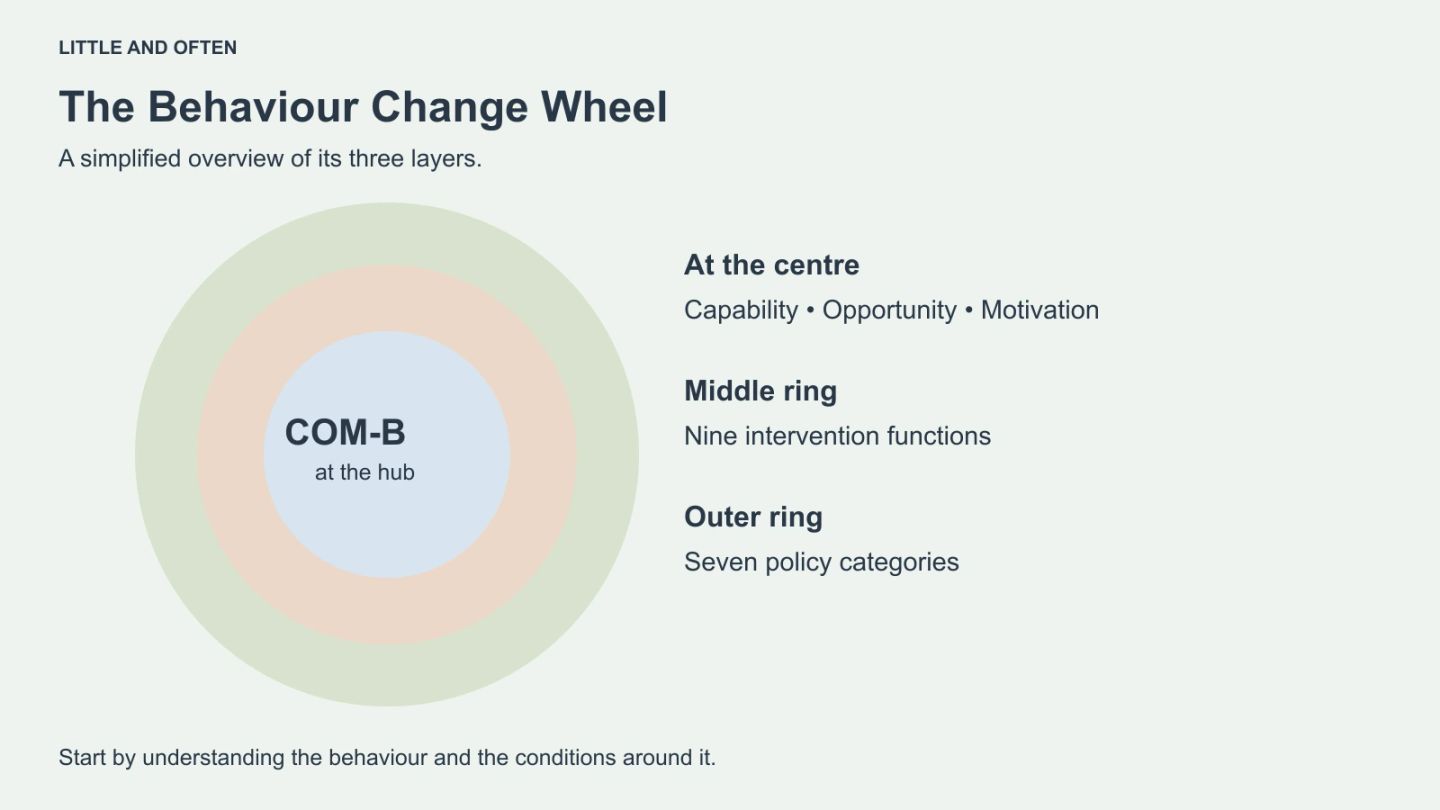
The COM-B model is the hub. The Behaviour Change Wheel is the two rings drawn around it, and it exists to answer the next question: once you know which part is short, what kind of response fits?
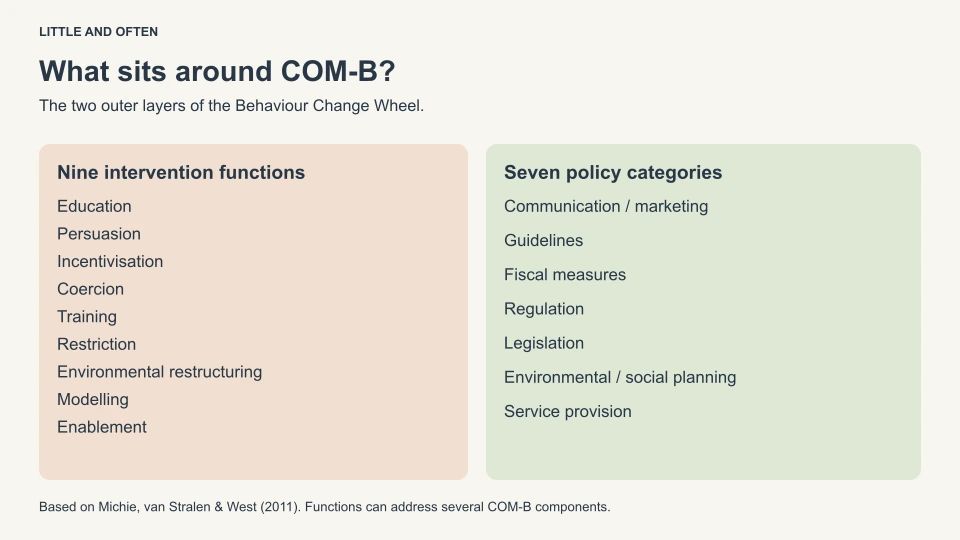
The middle ring holds nine intervention functions, which are broad types of response. In the researchers' terms they are education, persuasion, incentivisation, coercion, training, restriction, environmental restructuring, modelling and enablement. You don't need all nine. You need the one or two that match your gap.
The trick is that different gaps call for different functions.
- A capability gap usually wants education (giving you the how) or training (building the skill by doing it). Being told what a good walking pace feels like is education. Practising it until it's second nature is training.
- An opportunity gap usually wants environmental restructuring (changing your surroundings so the behaviour is easier to reach) or enablement (adding support that removes a barrier). Laying your kit by the door is environmental restructuring. A friend who walks with you is enablement.
- A motivation gap usually wants persuasion, incentivisation or modelling (seeing someone like you do it). A reward you notice at the time is incentivisation. Watching a neighbour your age walk every morning is modelling.
The outer ring holds seven policy categories, which are the levers big organisations pull: communication and marketing, guidelines, fiscal measures, regulation, legislation, environmental and social planning, and service provision. Those are for governments and health services, not your Tuesday. When Michie and colleagues tested the wheel, they ran it against real campaigns on tobacco and obesity, and it mapped what those programmes were doing onto the same three-part core. For personal use you can leave the outer ring alone and work with the hub and the nine functions.
Use it on your own stuck habit
You can run a rough COM-B check on any behaviour that keeps sliding. Pick one behaviour, be honest about each of the three parts, then choose a response that matches the gap you find. Here's a blank worksheet to copy.
The behaviour I want:
Capability (can I do it, and do I know how?): yes / no, because...
Opportunity (does my day and setting allow it?): yes / no, because...
Motivation (do I want it in the moment, not in theory alone?): yes / no, because...
The gap: capability / opportunity / motivation
The response that fits it:
And the same thing filled in, for someone who can't get back into reading.
The behaviour I want: read ten pages before sleep
Capability (can I do it, and do I know how?): yes, easily
Opportunity (does my day and setting allow it?): no, my phone is on the nightstand and the book is in another room
Motivation (do I want it in the moment, not in theory alone?): yes in theory, but the phone wins at bedtime
The gap: opportunity, feeding a weak automatic-motivation moment
The response that fits it: move the book onto the pillow and charge the phone in the hall (environmental restructuring)
Notice what didn't make the list. No "read more books" resolution, no guilt. The reader wasn't short on willpower. They had a barrier and a badly placed cue, and once those move, the behaviour has room to happen.
A place for the everyday habit to live

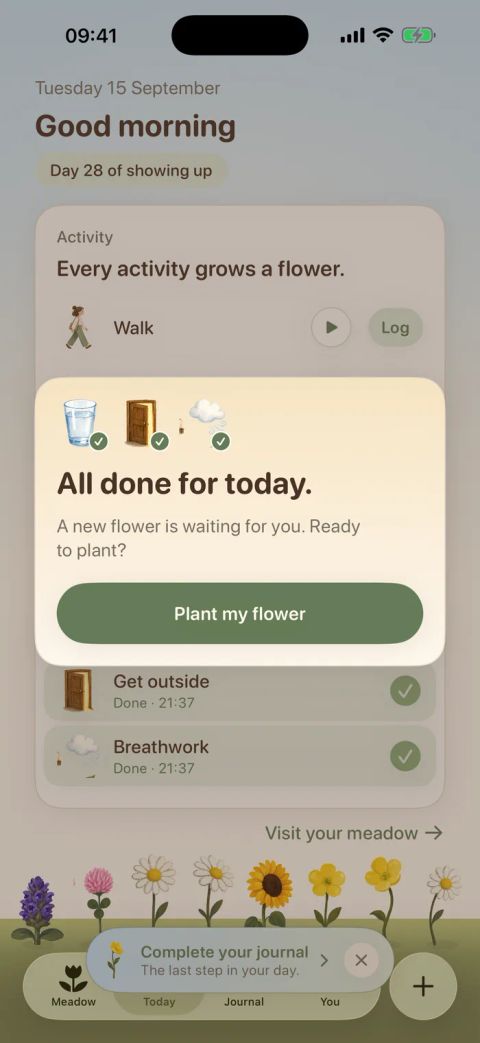
Once you've spotted your gap, the practice needs somewhere to sit so it doesn't quietly slip again. Meadow helps most with the opportunity and automatic-motivation side, because it gives a small habit a fixed home and a gentle nudge to show up. It's an iPhone app where you log a walk or a few minutes of movement, tick off a daily habit, and note your mood, energy and a daily win. Each day you turn up grows a wildflower in your own meadow, with rare flowers and small animal visitors appearing over time. There are no streaks, so a day the barrier wins resets nothing, and you pick the habit back up whenever you're ready.
The honest limits
COM-B is a framework from research, not a law of nature, and it's worth being straight about what that buys you. It's a way of organising your thinking so you check all three drivers before you act. It doesn't measure them for you, and two people can look at the same stuck habit and label the gaps differently.
The evidence that it helps is decent but not a promise. A 2024 overview of 20 reviews looked at what supports physical activity in stroke survivors and sorted the interventions by COM-B. It found that programmes touching at least two of the three parts worked more often than ones touching a single part, with capability-plus-motivation combinations coming out strongest. That's a useful signal that hitting more than one driver tends to help, though it's one field and observational, not proof that the model works everywhere.
Treat it as a good map, then. It won't diagnose you on its own, and naming your gap isn't the same as closing it. What it does well is stop you from spending another month applying willpower to a problem that was never about willpower.
How this fits with other habit tools
COM-B tells you which driver is missing. It doesn't tell you where your head is at, or exactly which small tactic to reach for, and two neighbouring guides cover those.
The stages of behaviour change model is about readiness, whether you've even decided to change yet, which is a different question from whether you're able, allowed and motivated to act. And once you've found your gap, our rundown of behaviour change techniques is the menu of specific moves, the named things you can do to close it. For the science of making a new action stick through repetition, our evidence-based habit-building strategies guide goes deeper on that side.
Common questions
What does COM-B stand for? Capability, Opportunity, Motivation and Behaviour. The first three are the conditions a behaviour needs. Capability and opportunity and motivation each split into two, a physical and psychological capability, a physical and social opportunity, and a reflective and automatic motivation.
Who came up with the Behaviour Change Wheel? Susan Michie, Maartje van Stralen and Robert West, published in the journal Implementation Science in 2011. They built it by reviewing 19 existing behaviour-change frameworks and combining them into one, with COM-B at the centre.
What's the difference between COM-B and the wheel? COM-B is the diagnostic hub, the three drivers you check. The Behaviour Change Wheel is the fuller picture, adding a ring of nine intervention functions and a ring of seven policy categories around that hub, so once you've found the gap you can pick a matching response.
Can I use it for my own habits? Yes, in a rough form. Run one behaviour through the three questions, find where it's short, and choose a response that fits that gap instead of a generic one. The full wheel, with its policy ring, is aimed at public-health and organisational programmes.
Is it proven to work? It's a widely used and well-cited way to structure behaviour change, and there's evidence that hitting more than one driver tends to work better than hitting one. It's a framework for thinking clearly, not a treatment with a fixed success rate, so use it to plan rather than to promise yourself a result.
Pick one behaviour that keeps sliding, fill in the worksheet above, and be honest about which of the three parts is failing. Then change that one thing, not everything, and give the new setup a fortnight before you judge it.
AUTHOR
Co-founder of Meadow.
Ash is co-founder of Meadow, a habit and movement tracking app that turns small acts of self-care into a growing wildflower meadow.
Every little bit counts
Five minutes counts. So does a dance in the kitchen.
Log the movement you enjoy and the small habits that help you feel good, and watch them bloom into something you can see.
Download Meadow