The stages of behaviour change describe the mental steps most people move through when they shift a habit, from not thinking about it at all, through deciding and doing, to keeping the change going months later. Two psychologists, James Prochaska and Carlo DiClemente, mapped these steps after noticing that people rarely flip from an old habit to a new one in a single decision. They edge towards it, stall, commit, act, and often slip back before the change holds.
Knowing which step you're on is useful because it tells you what to do next. Someone who hasn't decided to change needs different things from someone who's three weeks into a new routine and wobbling.
Their model, the transtheoretical model, sets out six stages. Five describe forward movement, and one, relapse, describes the slip back that turns out to be part of the process for most people. Here's what each stage looks like in an ordinary week, how to spot the one you're in, and what tends to help you move on from it.
The six stages, in plain English
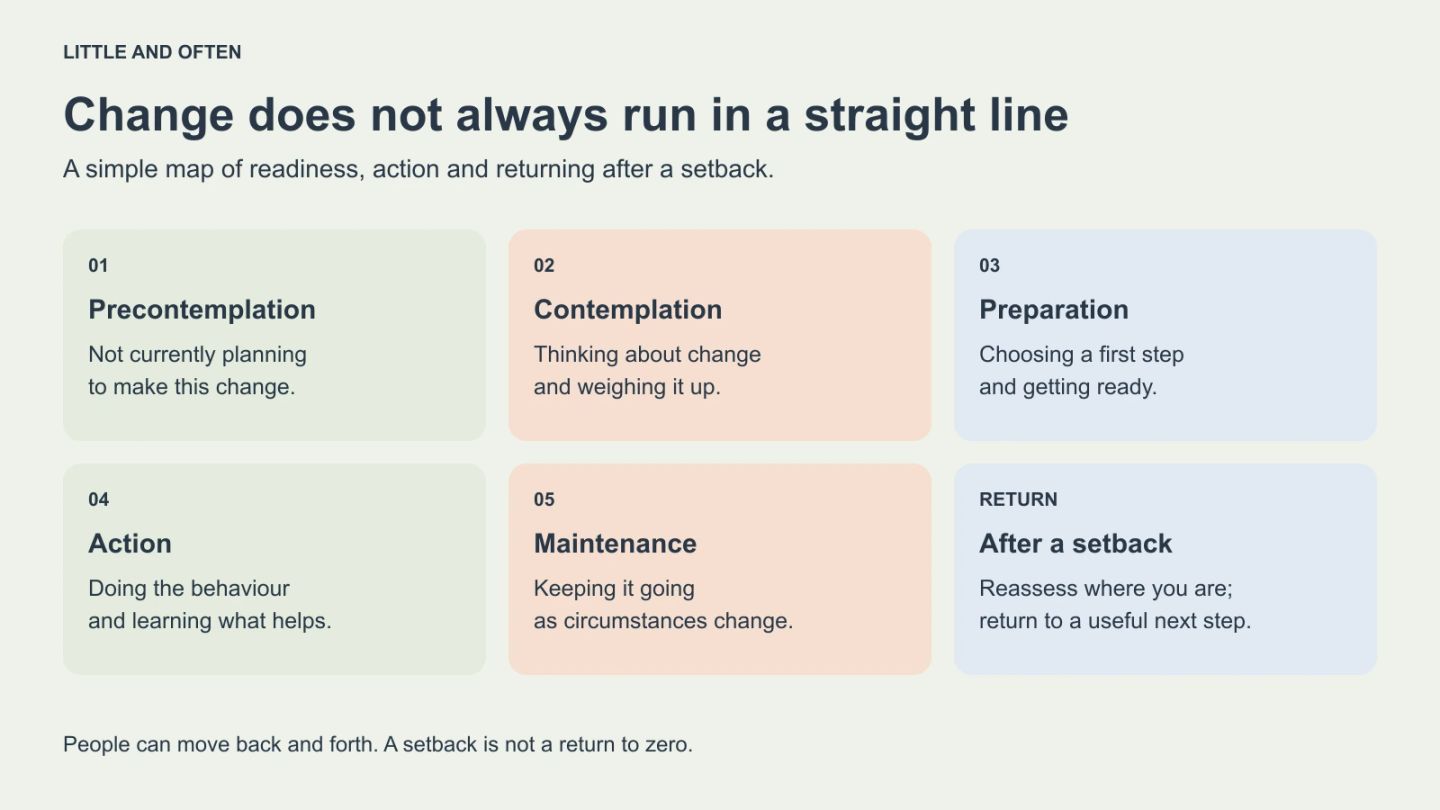
The stages aren't a ladder you climb once. Prochaska and DiClemente found that change looks more like a spiral, where people go round the loop a few times before it sticks. Most of us have lived through the whole cycle with something, a walk we meant to start, a phone habit we meant to drop.
Precontemplation: not on your radar
You're not thinking about changing. Maybe you don't see a problem, or you've tried before, it didn't take, and you've quietly filed it under "not for me". A friend suggests you walk more and you change the subject. In this stage people often notice the downsides of changing far more than the upsides of it.
What helps here isn't a pep talk or a plan. It's information without pressure, and an honest look at what staying exactly as you are is costing you. Nothing else lands until that question does.
Contemplation: turning it over
Now you can see a reason to change, and you're chewing on it, but you haven't committed. "I should start walking" has been rattling around your head for weeks. You want the result and you're not ready to give up the comfort of things as they are.
People can sit here a long time. Prochaska called the stuck version of it chronic contemplation, a kind of behavioural procrastination where thinking about change quietly replaces doing anything about it. What moves you on is weighing the pros and cons of both the old way and the new one until the case for changing clearly wins, and picturing the payoff concretely enough that it pulls.
Preparation: getting ready
You've decided, and you're setting things up. You've bought the trainers, told a friend, picked a Monday to start. You might have had a false start already this year, which is common at this stage and not a bad sign.
This is the moment a vague intention becomes a specific plan. The thing that helps most is shrinking the plan to something you can begin this week: a named action, a set time, a cue that already happens in your day. "I'll walk to the end of the road after I drop the kids off" beats "I'll get fitter".
Action: doing it
You're doing the new thing, and other people can see it. This is the stage most people mean when they say they're "making a change", and it's usually the shortest and most tiring. It tends to last up to about six months, and it eats time and energy while the behaviour is still new.
Support matters most here, along with rewards you notice and friction you've stripped out in advance. Lay your kit out the night before. Mark the day off somewhere visible. Plan for the first hard day, because it's coming, and a plan you made calmly beats a decision you make while tired.
Maintenance: keeping it going
The change has been running for a good few months and takes less out of you than it did. You're not fighting to start any more, you're guarding against sliding back. This stage can stretch from six months to years, and the work quietly shifts from building the habit to protecting it.
What helps is spotting your high-risk moments before they arrive, the holiday, the busy fortnight at work, the dark evenings, and having a plan for each. Keeping the behaviour going across different situations, the awkward ones as well as the easy ones, is what turns it from a phase into a fixture.
Relapse: the slip that's part of the loop
You stop. The walks fizzle out over a stressful fortnight and suddenly it's been three weeks. This is where a lot of people decide they've failed and give up for good, which is the actual mistake, more than the missed walks.
Slipping back is the norm, not the exception. Most people who relapse don't crash all the way to the start. Around 85% land back in contemplation or preparation and only about 15% return to precontemplation, so the slip usually costs you a little ground, not all of it. What helps is naming the trigger that knocked you off, treating the slip as information about your plan, and picking up from where you truthfully are now.
How to tell which stage you're in
You can usually place yourself in under a minute. Read these and see which one sounds like your current relationship with the change you have in mind.
I'm not planning to change and don't see the need. That's precontemplation.
I'm thinking seriously about it but keep putting off starting. That's contemplation.
I've decided and I'm getting set up to begin in the next few weeks. That's preparation.
I've been doing it for a few weeks or months and it still takes effort. That's action.
I've kept it up for more than half a year and mostly protect it now. That's maintenance.
I was doing well and I've slipped and stopped. That's relapse, and it's a stage, not a verdict.
Once you've placed yourself, look back at what helps at that stage. The common error is doing action-stage things, buying gear and setting alarms, while you're still in contemplation and haven't made the decision. The plan fails, and the failure feels like proof you can't change, when the real issue was aiming a step or two ahead of where you were.
Why slipping back doesn't mean starting over
The most useful idea in the whole model is that relapse is built into it. Prochaska and DiClemente drew the stages as a spiral precisely because people loop through them more than once, learning something each time round.
Treat a slip as a data point. Ask what set it off, whether the plan asked too much of a bad day, whether the cue was reliable, whether the version you chose was one you could stand. Then restart from your real stage instead of pretending the last few months didn't happen. If you kept it up for months and then stopped, you're not back at precontemplation, you're somewhere around preparation, and you can move quickly. Our guide to how to be consistent goes deeper on getting going again after a gap.
How this differs from building a habit
Readiness and habit are two different things, and it's worth keeping them apart. The stages of change are about your head: whether you've decided to change and how committed you are. Habit formation is about repetition: how an action becomes automatic once you're already doing it.
You need both. The stages carry you from "not interested" to "up and doing it". After that, the work of making the behaviour run on its own without a decision each time is a separate job, driven by cues and repetition rather than willpower. That's the territory of the habit loop and the reason there's no fixed answer to how long it takes to build a habit. The stages tell you when you're ready to start repeating. The habit machinery decides whether the repeating sticks.
The honest limits of the model
The stages are a good map of readiness. They're a weaker promise about results, and it's fair to say so.
When researchers have tested whether tailoring help to someone's stage changes behaviour, the results have been mixed and often disappointing. A 2005 systematic review by Bridle and colleagues looked at 37 randomised controlled trials across smoking, diet, activity and other behaviours and found little evidence that stage-based interventions worked better at changing behaviour or moving people between stages. Later reviews of physical activity have reached similar, cautious conclusions. Stage-matched programmes can help, and they don't clearly beat well-designed programmes that ignore stages altogether.
There's also a fair criticism that the stage boundaries are somewhat arbitrary. The line between "next 30 days" and "next six months" is a definition, not a natural break in how people think. So use the model for what it's good at. It's a way to understand where you are and pick a sensible next move, and it isn't a guarantee that naming your stage will carry you through the change.
A place to keep the action going

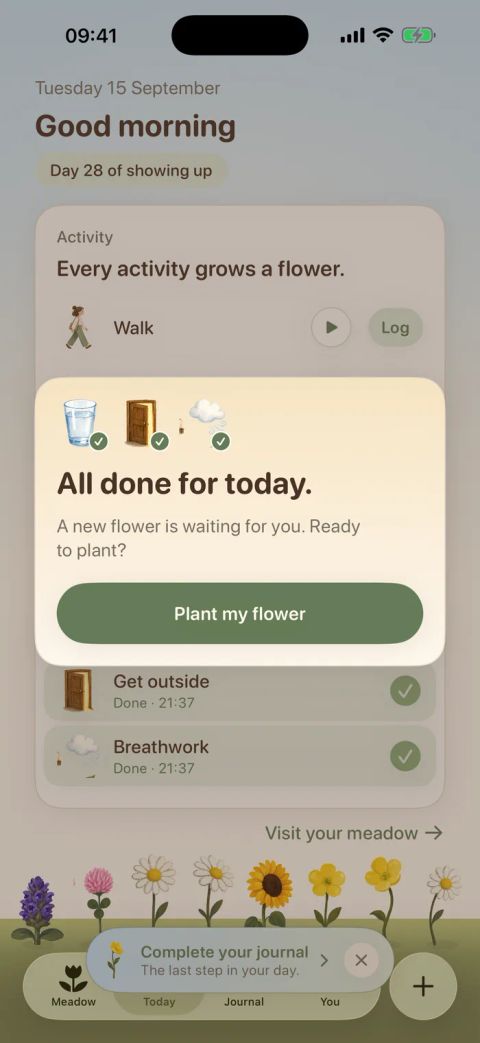
Once you reach the action and maintenance stages, the practice needs somewhere to live, and Meadow is built for exactly that stretch. It's a habit app for iPhone where you log movement you enjoy like a walk or a little yoga, tick off small daily habits, and note your mood, a daily win and a short affirmation. Each day you show up grows a wildflower in your own meadow, with rare flowers and small animal visitors turning up over time. There are no streaks, so a slip like the relapse stage describes resets nothing, and you pick up from wherever you are when you're ready.
Common questions
How many stages of change are there? Five describe forward progress: precontemplation, contemplation, preparation, action and maintenance. Relapse is usually counted as a sixth because slipping back is part of the cycle for most people, and some versions add a rare final stage, termination, where there's no pull back to the old behaviour at all.
How long does each stage last? It varies a lot by person and behaviour. As rough guides from the model, action tends to run up to about six months, and maintenance from six months onwards, sometimes for years. Contemplation has no time limit at all, which is the problem with it. Someone can turn a change over in their mind for years.
I keep starting and stopping. Which stage is that? You're cycling between action and relapse, which is ordinary and not a sign you can't do it. Each loop teaches you something about your triggers. The fix is usually a smaller action or a steadier cue, so the next attempt asks less of a hard day.
Is the model proven? It's a well-known and useful way to describe readiness, but the evidence that matching help to someone's stage changes behaviour is mixed. Treat it as a map for choosing your next step, not a treatment that works on its own.
What's the difference between this and building a habit? The stages of change are about deciding to change and committing to it. Building a habit is about repeating an action until it becomes automatic. You move through the stages first, then the repetition does its own separate work.
Place yourself on one stage right now, then do the single thing that fits it: if you're contemplating, write down the two biggest upsides of changing and the one thing holding you back. If you're preparing, name your first action and the everyday moment it will follow. If you've slipped, name the trigger and restart one size smaller. One move that matches where you stand today beats a grand plan aimed at a stage you haven't reached yet.
AUTHOR
Co-founder of Meadow.
Ash is co-founder of Meadow, a habit and movement tracking app that turns small acts of self-care into a growing wildflower meadow.
Every little bit counts
Five minutes counts. So does a dance in the kitchen.
Log the movement you enjoy and the small habits that help you feel good, and watch them bloom into something you can see.
Download Meadow