Behaviour change techniques are the specific, named methods that research has found reliably shift what people do: setting a clear goal, turning it into an if-then plan, tracking your progress, putting a cue where you can't miss it, rewarding yourself for showing up. They come from a formal catalogue that psychologists use to describe the working parts of any programme, and you can borrow the same moves for one small habit at home.
Most of them work by changing your plan or your surroundings so the action asks less of you on the days you've got less to give. Willpower barely gets a mention.
This is a plain-English tour of the techniques worth knowing, what the evidence says about each, and how to bolt two or three together for a single habit. Our guide to evidence-based habit-building strategies is the looser roundup of what works. Here the focus is the formal techniques and how you combine them.
Where these techniques come from
They aren't folk wisdom. In 2013 a team led by Susan Michie built a shared catalogue so that researchers could say exactly what a diet or exercise programme contained, instead of calling it "a bit of coaching" and hoping the next study meant the same thing (the taxonomy is set out here). It lists 93 techniques sorted into 16 groups, and the first group is goals and planning.
You don't need all 93. A handful of the groups carry most of the everyday weight, so those are the ones below. I've kept the labels the researchers use and dropped the numbering.
Set a goal that's specific and a bit of a stretch
Start with what you're aiming at, and make it concrete. Edwin Locke and Gary Latham spent decades on this and found the same thing across hundreds of studies: specific, hard goals lead to better performance than easy goals or the vague nudge to "do your best" (their summary of goal-setting theory). A goal you can picture pulls your attention and effort towards it. "Get fitter" gives you nothing to aim for. "Walk for ten minutes after lunch, five days a week" does.
Family doctors reach for the same move. An article for the American Academy of Family Physicians makes goals the first port of call for patients trying to change a behaviour, and recommends the SMART shape, specific and measurable, with near goals preferred over distant ones (their guide to the strategies). A month is easier to work towards than a year.
Aim a touch beyond comfortable, not miles beyond. A goal you can't reach stops motivating and starts nagging.
Turn the goal into an if-then plan
A goal tells you what. An action plan tells you when and where, and that second step does a lot of the work. An implementation intention is a one-line if-then plan: if it's this moment or this place, then I do this action. If I've finished lunch, then I put my trainers on and step outside.
Peter Gollwitzer and Paschal Sheeran gathered 94 studies with more than 8,000 people and found these plans had a medium-to-large effect on whether people reached their goals, around d = 0.65 (the meta-analysis is summarised here). That's a strong result for something you can write on a sticky note. The plan hands the decision to the situation, so you don't have to argue yourself into it every time.
Keep the cue sharp. "After lunch" works because you'll notice it. "At some point today" drifts to a later that never comes.
Track it so you can see what's happening
Watching your own behaviour changes it, and this is one of the better-evidenced techniques on the list. Ben Harkin and colleagues pooled 138 studies with almost 20,000 people and found that prompting people to monitor their progress reliably improved goal attainment (the meta-analysis is here). The effect was stronger when people wrote the information down and stronger again when they reported it to someone.
The family-practice guide backs this up from the clinic. Self-monitoring works across health behaviours, and food diaries in particular help with weight, so much so that the act of tracking often nudges the behaviour on its own.
A tick on a calendar counts. So does a note in an app. The point is to see the pattern, not to keep a perfect record.
Put a cue where you'll trip over it
Habits run off cues. Benjamin Gardner and colleagues describe a habit as an action set off automatically by a context it's been paired with, and their practical advice is to tie the new action to a cue already inside your daily routine, something you meet often and can't miss (their paper for GPs). The kettle going on. Closing the laptop for lunch. Brushing your teeth.
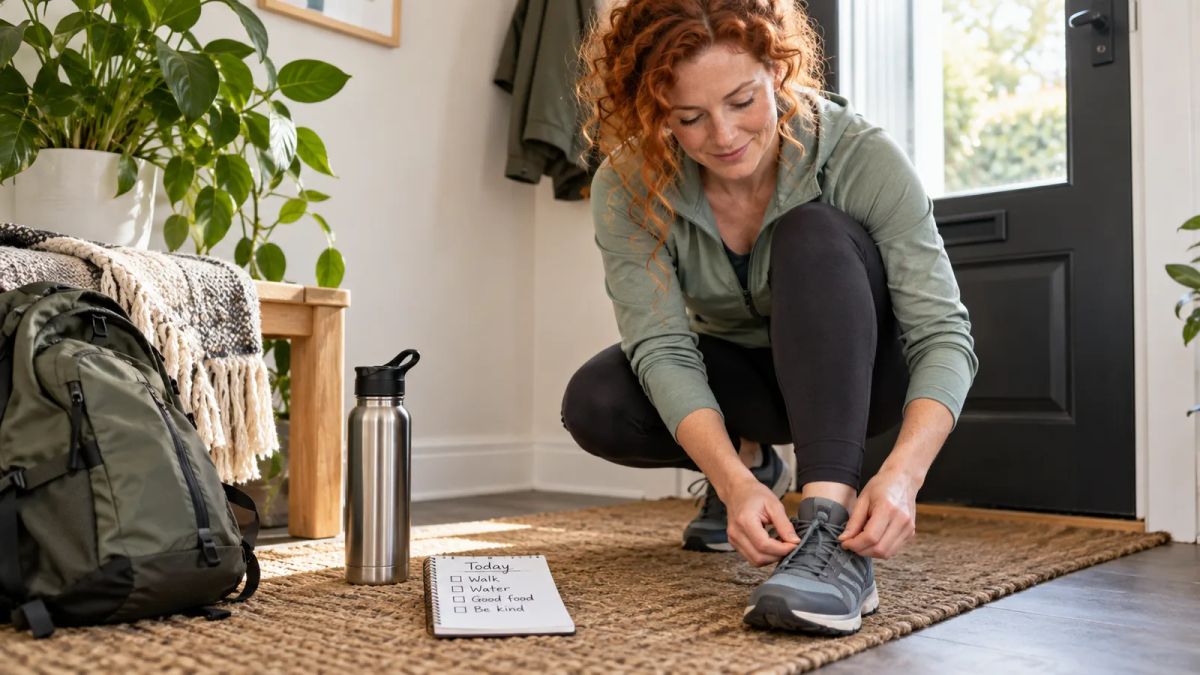
Prompts are the physical version of the same idea. Trainers left by the door. The book on the pillow. A glass by the tap. You're leaving yourself a reminder in the place the action needs to happen, so you aren't relying on remembering.
Feed the result back to yourself
Feedback is different from tracking. Tracking records that you did the thing. Feedback is looking at where you've got to and comparing it against the goal, then adjusting. Locke and Latham found feedback to be one of the conditions goals need to work, because without it you can't tell whether to push harder or ease off.
In practice that's a Sunday-night glance at the week. Four walks out of five, so the plan's holding. One walk out of five, so the cue probably isn't landing and needs moving. The number isn't a verdict on you. It's information about the plan.
Reward showing up
The taxonomy keeps a whole group for reward, and the everyday version is small and immediate. Something you get for doing the action, close enough in time that your brain links the two.
Save a podcast for the walk. Have your good coffee only after the morning stretch. The treat has to be something you want and has to stay tied to the habit, or it stops pulling. Rewards are a strong way in, and they tend to fade, so expect to change them up now and then.
Line up a bit of support
Getting other people involved is its own group in the taxonomy, and it shows up in the evidence twice over. The family-practice guide points to leaning on someone's social network to keep a change going. Harkin's review found that monitoring worked better when people reported their progress to others, so telling a friend isn't soft, it's part of what makes the tracking bite.
A walking partner, a text to a mate on Friday, a family member who asks how it went. Pick whatever fits your life and won't feel like surveillance.
Set the room up for the habit
Because behaviour answers to the situation, changing the situation is one of the surest ways to change what you do. Gardner's work makes the point about cues, and it holds for effort too. Reduce the steps between you and the good habit, and add steps in front of the one you're cutting.
Fill the water glass the night before. Lay your kit out. On the other side, put the biscuits at the back of the cupboard and log out of the app that eats your evening. None of it is dramatic, and moving where things sit carries a share of the load that gritting your teeth can't keep up.
Put a few together for one habit
No single technique does everything, which is why the research programmes stack several. Here's a blank you can fill in for one habit, pulling in the goal, the plan, a cue, tracking, a reward and a fallback all at once.
Goal: __________ (a specific action, when, how often)
If-then: If __________, then __________.
Cue I'll see: __________
How I'll track it: __________
Small reward: __________
Bad-day version: __________
And a worked example for a daily walk:
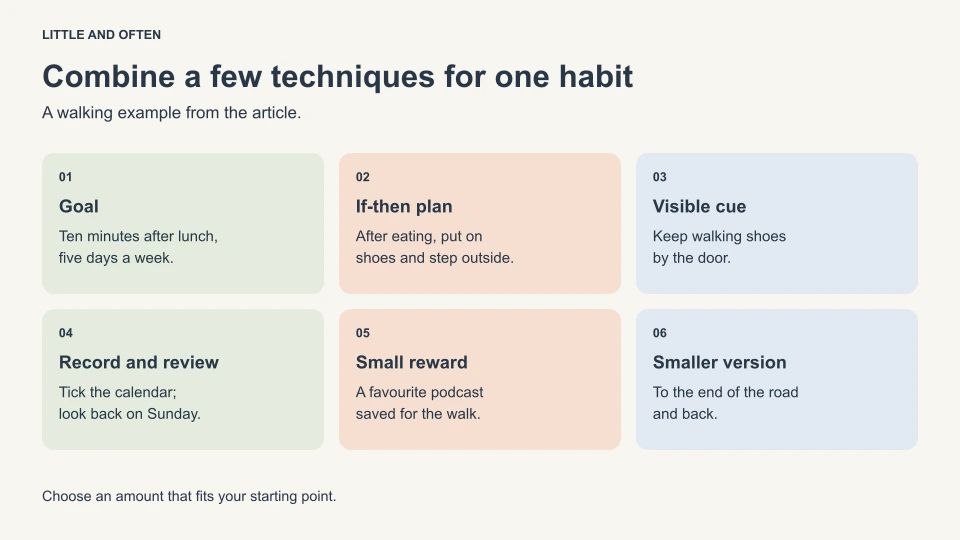
Goal: Walk for ten minutes after lunch, five days a week, for the next month.
If-then: If I've finished eating, then I put my trainers on and step outside.
Cue I'll see: Trainers left by the front door.
How I'll track it: A tick on the kitchen calendar, checked on Sunday.
Small reward: A podcast I only listen to on the walk.
Bad-day version: To the end of the road and back.
That one card uses six techniques. The goal is specific and near. The if-then ties it to a cue you meet every day. The trainers are the prompt, the ticks are the tracking, the Sunday check is your feedback, and the podcast is the reward. Tell a friend you're doing it and you've added support without any extra effort.
You'll miss days, and a missed day barely dents a habit forming. What does the damage is the story afterwards, the "I've blown it" that turns one gap into a fortnight off. Go back to the cue at the next lunchtime, shrink the action right down for a few days, and pick your record back up instead of tearing it off the wall. Don't wait for Monday.
Keep the whole set in one place
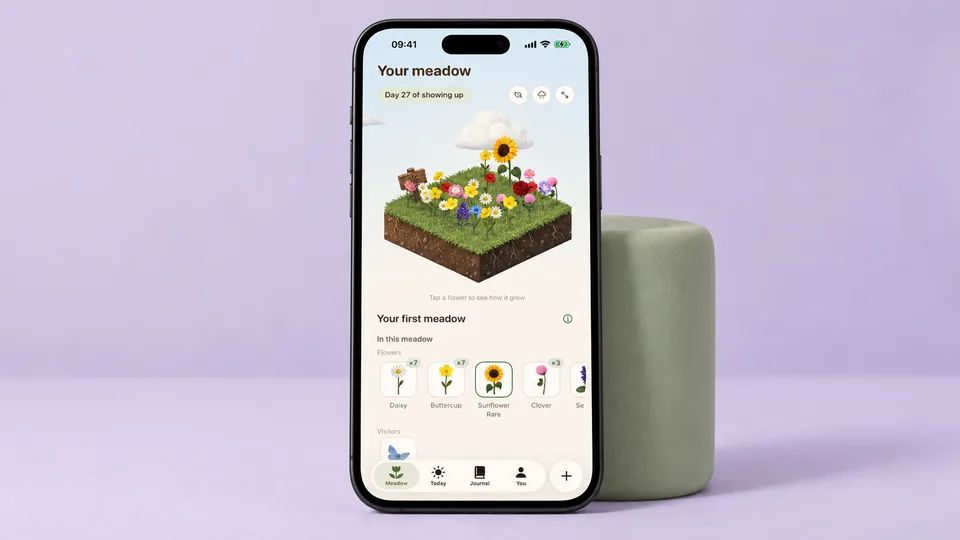
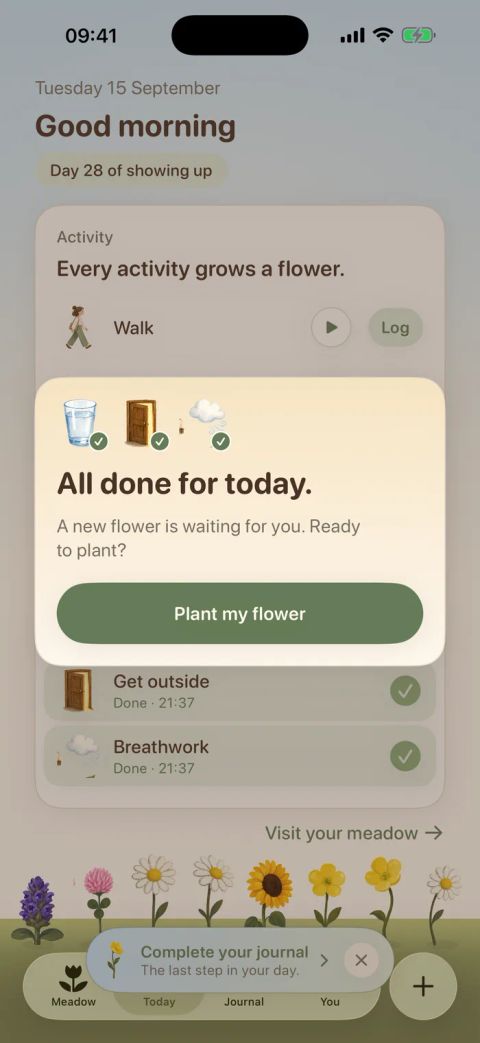
If you'd rather these moves lived somewhere other than a kitchen calendar, Meadow gives them a home on your phone. It's a gentle movement and habit app for iPhone where you tick off a small daily habit, log a walk or a few minutes of movement, and note your mood, energy, a daily win and a short affirmation, which covers your cue, your tracking and a quick read on how it's going. Each day you show up grows a wildflower, so the reward is built in, and rare flowers and the odd animal visitor turn up as your meadow fills out. There are no streaks, so the missed day you're meant to forgive resets nothing you've grown.
Common questions
What are the most effective behaviour change techniques? There's no single winner, which is why this is a list. If you want a starting order: set a specific goal, write it as an if-then plan tied to a daily cue, and track it. Add a reward and some support if the habit's a slog. They work better together than any one does alone.
Do these work on their own? Some do more than others. Self-monitoring and if-then plans both have strong evidence as standalone moves. Others, like rewards, tend to give you a lively start that needs topping up. Stacking two or three is more dependable than betting everything on one.
How many techniques should I use for one habit? Three or four is plenty for a single habit, and one habit at a time is plenty. Setting up five habits at once splits your attention and usually leaves you with none by Thursday.
What's the difference between a technique and a habit? The habit is the behaviour you want to run on autopilot. The techniques are the tools you use to get it there. Our piece on the habit loop explains the cue-routine-reward cycle the behaviour settles into.
Are these the same as nudges? They overlap. A nudge usually changes your environment so the better choice is the easier one, which is one group here. The taxonomy is broader, covering your goals, plans, tracking and support as well as the setup around you.
Pick one habit and write the card above right now: a specific goal, an if-then plan tied to something you already do every day, one way to track it, and the smaller version for the days it all goes sideways. If you want the action itself to be tiny enough to survive a bad week, tiny habits is the place to start. That card holds most of what the research supports, and it's small enough to begin today.
AUTHOR
Co-founder of Meadow.
Ash is co-founder of Meadow, a habit and movement tracking app that turns small acts of self-care into a growing wildflower meadow.
Every little bit counts
Five minutes counts. So does a dance in the kitchen.
Log the movement you enjoy and the small habits that help you feel good, and watch them bloom into something you can see.
Download Meadow