Atomic Habits is James Clear's 2018 book about building good habits and dropping bad ones by reshaping the small things you repeat rather than chasing big goals. Its central claim is that tiny improvements, around one per cent a day, pile up over months and years, and that the stack of small habits carrying you along will out-do the occasional heroic push.
This is a summary of the ideas, in plain terms, with an honest note at the end on which parts have real research behind them and which are popular but thin. Everything here is Clear's framework unless a study is named. If you want the full argument and the stories, the book is worth the few hours.
The big idea: small habits compound
Clear opens with a number that gets quoted everywhere. Get one per cent better each day for a year and you end up roughly thirty-seven times better. Slide one per cent worse each day and you drift close to nothing. The point behind the maths is that a single workout, a single early night or a single tidy desk changes almost nothing on the day. Repeat it a few hundred times and the total looks like a different life.
That is why he calls them atomic habits. Small enough to feel trivial, and part of a larger system when you line them up.
Systems over goals
The line people remember is his warning that "You fall to the level of your systems." Goals are the result you want, a stone of weight lost or a book written. The system is the set of daily actions that would get you there.
Clear's argument is that everyone at the start line shares roughly the same goal, so the goal can't be what separates the people who make it from the people who don't. The daily process does. Winners and losers want the same thing, and the difference shows up in what they do on an ordinary Tuesday. So he tells you to fall in love with the routine and let the outcome follow, instead of fixating on a target that stays out of reach until the last minute.
Identity comes first
The part of the book that tends to stick with readers is the idea that lasting habits grow out of identity, not the other way round. Clear draws three layers: what you get (outcomes), what you do (processes), and what you believe about yourself (identity). Most people try to change from the outside in, starting with a result. He argues the durable route runs the other way, from the inside out.
The move is to decide the kind of person you want to be and then let small actions cast votes for it. Someone becomes a reader one page at a time. Someone becomes a walker one short loop at a time. Each repetition is quiet evidence that says this is who I am now, and the habit sticks because dropping it would mean arguing with your own sense of yourself.
The habit loop
Under every habit, Clear says, runs a four-part loop borrowed from behavioural science: cue, craving, response, reward. The cue is the trigger that catches your attention. The craving is the wanting it stirs up. The response is the thing you do. The reward is the payoff that satisfies the craving and teaches your brain to run the loop again next time it sees the cue.
Once you see the loop, the rest of the book is a set of instructions for steering it. We pull the mechanism apart in more depth in our guide to tiny habits, because the loop is where most habit advice either works or falls over.
The four laws of behaviour change
Clear turns each part of that loop into a rule. To build a good habit:
- Make it obvious (the cue).
- Make it attractive (the craving).
- Make it easy (the response).
- Make it satisfying (the reward).
To break a bad one, you flip all four. Make it invisible, unattractive, difficult and unsatisfying. The neat thing is you don't have to work all four at once. Most habits fail at a single point, so you find the weak link and push there. Our full breakdown of the four laws of behaviour change walks through each one and its inversion.
Below the laws sit the tactics people remember the book for.
Habit stacking
The trouble with a new habit is that it has no obvious moment to happen in. Clear's fix is to bolt it onto something you already do without thinking, using a formula: after [current habit], I will [new habit]. After I pour my morning coffee, I will write down one thing I'm grateful for.
He's firm that the cue has to be exact. His own first attempt, doing push-ups when he took a break for lunch, flopped because a break has no fixed moment. Tying the push-ups to closing his laptop and doing them next to his desk worked, because now there's a precise trigger to hang the action on. Our guide to habit stacking goes deeper on chaining several of these together.
The two-minute rule
This is the one that rescues people who keep aiming too big. Take the habit you want and shrink the first move down to something you can finish in two minutes or less. Reading thirty books a year becomes reading one page. Doing yoga four days a week becomes taking out your yoga mat.
The logic is that a habit has to exist before it can grow, and the fastest way to make it exist is to make starting almost effortless. Putting on your running shoes is a smaller ask than a five-mile run, and most days, once the shoes are on, you go. You're building the habit of showing up first and letting it expand later, which is the mistake most of us make backwards.
Environment design
Clear leans hard on the idea that willpower is overrated and your surroundings do quiet work all day. So he tells you to arrange the room in your favour. Put the fruit bowl where you'll see it and the biscuits out of sight. Leave the book on the pillow. Charge the phone in another room at night. You're making the good cue impossible to miss and burying the bad one, so the easy path and the right path become the same path.
Open our free Small-habit experiment (PDF). Choose an identity, a small action and a cue, then review a week of attempts. Includes a worked example and space to adjust your plan. Save or print it; no sign-up needed.
What holds up, and what's popular but thin
Here's the part most summaries skip. Atomic Habits is a well-organised synthesis by a practitioner, not a new scientific theory, and Clear says as much. He didn't invent habit science, and treating the book as settled research does it a disservice. Some pieces rest on firmer ground than others.
The famous one per cent maths is a metaphor, not a growth curve you should expect your life to follow. Real improvement often flattens out, with diminishing returns once you're past the early gains, so read the thirty-seven-times figure as a way of picturing consistency and not a promise.
The make-it-obvious and make-it-easy laws line up well with decades of work. Habit researchers Wendy Wood and David Neal describe habits as learned associations between a context and a response, which is exactly what reshaping your surroundings and cutting friction act on. Make it satisfying has support too, since keeping an eye on progress is one of the better-studied moves in the field. A meta-analysis of 138 studies found that prompting people to monitor their progress towards a goal improved how often they reached it, so ticking a box is a real nudge and not busywork.
Make it attractive is the law to hold loosely. Temptation bundling, its headline tactic, rests largely on one field experiment. Gym-goers who could only hear a gripping audiobook at the gym visited 51% more often at first, but the same paper reports the effect faded, particularly after Thanksgiving. A useful early push, then, and not a habit-holder on its own.
One honest note runs through the whole subject. There's no fixed number of days after which a habit is finished, whatever the "21 days" folklore says. In the best-known real-world study, people took a median of 66 days to reach peak automatic behaviour, and the range ran from 18 days to a predicted 254 depending on the person and the habit. The same study found that missing a single day did little harm. So judge yourself by whether you're still turning up, not by a deadline you invented.
And a plain limit worth stating. A book about small habits is a poor substitute for real help with an addiction or a mental-health condition, where medical support and, often, a GP or therapist do the work no calendar of ticks can.
Who it's for, and is it worth reading
Atomic Habits suits you if you keep setting goals and struggling to act on them day to day, and you want a clear, usable system for the ordinary stuff: exercising, reading, drinking water, going to bed on time. It's practical, easy to read and honest about the fact that motivation runs out. That's its real strength.
You'll get less from it if you already know the habit-formation research, since much of the science will feel familiar dressed in new names, or if your problem is a deeper one that tactics can't reach. Knowing the four laws isn't the same as living them, and the book can leave you feeling productive for having read it while nothing on your calendar has changed. The value only shows up when you pick one habit and run the method on it.
For most people building everyday health habits, it's worth the read. Take one or two ideas, the two-minute rule and habit stacking are the ones to start with, and put them to work the same week.
See the small wins add up

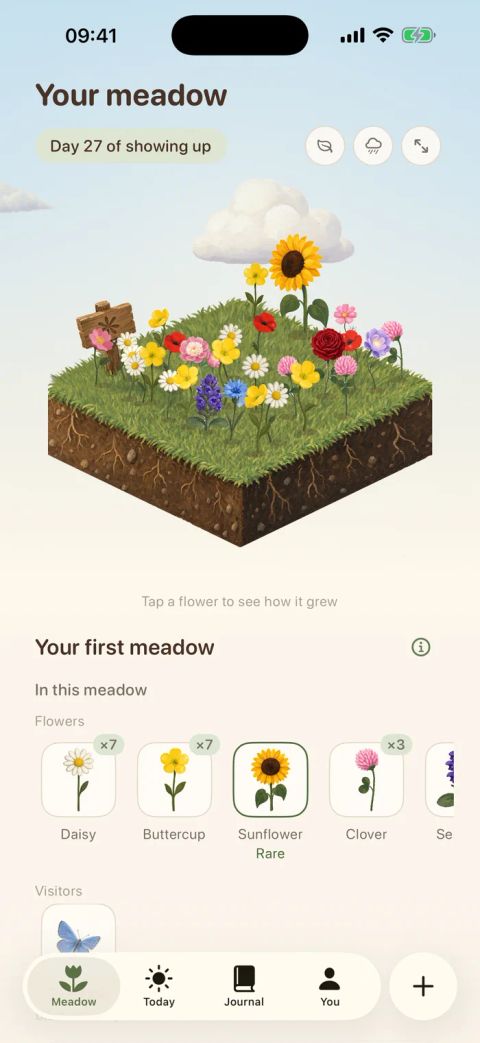
A satisfying habit is easier to keep when you can watch it build, which is where a phone earns its place. Meadow turns each day you show up into a wildflower. It's a movement and habit app for iPhone from Wildcard Wellness, where you tick off a small daily habit, log a walk or a few minutes of yoga, and note your mood, energy and one daily win. Every time you turn up, a new flower blooms in a meadow that's yours alone, so the reward Clear talks about becomes something you can see grow. There are no streaks, so a missed day resets nothing, which fits a habit you're still teaching yourself to keep.
Frequently asked questions
What is the main idea of Atomic Habits?
That small habits, repeated, compound into large changes, and that a good daily system beats a big goal. Clear frames habit change around a four-part loop (cue, craving, response, reward) and four laws for steering it.
What are the four laws of behaviour change?
Make it obvious, make it attractive, make it easy, and make it satisfying, one for each part of the habit loop. Flip them to invisible, unattractive, difficult and unsatisfying to break a habit you don't want.
What is the two-minute rule?
Scale any new habit down to a first step you can finish in two minutes or less, like reading one page or laying out your yoga mat. You build the habit of starting, then let it grow.
How long does it take to build a habit with these methods?
There's no set number. A real-world study found a median of 66 days to reach automatic behaviour, with a wide spread from about 18 days to 254, so the "21 days" figure is a myth. Keep turning up and stop counting.
Is Atomic Habits worth reading?
For most people wanting a practical system for everyday habits, yes. If you already know the psychology or you're dealing with something a self-help book can't fix, temper your expectations and get proper support where you need it.
One thing to do today
Pick a single habit you keep meaning to start, shrink it to a two-minute version, and stack it onto something you already do daily. After I put the kettle on, I will do one stretch. Write that one line down. A habit with a clear cue and a two-minute door is far more likely to survive the week than a big intention with neither.
AUTHOR
Co-founder of Meadow.
Ash is co-founder of Meadow, a habit and movement tracking app that turns small acts of self-care into a growing wildflower meadow.
Little and often, with Meadow
Consistency, not intensity.
Meadow turns the movement you enjoy and the habits that help you feel good into a meadow of wildflowers. No streaks to break, and your flowers never wilt.
Download Meadow