All-or-nothing thinking is the habit of sorting a situation into one of two boxes, success or failure, good or ruined, with nothing allowed in between. It's the voice that says one missed run means you've fallen off the wagon, or one biscuit has wrecked the day, and it quietly talks people out of habits that were going perfectly well.
Psychologists also call it black-and-white thinking, dichotomous thinking or absolutist thinking. It's one of the most common ways the mind bends a situation out of shape. Once you can spot it, you can soften it, and a lot of things get easier to keep going.
This is a general self-help guide, not therapy or a diagnosis. If your thinking feels stuck or distressing, there's a note near the end on where to find support.
What all-or-nothing thinking is
The psychiatrist Aaron Beck first described these patterns in 1963, working with people who were depressed, and called them cognitive distortions. His idea was that the way you interpret an event shapes how you feel about it, and that some interpretations are reliably skewed. David Burns, a colleague, later popularised the list in his book Feeling Good.
All-or-nothing thinking is the first distortion on almost every version of that list. You take something with many shades to it and judge it by one of two extremes. The day is perfect or a write-off. You're on the diet or you've blown it. The report is flawless or a disaster. There's no middle, and the middle is where nearly all of real life happens.
It rarely feels like a distortion from the inside. It feels like an honest verdict. That's what makes it worth learning to notice.
Some everyday all-or-nothing thinking examples
The pattern is easier to catch when you see it in ordinary sentences. Here are some all-or-nothing thinking examples across the parts of life where it tends to show up.
- Diet. "I've eaten one biscuit, so today's ruined. I'll start again on Monday."
- Exercise. "I missed my Tuesday session, so this week doesn't count. There's no point now."
- Work. "There's a typo on the first slide, so the whole presentation is a mess."
- Relationships. "They haven't texted back all day, so they clearly don't care about me."
- Habits. "I skipped my two pages of reading last night, so I've broken the habit and I may as well stop."
Read them again and you'll notice the same handful of words doing the damage. Ruined. Whole. Never. No point. Blown it. Those absolutes are the fingerprints of black-and-white thinking, and they turn a small stumble into a reason to abandon the lot.
Why one missed day talks you out of everything
Here's the quiet trap. The missed day itself is almost never the problem. The story you tell yourself about the missed day is.
In a real-world study of how habits form, summarised by the British Psychological Society, a single missed day had little effect on how automatic a behaviour eventually became. One gap doesn't wipe out the weeks behind it. What undoes people is the "I've blown it now" that follows, the thought that turns one skipped walk into a fortnight of nothing and then a quiet decision that they're not the sort of person who sticks to things.
James Clear, who wrote Atomic Habits, has a rule for this that's worth taping to the fridge: never miss twice. Missing once is an accident. Missing twice is the beginning of a new pattern. As he puts it, the harm isn't the single missed day, it's "the cumulative impact of never getting back on track."
All-or-nothing thinking works against you in mood as well, not habits alone. A rough hour gets promoted to a ruined day. One awkward comment becomes proof that the whole evening, or the whole friendship, went wrong. The pattern shrinks a complicated day down to a single harsh label, and you end up carrying the label instead of the day.
Where black-and-white thinking comes from
Nobody chooses this on purpose. It usually grows from a few ordinary roots.
Perfectionism is a big one. When your sense of being good enough is tied to flawless performance, anything short of perfect reads as failure, so a small slip feels like a verdict on you. Perfectionism is associated with real strain, and it reaches further than a set of high standards. A meta-analysis of athletes found that feeling pressured by others to be perfect was linked to more emotional and physical exhaustion, and to devaluing the sport, the early stage of giving it up altogether. Standards you set and enjoy for yourself didn't carry the same cost.
There are other roots too. Under stress the brain reaches for clear, simple categories because they feel safer than uncertainty. Some of us learned early, from a demanding parent or a harsh school, that results were either brilliant or shameful. And if you find not-knowing uncomfortable, two neat boxes are more soothing than a messy grey in between.
You don't have to trace yours back to a single cause. It helps to know the pattern is learned, common and, like most learned things, open to change.
How to soften all-or-nothing thinking
You don't argue yourself out of this in one go. You chip away at it, one caught thought at a time, until the grey starts to feel as real as the black and white.
- Catch the language of always and never. Absolutes are your early-warning system. When you hear yourself say ruined, blown it, always, never, whole or nothing, treat it as a flag that the pattern is running, not as a fact.
- Look for the third option. Between "perfect week" and "failed week" sits "a week where I did three of five walks." Say the accurate version out loud. Three walks is three more than none, and it's the honest score.
- Aim for good enough. A page of reading is not a chapter, and it still counts. A ten-minute walk is not a workout, and it still counts. Good enough, done today, beats perfect, planned for a Monday that keeps not arriving.
- Talk to yourself the way you'd talk to a friend. The self-compassion researcher Kristin Neff has spent years showing that meeting a setback with kindness supports steadier motivation than a good telling-off does. You wouldn't call a friend a failure for missing two runs. Extend yourself the same line: it's fine, life happens, go again tomorrow.
- Adopt never miss twice. Make one gap the rule and two gaps the exception you don't allow. It gives the all-or-nothing voice a specific, small job to argue against, and it's far easier to win.
A smaller version for the hard days
Decide now, while you're thinking clearly, what the habit looks like on a day when even the normal version feels like too much.
If your habit is a walk, the bad-day version might be one lap of the block. If it's a page of reading, a single paragraph. If it's a workout, one set. It sounds almost too small to bother with, and that's the point. A tiny version keeps the thread unbroken, which is exactly what all-or-nothing thinking wants to cut. There's more on this in our guide to self-discipline that isn't built on white-knuckle willpower.
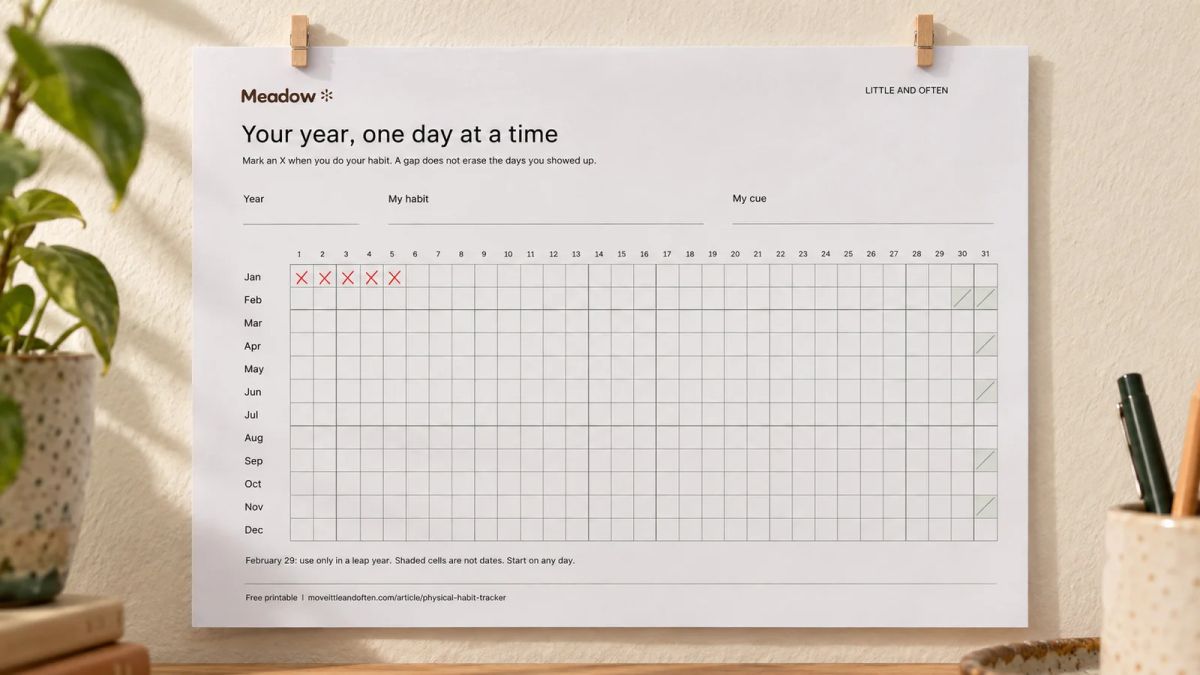
Open our free Kinder thoughts worksheet (PDF). Write down a difficult moment, separate facts from a harsh judgement and choose a kinder response. Includes a small next-step prompt. Save or print it; no sign-up needed.
Getting back on the next morning
Don't wait for Monday, the first of the month or some clean starting line. Those are all-or-nothing thinking in disguise, the idea that a run has to be spotless or restarted from zero. The next chance is the next meal, the next morning, the next time your usual moment comes round. Take it, keep whatever record you've already built, and treat the gap as the exception it was. For the bigger picture on turning up over time, see how to be consistent.
A place where a missed day costs you nothing

If it helps to see your effort adding up somewhere, the shape of the app you use makes a difference. Plenty of habit apps run on streaks, and a streak is all-or-nothing thinking built into software. Miss one day and the counter smashes back to zero, which is the last thing a wobbling habit needs.
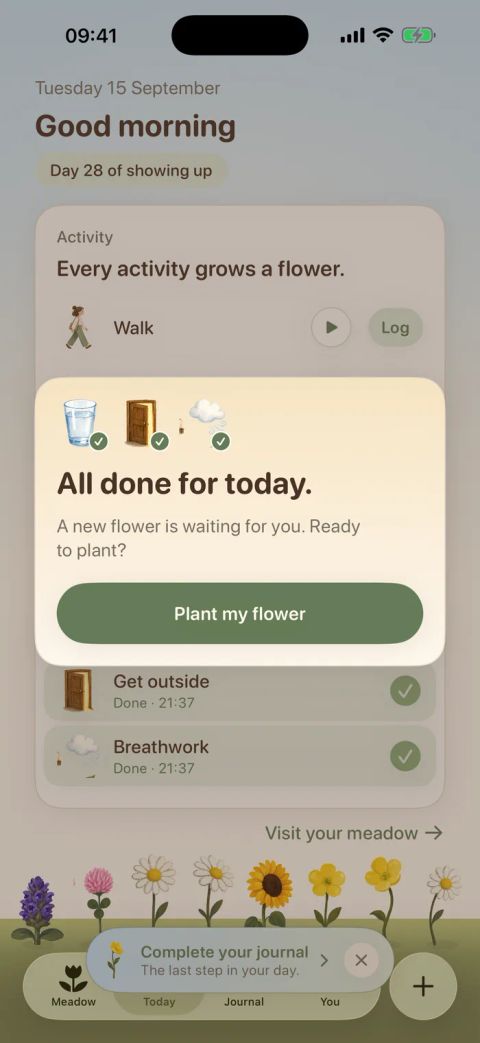
Meadow is built the other way round. It's an iPhone app from Wildcard Wellness where each day you show up, by logging a little movement or ticking off a small habit, a new wildflower blooms in a meadow that's yours. You can note your mood and energy and jot down a daily win too. There are no streaks, so a rained-off walk or a flat morning resets nothing, and your flowers never wilt. You pick up whenever you're ready, which is the never-miss-twice idea made easy to live by. If you like the streak-free approach, we also look at why not breaking the chain cuts both ways.
When it's more than a habit wobble
Softening the odd harsh thought is one thing. All-or-nothing thinking that runs most of the time, or that leaves you feeling worthless, is worth taking more seriously. This pattern is associated with anxiety, depression and eating disorders, and a self-help article can't tell the difference between a passing habit of mind and something that needs proper support.
If black-and-white thinking is persistent, distressing, or affecting how you eat, sleep, work or relate to people, please talk to someone. A GP is a sensible first stop, and the NHS mental health pages list talking therapies and urgent help. Cognitive behavioural therapy, which grew straight out of Beck's work on these distortions, is one of the approaches with a strong track record for exactly this kind of thinking.
A few common questions
Is all-or-nothing thinking a mental illness? No. It's a common thinking pattern that most people fall into sometimes. It's linked with several conditions, but having the odd all-or-nothing thought is a sign you're human, not unwell.
Is it the same as perfectionism? They're close cousins, not twins. Perfectionism sets the impossibly high bar. All-or-nothing thinking is the judgement that anything under the bar is a total failure. They tend to feed each other.
Can you get rid of it completely? You don't need to. The aim is to notice it sooner and let it steer fewer of your decisions, so a missed day stays a missed day instead of becoming a reason to quit.
Next time you catch yourself thinking "I've blown it now", try finishing the sentence differently: "so the next small thing I can do is..." Then do that one small thing today. That's the whole practice, one caught thought at a time.
AUTHOR
Co-founder of Meadow.
Ash is co-founder of Meadow, a habit and movement tracking app that turns small acts of self-care into a growing wildflower meadow.
Every little bit counts
Five minutes counts. So does a dance in the kitchen.
Log the movement you enjoy and the small habits that help you feel good, and watch them bloom into something you can see.
Download Meadow