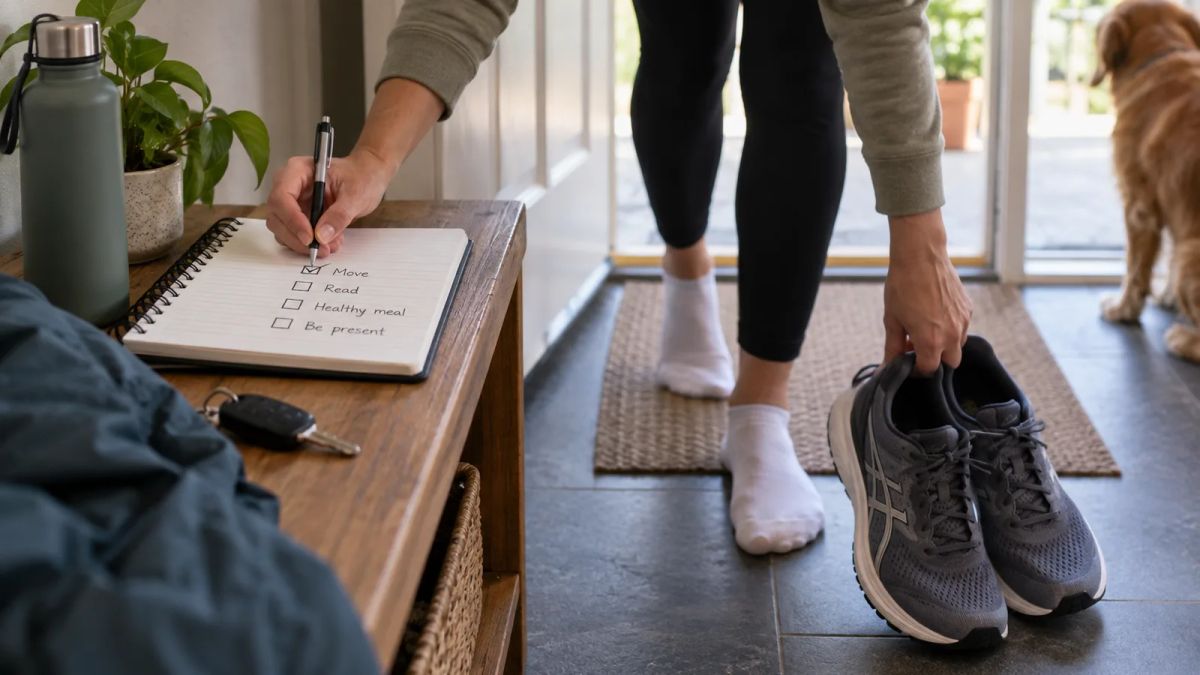
An accountability partner is someone who checks in on your goal at agreed times and expects you to tell them how it went. That one arrangement, knowing a real person will ask on Friday, is often what gets the run done, the pages written or the early night kept on the days your own good intentions would have quietly folded.
Most goals don't die in a dramatic moment. They fade. You mean to start Monday, then it's Thursday, then it's next month, and no one noticed because no one was watching.
A partner removes the "no one noticed" part. You still have to do the work, but now there's a small, regular moment of truth built into your week.
This guide covers what a good partner does, why the arrangement works, how to find and choose the right one, how to set it up so it lasts past week two, where these partnerships fall apart, and what to do instead if there's no one to ask.
What an accountability partner does
A partner isn't a coach, a therapist, or a cheerleader who tells you you're wonderful. The job is narrow and useful. They hear what you plan to do, they check whether you did it, and they ask you a straight question when you didn't.
The arrangement usually runs both ways. You hold them to their goal, they hold you to yours, and the check-in covers both. It doesn't have to be symmetrical. One of you might be training for a marathon while the other is trying to leave the office on time. The deal is the same either way: regular contact, honest reporting, and a bit of friendly pressure not to let yourself off the hook.
What they're not there for is to do the work, chase you every morning, or carry your motivation for you. A partner who has to drag you to the start line has quietly become your manager, and that never lasts.
Why a partner works when willpower doesn't
Three things are doing the work here, and it helps to know which.
The first is commitment. Saying a goal out loud to another person changes what it is. In a study of 267 people by Dr Gail Matthews at Dominican University of California, those who wrote their goals down, listed the actions they'd take, and sent a weekly progress report to a friend did far better than those who only thought about their goals. Around 70% of the friend-reporting group said they'd reached their goal or got more than halfway, against about 35% of the group who kept their goals in their heads. Writing the goal down helped. Adding a person you had to report to helped more.
The second is monitoring. A meta-analysis of 138 studies by Harkin and colleagues found that prompting people to keep track of their progress towards a goal improved how often they reached it, and the effect was stronger when that progress was reported to someone else or recorded where it could be seen. A weekly check-in is monitoring with a face attached.
The third is plain social support. Doing a hard thing alongside someone who's also doing a hard thing is less lonely, and your small wins get witnessed. When you tell your partner you finally ran three times this week, their "nice one" lands differently from a tick in your own diary.
If staying power is your weak spot, we go deeper on the mechanics in how to be consistent and self-discipline.
Where to find one
You probably know several candidates already. The trick is matching the person to the goal.
- Look inside the goal itself. Training for a 10k? A running club or a friend at the same level is right there. Writing a book? A local writing group or an old coursemate who's doing the same.
- Step one ring out from your closest people. A colleague, a gym acquaintance, a friend of a friend. Someone who likes you but isn't so tangled in your life that they'll always let it slide.
- Use online communities. Goal-focused subreddits, Discord servers, and coworking video rooms are full of people looking for exactly this.
- Ask directly. Most people are pleased to be asked, and plenty are secretly hoping someone will hold them to something too.
A quick word on close family and best friends. They often love you too much to call you out, and a soft "don't worry about it, you'll get there" is the opposite of what the arrangement is for. Pick someone who can be warm and still ask the awkward question.
How to choose the right person
Willing isn't the same as suitable. Look for a few things before you commit.
- They keep their own word. Someone who cancels on everyone will cancel on you.
- They can be honest without being unkind. You want a person who'll say "that's the second week you've said the same thing" in a tone you can hear.
- Their goal is in the same weight class as yours. Two people both taking it seriously will pull each other along. One serious and one idly curious tends to drift.
- You can admit failure to them. If the thought of telling them you skipped makes you want to hide, they're the wrong person or you've built the wrong dynamic.
The one to avoid is the person who reassures you every single time you slip. Kindness that never asks the hard question is the most common way these partnerships die without anyone deciding to end them.
How to set it up
A partnership with no structure becomes two people who both mean to check in and never do. Agree the boring details at the start.
Fix the cadence. Pick a standing slot, same day and time, and protect it. Weekly suits most goals. A ten-minute call or a voice note beats a vague "let's catch up soon", which never comes.
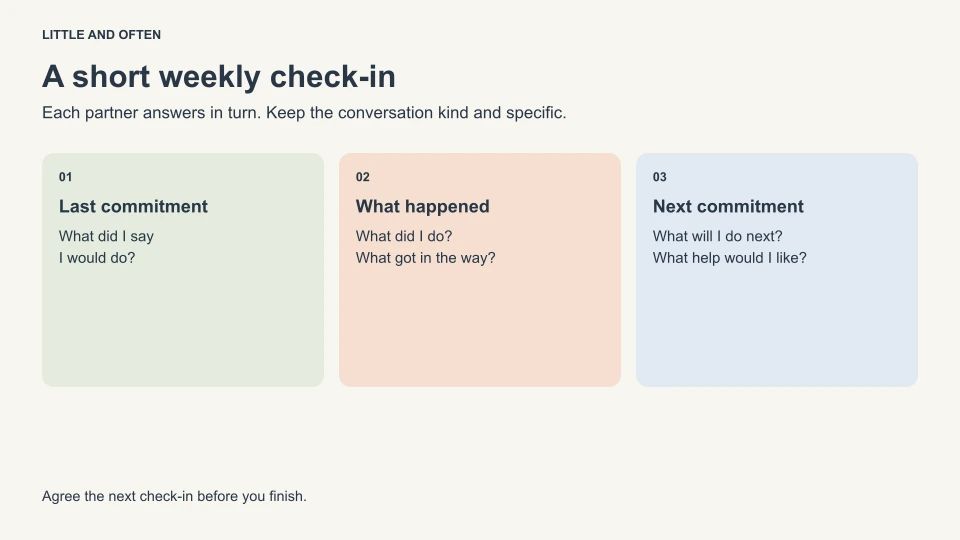
Agree what you'll each bring. The same three things every time: what you committed to last week, what happened, and what you're committing to next.
Set the ground rules. Honesty is the whole point, so agree up front that neither of you will soften the truth to spare the other's feelings. Decide what a missed check-in means, and agree that a bad week gets reported, not skipped.
Here's a check-in you can copy. Run through it the same way each week, both of you answering in turn:
Weekly check-in, same time every week
What did you say you'd do last week?
What happened, and how much of it got done?
What got in the way, and was it a one-off or a pattern?
What's the one thing you're committing to before we next speak?
How can I help you between now and then?
Keep the whole thing short. Fifteen minutes, twice through, done. The value is in running it every week, not in running it for an hour once.
For turning those weekly commitments into a goal that survives a rough patch, see how to stick to your goals.
Where these partnerships fall apart
Most fail in one of a handful of ways. Knowing them in advance is half the fix.
Too soft. The big one. A partner who nods along and never questions you is company, not accountability. If you both find you're only ever congratulating each other, name it and agree to get stricter.
Mismatched goals or effort. If one of you is chasing a real change and the other is dabbling, the serious one ends up doing all the pushing and none of the receiving. Match up with someone whose stakes feel like yours.
Vague goals. "Get fitter" gives your partner nothing to check. "Walk 20 minutes on Monday, Wednesday and Friday" gives them a yes-or-no question. Bring goals your partner can verify without having to interpret.
One-sided chasing. The moment you're reminding them and they're never reminding you, the deal has broken. Raise it early, before resentment does it for you.
Drift. Life gets busy and the check-ins slide from weekly to whenever. Put the slot in both calendars as a recurring event and treat it like any other appointment you'd feel bad missing.
If you can't find a partner
No obvious person to ask? A few setups carry some of the same weight.
An accountability group spreads the job across several people. A handful of you share goals and report back on a regular call or thread. No single person is responsible for you, but your progress is still out in the open, which is where most of the effect comes from.
Body doubling is working while another person is present, in the room or on a video call, even when you're each doing your own separate task. Cleveland Clinic describes it as using someone's presence as an "anchor" for focus, and it's a well-known tactic among people with ADHD. The evidence is mostly anecdotal and there's little formal research behind it, but a silent co-working call gets a lot of people started when nothing else will.
Apps can stand in too. Some let you set a goal and stake money you forfeit if you fail, and others pair you with a stranger for check-ins. They work as a stopgap, though a person who knows you tends to ask sharper questions than a notification does.
Something to check in with between calls
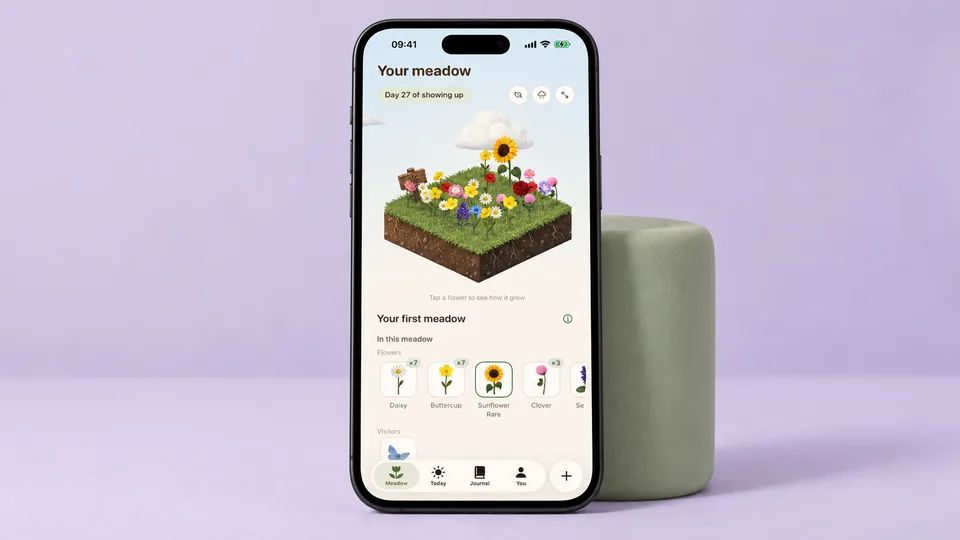
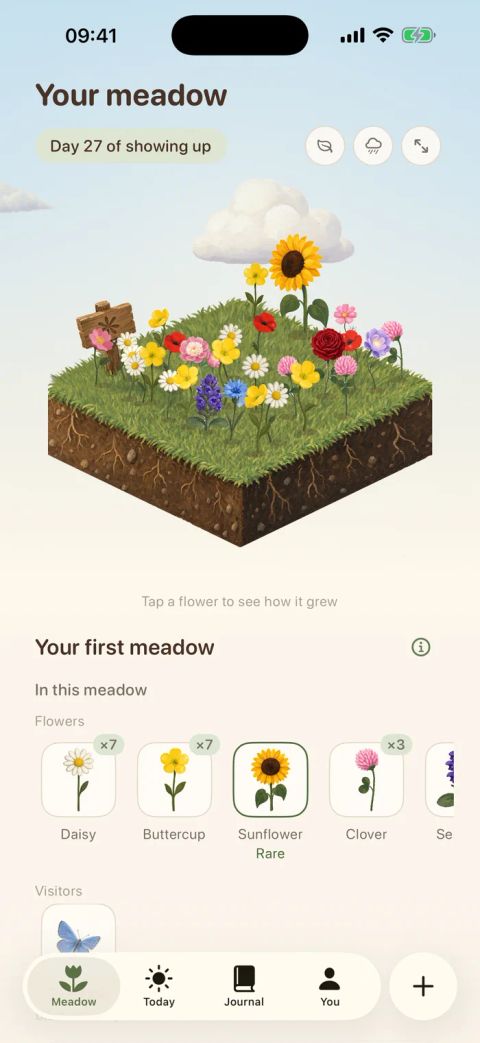
An accountability partner works best when you turn up with something to show. Meadow, a gentle iPhone app from Wildcard Wellness, gives you somewhere to log the days in between. Each day you show up, by recording a bit of movement or ticking off a small habit, a new wildflower blooms in a meadow that's yours, and you can note your mood, energy and a daily win beside it.
There are no streaks, so a missed day resets nothing and your flowers never wilt. You arrive at the check-in with an honest picture of the week rather than a broken run you feel you have to explain away. You can find it at growyourmeadow.com.
A few common questions
How often should we check in? Weekly is the sweet spot for most goals. Daily can help for the first fortnight of something hard, then ease off. Monthly is usually too far apart to catch a slide before it becomes a stop.
What if my partner keeps flaking? Say so, kindly and early. If nothing changes after one honest conversation, find someone else. A partner who doesn't show up is worse than none, because you talk yourself into thinking you have a system when you don't.
Do we need the same goal? No. You need the same seriousness. Your partner doesn't have to understand marathon splits to ask whether you ran.
Isn't this overkill for a small habit? It can be. For a tiny daily habit a simple record often does the job on its own. Save a partner for the goals big enough that you keep talking yourself out of them.
Pick one person today, whoever came to mind first while reading this, and send them a single message: here's the goal, here's how often I'd report, would you do this with me. The arrangement only starts working once someone else knows the plan, so make that the first thing you do.
AUTHOR
Co-founder of Meadow.
Ash is co-founder of Meadow, a habit and movement tracking app that turns small acts of self-care into a growing wildflower meadow.
Little and often, with Meadow
Consistency, not intensity.
Meadow turns the movement you enjoy and the habits that help you feel good into a meadow of wildflowers. No streaks to break, and your flowers never wilt.
Download Meadow