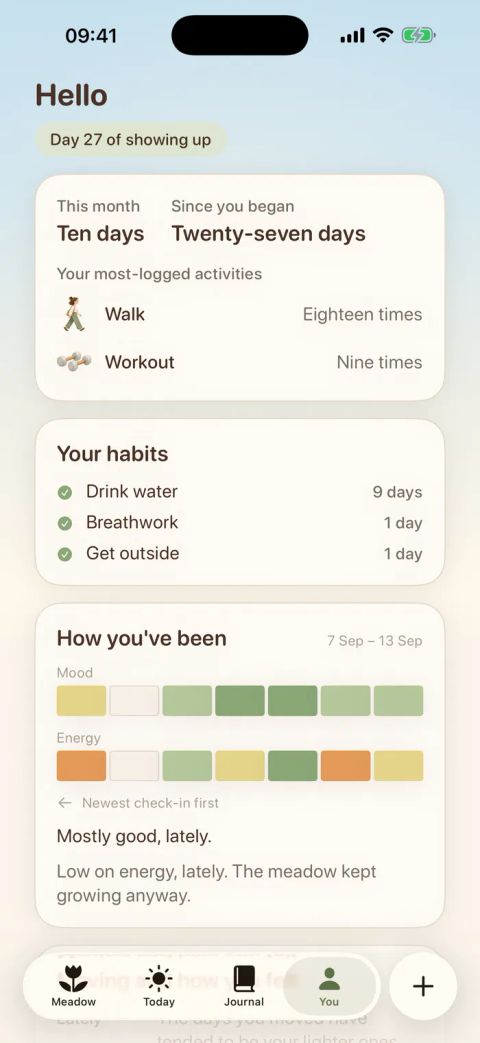
Sticking to a goal is mostly about what you do after the excitement wears off. Expect the early motivation to fade, build the goal into a daily habit so it stops running on willpower, tie it to the kind of person you want to be, and treat a missed day as one missed day instead of the end.
Most goals don't fall apart at the start. They fall apart around week three, once the first rush has gone and the thing you were sprinting towards has turned into a slog you have to choose all over again, on a tired Tuesday, with nothing pulling you forward.
That dip is normal. Planning for it is the whole game.
This guide is about the messy middle: why the initial burst always fades, how to keep going when it does, and how to get back on after you slip, which you will. If you're still at the planning stage, start with how to set goals and come back here for the part where you have to keep it up.
Expect the motivation to dip
The energy you feel in the first week is not the energy you'll have in the fifth. You started because you were fired up, and the mistake is assuming that feeling will still be there when the work gets boring. It won't. Motivation runs high when something is new and drains away as the novelty goes, and that drop is when most people quit and blame themselves.
There's a well-studied gap between meaning to do something and doing it. Paschal Sheeran and Thomas Webb reviewed the research on this and named it the intention-behaviour gap: a solid intention to change turns into far less actual change than you'd expect, and the people mainly responsible for the gap are what they call "inclined abstainers", people who fully mean to act and then don't. Wanting it is not the problem. The wanting was never going to be enough on its own.
Stop waiting to feel motivated again. On the flat days, the plan is to do the thing anyway, in whatever small form you can manage, because those are the days that decide whether a goal survives.
Run on habits, not willpower
If reaching your goal depends on you feeling up for it each day, you've built it on the least reliable thing you own. The fix is to turn the goal into a habit that runs whether you're in the mood or not.
A habit needs a fixed moment, so hook the new action onto something you already do every single day. The American Heart Association's advice for making habits stick is to attach the new behaviour to an established routine, so a cue you can't miss does the reminding for you. After I pour my morning coffee, I'll take my vitamins. After I finish lunch, I'll go for the walk. The old routine becomes the alarm for the new one, and you stop relying on remembering.
The less you have to decide, the more you'll do. When the walk is what happens after lunch, there's no daily debate to win and no motivation required. Our guide to how to be consistent goes deeper on building the setup, and self-discipline covers arranging your day so the good choice is the easy one.
Tie the goal to who you're becoming
Here's the shift that keeps people going long after the novelty has gone. Stop chasing the result and start acting like the person who already has it.
James Clear lays this out in his work on identity-based habits. He describes three levels of change, from the results you get, to the routines you run, to the identity underneath, and argues that the changes that last start with identity: decide the type of person you want to be, then prove it to yourself with small, repeatable wins. You might start a habit to hit a number, but you'll keep it once it becomes part of how you see yourself. Do the small action enough times and it stops feeling like effort and starts feeling like something you do without thinking.
The practical move is to name the person, not the target. "I want to lose a stone" points at a number that's months away and out of your direct control today. "I'm someone who moves every day" points at who you are, and you can prove it true this afternoon with a ten-minute walk. Skip a run and it reads as a small clash with how you see yourself, which is a stronger pull to lace up than any figure on a chart.
Keep the identity line short and put it where you'll read it. I'm a walker. I'm someone who reads before bed. I'm a person who drinks water first thing. Then let each ordinary day quietly back it up.
Never miss twice
You will miss a day. A cold, a late meeting, a bad night, a birthday. What decides whether that one gap becomes a fortnight of nothing is the rule you set for yourself before it happens, and the one worth holding onto is Clear's: never miss twice. Missing once is an accident. Missing twice is the start of a new pattern, the one where you don't do the thing.
The research is reassuring on the single miss. In Phillippa Lally's study of how everyday habits form, missing one opportunity to perform the habit had no meaningful effect on the process of it becoming automatic. One gap doesn't wipe out the weeks behind it. The damage comes from the story you tell afterwards, the "I've blown it now" that turns a skipped session into a stopped habit.
Make the second day non-negotiable. You don't have to make up for the miss or start again from scratch. You only have to show up once more, at the next chance, before the gap sets.
Forgive the missed day and move on
The instinct after slipping is to give yourself a hard time, on the theory that a good telling-off will keep you honest. It does the opposite. Beating yourself up adds guilt to the pile, and guilt makes you want to avoid the whole thing, which is how one missed day becomes ten.
There's a neat piece of evidence for the kinder approach. Michael Wohl and colleagues tracked first-year students across their exams and found that those who forgave themselves for procrastinating before the first set of exams procrastinated less before the next set. Letting go of the guilt freed them up to get on with the work, while stewing in it kept them stuck. Forgiving yourself here means dropping the guilt so you can get back to the work, and it beats sitting in it.
Talk to yourself the way you'd talk to a friend who missed a couple of runs. You wouldn't call them a write-off. You'd say life happens, and go again tomorrow.
Shrink it on the hard days
The reason goals collapse in the middle is that people build them for their best days, and their best days aren't most days. A plan that needs an hour and a clear head is a plan that dies the first time you're tired.
Decide now, while you're thinking straight, what the goal looks like on a day when even the normal version feels like too much. Not the full workout but one set. Not thirty minutes of reading but one page. Not the run but your trainers on and out the door. A version this small survives a rushed, flat evening, and keeping the thread unbroken beats dropping the lot and hoping to restart on Monday.
On the good days it grows on its own. One page becomes a chapter. Ten minutes becomes half an hour. Keep the official target tiny, so a low day still ends with the box ticked and the identity backed up one more time. For more on shrinking a habit right down, see tiny habits.
Write a comeback plan before you need it
Most of the advice above only helps if it's decided in advance, while you're fresh, not invented at 9pm on a bad day. You can plan the whole thing on a scrap of paper in two minutes. Fill in the blanks and stick it where the action happens:
The goal: ________
My identity line: I'm becoming someone who ________
The tiny daily version: ________
My hard-day version: ________
When I miss, my next chance is: ________
My one comeback action: ________
Filled in, it might read like this:
The goal: Move most days
My identity line: I'm becoming someone who moves every day
The tiny daily version: A ten-minute walk after lunch
My hard-day version: One lap of the block
When I miss, my next chance is: Tomorrow lunchtime, not next Monday
My one comeback action: Put my shoes on and step outside before I sit down
The point of writing the comeback line before you need it is that the version of you who's slipped is not the version who thinks clearly about slipping.
Pick the habit back up where you left off
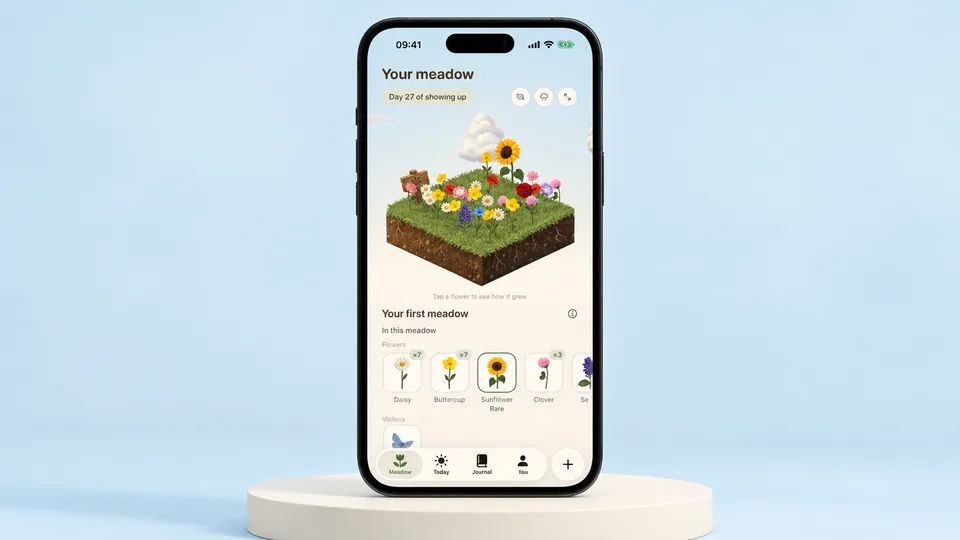
Some weeks go to plan and plenty don't, and a habit app that punishes the messy ones tends to get deleted around the time you needed it most. Meadow is built the other way. It's a gentle iPhone app from Wildcard Wellness where each day you show up, by logging a little movement or ticking off a small habit, grows a new wildflower in a meadow that's yours, with a quick note on your mood and energy if you fancy it.
The part that fits this article is what happens when you miss. There are no streaks, so a skipped morning or a rained-off walk resets nothing, and the flowers you've already grown stay put. You come back whenever you're ready and carry on from where you were, which is the "never miss twice" idea made easy to keep. You can try it at Meadow.
Common questions
Why do I always give up on my goals? Usually because you built the plan for the burst of motivation at the start and had no plan for when it faded. The energy was always going to drop. If the goal only works on the days you feel like it, the ordinary days sink it. Turn it into a small daily habit tied to a fixed cue, and you stop depending on the feeling.
How do I stay motivated once the novelty wears off? You mostly don't, and that's fine. The people who keep going aren't more motivated, they've built the action into their day so it needs less motivation to run. Lean on the identity ("I'm a walker") and the tiny hard-day version, and let those carry the days the enthusiasm doesn't show up.
How long until sticking to it gets easier? Longer than the "21 days" you'll have seen quoted, and it varies a lot between people and between habits. Lally's team found simple actions settled in far sooner than demanding ones, with a wide spread either way. Judge yourself on whether you're still turning up, not on whether it feels automatic yet.
What do I do when I've missed several days? Don't wait for a clean starting line like Monday or the first of the month, because those are excuses in disguise. Look at what got in the way, shrink the action if it was too big, and take the very next chance: the next meal, the next morning, the next time your cue comes round.
How many goals should I chase at once? One or two. Trying to overhaul your sleep, diet and exercise on the same Monday spreads you thin and most of it collapses by the second week. Get one action close to automatic, then add the next.
Pick one goal and write its identity line now: I'm becoming someone who [does the small action]. Then decide the one thing you'll do to come back the next time you miss, and write it down before you need it.
AUTHOR
Co-founder of Meadow.
Ash is co-founder of Meadow, a habit and movement tracking app that turns small acts of self-care into a growing wildflower meadow.
See how far you've come
Your habits, moods and little wins, all in one place
Meadow keeps track of the walks, the water and the good days, so you can look back and watch your effort add up.
Download Meadow