Getting 1% better every day means making an improvement so small it barely registers, then repeating it until the tiny gains stack into a large one. The phrase points at compounding: the way a habit, like money in a savings account, starts to earn a return on the returns you've already banked. James Clear put the idea at the front of Atomic Habits, and the thinking behind it belongs to Dave Brailsford, the cycling coach who called his own version the aggregation of marginal gains.
The appeal is obvious. One percent asks almost nothing of you on any given day, so there's no dramatic effort to dread and nothing much to fail at.
It's also where people get misled. The tidy arithmetic that makes the idea so shareable is a metaphor, and this guide covers both halves: the real force behind small, repeated improvement, and the point where the neat sums stop being literal.
Where the idea comes from
In the early 2000s Brailsford took charge of British Cycling, a team with almost no record of success. His approach was to hunt down small improvements everywhere at once. "The whole principle came from the idea that if you broke down everything you could think of that goes into riding a bike, and then improve it by 1 percent, you will get a significant increase when you put them all together," he told the press. He called it the aggregation of marginal gains.
Some of the changes were the ones you'd expect: better bike seats, grippier tyres, lighter suits. Others sound faintly absurd. The team tested massage gels to find the one that sped up recovery, hired a surgeon to teach the riders how to wash their hands so they fell ill less often, worked out the best pillow for each rider to carry between hotels, and painted the inside of the team truck white so they could spot the dust that fouled the bikes.
The results are the part everyone quotes. At the 2008 Beijing Olympics British cyclists won about 60% of the road and track golds. In 2012 Bradley Wiggins became the first British winner of the Tour de France.
Worth keeping in view: a national team also gets funding, talent and coaching, and that era of the sport later drew its own controversies. The marginal-gains story is a clean way to make a point about small improvements. It isn't a controlled experiment, and no single tweak won a medal on its own.
The maths, and why it flatters you
Clear turned Brailsford's idea into a line of arithmetic that spread everywhere. "If you get one percent better each day for one year, you'll end up thirty-seven times better by the time you're done," he writes. The number comes from treating 1% as daily compound interest. Raise 1.01 to the power of 365 and you get 37.78. Run it the other way, losing 1% a day, and 0.99 to the power of 365 falls to about 0.03, close to nothing.
That contrast is what makes the idea land. His framing is that habits are the compound interest of self-improvement, and the same slow multiplication that grows your savings grows the effect of what you repeat.
Now the honest part. You are not a number, and you can't be 37 times better at anything. A person's 1% isn't a fixed unit that reliably feeds the next day's 1%, most skills hit a ceiling long before day 365, and progress comes in fits and plateaus that no smooth curve captures. Treat 37x as a picture of the direction small habits pull you, not a forecast of where you'll land. The truth it carries is real even though the figure isn't: a small thing done daily beats a big thing done rarely, and small declines are as quiet and as compounding as small gains.

Why small beats a dramatic overhaul
A 1% change is easy to keep, and keeping it is the whole game. Grand plans fail on the ordinary bad day, the one where you're tired, behind and out of patience, because they were built for your best self and your best self doesn't show up most mornings. A tiny improvement clears the bar even then.
Small also dodges the all-or-nothing trap. Miss a day of a big regime and the plan feels blown, so you quit. Miss a day of something that took two minutes and you shrug and pick it up tomorrow.
There's a mechanics point underneath this too. Habits form through repetition in a steady context, which is the subject of our guide to habit formation, and a version small enough to repeat daily gets you more of the reps that do the forming. Our guide to tiny habits takes the shrinking part further, and the four laws of behaviour change give you four separate places to make the small version stick.
How to put it to work
The idea only earns its keep when you turn it into one concrete move. Here's the order that works.
- Pick one area you want to improve, and only one. Reading, water, movement, sleep, whatever it is.
- Shrink it to a version so small it feels almost too easy. One page, one glass, one stretch, one earlier bedtime by ten minutes.
- Attach that small version to something you already do every day, so an existing routine reminds you. After the kettle boils, after you brush your teeth, after you close the laptop.
- Repeat it until it runs on its own before you make it bigger or add a second one.
That last step is where most people trip. The pull is always to add more the moment you feel keen, and keenness fades faster than a habit forms. Bank the first 1% first.
Once one improvement holds, the aggregation part begins. You stack a second small habit onto the first, then a third, and the separate 1% gains start adding up the way Brailsford's did. Use this to write yours down.
The area I want to improve: __________
My 1% version (small enough to do on a bad day): __________
What it follows (a thing I already do daily): __________
The bad-day version (even smaller, for when the 1% feels like too much): __________
Filled in for reading, it might look like this.
The area I want to improve: reading more books
My 1% version: read one page
What it follows: after I get into bed and put my phone on the far side of the room
The bad-day version: open the book to my page and read a single sentence
Four short lines, and a vague wish to read more has a size, a trigger and a floor it can't fall below. On the flat days you do the sentence and keep the thread. On the good days you read a chapter, and that's a bonus, not the target.
When the neat maths breaks down
The compounding metaphor sells the idea, and it also oversells it, so hold on to a few honest caveats.
There's no fixed day on which a habit is finished. In the best-known real-world study, people took a median of 66 days to reach their peak of automatic behaviour, but the range ran from 18 days to a predicted 254, depending on the person and the habit. So don't judge a small change by a 30-day deadline you invented.
A missed day is not a broken chain. The same research found that "missing the occasional opportunity to perform the behaviour did not seriously impair the habit formation process", with automaticity resuming after a skipped day. One gap doesn't wipe the weeks behind it. What does harm is stacking up many missed days, so the aim is to come back quickly, not to be perfect.
And 1% better rarely holds for a full year at the same rate. You improve fast at first, then flatten as you approach the limit of a page a night or a ten-minute walk. That's normal, and it's the signal to bump the habit up a notch, not proof that the method failed.
Read the 37x figure as a story about direction and consistency. The metaphor is a good servant and a poor promise.
A place to watch the small days add up

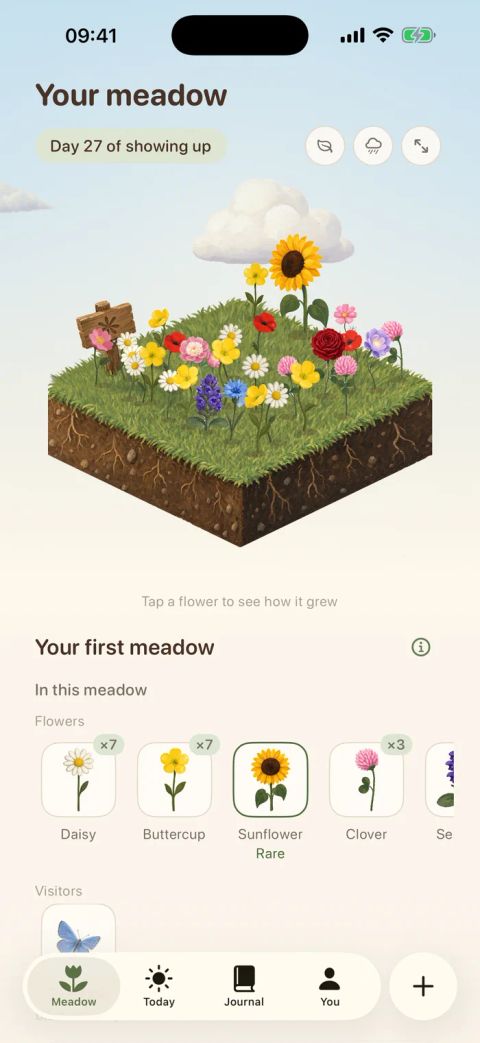
The hardest thing about a 1% habit is that each day looks like nothing, so it helps to see the days pile up somewhere. Meadow turns each day you show up into a wildflower. It's a movement and habit app for iPhone from Wildcard Wellness, where you tick off a small daily habit, log a walk or a few minutes of movement, and note your mood and energy. Every day you turn up, a new flower blooms in your own meadow, so a run of tiny efforts becomes something you can look at. There are no streaks, so a skipped day resets nothing you've grown, which suits a habit you're still teaching yourself to keep.
Frequently asked questions
Where does "1% better every day" come from?
Two places. Dave Brailsford, then head of British Cycling, built his coaching around the aggregation of marginal gains, chasing tiny improvements across everything a rider does. James Clear then popularised the phrase and the compounding maths in Atomic Habits.
Is the 37 times better figure real?
The sum is real: 1.01 to the power of 365 is 37.78. What it measures isn't. You can't be 37 times better at reading or fitness, and 1% isn't a fixed unit that compounds cleanly day after day. It's a memorable illustration of why small, repeated improvement beats occasional big pushes, not a prediction.
How is this different from tiny habits?
Tiny habits is a method for starting a behaviour by shrinking it and anchoring it to a routine. The 1% idea is about the compounding you get when a small habit repeats and stacks over months. They fit together: you use the tiny-habits method to start, and the compounding is what you're banking on.
What if I miss a day?
Little happens. Research on real habits found a single missed day had little effect, as long as it doesn't turn into a pattern. Skip it, keep your earlier progress and pick the habit back up at the next chance.
How many 1% habits should I run at once?
Start with one. Let it hold on its own before you add a second, then stack more slowly. Stacking too many at once is the fastest way to lose all of them.
One thing to do today
Fill in the four-line template above for a single habit you've been meaning to build. Pick the smallest honest version, tie it to something you already do daily, and decide now what the bad-day version looks like. Don't try to be 1% better today. Get the one habit written down so small it survives your worst day, because a habit you can keep is the only kind that ever compounds.
AUTHOR
Co-founder of Meadow.
Ash is co-founder of Meadow, a habit and movement tracking app that turns small acts of self-care into a growing wildflower meadow.
Little and often, with Meadow
Consistency, not intensity.
Meadow turns the movement you enjoy and the habits that help you feel good into a meadow of wildflowers. No streaks to break, and your flowers never wilt.
Download Meadow