A habit is an action your brain runs on its own, set off by a cue in your surroundings instead of a fresh decision each time. Habits form when you repeat the same small action in the same setting often enough that the setting starts to pull the action out of you without being asked. That is the whole mechanism. Everything after this is detail about how to set it up so it holds.
Most advice trips on one of two things. It either promises a fixed number of days, or it treats willpower as the thing doing the work. Neither survives a look at how habits are learned.
This is the overview, the map of how a habit forms from the first repetition to the day it runs by itself. If you want to go deeper on any one part, we have separate guides on the loop a habit runs on, how long it takes, starting tiny, and the habits that drag other good ones along behind them.
What a habit is
Psychologists have a tight definition. Gardner, Lally and Wardle, writing for GPs, describe habits as "actions that are triggered automatically in response to contextual cues" that have been paired with performing them before. The cue does the triggering. You don't weigh it up.
That is what separates a habit from a goal. A goal needs you to decide, again and again. A habit has handed the deciding over to the cue, which is why brushing your teeth at night barely registers as a choice. The researchers Wendy Wood and David Neal put it plainly. Habits, they write, are learned dispositions to repeat past responses, triggered by features of the context that have gone with the behaviour before, with no goal steering things in the moment.
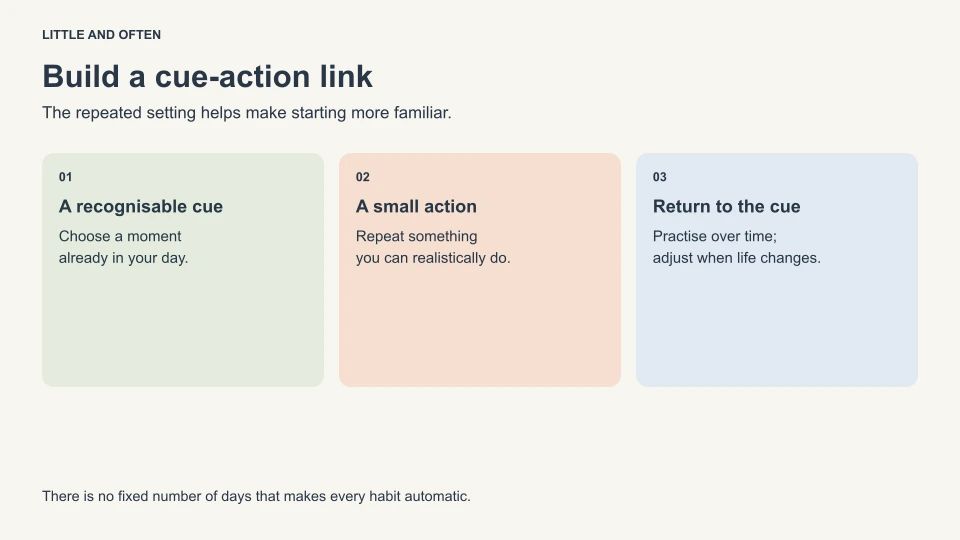
So the work is building a cue-action link strong enough that your surroundings carry the remembering for you, which comes down to setup more than grit.
The loop every habit runs on
Underneath a habit sits a short circuit with a few named parts. The journalist Charles Duhigg, drawing on MIT research in The Power of Habit, lays it out as three: a cue, a routine and a reward. Something triggers you, you carry out the behaviour, and you get a payoff that tells your brain the sequence was worth filing away.
James Clear, in Atomic Habits, names a fourth part sitting between the cue and the routine: the craving, which he calls the motivational force behind every habit. You don't crave the biscuit. You crave the small break the biscuit stands in for.
Here is one loop laid out. The kettle clicks off mid-afternoon (cue), you feel the pull of a pause (craving), you reach for a biscuit (routine), and you get a few minutes away from the screen (reward). Run that a few dozen times and your hand is in the tin before you've decided anything. Every habit you own, the ones you like and the ones you don't, runs on this same handful of parts, which is why it's worth learning once. Our full guide to the habit loop works through each part with worked examples.
How a habit forms
The engine is repetition in a steady setting, and not much else. Gardner, Lally and Wardle sum the whole process up in one phrase, context-dependent repetition, and describe how mere repetition of a simple action in a consistent context leads, through associative learning, to the action being activated on later exposure to those cues. Do the thing in the same slot enough times and the slot starts doing the prompting.
This is happening in your brain, not your character. A review of the neuroscience, "Creatures of Habit", describes habits strengthening "through repetition and associations with cues from the surrounding environment such that their expression becomes dependent on the relevant cues." Early on, a new action leans on the part of the brain used for deliberate choices. As it turns automatic, control slides across to a circuit that runs on cue, and the behaviour moves off the decision desk and onto autopilot.
Automaticity builds fast at first and then levels off. In the same GP paper the authors report that daily ratings of how automatic a behaviour felt showed an asymptotic increase, climbing steeply early and slowing to a plateau. The early reps buy you the most. The later ones mostly hold the line.
Two things decide how well this goes, and neither is trying harder.
The first is how small the action is. A light action clears the bar on a bad day, so it gets its reps in, and the reps are what count. A heavy one gets skipped, and a skipped action learns nothing.
The second is how steady the context is. The same cue, in the same place, at the same point in your day, gives the cue-action link a clean signal to lock onto. Move the behaviour around and the link never gets a consistent thing to attach to. This is why a new habit often falls apart on holiday or after a house move: the cues it was pinned to have gone.
The honest timeline
There is no fixed number of days, whatever the popular figures suggest. The tidy "21 days" line is not from any study of habits, and our timeline guide traces where it came from.
The number worth knowing is a range. In the habit-formation study run by Phillippa Lally's team, covered by the British Psychological Society, volunteers each picked a daily action and rated how automatic it felt over twelve weeks. The average time to reach maximum automaticity was 66 days, but the spread ran from 18 days to a predicted 254, depending on the person and the action. People building an exercise habit needed about one and a half times as long as those adding a food or drink.
Read that as a width, not a target. If you treat 66 days as a deadline, you set yourself up to feel behind when nothing has gone wrong. Judge yourself by whether the action is getting easier and needs less pushing, not by a day count.
Why one missed day doesn't undo it
You will miss a day. Then, some week, you'll miss three. This is where most people quietly quit, and the science says they don't need to.
In the Lally study, a single missed day had little impact on the habit that was forming, early on or later. One gap does not wipe out the reps behind it. Automaticity builds slowly, and it fades slowly too, so a habit you've practised for a month is still mostly there after a Tuesday off.
The real damage isn't the missed day. It's the story that follows it, the "well, that's ruined now" that turns one skip into a fortnight of not bothering. The fix is a rule you set in advance: never let a miss become two in a row. Get the tiny version done the very next day, even if it's a token, and the thread stays unbroken.
How to build one, using all of this
The science points at a short, unglamorous method. Work through it in order.
- Pick one habit and shrink it. Make the action so small you could do it on your worst day of the month. One stretch, not a workout. A single glass of water, not a hydration plan. It grows on its own on the days you have more in you, so keep the official version tiny. Our guide to tiny habits covers the method in depth.
- Anchor it to a cue that already happens. The American Heart Association suggests attaching a new behaviour to a routine already in your day. "After I switch the kettle on" holds up better than "at 8am", because the kettle rarely gets missed while the clock slides around. Gardner and colleagues make the same point: a cue inside an existing daily routine gives you a stable place to start.
- Keep the setting the same. Do it in the same spot, at the same point in the day, as often as you can. The steadier the context, the faster the cue learns to pull the action.
- Make the reward easy to feel. Notice the good bit while it's happening, the warmth of the tea or the quiet after the stretch, so a craving has something to form around. A small tick on a tracker works too.
- Watch for a keystone. Some habits tend to pull others along with them, so a short daily walk or a regular bedtime can do more work than its size suggests. If you want one habit to earn its keep, our guide to keystone habits shows how to spot one.
Keeping a record helps more than it sounds like it should. A meta-analysis of 138 studies found that prompting people to monitor their progress towards a goal improved how often they got there. A mark also hands you a small "done" each day and shows the pattern building over weeks.
Any format works, and the best one is the one you'll look at. Write your plan on a single line before you start, blank first:
Habit (tiny version): __________ Cue (after I…): __________ Bad-day version: __________
Mon ☐ Tue ☐ Wed ☐ Thu ☐ Fri ☐ Sat ☐ Sun ☐
And a worked example, a fortnight into a stretching habit:
Habit (tiny version): two minutes of stretching Cue (after I…): switch the kettle on Bad-day version: one stretch
Mon ☑ Tue ☑ Wed ☐ Thu ☑ Fri ☑ Sat ☐ Sun ☑
Keep it by the kettle, on the fridge, or in a notebook you open every day. The point is a home for the habit, not a spotless run of ticks.
Somewhere to watch the reps add up

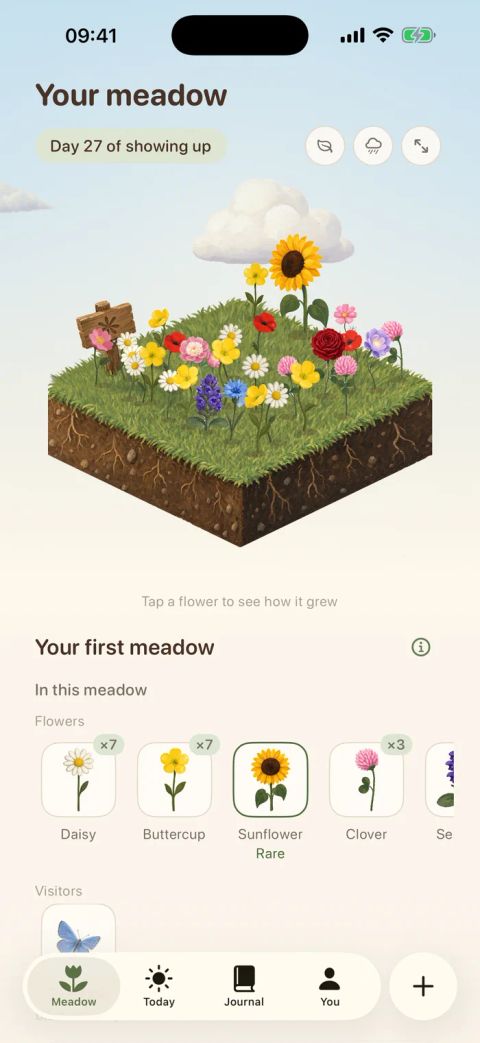
Repetition is the part that builds a habit, and it helps to have somewhere you can watch it stack up. Meadow is a gentle movement and habit app for iPhone, made by Wildcard Wellness, where each day you show up grows a wildflower in a meadow that is yours. You tick off a small habit, log a walk or a few minutes of yoga, and note your mood, energy and a daily win, and the meadow fills in as the days add up. There are no streaks, so a missed day wilts nothing you have grown, which lines up with the finding that one gap barely dents a habit that is forming.
Frequently asked questions
How are habits formed?
By repeating the same action in the same context until the context starts triggering the action on its own. Gardner, Lally and Wardle call this context-dependent repetition. Each rep strengthens the link between the cue and the behaviour, and the behaviour feels more automatic over time, steeply at first and then levelling off.
What are the four stages of a habit?
Cue, craving, routine and reward, in James Clear's framing. Something triggers you (cue), you want the change of state it points to (craving), you do the behaviour (routine), and you get the payoff (reward). Charles Duhigg's earlier version keeps the craving implicit and names three parts: cue, routine and reward.
How long does it take for a habit to form?
Anywhere from about three weeks to most of a year. The average in the Lally study was 66 days, but the range ran from 18 to a predicted 254 depending on the habit and the person, and simpler actions bedded in faster than demanding ones. There is no universal number, so treat any single figure with suspicion.
Does missing a day ruin a habit?
No. A single missed day had little effect on habit formation in the research. The habit fades slowly, so one gap leaves the work behind it mostly intact. Avoid letting one miss turn into two in a row, and get the smallest version done the next day.
Why do my habits fall apart when my routine changes?
Because a habit is pinned to its cues, and a holiday, a new job or a house move takes those cues away. The action was being triggered by a context that has gone. Rebuild by finding a new stable cue in your changed day and shrinking the action right down for the first week.
One thing to do today
Write one line naming the smallest version of a habit and the everyday moment it will follow, in the shape "after I do X, I will do Y". Pick a cue that already happens without fail, keep the action small enough for a bad day, and do it in the same place each time. Then measure yourself by whether it is getting easier, not by any number of days on a calendar. That single sentence is the whole plan, and it is small enough to start now.
AUTHOR
Co-founder of Meadow.
Ash is co-founder of Meadow, a habit and movement tracking app that turns small acts of self-care into a growing wildflower meadow.
Little and often, with Meadow
Consistency, not intensity.
Meadow turns the movement you enjoy and the habits that help you feel good into a meadow of wildflowers. No streaks to break, and your flowers never wilt.
Download Meadow