Building a lasting yoga habit is mostly about making practice small enough, and anchored firmly enough, to survive an ordinary Tuesday. The poses are the easy part. Most people already know a few shapes or have a video bookmarked. What slips is the showing up.
This guide is about the showing up: why yoga habits tend to fall apart, how to shrink your practice to a size you can keep, how to tie it to a cue so you stop relying on motivation, whether home or a class suits you better, and how to carry on when life gets in the way. If you want the poses themselves, our yoga for beginners guide walks through a first sequence. This one is about keeping it going.
Why yoga habits fall apart
The usual story is a burst of enthusiasm followed by a slow fade. You practise most days for a fortnight, then a busy week lands, you miss a couple of sessions, and the mat stays rolled up in the corner.
That's rarely a willpower problem. It's a design problem.
Three things quietly do the damage. The practice was too big to fit a normal day, so it only happened on good ones. It floated free of any fixed moment, so it depended on you remembering and feeling like it. And the first missed run got read as failure, which made stopping feel easier than starting again. Fix those three. The habit tends to hold.
Make the practice small enough to keep
The five minutes you do beats the hour you keep meaning to.
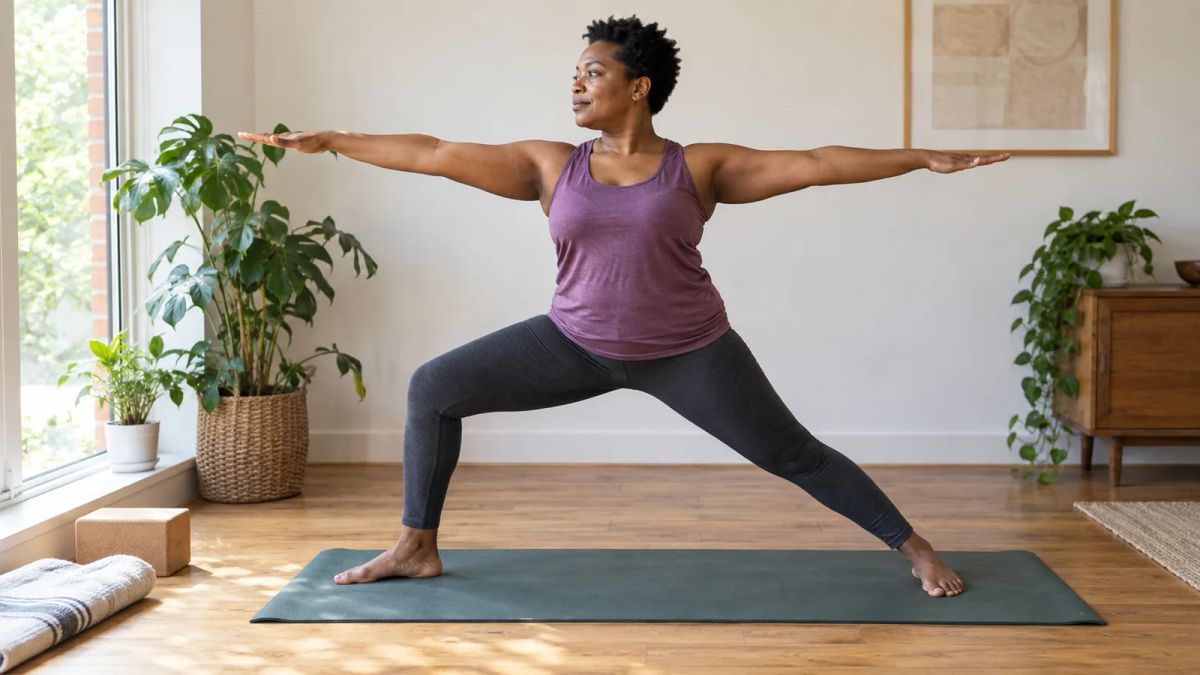
A long session needs two things you cannot count on: a clear stretch of time and the energy to fill it. A short one needs neither. When your practice is ten minutes of cat-cow, a couple of standing shapes and a few slow breaths, there's no version of your day too packed to hold it. That's the point of starting small. Ten minutes won't transform your body. It's a promise you can keep on a flat, rushed, unremarkable day.
Consistency turns out to count for more than length. A national survey of yoga practitioners found that how often people practised, especially at home, predicted health outcomes better than how many years they had been going or how many studio classes they attended. This was a survey, not a trial, so it shows an association rather than proof of cause. It points the same way as everything else here: turning up often is the engine.
Set your official target low and treat anything above it as a bonus. If the honest floor is one sun salutation, make that the whole habit. You can always do more once you're on the mat, but the day you can't is the day the small target saves the run of showing up.
Anchor it to something you already do
A habit with no fixed moment drifts to a "later" that never comes. The fix is to attach your practice to a routine you already run without thinking.
The American Heart Association suggests tying a new action to an existing one so the old routine becomes the reminder. James Clear calls the same move habit stacking, with a formula worth copying: "After [current habit], I will [new habit]." He makes one point firmly, be specific. "After I put the kettle on, I roll out the mat" holds up far better than "sometime in the morning", because a vague plan has no moment to live in.
Pick an anchor that happens every single day and leaves a natural gap after it. Here is the template, blank and then filled:
After I ________, I will ________.
After I finish the school run, I will do ten minutes of yoga before I sit down.
After I brush my teeth at night, I will do three slow stretches on the bedroom floor.
After I close my laptop for the day, I will roll out the mat for five minutes.
The anchor does the hard work. You are not asking yourself to remember or to feel motivated, you are letting a thing you already do every day pull the new one along behind it. Our guide to tiny habits goes deeper into why this beats relying on willpower.
Home or a class, whichever you will repeat
The best format is the one you will come back to, and that answer differs from person to person.
A home practice wins on friction. No travel, no timetable, no fee per session. The survey above found home practice was the strongest predictor of benefit, most likely because it is the one most people can sustain around work and family. The catch is that no one is watching your alignment, and it takes a little self-direction to press play when the sofa is right there. A fixed cue and a short, familiar sequence carry you past that.
A class wins on feedback and momentum. A teacher can see when your shoulders are creeping towards your ears, the fixed time in the diary is its own commitment, and a room full of people has a pull that a living room doesn't. The cost is money, travel and a slot you have to protect. For many people a class once a week plus a few short home sessions is the sustainable middle, the class keeping your technique honest and the home practice keeping the habit ticking over between them.
There is no correct choice. Try both, notice which one you keep coming back to, and build the habit around that, not around the version you feel you ought to prefer.
The three blockers, and what to do about each
Most stalled yoga habits trip over the same three obstacles.
"I don't have time." This is usually a size problem wearing a time costume. An hour is hard to find most days. Ten minutes is not, and neither is five. Shrink the practice until it fits the day you have, not the day you wish you had, and let it grow on the days there is room.
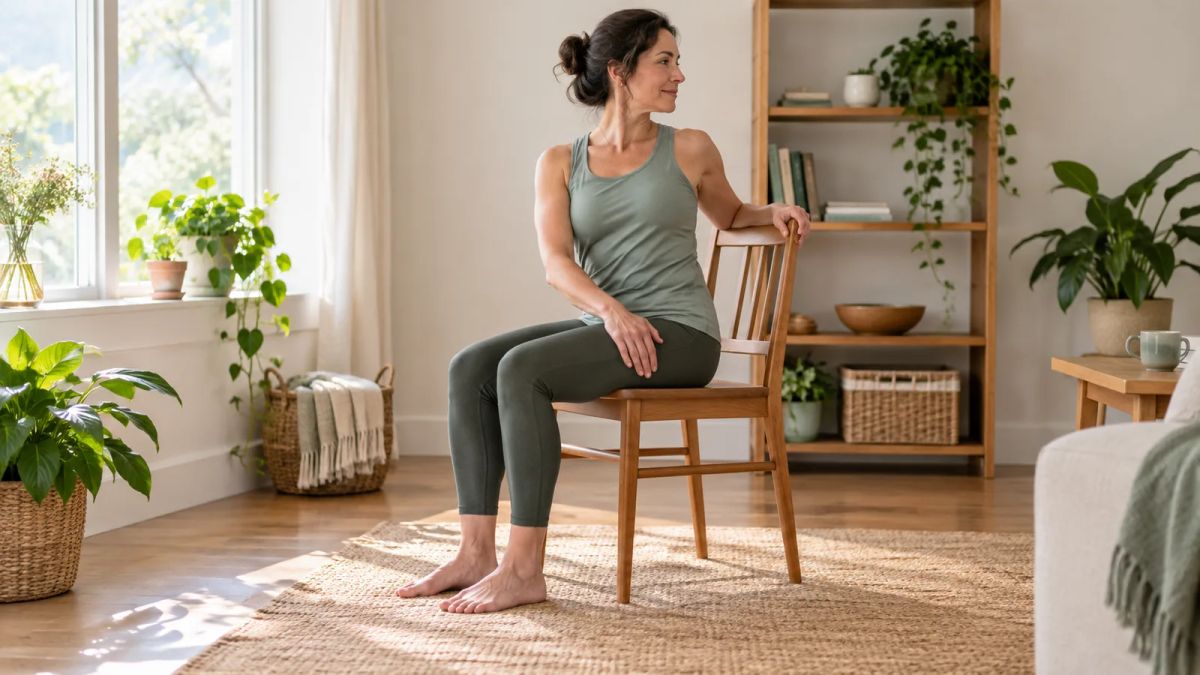
"I'm not flexible enough." Flexibility is not the entry fee for yoga. It is one of the things a regular practice slowly gives you, not something you need before you begin. The NCCIH describes yoga as a practice of postures, breathing and meditation spanning styles from gentle to demanding, and beginners at every level of stiffness can start in the gentle end. Blocks, a cushion or a chair bridge whatever gap there is. Waiting until you are flexible to start yoga is like waiting until you are fit to start walking.
"I lose motivation after a week or two." Motivation was always going to fade, and a habit built to depend on it was built on sand. This is what the small target and the fixed cue are for. When practice is easy enough to do on a low day and attached to something you already do, you stop needing to feel inspired. You do it the way you brush your teeth.
Staying consistent when life gets in the way
No plan survives contact with a bad week untouched. What separates a habit that lasts from one that quietly dies is what you do on the days it wobbles, and you can decide that in advance.
Your version for hard days
Decide now, while you're thinking clearly, what your practice shrinks to on a day when even ten minutes feels like too much. It might be two rounds of cat-cow and a minute lying still, or three slow breaths sitting on the edge of the bed. This sounds almost too small to bother with, and that's why it works, because it keeps the thread unbroken when the alternative is dropping the whole thing.
The small version is not cheating. It is the habit surviving to the next day.
Restarting after you miss
A missed day is not a broken habit. Research on how habits form found that a single missed day had little effect on whether a behaviour eventually became automatic. One gap does not undo the weeks behind it.
What does the damage is the story that follows, the "I've blown it now" that turns one skipped session into a fortnight of nothing. Skip the story. Keep the marks you already have, forgive the gap, and get back on the mat at the next chance. A run of practice is not a fragile glass streak that shatters the first time life gets in the way.
Track it so you can see it building
A small daily mark and a yoga habit go well together. The mark gives you a moment of "done", and over the weeks it shows you the pattern you have been quietly building, which is encouraging on the days progress feels invisible.
This is not busywork. A meta-analysis of 138 studies found that prompting people to monitor their progress towards a goal improved how often they reached it. A tick helps more than it looks like it should.
Use whatever you will look at again. A cross on the wall calendar by the kettle, a line in a notebook, a tick in an app. Our guide to using a habit tracker walks through the paper route if that suits you.
One thing to avoid: a tracker that punishes a gap. A long streak counter can quietly become the enemy of the habit, because the day you miss, the number resets to zero and the story of failure gets louder. What you want is a record that survives a missed day as calmly as you are learning to.
Somewhere for the practice to live
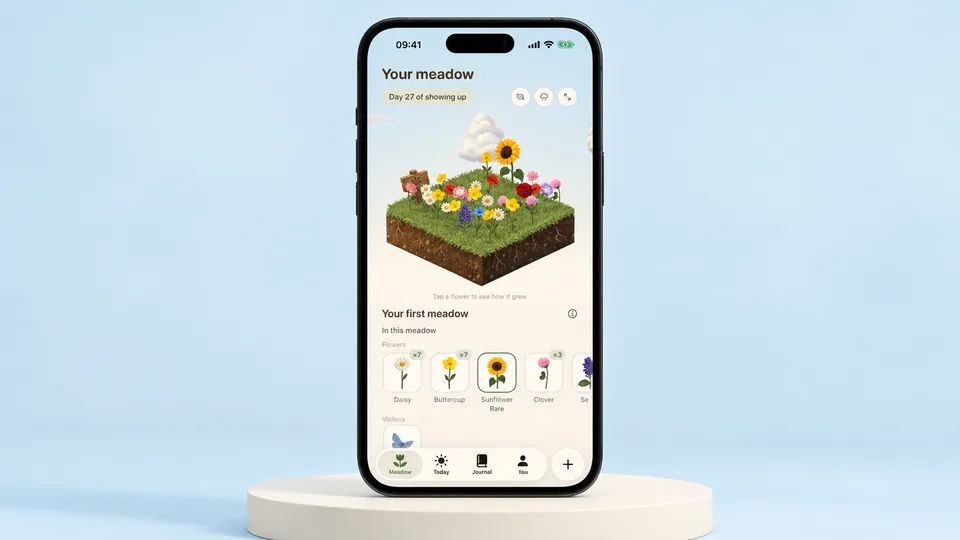
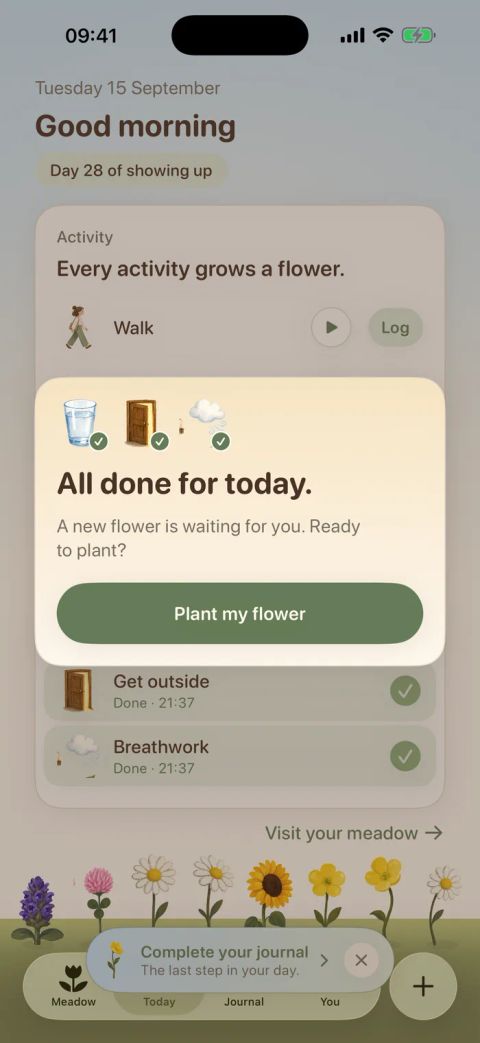
A yoga habit sticks when it is easy to pick back up, and Meadow is built for exactly that. It is a gentle iPhone app from Wildcard Wellness with yoga among its activities, so you can tick off your practice after your chosen cue and note your mood, energy and a daily win. Every day you show up grows a wildflower, and rare flowers and small animal visitors turn up in your patch over time. There are no streaks, so a missed day resets nothing and your flowers never wilt, which suits picking it back up far better than a counter that punishes a gap.
How much yoga should you aim for?
Enough to be regular, not so much that it becomes another thing you dread. Two or three short sessions a week is a solid start, and daily is fine if the sessions stay short. Yoga counts towards staying active too. The NHS lists it among the muscle-strengthening activities adults are encouraged to do on at least two days a week, so the time on the mat is doing more than one job.
If you are pregnant, new to exercise, older, or managing a health condition, talk to your GP or a qualified instructor about how to adapt your practice before you build it into a routine.
Frequently asked questions
How long does it take for yoga to become a habit?
There's no honest single number, and anyone quoting "21 days" is repeating a myth. The best-known research put the average nearer 66 days, with a range running from 18 days to a predicted 254 depending on the person and the behaviour. Judge yourself by whether you are still turning up, not by whether it has clicked yet.
How often should I practise to build a habit?
Often and small beats rare and long. Two or three short sessions a week is a good starting point, and you can let it grow from there. Frequency does more for you than the length of any one session, so protect the regularity first.
Is a home practice as good as going to a class?
For building a habit, a home practice is often easier to sustain, and frequent home practice is strongly linked with benefit. A class adds feedback on your alignment and a fixed commitment. Many people do best with a mix.
What if I keep skipping days?
Two things tend to fix it. Make the practice smaller, until you could do it on your worst day of the month, and tie it to a firmer cue that happens every single day with a natural gap after it. If you are still skipping, the habit is still too big.
Do I need to be flexible before I start?
No. Flexibility is something a regular practice builds over weeks and months, not something you need in advance. Gentle styles, blocks and cushions meet you where your body is now.
Pick your anchor tonight. Choose one everyday moment that happens without fail, decide the smallest practice you would do after it tomorrow, and write the sentence down: "After I ________, I will do ________ minutes of yoga." That sentence is the habit.
AUTHOR
Co-founder of Meadow.
Ash is co-founder of Meadow, a habit and movement tracking app that turns small acts of self-care into a growing wildflower meadow.
Every little bit counts
Five minutes counts. So does a dance in the kitchen.
Log the movement you enjoy and the small habits that help you feel good, and watch them bloom into something you can see.
Download Meadow