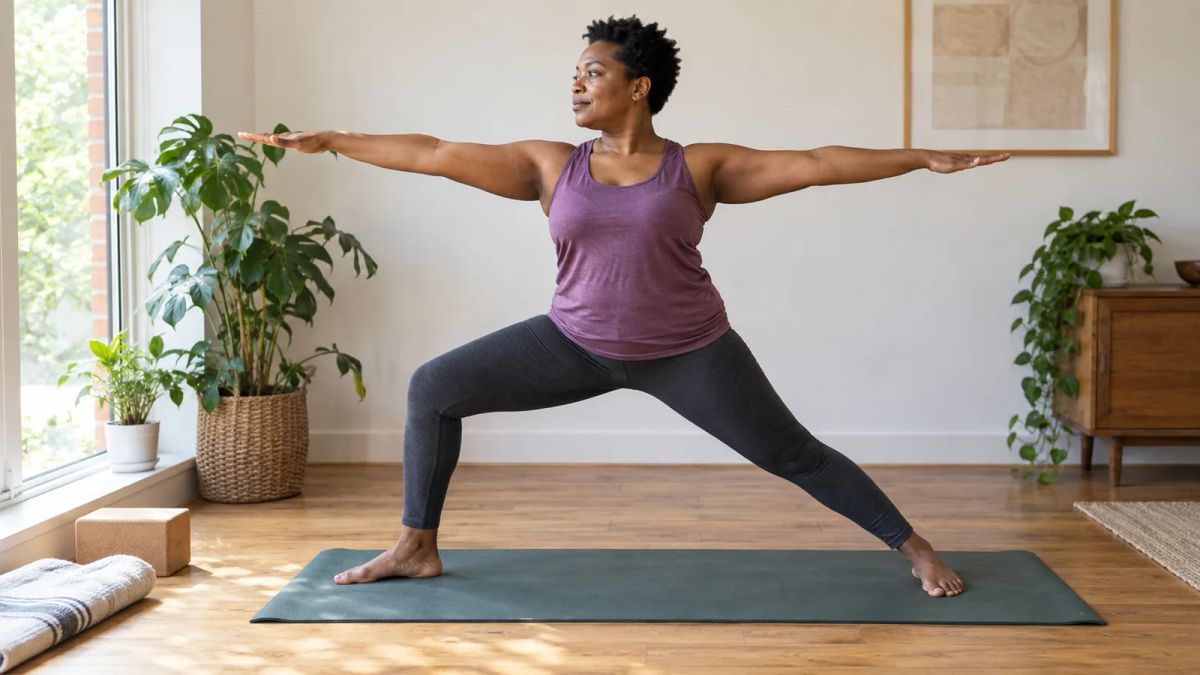
Yoga after 60 works best standing with a hand on a sturdy chair or a wall, so you get the balance work, stretching and slow strength of a real practice with something solid to hold the moment you want it. You keep both feet on the ground and move at your own speed, and the support is there whenever you reach for it.
That sets it apart from two things you may have read about. Chair yoga is done sitting down, which suits the days when standing feels like too much. General yoga for beginners tends to assume you can get down to a mat and back up without a second thought. This guide sits between them, for people who can stand but would like a steadier way in.
Nothing here asks you to fold in half or balance on one leg unaided.
Below is what yoga can and cannot do for you after 60, how to set up so it feels safe, a starter sequence you can follow today with your breath, and how to keep it going once the novelty wears off.
What yoga can do for you after 60
The benefits are real and modest, and they are worth having.
A 2019 review pulled together 16 randomised trials, covering 967 older adults for physical function, with average ages across the studies running from 61 to 84. Compared with people who stayed inactive, yoga improved balance by a moderate amount, along with lower-limb strength and lower-body flexibility. The same review found better scores for depression, sleep and perceived mental health.
Balance and leg strength are the two that change how steady you feel on the stairs and how confident you are on your feet. Flexibility is what lets you reach a high shelf or a seatbelt without a twinge.
On falls specifically, be careful about the claims you read. A 2016 meta-analysis in Age and Ageing found small improvements in balance and medium improvements in mobility in people aged 60 and over, and the authors were plain that "further research is required to determine whether yoga-related improvements in balance and mobility translate to prevention of falls". Steadier balance is encouraging. It is not the same as a proven drop in falls, so treat anyone promising the latter with a raised eyebrow.
The mood side rests on firmer ground. Harvard Health notes that yoga is known for easing tension and anxiety in the body and mind, and that eight weeks of practising twice a week left people with more muscle strength, endurance and flexibility. Plenty of people come for the body and stay for the quiet of fifteen unhurried minutes.
Before you start
One conversation can save you a lot of bother. If you have a health condition, or you have not exercised in a while, the NHS advises checking with a GP before you begin, and that goes double if you have had a fall or worry about falling. The US National Center for Complementary and Integrative Health adds a note aimed at our age group: yoga injuries treated in emergency departments are more common in people aged 65 and over than in younger adults, so it recommends talking your needs over with both a GP and the instructor first.
A recorded video cannot see your hip or your blood pressure. A teacher can. If anything about your health gives you pause, a beginner class aimed at older adults, or a few sessions with an instructor who watches your alignment, beats following a screen alone.
Set yourself up on a firm chair with no wheels and no arms, or beside a clear stretch of wall. Go barefoot or wear grippy socks, keep your clothes loose and some water within reach, and push any trip hazards out of the way.
A few things are worth skipping or keeping shallow while you are new to it. Go easy on deep forward folds if your blood pressure drops when you stand, ease off strong backbends, and leave out anything that tips your head below your heart for long or loads your neck, which rules out headstands and shoulderstands. Stop at any sharp pain. A stretch should feel like a stretch and never like a warning.
A starter sequence you can follow today
You can get a feel for standing yoga in about fifteen minutes with the sequence below. Keep your breath slow and through the nose throughout, keep the chair within reach, and do each move only as far as feels easy. If a step does not suit you on a given day, leave it out.
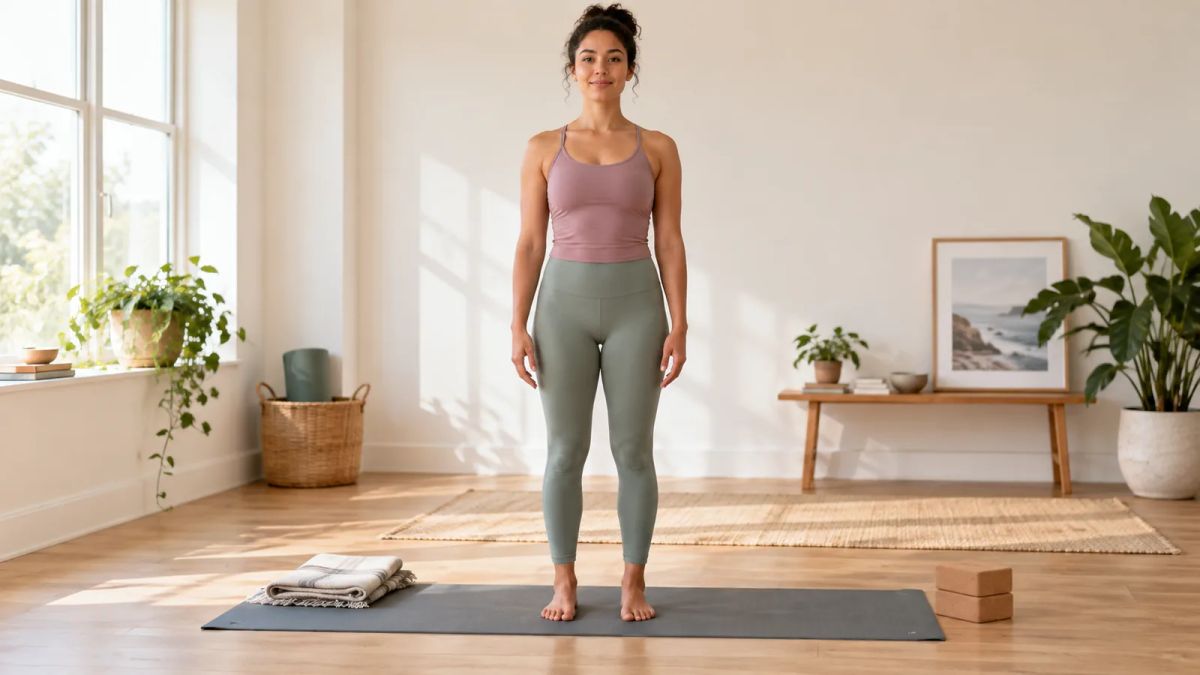
1. Stand and find your breath
Stand tall beside your chair, feet hip-width, one hand resting on the chair back. Let your shoulders drop and lengthen up through the top of your head. Breathe in slowly through your nose, then out through your nose, for five slow rounds. This sets the pace for everything after it.
2. Reach and side bend
Keep one hand on the chair. Breathe in and float the other arm out and up beside your ear. Breathe out and lean softly away from the raised arm, feeling the stretch down that side. Come up on an in-breath, lower the arm, and swap sides. Two or three each way.
3. Shoulder rolls and chest opening
Roll your shoulders up towards your ears and back down in slow circles, five or six times, keeping a hand on the chair if you like. Then draw your shoulder blades together, lift your chest, and breathe wide into the front of your body for three breaths. It undoes a morning spent hunched over a phone or a newspaper.
4. Heel raises

Hold the chair with both hands. Breathe in and rise slowly onto the balls of your feet, lifting your heels. Breathe out and lower with control. Repeat eight to ten times. This builds the calf and ankle strength that steadies you on kerbs and stairs.
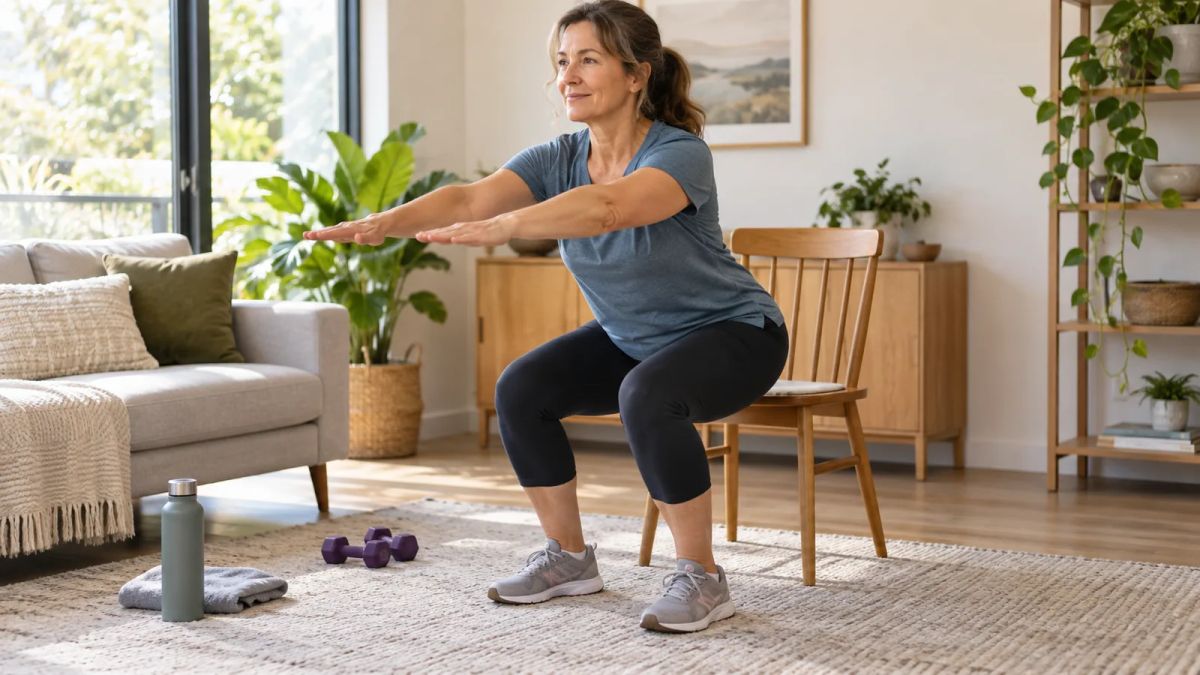
5. Supported chair pose
Stand behind the chair, both hands on the back, feet hip-width. Breathe in, then breathe out as you bend your knees and send your hips back a little, as if lowering towards a seat, going only as far as feels comfortable. Breathe in to stand. Repeat six to eight times, keeping your knees over your ankles and not past your toes.
6. Supported tree
Hold the chair with one hand. Shift your weight onto one foot and rest the toes of the other foot on the floor beside your standing ankle, or lift it to press lightly against your lower calf, whichever keeps you steady. Breathe slowly for three or four breaths, standing tall, then swap sides. This is the balance pose, and the chair is there to be used.
7. Standing forward fold with hands on the seat
Face the chair. Breathe in and lengthen your spine, then breathe out and hinge forward from your hips, placing both hands flat on the seat so your back stays long and your head stays level with your heart. Let your neck relax. Hold for a few breaths, then roll up slowly on an in-breath. Keep it shallow, or skip it, if your blood pressure tends to drop when you stand.
8. Stand and close
Come back to where you began, one hand on the chair, feet hip-width. Take five slow breaths, in and out through the nose, and notice how you feel compared with when you started. That noticing is part of the practice.
A round like this runs about twelve to fifteen minutes. Done two or three times a week, it is enough to feel a difference within a few weeks. If you want more of the joint-freeing side of things on the days between, our mobility exercises for seniors guide covers stretches and range-of-motion work you can do standing or seated.
Keeping it going after the first week
Finding fifteen good minutes is the easy part. Doing them often enough to feel steadier is where most plans quietly slip, and that has little to do with willpower.
Anchor the practice to something you already do every day. "After I put the kettle on, I do my standing sequence while it boils" gives the habit a fixed home, which holds up better than a loose plan to fit it in somewhere. Pick a cue that happens anyway, most mornings, without you having to think about it.
Decide your shorter version now, before a stiff or rushed morning turns up. Three heel raises, one supported tree on each side and a minute of breathing still counts, and a short practice keeps the thread going. Miss a day, or a week, and you have undone nothing. Choose the next morning and pick it back up.
A small record helps you see the practice settling into your week. Keep one on paper if that suits you.
Practice: Standing yoga sequence Cue: while the kettle boils
Mon ☐ Tue ☐ Wed ☐ Thu ☐ Fri ☐ Sat ☐ Sun ☐
A filled week might look like this, gaps and all, with no drama about the blanks.
Practice: Standing yoga (12 min) Cue: while the kettle boils
Mon ☑ Tue ☐ Wed ☑ Thu ☑ Fri ☐ Sat ☑ Sun ☑
Somewhere to keep the breathing going

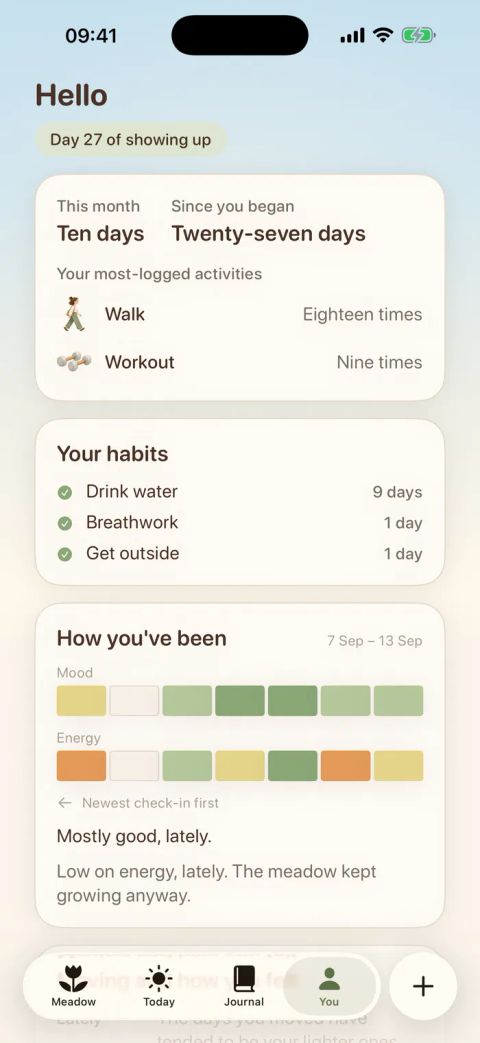
The slow nose-breathing you practise through the sequence travels well, and Meadow gives it a home on your phone. It is a movement and habit app for iPhone with a built-in breathwork feature, so you can sit and breathe alongside the wildflower meadow you have grown through your own efforts. You can also log a short yoga session with a timer, tick off small daily habits, and note your mood and energy. Each day you show up grows a new flower, and there are no streaks, so a week away from the practice resets nothing and your flowers never wilt.
Common questions
Which type of yoga is best for beginners over 60?
Look for a class labelled Hatha, gentle or restorative for your first steps, since these teach the basics slowly. Cleveland Clinic suggests Hatha as a starting point because it grounds you in breath and body awareness, and points to Iyengar yoga for anyone with injuries or physical limits, because it uses props and careful alignment and a teacher can bring in a chair when getting to the floor is hard.
How often should I practise?
Two or three sessions a week is a sensible start. The trials that reported benefits generally ran classes once or twice a week over several weeks, so turning up steadily over months does more than any single long session.
Is yoga safe with arthritis or high blood pressure?
Often yes, with the right adjustments, and this is exactly the case for a word with your GP first. Skip head-below-heart poses and long holds if your blood pressure drops on standing, keep everything within a comfortable range if your joints are sore, and tell any instructor about your conditions so they can adapt the poses for you.
Pick the chair you will use, set it somewhere you pass each morning, and do steps one to four tomorrow while the kettle boils. That is enough to begin.
AUTHOR
Co-founder of Meadow.
Ash is co-founder of Meadow, a habit and movement tracking app that turns small acts of self-care into a growing wildflower meadow.
See how far you've come
Your habits, moods and little wins, all in one place
Meadow keeps track of the walks, the water and the good days, so you can look back and watch your effort add up.
Download Meadow