WOOP is a four-step tool for turning a wish into action. You name the wish, picture the best outcome, face the obstacle that trips you up, then write an if-then plan for the exact moment it appears. Gabriele Oettingen, a psychologist at New York University and the University of Hamburg, built it over decades of research into why goals stall.
The odd part is what it asks you to dwell on. WOOP gives your obstacle as much attention as your goal, because picturing the happy ending on its own tends to leave you less likely to reach it. This guide walks through all four steps with worked examples, shows why the obstacle does the work, lays out the honest evidence, and hands you a template to fill in before you close the page.
What the four letters stand for
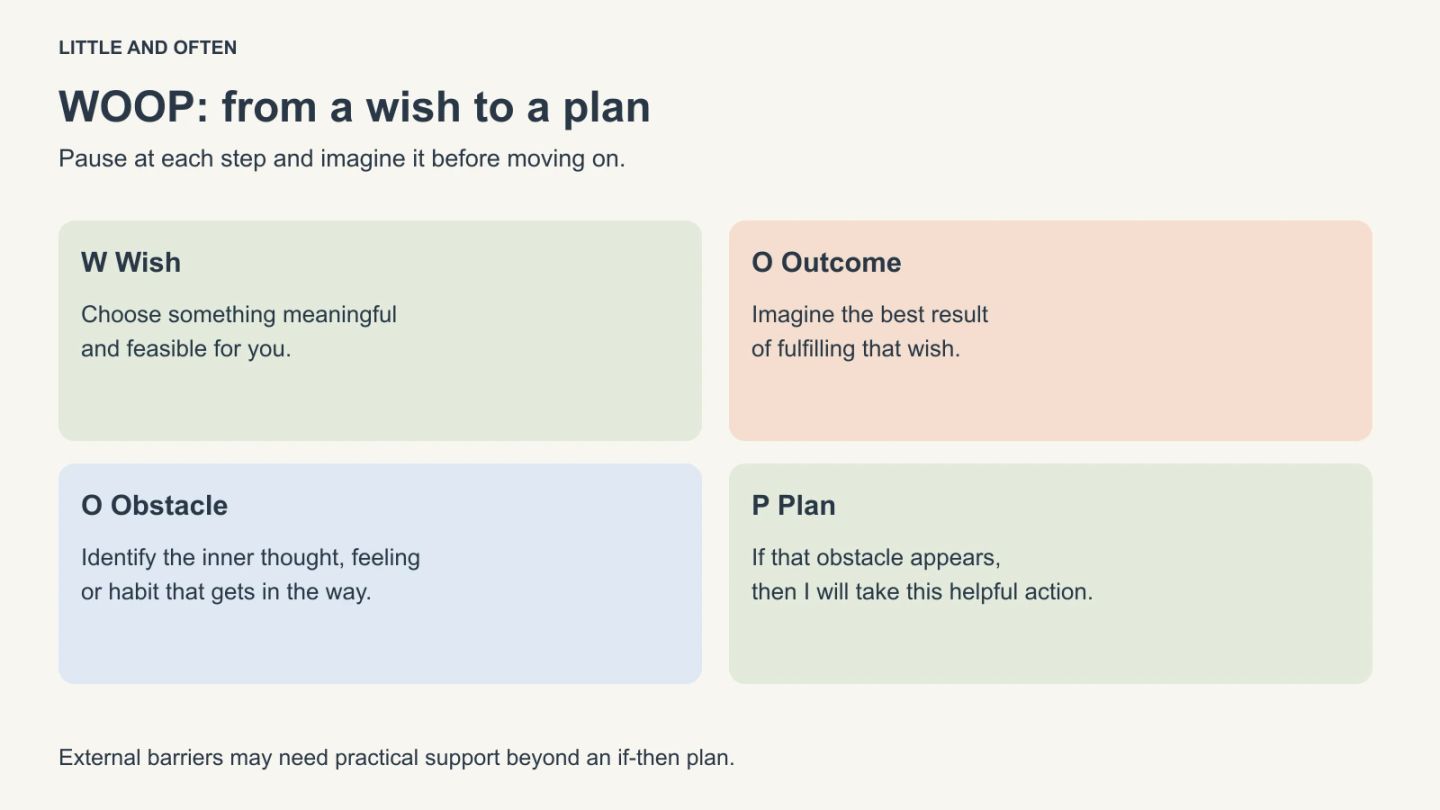
The name is the method. Wish is the goal you care about this week or this month. Outcome is the best thing that would happen if you pulled it off. Obstacle is the thing inside you that usually gets in the way. Plan is a short if-then instruction for what you'll do when that obstacle shows up.
You run through them in that order, and the order is doing something specific, which the next few sections explain. Oettingen designed WOOP to be quick. It takes a few minutes, works best written down or done with your eyes closed somewhere quiet, and it rewards repetition. You can point it at a big wish for the year or a small one for this afternoon.
Why picturing success on its own backfires
The usual advice is to visualise the finish line. See yourself slim, calm, promoted, mid-marathon. It feels good, and that's the problem.
Oettingen and Doris Mayer tracked people across four situations: graduates hunting for a job, students nursing a crush, undergraduates facing an exam, and patients recovering from hip replacement surgery. The more positively people fantasised about the future they wanted, the less effort they put in and the worse they did. People who rated their chances realistically, by contrast, tried harder and got further.
Oettingen's explanation is that a vivid daydream gives your mind a taste of the reward before you've earned it. You feel calm and satisfied, your energy drops, and the push to go and do the work fades. Positive thinking, on its own, can quietly talk you out of the effort.
What mental contrasting changes
WOOP fixes the daydream by bolting reality onto it. You still picture the outcome you want, then you turn straight to the obstacle in your way and hold the two side by side. Oettingen calls this mental contrasting.
Indulging in the fantasy alone leaves you relaxed and unmotivated, and dwelling only on the problems leaves you flat, but holding the wish and the obstacle together is what produces the drive to act. The contrast wakes up a question your brain answers on its own: is this wish within reach? When the answer is yes, mental contrasting binds you to the goal and points your energy at it. When the answer is no, it lets you drop a wish that was never going to happen and spend that energy elsewhere, which is a useful result in itself.
The whole approach rests on more than twenty years of motivation research, and Oettingen packaged it as WOOP so you can run it from memory without a worksheet.
Run WOOP step by step
Pick one wish and work it through all four steps. Here's a worked example running alongside each one.
Wish
Name one wish that means something to you and stretches you a little while staying possible. Keep it to a timeframe you can picture, this week or this month, not "someday". Sum it up in three or four words so it's easy to hold in mind.
Worked example: move my body most days this month.
Outcome
Picture the best outcome of getting your wish. What's the one thing you'd feel or gain? Close your eyes and let it play out for a moment, and make it vivid. This is the part that feels like ordinary positive thinking, and it's fine here because it's about to be balanced by the step that follows.
Worked example: more energy in the evenings and a clearer head by bedtime.
Obstacle
Now turn to what stops you, and look inward. Oettingen's obstacles are the habits, feelings and thoughts inside you: the flop onto the sofa, the "I'll start Monday", the scroll that eats an hour. External hurdles are real, but the obstacle WOOP works on is the one you carry around. Ask what it is in you that holds you back, then picture that as clearly as you pictured the outcome.
Worked example: I get home, sit down, and can't make myself get back up.
Plan
Make an if-then plan for that obstacle. The format is fixed. If the obstacle happens, then I will do this helpful thing. You're deciding in advance, so when the moment comes you don't have to win an argument with yourself.
Worked example: if I get home from work and want to collapse on the sofa, then I'll keep my shoes on and walk to the end of the road before I sit down.
The if-then plan is a well-studied technique in its own right. Peter Gollwitzer, who has worked closely with Oettingen, calls it an implementation intention. In a review pooling 94 tests of the method, if-then plans produced a medium-to-large improvement in whether people followed through. Naming the cue in advance hands the remembering to the situation, so the obstacle itself becomes the trigger for your response.

Does WOOP work?
It helps, and the research is honest about how much. A meta-analysis pooled 21 studies with almost 16,000 people and found mental contrasting with implementation intentions gave a small-to-moderate lift in reaching goals. That covered health behaviours like exercise and diet, schoolwork, and relationships.
A small-to-moderate effect is no magic switch. It's the kind of edge that adds up over weeks when you keep using it, and does nothing sitting in a drawer. The same review found WOOP worked better when someone talked you through it in person than when you read it off a page, so treat your first few run-throughs as practice. Write them down, do them properly, and the technique sharpens as it becomes familiar.
Two honest limits are worth naming. WOOP leans on obstacles you can name and act on, so a wish blocked by something outside your control, money or caring duties or a health condition, needs more than an if-then line. And it's a tool for following through on a goal you've already chosen, not a way to choose the right goal. For that groundwork, our guide to how to set goals covers the setup, and goal-setting theory explains why clear, stretching goals beat vague ones.
A WOOP template you can fill in now
You can do a full WOOP on the back of an envelope. Fill in the blanks, then keep the plan somewhere you'll see it when the obstacle turns up.
Wish: ________
Outcome: ________
Obstacle: ________
Plan: If ________, then I will ________
Filled in, it might read like this:
Wish: Read more instead of scrolling before bed
Outcome: Calmer evenings and finishing a book again
Obstacle: I pick up my phone the second I get into bed
Plan: If I'm in bed and reach for my phone, then I'll put it on the far side of the room and open my book instead
Somewhere to log the plan you made
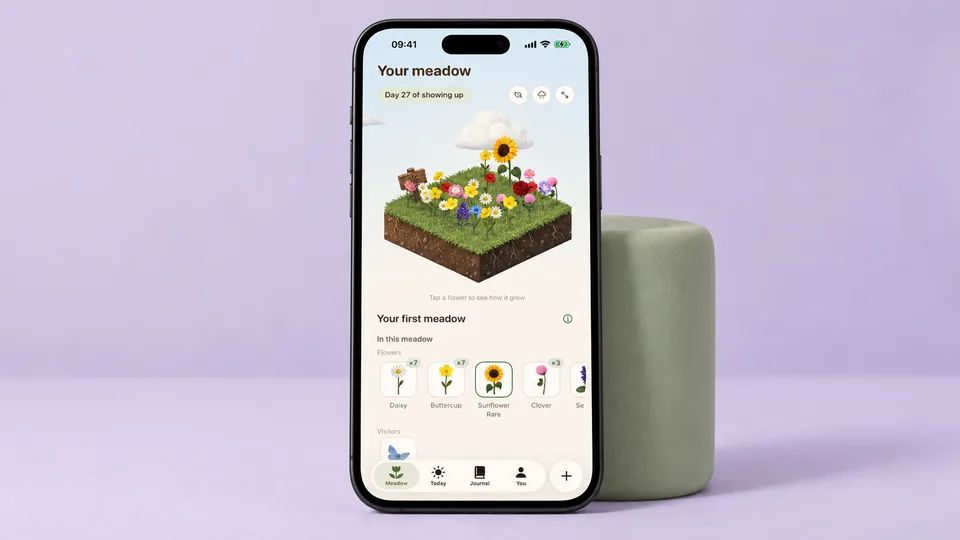
Once WOOP has handed you a small daily action, the job becomes showing up for it. Meadow is an iPhone app from Wildcard Wellness built around that: you log a walk or a few minutes of movement, tick off a small habit like the one your plan describes, and note your mood and energy if you want to. Every day you turn up grows a wildflower in a meadow that's yours. There are no streaks, so the evening your if-then plan loses to a hard day resets nothing, and the flowers you've already grown stay put. You can find it at Meadow.
Common questions
What kind of wish works best? One that means something to you and stretches you a little while staying within reach. WOOP does less for a wish you don't care about or one that's pure fantasy, since the reality check in the obstacle step is doing the sorting.
My obstacle is a lack of time, not a feeling. Now what? Look one layer down. "No time" is often a stand-in for a choice you make in the moment: staying at your desk, saying yes to one more thing, watching another episode. Find the inner habit underneath and write the plan for that.
How often should I do WOOP? As often as the wish needs. For a daily habit, running it once sets the plan, and repeating it each morning for a week or two makes the if-then response quicker to fire. For a one-off, like a hard conversation, a single WOOP beforehand is enough.
Is this the same as visualisation or affirmations? No. Visualisation and affirmations stop at the good feeling, which is the part Oettingen's research warns about. WOOP uses the pleasant image for about a minute, then spends the rest of its energy on the obstacle and the plan.
What if I can't find an obstacle? Imagine the coming week and watch for the moment the wish usually slips. The obstacle is whatever shows up right before you give up, put it off, or talk yourself out of it. If nothing comes to mind, the wish might already be a settled habit, or it might not matter to you as much as you thought.
Pick one wish now and give it four lines. Write your wish, the best outcome, the honest obstacle inside you, and the if-then plan for the moment that obstacle arrives. It takes about five minutes, and you'll walk away with a plan that's already decided. If you want to see the whole arc from picking a goal to sticking with it, how to achieve goals carries on from here.
AUTHOR
Co-founder of Meadow.
Ash is co-founder of Meadow, a habit and movement tracking app that turns small acts of self-care into a growing wildflower meadow.
Every little bit counts
Five minutes counts. So does a dance in the kitchen.
Log the movement you enjoy and the small habits that help you feel good, and watch them bloom into something you can see.
Download Meadow