You achieve a goal by turning it into something you do on ordinary days, then keeping at it through the weeks when you'd rather not. Setting the goal is the quick part. The achieving happens across the two hundred unremarkable afternoons that come after, and that's where most goals quietly stall.
So this guide is about follow-through. Not the burst of motivation on day one, but the machinery that keeps the action going when the motivation has gone: a clear next step, a fixed moment to do it, a plan for the obstacle you already know is coming, a way to see the days adding up, and a habit of fixing what isn't working before you quit.
If you're still deciding what the goal should be, our guide to how to set goals that stick covers the setup in detail. This one picks up the moment you have a goal and asks the harder question: how do you get it done.
Start with a goal you can act on this afternoon
A goal you can't act on today isn't a plan, it's a wish. "Get fit" gives you nothing to do after lunch and no way to tell whether you did it.
Edwin Locke and Gary Latham spent decades testing what a workable goal looks like. Their finding held across hundreds of studies: specific and challenging goals produce higher performance than vague or easy ones, because a clear target tells you where to aim your effort. Their theory leans on a few conditions, including clarity, a bit of challenge, real commitment, and feedback on how you're doing.
The one that carries the load for everyday goals is clarity. Turn "get fit" into "walk for twenty minutes after lunch on weekdays" and there's now a thing to do, a time to do it, and a way to know it happened. That's the version you can carry into the rest of this piece.
Turn the outcome into a process you repeat
Split the goal in two. The outcome is the result you're after: lose half a stone, read twelve books, sleep better. The process is the small action you'd repeat to get there: a short walk most days, ten pages a night.
You don't fully control the outcome. Your weight answers to sleep, stress and hormones as much as to today's effort, so aiming your attention there leaves you judging yourself on things you can't move. What you do control is whether you did the walk.
James Clear makes the point in his guide to goal setting: your goals set the direction, but your daily system delivers the progress. Keep the outcome as a compass you glance at now and then, and spend your days on the process, because the process is the only part today can touch.
Then bolt that process onto something you already do without thinking. The American Heart Association's advice for making habits stick is to attach the new action to an established routine, so a cue you can't miss does the reminding. After the school run, walk. After you pour the morning coffee, take the vitamins. The old habit becomes the alarm clock for the new one.
Decide the exact moment with an if-then plan
Wanting to do something and doing it are two different problems, and the gap between them is usually a missing decision about when.
The psychologist Peter Gollwitzer studied the fix and named it the implementation intention, an if-then plan that spells out when, where and how you'll act: if situation Y happens, then I do behaviour Z. You settle the decision in advance, so when the moment comes you're not negotiating with yourself. The cue arrives, the plan runs.
The format is short and it's worth writing down.
If it's Monday, Wednesday or Friday lunchtime, then I change my shoes and walk the block. If I've made the coffee, then I take the vitamins. If it hits nine at night, then my phone goes on to charge in the kitchen. Tie the action to a cue that already turns up every day and you've handed the remembering to your routine instead of your willpower.
Meet the obstacle before it arrives
Picturing the finish line feels good and does surprisingly little. Daydreaming about the slimmer, calmer, sorted version of you can even sap the drive to get there, because part of your brain treats the fantasy as if the work were already done.
Gabriele Oettingen built a method that turns the daydream into something useful, boiled down to four steps called WOOP: Wish, Outcome, Obstacle, Plan. You name the wish, picture the best outcome, then turn and face the obstacle inside yourself that tends to get in the way, and finally write an if-then plan for that obstacle. Holding the good outcome and the real barrier in mind at once is what Oettingen calls mental contrasting, and it's the turn towards the obstacle that gives a nice intention some grip.
A meta-analysis of 21 studies covering nearly 16,000 people found this approach produced a small-to-moderate improvement in whether people reached their goals. It takes five or ten minutes and works best on paper.
Yours might run like this. I want to move most days. The best outcome is more energy by the evening. My obstacle is that I flop on the sofa the second I get in. So if I get home and want to sit down, then I keep my coat on and walk to the postbox first.

Track it so the days are visible
Once the action is running, the thing that keeps it running is being able to see it. A goal you can't see the progress of is easy to quietly abandon, because there's nothing to tell you you're drifting.
Watching your own progress does measurable work. A large review by Thomas Harkin and colleagues, pooling 138 studies, found that prompting people to monitor their progress toward a goal made them more likely to reach it, with bigger effects when the progress was physically recorded or shared with someone. A mark on a wall calendar, a note in an app, a tick on the fridge: the point is that you'll see it.
Here's a weekly sheet you can copy onto a scrap of paper and stick where the action happens. Fill in the top once, then tick a box each day and answer the two lines on Sunday:
Goal this week: ________
My daily action: ________
After I ________ , I do it
If (obstacle) ________ , then I ________
Mon ☐ Tue ☐ Wed ☐ Thu ☐ Fri ☐ Sat ☐ Sun ☐
What got in the way: ________
One change for next week: ________
Filled in, a week might look like this:
Goal this week: More energy in the evenings
My daily action: A ten-minute walk
After I finish lunch , I do it
If I'm still at my desk at 1pm , then I shut the laptop and go before I eat
Mon ☑ Tue ☑ Wed ☐ Thu ☑ Fri ☑ Sat ☐ Sun ☑
What got in the way: Back-to-back calls on Wednesday
One change for next week: Block 1pm to 1.15pm in the calendar
Five ticks out of seven is a good week, and the sheet shows you that in a glance. It also catches the pattern, that Wednesday keeps falling over, before it becomes the reason you give up.
Make it smaller on hard days, and restart fast after a miss
Every goal meets a run of flat, rushed, unmotivated days, and those are the days that decide whether you keep the goal or drop it.
The move for a bad day is to shrink the action instead of skipping it. Aim for one page of the book, one lap of the block, one set of the exercise. A version this small survives a day when you've got nothing left, and doing the tiny version keeps the habit alive far better than a clean miss. Our guide to tiny habits walks through why shrinking beats gritting your teeth.
When you do miss, and you will, the thing to avoid is turning one miss into three. Work by Phillippa Lally's team, tracking people forming everyday habits, found that missing a single day didn't derail the process, and the time to feel automatic varied enormously from one person and one habit to the next. So one missed walk costs you almost nothing. It's the story you tell yourself afterwards, that you've blown it and might as well wait for Monday, that does the damage.
Don't wait for Monday. Start again at the next chance the cue comes round: the next lunch, the next morning. For more on holding the line through a busy stretch, see how to be consistent.
Keep the count on your phone
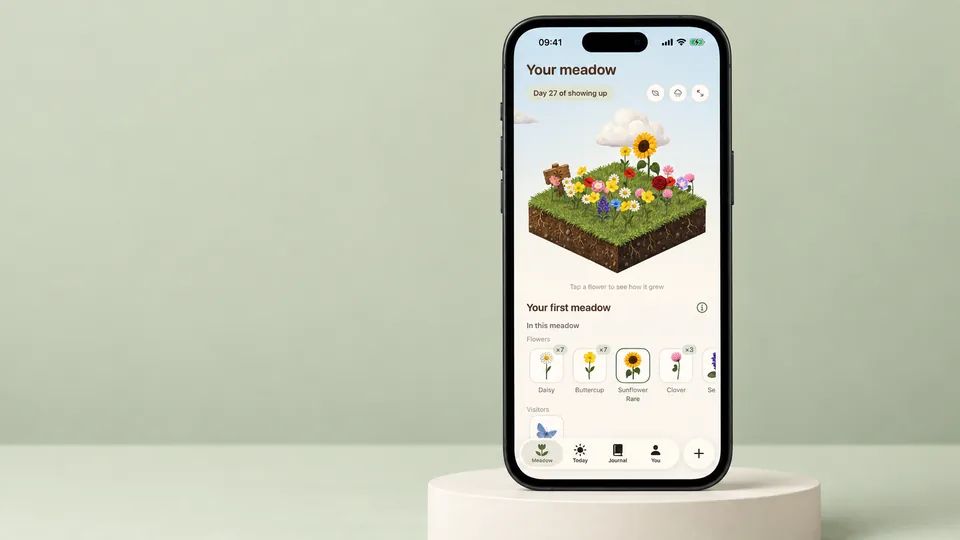
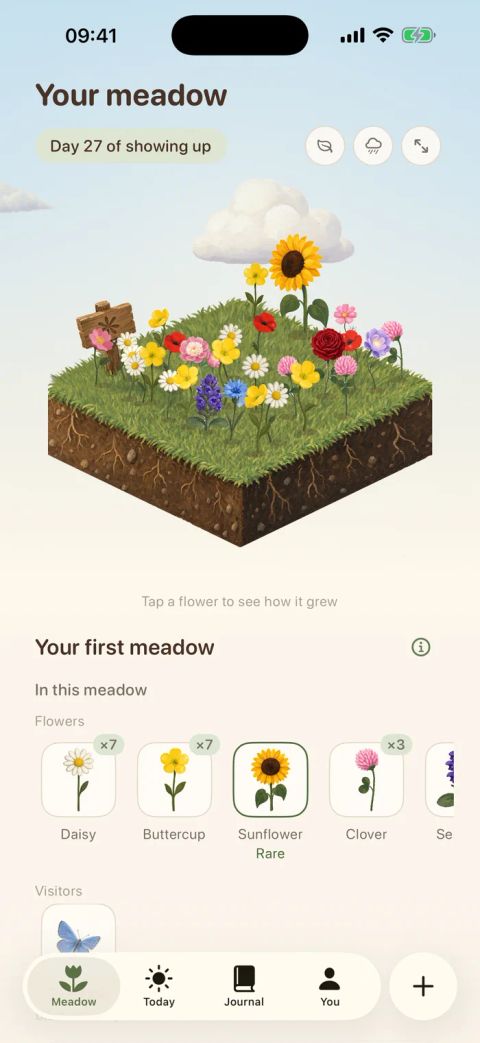
When the paper sheet keeps going missing, Meadow does the same job on your iPhone. It's a gentle app from Wildcard Wellness where logging a walk or a few minutes of movement, or ticking off a small habit, grows a wildflower in a meadow that's your own, and you can jot down your mood and energy while you're there. Because it runs on showing up rather than perfect weeks, there are no streaks to break, so a day you miss resets nothing and the flowers you've already grown stay where they are. You can find it at Meadow.
Review once a week and change what isn't working
A goal you set once and never look at again is a goal you'll have forgotten by next month. A short weekly review keeps it alive and lets you fix the leak before the whole thing drains away.
Once a week, three plain questions. Did I hit the action most days? If not, was the action too big or was the obstacle plan wrong? What one thing would make next week easier?
Then act on the answer. If the action felt trivial all week, nudge it up. If you kept missing at the same point, shrink it or rewrite the if-then plan for the obstacle that keeps beating you. The plan is meant to change as you learn what your week does to it. You're steering, not setting and forgetting.
Common questions
How many goals should I chase at once? One, maybe two. Overhauling your sleep, diet, exercise and screen time from the same Monday spreads your attention so thin that most of it collapses by the second week. Get one action close to automatic, then add the next.
How long until it gets easier? There's no fixed number, and anyone quoting you 21 or 66 days is guessing. Lally's research found the time varied widely and depended heavily on how demanding the action was. Judge yourself on whether you're still turning up, not on when it stops taking effort.
What if I keep failing at the same goal? Look at where it breaks, not at your character. Nearly every repeated failure is a broken cue or an obstacle you never planned for, and both are fixable on the sheet. Shrink the action, move it to a more reliable time, or write the if-then plan for the thing that keeps stopping you.
Should I tell people my goal? It can help. Harkin's review found progress you make public or record tends to move you along more than progress kept private. Tell one person who'll ask how it's going, or track somewhere you'll see it every day.
What do I do after a week off? Treat it as a pause, not a failure. Your old flowers, ticks and pages are all still there. Pick the smallest version of the action and do it at the very next cue, today if you can, and let one good day rebuild the rest.
Pick your goal and write one line for it now: after [something you already do every day], I do [the smallest honest version of the action]. Then name the obstacle most likely to stop you this week and write the if-then plan for it. That's the whole engine, and it's small enough to finish before you stand up.
AUTHOR
Co-founder of Meadow.
Ash is co-founder of Meadow, a habit and movement tracking app that turns small acts of self-care into a growing wildflower meadow.
Little and often, with Meadow
Consistency, not intensity.
Meadow turns the movement you enjoy and the habits that help you feel good into a meadow of wildflowers. No streaks to break, and your flowers never wilt.
Download Meadow