Goal-setting theory is the finding that specific, challenging goals pull more out of people than vague encouragement like "do your best". Edwin Locke and Gary Latham built it across decades of studies, and it comes with a short list of conditions that decide whether a goal helps you or works against you.
That second half is the part most articles skip.
Knowing the theory won't set your goals for you. It does explain why some goals drag you forward and others sit on a list until you give up on them, and it flags the moments where a goal starts doing damage. This piece walks through where the theory came from, the five principles it rests on, why "get fit" loses to "walk for twenty minutes after lunch", the conditions a goal needs to work, and the honest downsides when a goal is pushed too hard.
If you want the practical version, how to set goals is the toolkit. This is the why underneath it.
Where the theory comes from
In 1968 Locke published research showing something that sounds obvious once you hear it and turned out to be one of the most consistent findings in psychology. Specific and challenging goals led to higher performance than easy goals or "do your best" goals in around 90 per cent of the studies he and others ran.
Locke and Latham spent the next thirty-odd years testing it. Across hundreds of studies, different tasks, different countries, and goals people set for themselves or were handed by someone else, the pattern held. A clear, hard target beat a soft one.
The reason is plainer than it looks. A vague goal gives you nowhere to aim and no way to know if you're getting there. "Do your best" has no edge to it, so you settle at whatever feels like enough. A specific target tells you what enough looks like, and a hard one keeps you working past the point where you'd otherwise coast.
The five principles
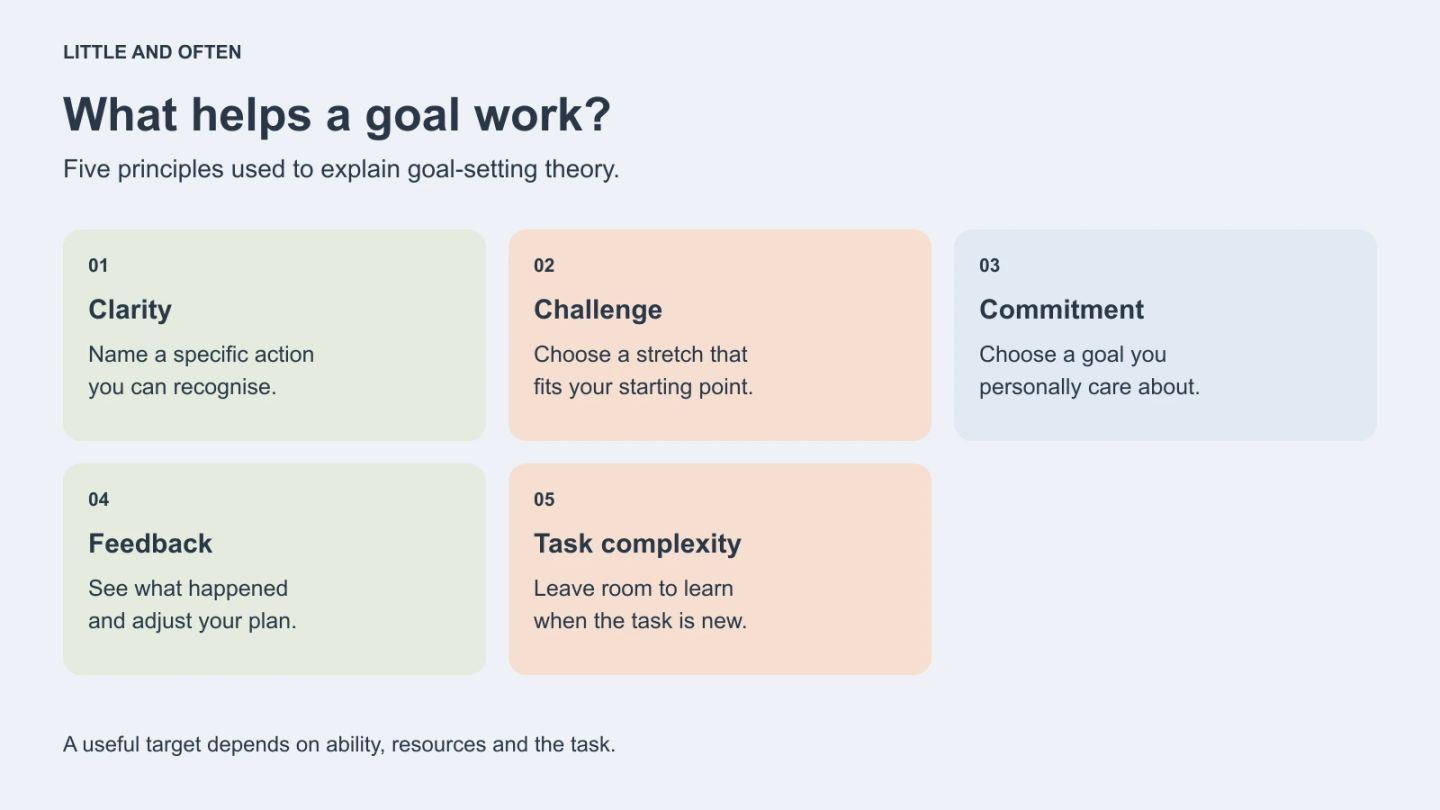
Locke and Latham's work is usually boiled down to five conditions a goal needs to do its job. Most goal advice is a restatement of these.
- Clarity. A clear goal is specific and measurable, so you can tell whether you've hit it. "Read more" is a wish. "Read ten pages before bed" is a goal you can check off or not.
- Challenge. The goal has to stretch you. Locke and Latham found effort rises with difficulty, so a target that's too soft doesn't pull much out of you. The catch is that it still has to be reachable.
- Commitment. You have to want the goal and mean it. The link between a goal and performance is strongest when you're committed to it, and that holds most for hard goals, because they take the most effort to stick with.
- Feedback. You need to see how you're doing. Without a signal that you're on track or drifting, you can't adjust, and a hard goal turns into guesswork.
- Task complexity. The goal has to fit the difficulty of the task. Pile too much on at once, or set a rigid target on something you're still learning, and it drags your motivation down instead of lifting it.
Read those back and you'll notice the SMART checklist, the fitness-tracker nudge, and half the advice on any goals blog are versions of the same five ideas.
What a good goal does
A specific, hard goal works through a few plain mechanisms. It points your attention at the thing that counts and away from everything else. It raises how much effort you put in, and it keeps you at it for longer. And it nudges you to go looking for a better way of doing the task.
Picture two people who both want to "get fitter this year". One leaves it there. The other decides to walk for twenty minutes after lunch on workdays. The second person knows what today asks of them, notices on Wednesday that they've missed two days, and can do something about it. The first is still deciding what "fitter" means in March.
That's the whole engine. Direction, effort, persistence, and a reason to problem-solve, all switched on by a target clear enough to argue with.
The conditions that decide whether it works
The headline finding comes with fine print. A hard goal only lifts performance while certain things are true, and Locke and Latham call these the moderators.
Ability is the first. A goal can't conjure a skill you don't have yet. Set a target miles beyond what you can currently do and effort stops tracking with it, which is why "run a marathon in spring" from the sofa tends to end in a sulk. How to set realistic goals goes deeper on pitching the size right.
Commitment is the second, and it's the one people fake. A goal you picked because you thought you should loses to the first busy week. A goal you'd choose on a flat Tuesday evening, one that survives past January, is what you'll defend.
Feedback is the third. You need an honest read on progress. A review of 138 studies found that keeping track of your progress toward a goal made you more likely to reach it. Writing it down beats keeping the tally in your head, which is why a wall chart or an app does real work rather than sitting there as decoration.
Task complexity is the fourth, and it leads straight into where goals go wrong.
When goals backfire
The motivational posters leave this part out. In 2009 a group of researchers led by Lisa Ordóñez published "Goals Gone Wild", arguing that the benefits of goal setting had been oversold and the harms mostly ignored.
They laid out a set of predictable side effects. A goal narrows your focus, which is the point, but that means you stop noticing everything outside it. Aggressive targets tempt people into cutting corners and outright cheating to hit the number. They skew how much risk feels acceptable. They can eat away at the enjoyment that got you started, turning something you liked into a quota. And on a task you're still learning, a hard outcome target can make you worse, because you're chasing a result before you've worked out how to reach it.
Their examples come from business, where the stakes were high. Sears once set repair-sales targets that pushed mechanics to charge customers for work they didn't need. The authors' point is that a goal is strong medicine. Useful at the right dose on the right problem, harmful when handed out for everything.
For everyday health habits the danger is milder but still real. A rigid step count can turn a nice walk into a chore you resent. A weight target can crowd out the actual goal, which was to feel better. When the number starts running the show and the thing itself stops being worth doing, that's the side effect, not a personal failing.
Aim to learn before you aim to perform
One fix from the research is worth borrowing. When a task is new to you, a learning goal often beats a performance goal. Instead of "lose half a stone", something like "try three types of movement this month and find one I'd do again" points you at the skill instead of the scoreboard.
Once you know what you're doing, switch. A performance target works well when the method is settled and it's effort you need, not discovery. Early on, while you're still figuring out what fits your life, chasing an outcome can trip you up.
A place to see the feedback build

Feedback is the moderator most people drop, because tracking by memory doesn't work. Meadow is a gentle iPhone app built around that gap. You log a bit of movement or tick off a small habit, and each day you show up grows a new wildflower in a meadow that's yours, so your progress is something you can look at rather than guess at. There are no streaks, so a missed day resets nothing and the flowers you've grown stay put. That keeps the feedback kind instead of turning it into a target that punishes you for one off day. You can try it at Meadow.
Turning the theory into practice
The research points at a short set of moves. Use them on a real goal like this:
- Make it specific enough to check. Swap "get fit" for one action with a number and a time, like "walk twenty minutes after lunch on workdays".
- Pitch it hard but reachable. It should stretch a normal day but not demand a perfect one.
- Pick something you'd choose on a tired evening, not something that only appeals when you're inspired. That's commitment you can bank on.
- Give yourself a way to see progress. A chart, an app, a line in a notebook, anything you record.
- Start with a learning goal if the thing is new, then move to a performance target once you know the ropes.
- Watch for the goal running you. If the number has killed the pleasure, loosen it before you quit.
If sticking with it is where you tend to fall down, how to be consistent covers the follow-through.
Common questions
Is goal-setting theory proven? It's one of the better-supported findings in psychology, tested across decades and hundreds of studies. The core result, that specific and hard goals beat vague ones, is solid. The caveats about when goals backfire rest on the same kind of evidence.
Does it work for personal goals or only at work? Most of the original research was done in workplaces and labs. The principles carry over to personal habits, though with no boss checking in, commitment and feedback have to do more of the lifting.
Are SMART goals the same thing? No, though they overlap. SMART is a checklist that grew up alongside the theory and picks up clarity and challenge. Goal-setting theory is the research explaining why those features help and where they stop helping.
What's a learning goal versus a performance goal? A performance goal names the result you want. A learning goal names the skill or approach you want to build. New tasks respond better to learning goals, settled ones to performance goals.
Pick one goal you're carrying right now and rewrite it in a single specific line: the action, a number, and when it happens. That one edit, from a vague wish to a checkable target, is the change the whole theory rests on.
AUTHOR
Co-founder of Meadow.
Ash is co-founder of Meadow, a habit and movement tracking app that turns small acts of self-care into a growing wildflower meadow.
Little and often, with Meadow
Consistency, not intensity.
Meadow turns the movement you enjoy and the habits that help you feel good into a meadow of wildflowers. No streaks to break, and your flowers never wilt.
Download Meadow