Realistic goals keep you going long enough to see a result. An overambitious one tends to fold inside a fortnight and take a slice of your confidence with it, so the next attempt starts from a worse place than the first.
That's the case in a line. The rest of this piece is the why behind it: how a goal you can reach protects your motivation, how small wins build the self-belief that carries you, why realistic goals survive the days you'd rather do nothing, and why they're the ones still standing months later. There's an honest section too on what "realistic" does and doesn't mean, because it isn't a polite word for timid.
What makes a goal realistic
A realistic goal is one matched to where you are now, not where you wish you were. It fits the time you have, the energy you can spare on an average day, and the point you're starting from. "Run a marathon in three months" isn't realistic for someone who hasn't run since school. "Walk for twenty minutes most days" is, and it's the honest first rung of the same ladder.
Realistic also means built from your own baseline. If you move once a week now, three sessions is a stretch and five is a fantasy. The goal has to start near your real life, so the first week is winnable.
Realistic goals keep your self-belief intact
Belief in your own ability to pull something off has a name in psychology: self-efficacy, from Albert Bandura's work. Self-efficacy is your belief in your capacity to carry out the actions a task needs, and the strongest thing that builds it is a track record of getting things done. Bandura called those mastery experiences, and nothing feeds confidence like succeeding at something firsthand.
An unrealistic goal starves that record. You set the bar where you can't reach it, you miss, and the miss becomes the evidence. Do that a few times and you learn the wrong lesson, that you're someone who doesn't follow through. A goal pitched where you can hit it does the opposite. It banks a win you can point to.
Commitment works the same way. In Edwin Locke and Gary Latham's goal-setting research, how committed you are to a goal depends partly on whether you believe you can achieve it. A target you privately think is out of reach gets a half-hearted effort, because some part of you has already written it off.
Small wins pull you forward
Motivation is less the fuel that gets you started and more the thing that progress produces. You do a small thing, you notice it worked, and the noticing makes the next one easier.
Bandura and Dale Schunk showed this with children who'd fallen behind in maths. Splitting the work into near, proximal subgoals produced faster progress and stronger self-belief than one distant goal, and a distant goal on its own did close to nothing. Each subgoal cleared was a small success, and the successes stacked into confidence. Realistic goals hand you more of these, more often, because they're sized to be reached.
Ambitious targets put the payoff months away. Realistic ones put a win at the end of today, and today is the only day you can act on.
They survive the days you'd rather not
Every plan meets a bad day. A cold, a deadline, a night of broken sleep. A realistic goal has room built in for those days, so one of them doesn't sink the whole thing.
Set the bar too high and there's no slack. The first missed session doesn't read as a normal blip, it reads as failure, and failure invites the "I've blown it, what's the point" spiral that turns one skipped day into a fortnight off. Locke and Latham found that goals which are too hard, too many or crammed into too short a window can backfire rather than drive you.
The research on habit formation is reassuring here. Tracking people building everyday habits, Phillippa Lally's team found that missing a single day didn't stop a habit forming, and that the time to feel automatic varied hugely from one person to the next. One off day is not the end of anything. A realistic goal is one you can pick back up the next morning without a sense of having failed.
They're the ones still going months later
The goals that last tend to be the modest, doable ones. In a study of more than a thousand people making New Year's resolutions, 55% still counted themselves successful a year on, and those who framed the goal as something to move towards did better than those trying to cut something out (58.9% against 47.1%). A goal you can approach and repeat beats one built on grand restriction.
There's a quieter reason realistic goals stick. They turn into a routine you barely have to decide on. James Clear's shorthand is that goals set your direction while your daily system does the work, and a realistic action is one small enough to become that system. The American Heart Association's advice for making a habit stick is to attach the new action to something you already do and keep it small, so an existing cue prompts it. You can bolt a modest action onto your morning. A huge one needs willpower you won't always have.
Realistic doesn't mean unambitious
People set the bar too high out of a fear that a realistic goal is settling. It isn't. Ambition lives in where you're heading, and realism lives in the size of today's step. You can want to run a half-marathon and still make this week's goal three short runs. The direction is bold and the daily action is doable, which is the pairing that gets you there.
Realistic goals are also the ambitious ones that survive contact with real life. A wild target you abandon in week two moves you nowhere. A modest one you keep for a year compounds into something a "get fit" resolution never reaches. Watching your progress helps the modest version along: a review of 138 studies found that monitoring how you're doing makes you more likely to reach a goal, so a daily tick earns its few seconds.
If you want the mechanics of setting one up, our guide to how to set goals covers SMART goals and their limits, if-then plans and a template. For shrinking an action until it's almost too small to skip, see tiny habits, and if you're starting in January, new year habits works through keeping one past the first fortnight.
Watch the small wins add up

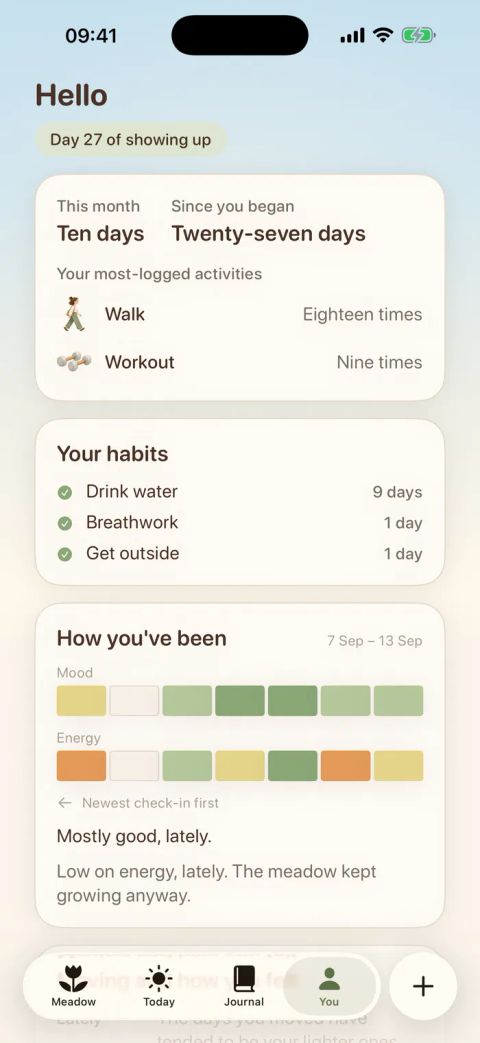
A realistic goal gets easier to believe in when you can see the wins piling up, and that's the idea behind Meadow, a gentle iPhone app from Wildcard Wellness. You log a short walk or a few minutes of movement, tick off a small daily habit, and each day you show up grows a wildflower in a meadow that's yours, with a quick note on your mood and energy if you fancy it. There are no streaks, so the day you miss resets nothing and the flowers you've grown stay put, which takes the all-or-nothing pressure off a goal you're still building. You can try it at Meadow.
Common questions
Isn't a realistic goal settling for less? No. A realistic goal is the size of your next step, not the size of your ambition. You can aim high and still make today's target something you can hit, and the small hits are what get you up the hill.
How do I know if my goal is realistic? Look at your last month, not your best intentions. If you moved once a week, a goal of three sessions is a stretch worth trying and five is likely to break. Pick the version you could do even on a busy, tired day, and let the good days go further on their own.
What if I can't hit even a realistic goal? Shrink it. A goal you keep missing is telling you it's still too big, not that you've failed at it. Cut it to a version so small it feels almost daft, get that running, then build from there.
Should goals be easy or challenging? A little of both. Locke and Latham's research points to goals that are hard enough to pull effort out of you but reachable enough that you still believe you can get there. Too easy and you coast, too hard and you quit.
Do realistic goals work better than ambitious ones? They tend to outlast them, which is what counts over months. An ambitious goal you drop by February changes nothing, while a modest one you keep quietly rebuilds your habits and your confidence.
Take whatever goal you're carrying and ask one thing of it: could I do the smallest version of this on my worst day this week? If not, cut it down until the answer is yes, and start there tomorrow. That first winnable step is worth more than the ambitious plan you'll have quit by the weekend.
AUTHOR
Co-founder of Meadow.
Ash is co-founder of Meadow, a habit and movement tracking app that turns small acts of self-care into a growing wildflower meadow.
See how far you've come
Your habits, moods and little wins, all in one place
Meadow keeps track of the walks, the water and the good days, so you can look back and watch your effort add up.
Download Meadow