You've set the goal and made a good start, and now the job is to keep it from quietly falling apart. That job isn't setting the goal or restarting it from scratch. It's watching how you're doing while you're in the middle of it, and making small corrections before a slack week turns into a stalled month.
The move with the best evidence behind it is plain. Keep track of your own progress, look at it on a set schedule, and write down what you see. Do that and you'll catch a goal drifting while there's still an easy fix, instead of noticing three weeks later that you stopped.
This guide is about the middle stretch. How to review progress on a rhythm, spot drift early, change the plan when the plan is the broken bit, get through a missed week without giving up, and pull in someone who'll keep you honest. There's a five-minute review template near the end you can copy onto a sticky note.
Check in on a schedule, not on a whim
Monitoring your progress is the engine that keeps a goal moving, and the research on it is clear. A meta-analysis of 138 studies, covering close to 20,000 people, found that prompting people to monitor their progress reliably raised their odds of reaching the goal, and the effect grew stronger when they checked in more often. The size of it was moderate, not magic, but it showed up again and again.
The question isn't whether to track, it's how often. Too rarely and you drift for weeks before you notice. Check obsessively and every small dip feels like a failure. A daily tick that takes five seconds, plus one proper look each week, covers most goals well.
Pin the weekly review to a time you won't argue with. Sunday evening, Monday coffee, the train home on Friday. Bolting it onto something you already do every week is the same trick as habit stacking, where an event you can't miss becomes the reminder, so the review happens whether or not you feel like it.
There's a reason the check-in does so much work. Edwin Locke and Gary Latham, whose research on goal setting ran across 35 years, found that a goal only lifts performance when it comes with feedback on how you're doing. Without it you're putting in effort blind, unable to tell whether to push harder or change tack.
Make your progress something you can see
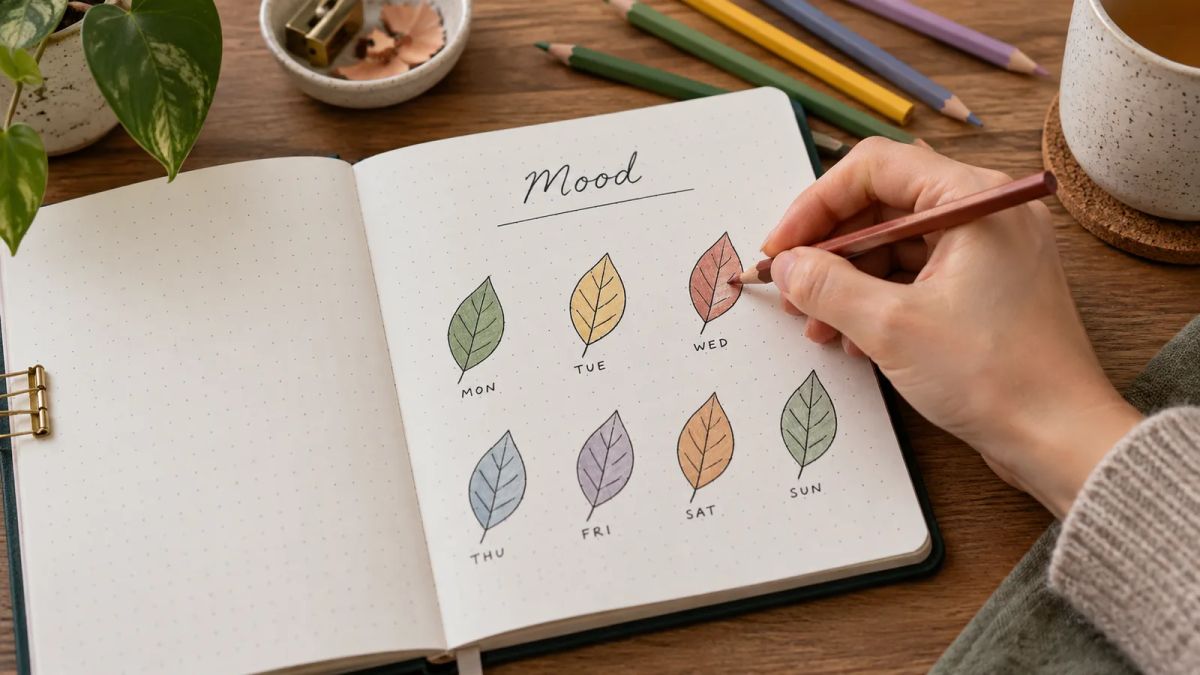
The same meta-analysis found progress had a bigger effect on the goal when people physically recorded it, not kept it in their head. Writing it down turns a vague sense of "I've been alright lately" into a row of marks you can't talk your way out of.
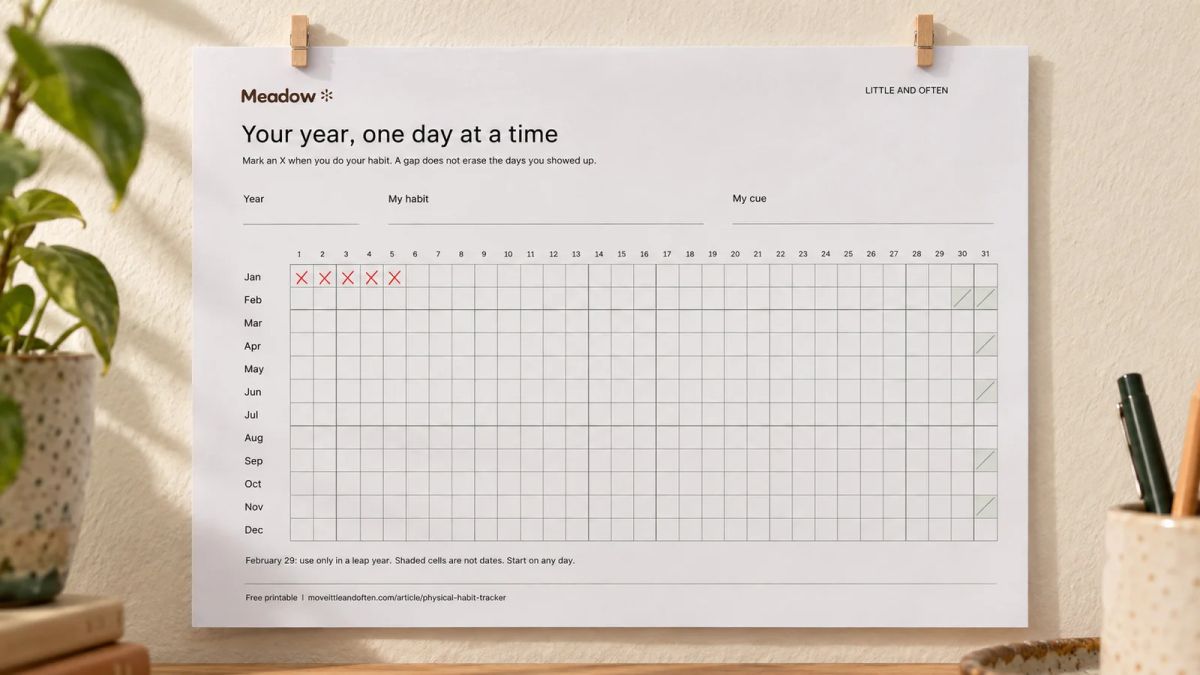
James Clear makes the case for a plain habit tracker, a calendar where you mark an X on the days you show up. He gives three reasons it works: it's a visual cue that reminds you to act, it feels good to mark, and a run of marks you don't want to break keeps you going. The medium barely matters. A wall calendar, a note on your phone, a tick on the fridge, whatever you'll see.
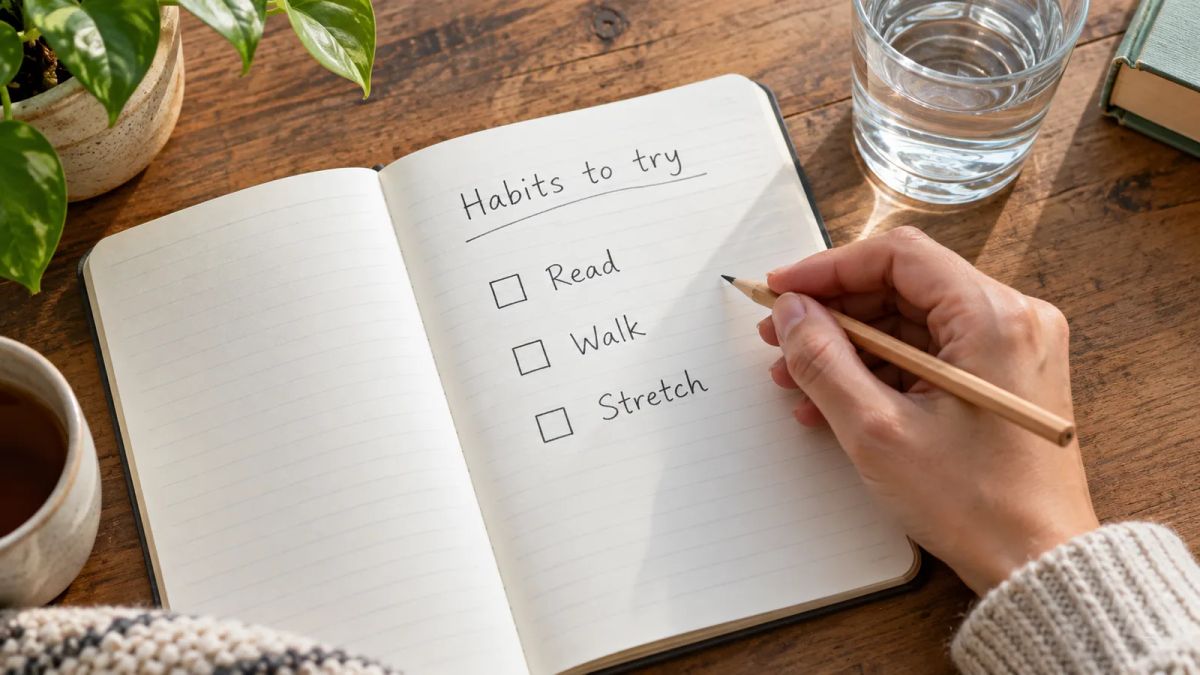
Keep what you track honest and small. One mark for "did the thing today" beats an elaborate spreadsheet you abandon in a fortnight. If you've set a process goal, three short walks a week, say, then track the walks, the part you control, and let the outcome look after itself.
Catch drift before it becomes quitting
Goals rarely collapse in one dramatic quit. They shrink. The walk slides from thirty minutes to ten, the ten-minute version slides to "tomorrow", and a quiet week later the whole thing has faded without a decision ever being made.
Frequent monitoring is how you catch that early. When your marks show you slipping below where you meant to be, you've got something to act on. Locke and Latham found that people who are behind target tend to raise their effort or try a new approach, but only when they can see they're behind. A blank week on the calendar is a signal, not a verdict.
Watch for the tells. The action keeps drifting later in the day. Your bad-day version has quietly become every day. You've stopped ticking the tracker at all, which is usually the first thing to go. Any one of these caught in week two is a small correction. Left till week six, it's a restart.
Adjust the plan, not the goal
Most people get this backwards. They hit a rough patch, decide they've failed the goal, and either bin it or punish themselves with a bigger target. Nearly always the goal was fine and the plan around it was wrong.
Start by shrinking the action to something that survives a bad day. If a thirty-minute session keeps losing to a busy evening, the honest version is ten minutes, or five. A small action you do beats a big one you skip.
Then fix the moment it's meant to happen. The psychologists Peter Gollwitzer and Paschal Sheeran showed that an if-then plan, "if situation Y comes up, then I will do Z", helps people act on a goal exactly when something gets in the way. Their evidence is that these plans work hardest when obstacles crop up in the course of a goal. So name the obstacle that keeps winning and write the plan for it. If it's raining at six, then I walk at lunch instead. If the meeting runs late, then I do the two-minute version at my desk. You're not lowering your sights, you're deciding in advance how to handle the thing that keeps derailing you.
Get through a setback or a busy week
You will miss. A day, a week, a fortnight over Christmas. The miss is not the problem. What you do next is.
In one real-world study tracking people building everyday habits, missing a single day didn't derail the process, and the automatic feeling recovered soon after. That study also found the time to feel automatic varied hugely, from about three weeks to eight months depending on the person and the habit, so judge yourself on whether you're still turning up, not on a number you read somewhere.
James Clear's rule for this is never miss twice. One miss is an accident. Two in a row is the start of a new, worse habit. So the aim after any slip is narrow: get the next one done, at the next cue, not next Monday. Waiting for a clean line, the first of the month, a fresh notebook, is a slower way of quitting.
For a busy stretch, drop to a floor version and hold it. Keep one two-minute token of the habit alive, so the thread doesn't snap and there's nothing to restart when the week eases up. Keeping the run going through the flat weeks is most of the game, and how to be consistent goes deeper on that.
Bring in someone who'll ask
Checking in with yourself is good. Checking in where someone else can see is better. That same meta-analysis found progress monitoring had a stronger effect on the goal when people reported it or made it public instead of keeping it to themselves.
A standing Sunday text to a friend, a walking buddy who notices when you don't show, a group chat where you post your ticks. The mechanism is dull and it works: knowing you'll have to say it out loud makes you more likely to do it. Pick one person and give them a specific thing to expect from you each week.
Watch the good days stack up
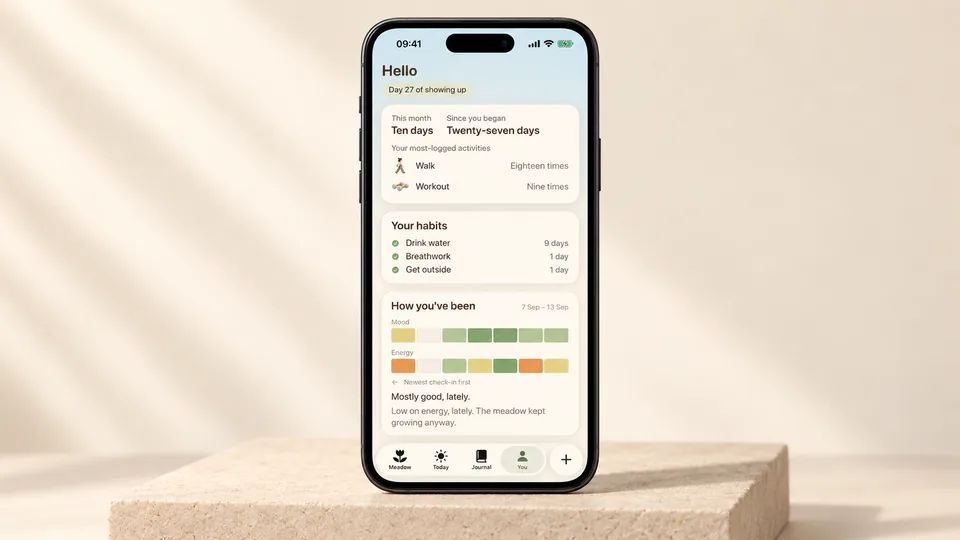
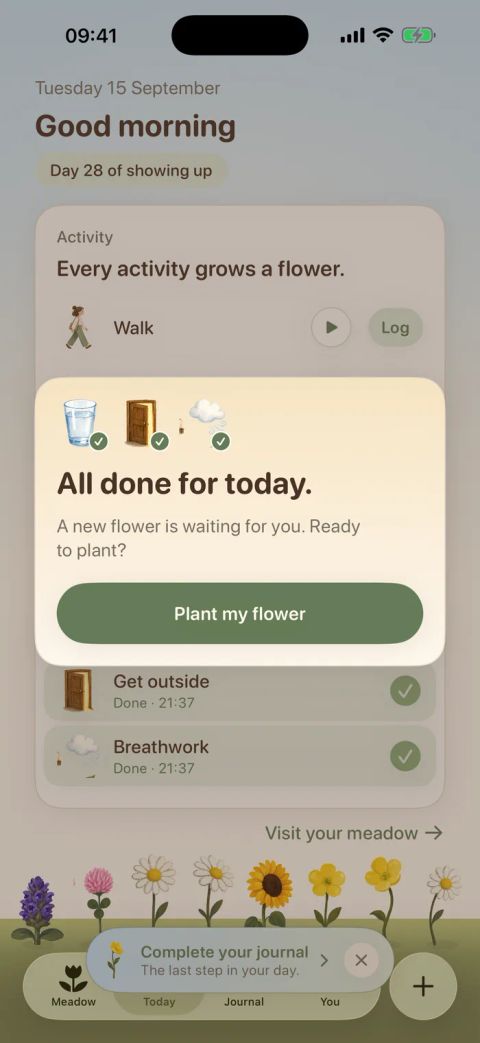
The easiest record to keep is one that rewards you for keeping it. Meadow, a gentle iPhone app from Wildcard Wellness, turns each day you show up into a wildflower in a meadow that's yours. You log a short walk or a few minutes of movement, tick off a small habit, and note your mood and energy, and the weeks of small efforts become something you can look back over. It has no streaks, so a missed day or a flat week wilts nothing you've grown, which is the point when you're trying to hold a goal together through the messy middle. You can find it at Meadow.
Run a five-minute weekly review
This is the whole system on one sticky note. Once a week, look at your marks and answer these. Here's a blank version to copy:
Goal I'm working on: ________
Days I hit it this week: ________ out of ________
What got in the way: ________
Plan change for next week: if ________ , then I'll ________
My floor version for a bad day: ________
Who I'll tell: ________
Filled in, it might read like this:
Goal I'm working on: Walk most days for more evening energy
Days I hit it this week: 4 out of 7
What got in the way: Afternoon meetings ran over, missed the lunch walk
Plan change for next week: if a meeting runs past 1pm, then I'll walk at 5 before I sit down
My floor version for a bad day: One lap of the block
Who I'll tell: Text Sam on Sunday with my count
Five honest minutes here does more than an hour of good intentions on New Year's Day. You're steering as you go, and the plan is meant to change.

Common questions
How often should I check my progress? A quick daily mark plus one proper weekly review suits most goals. Daily keeps the habit in front of you, weekly is far enough back to see the trend without panicking over one off day. Wind the weekly review down to fortnightly once the habit feels settled.
What if the numbers say I'm failing? Treat them as feedback, not a verdict. A bad week tells you the plan needs a tweak, usually a smaller action or a better cue, not that you should scrap the goal. Change one thing and watch next week's marks.
When should I change the goal itself? When it no longer fits your life or the reason for it has gone, not because you had a hard fortnight. If your circumstances have shifted, resetting the goal is sensible. If you're only off the pace, fix the plan and keep the goal.
How do I get going again after weeks off? Don't try to make up the lost ground. Start again at the next cue with the smallest version of the action, get one mark on the calendar, and let a couple of easy wins rebuild the run before you push the size back up.
Is a paper tracker or an app better? Whichever you'll look at. Paper on the wall is hard to ignore, an app nudges you and does the counting. The best tracker is the one still in use in a month.
Before you close this, set your weekly review. Put a repeating fifteen-minute slot in your calendar for Sunday evening, name the one thing you'll check, and copy the six-line template above into wherever you'll see it. That recurring appointment is what turns a goal you set into a goal you keep.
AUTHOR
Co-founder of Meadow.
Ash is co-founder of Meadow, a habit and movement tracking app that turns small acts of self-care into a growing wildflower meadow.
Every little bit counts
Five minutes counts. So does a dance in the kitchen.
Log the movement you enjoy and the small habits that help you feel good, and watch them bloom into something you can see.
Download Meadow