A habit is an action you've repeated so often, in the same setting, that it starts to run on its own when that setting turns up. No decision needed. You brush your teeth before bed, put your seatbelt on as you get in the car, or reach for your phone the second you sit down, and most of the time you don't clock yourself doing any of it. That automatic quality, set off by a cue you've paired with the action through repetition, is what makes a habit a habit.
What counts as a habit
Psychologists use a tighter version of that definition. A habit is an action triggered automatically in response to a cue you've come to associate with it, built up by doing the same thing in the same context again and again. The key word is learned. A habit isn't something you were born doing, the way you were born blinking or flinching. You picked it up by repeating an action in a situation enough times that your brain stopped treating it as a fresh problem to solve.
Three things have to line up for something to count. There's a cue, which is the situation or trigger. There's the action itself. And there's the repetition that welds the two together, until the cue starts pulling the action out of you with barely any input on your part.
That last part is what people miss. A behaviour you have to talk yourself into every time isn't a habit yet. It's still a choice.
Habit, routine and one-off choice
People use habit and routine as if they're the same word. They're not, and the gap is worth knowing.
A habit is a single action that's gone automatic. A routine is a string of actions you run as a block, and it usually still needs a bit of conscious steering to get through. Your morning might go shower, coffee, pack the bag, out the door. Any one step in that can be a habit, and the routine is the container you keep them in.
A one-off choice is different again. It's a decision you weigh up in the moment: what to order, whether to go to the gym today, which way to drive. You're doing the thinking each time. A habit has had the thinking taken out of it.
Wendy Wood and David Neal's research draws the line sharply. Strong habits are set off by the context cues that were around when you did the action before, things like a place or a time of day, and they fire fairly independently of what you happen to want right now. That's why you can be halfway through eating the biscuit before you remember you meant to cut back. The cue pulled the response before your goal got a say. Researchers estimate that a large share of daily behaviour, roughly 40 percent, happens in the same context day after day, which is a lot of life running on cue and repeat.

The cue, routine and reward loop
Where does the automatic pull come from? Repetition builds a lot of it, but reward is what gets the loop going in the first place.
Charles Duhigg popularised a simple version: cue, routine, reward. Something triggers the behaviour, you carry it out, and you get a payoff that tells your brain the sequence was worth keeping. James Clear splits the middle into craving and response, giving four beats, but the shape holds. The reward doesn't have to be dramatic. Relief from stress, a hit of sweetness, the small satisfaction of a cleared inbox, any of these can be enough to make the loop worth repeating.
We're keeping the loop short here on purpose. For the full breakdown of each stage and how to work with it, our guide to the habit loop walks through it.
What's happening in your brain
You can watch a habit take shape in the brain. As an animal learns to run a maze, neurons in the striatum, part of a deep structure called the basal ganglia, fire all the way through the run at first. Once the route becomes habitual, that firing collapses to a burst at the start and a burst at the end, with near silence in the middle. Ann Graybiel, the MIT neuroscientist behind much of this work, calls it chunking. The brain packs a whole sequence into one unit, bracketed by the cue that launches it and the reward that closes it.
It's why a familiar drive can drop out of memory while you arrive in one piece. The middle ran as a chunk.
One honest note belongs here. Even settled habits aren't fully on autopilot. Graybiel's group found that a region of the prefrontal cortex keeps quiet tabs on them, and when they switched that region off, the habit stopped. Automatic means mostly hands-off, not beyond your reach.
Good habits and bad habits
The machinery is identical whether the habit helps you or harms you. A morning walk and a mid-afternoon trip to the vending machine form the same way, through a cue, an action and a reward repeated until it holds. The difference sits in the effect the habit has on you, while the mechanism underneath is the same.
Good habits tend to pay off slowly and quietly: teeth that don't rot, a body that moves more easily, a calmer evening. Bad habits usually pay off fast and charge you later, which is exactly what makes them stick. The reward lands now, the bill turns up much further down the line, and the loop keeps running in between.
How automatic do habits get
Here's where a lot of habit advice oversells. You've probably heard it takes 21 days, or that some fixed number of repetitions locks a habit in. The research doesn't back a single figure. In one well-known study, actions took a median of around 66 days to reach their peak level of automaticity, but individual people ranged from about 18 days to well over 200, depending on the person and how demanding the habit was.
Two things are worth holding on to from that. Slower than you'd like is normal, so a habit that hasn't clicked by week three isn't a failed one. And missing a single day barely dents the process. The same work found that one missed opportunity didn't meaningfully throw habit formation off course. You don't wipe out weeks of repetition with one off day, which takes most of the drama out of slipping up.
Why knowing what a habit is helps you build or change one
Once you see a habit as a cue-triggered action rather than a test of willpower, building and breaking them both get more concrete.
To build one, you give a small action a reliable cue and repeat it in the same context until the cue does the work for you. Hang it on something you already do without fail, like flicking the kettle on or sitting down at your desk. Keep it small enough that a rough day can't knock it over. Our guide to habit formation covers the how in depth, and if you want the smallest possible starting point, tiny habits is built around that idea.
To change one, you work on the parts you can reach. Change the cue so it stops firing, or keep the cue and swap the action for something that gives a similar reward. You're redirecting the loop, not deleting it.
Watch the repetition add up
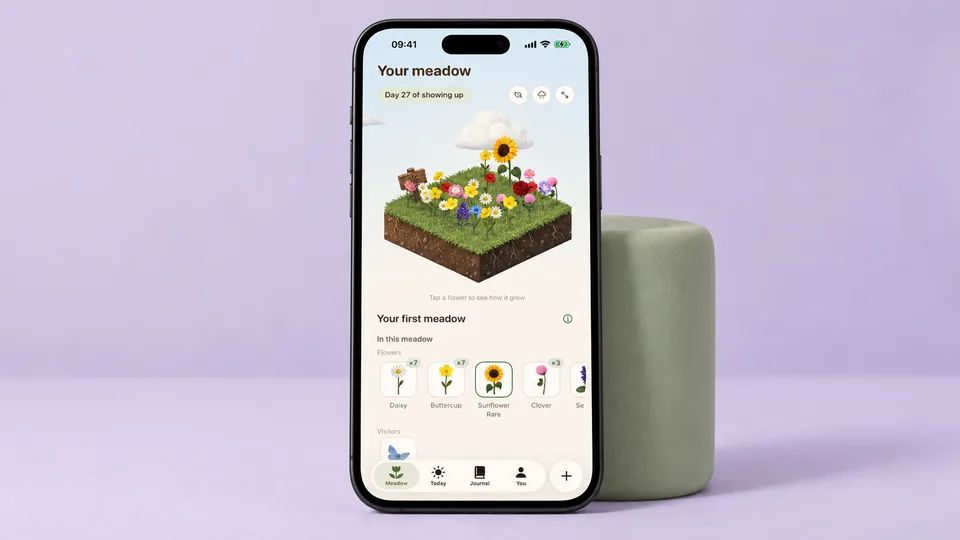
Since habits are built by doing the same small thing over and over, it helps to see that repetition piling up somewhere you can look at. Meadow is an iPhone app that turns each day you show up into a wildflower in your own meadow. You log a walk or a few minutes of movement, tick off a small habit, and note your mood and energy, and the meadow fills in as the days stack up. It's built around consistency, so there are no streaks to break and a day you miss leaves your flowers exactly where they were. You can find it at growyourmeadow.com.
Common questions about habits
Is a habit the same as an addiction?
No, though they share some wiring. A habit is an automatic cue-response you can usually override once you notice it. An addiction involves stronger cravings, changes in the brain's reward systems and continued use despite clear harm, and it often needs proper support to change. If a behaviour feels beyond your control, talk to your GP.
How many of my daily actions are habits?
More than it feels like. Studies suggest a large share of everyday behaviour, around 40 percent, is performed in the same context almost every day, which is the fingerprint of a habit at work.
Can a thought be a habit?
Yes. Habits aren't limited to physical actions. A worry that fires whenever you open your banking app, or the automatic self-criticism after a mistake, can run as a mental habit through the same cue-and-repetition process.
Do bad habits ever fully go away?
The loop tends to fade instead of vanishing. Old cues can still tug at you months later, especially under stress, which is why swapping a new response onto the same cue tends to beat trying to erase the habit outright. Expect the pull to shrink, and to show up again now and then.
The first step
Start with the smallest version. Pick one habit you'd like to have, name the exact cue you'll hang it on, and do the action once right after that cue turns up. Tomorrow, do it again. That repetition, in that same spot, is the whole thing in motion.
AUTHOR
Co-founder of Meadow.
Ash is co-founder of Meadow, a habit and movement tracking app that turns small acts of self-care into a growing wildflower meadow.
Every little bit counts
Five minutes counts. So does a dance in the kitchen.
Log the movement you enjoy and the small habits that help you feel good, and watch them bloom into something you can see.
Download Meadow