Feeling guilty about skipping exercise is one of the most common weights people carry, and the guilt almost never gets you moving. Often it does the opposite. This guide is about why that guilt shows up, why it makes such a poor coach, and how to loosen its grip so movement can feel like something you want to do again.
One thing first. Missing workouts does not make you lazy or a lost cause. It makes you a person with a life, a body that has limits, and a week that did not go to plan.
Why exercise guilt shows up in the first place
Guilt grows in a particular kind of soil, and it helps to know what feeds it.
A big part is all-or-nothing thinking. That's the habit of sorting things into two boxes only: you did the full workout or you did nothing, you're on plan or you've blown it. Psychologists call it black-and-white or dichotomous thinking, and it rarely matches real life. People caught in it tend to swing between extreme effort and none at all, which is the exact pattern that leaves you either grinding through a session or feeling bad on the sofa about not doing one (Psychology Tools). A twenty-minute walk lands in neither box, so it stops counting in your head, even though it counts everywhere else.
Then there's the pressure in the air around fitness. Feeds full of daily gym sessions, step counts and before-and-afters set a quiet bar that most lives cannot clear every week. When the picture in your head is someone training six days out of seven, a normal week with two walks and a lot of sitting starts to feel like failure, when it is closer to how most people live.
The third thing is subtler. Exercise gets tangled up with self-worth, so a missed session stops being a missed session and turns into evidence about the kind of person you are. That's a heavy load to put on a walk you didn't take, and it's the part of guilt that stings the most.
Why guilt makes such a poor coach
Guilt feels productive. It has an urgent, do-something quality that seems like it should march you back to the gym. In practice it usually backfires.
When a missed session turns into harsh self-criticism, exercise itself starts to carry a sting, and we avoid whatever stings. A systematic review of self-compassion and physical activity found that people who respond to themselves kindly after a lapse get back to moving sooner, and that self-criticism tends to stretch a small setback into a longer break (PMC review, 2025). A nine-month study of 654 UK adults found the same shape of thing: people who were more self-compassionate about the hurdles to exercise felt more able to get past those hurdles, and went on to do more activity, both moderate and light (Zhang et al., British Journal of Health Psychology, 2025).
The kinder voice tends to get you moving more, not less. That's the thing guilt keeps hiding from you.
Kind ways to let the guilt go
None of what follows asks you to care less about your health. It asks you to stop using pain as the engine. Try these in whatever order fits your week.
Separate movement from punishment
Notice when exercise is framed as making up for something: burning off dinner, earning a rest, paying a debt for a lazy weekend. Movement done as punishment is easy to dread and easy to drop. The same walk done because it clears your head or loosens a stiff back is far easier to come back to. When you catch the punishment framing, swap the reason. You're moving to feel better today, not to settle a score with yesterday.
Talk to yourself the way you'd talk to a friend
If a friend told you they'd missed the gym all week because work was brutal and the baby wasn't sleeping, you wouldn't call them a failure. You'd probably say it sounds like a hard week and ask how they were doing. Self-compassion is aiming that same voice at yourself. It isn't letting yourself off the hook, it's the thing the research keeps tying to people getting back to exercise after a gap (PMC review, 2025). Next time the guilt starts up, name the week for what it was and then ask what would help, the way you would for someone you like.
Lower the bar until it almost feels too easy
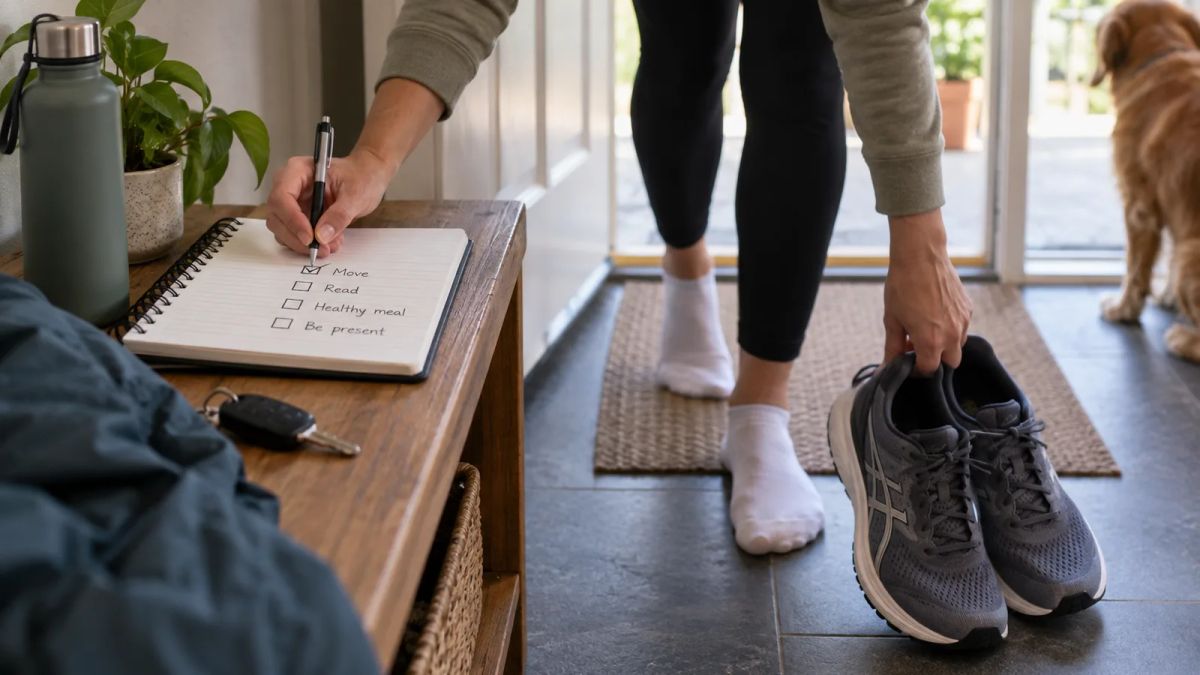
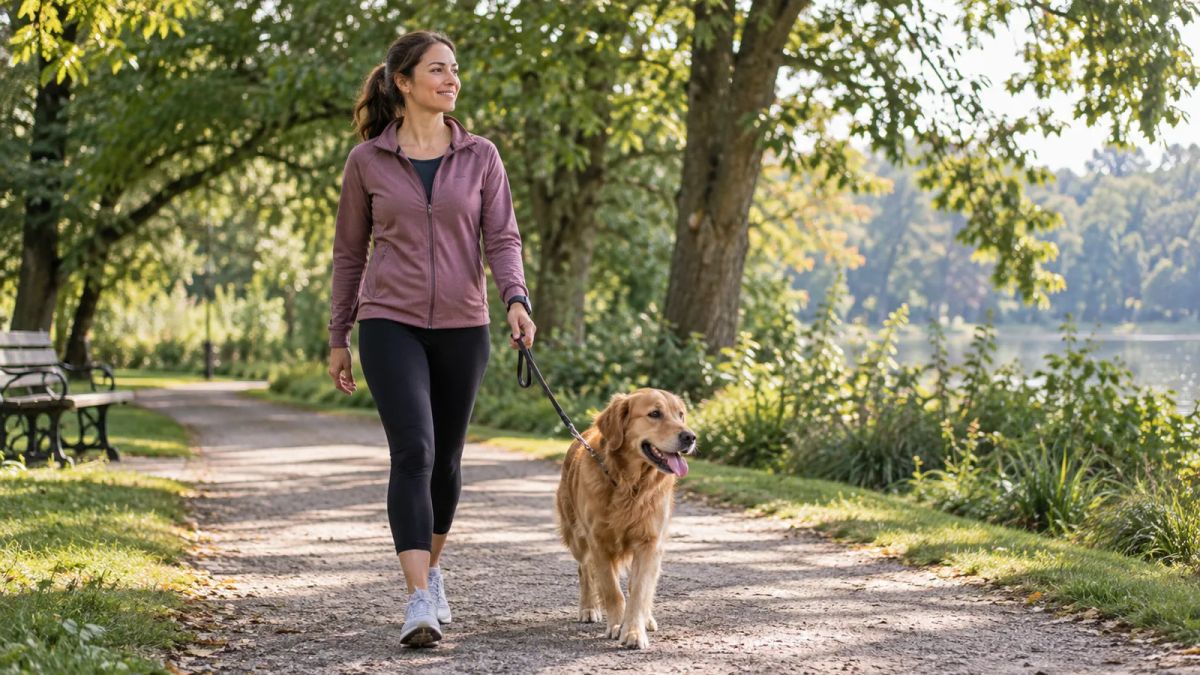
When a full workout feels out of reach, guilt says the only options are all or nothing. There's a third option: something tiny. A five-minute walk. One flight of stairs. A couple of stretches while the kettle boils. This isn't a consolation prize. The NHS notes that short sessions count towards your week and that even exercising once or twice a week lowers the risk of heart disease and stroke (NHS). James Clear's version is the two-minute rule: shrink the habit until starting is almost effortless, because a tiny action done often beats a big one you keep skipping (James Clear).
Some tiny versions to keep in your back pocket:
- Walk to the end of the road and back.
- Do ten squats while the coffee brews.
- Stretch for the length of one song.
- Get off the bus a stop early.
Reconnect with why movement feels good
Guilt keeps your eyes on the scales and the streak, and off what movement does the same day you do it. Regular physical activity lifts mood, and you don't need a hard session to feel it. A review of 97 studies covering more than 128,000 people found that all sorts of movement, walking and yoga and strength work included, eased symptoms of mild to moderate depression and anxiety (Harvard Health). When you move because your head feels clearer afterwards, you're chasing something you can feel today, which is a lot stickier than guilt.
Forgive the missed days, then do the next one
Missing a day is normal, not a warning sign. When researchers watched people build new habits, one skipped day made no meaningful difference to whether the habit eventually stuck (Lally et al., European Journal of Social Psychology). The trap is the second miss, then the third, when one off day quietly becomes a fortnight off. James Clear sums it up: never miss twice (James Clear). You don't need to make up the session you lost. You need the next one, small and soon.
A softer way to keep showing up

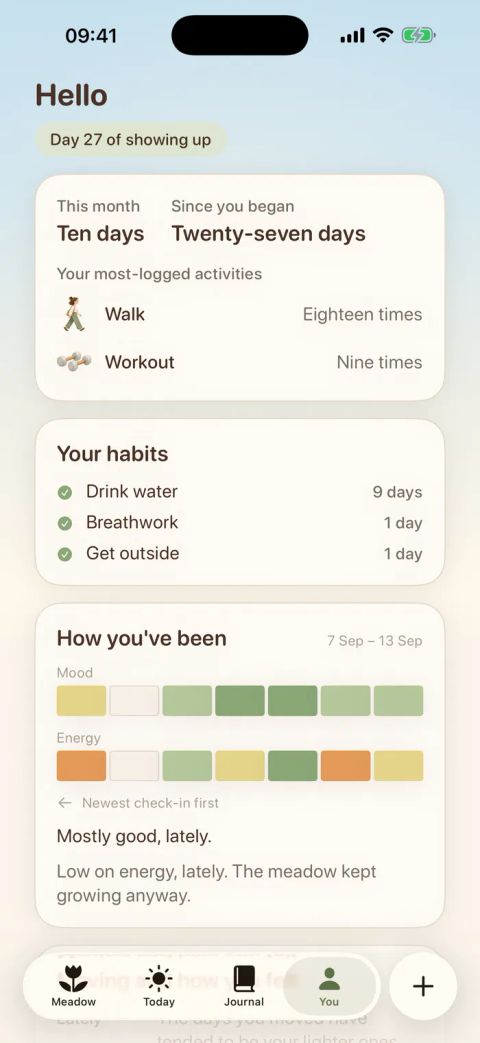
Some mornings go to plan and plenty do not, and it helps to track movement somewhere that treats a missed day as nothing to fix. Meadow is a habit app built around that idea. You log a walk or a few minutes of movement, tick off small daily habits, and note your mood and energy, and each day you show up a new wildflower blooms in a meadow that's yours. There are no streaks to break, so a rained-off week or a rough patch resets nothing you've grown, and the flowers you already have stay put. When the point is to come back easily, having no counter shaming you makes coming back easier.
Some weeks you won't move much, and that's human
The fitness feeds leave this part out. There will be weeks when you're ill, or slammed at work, or looking after someone, or plain flat, and you'll barely move at all. That is not a failure of character. It's a normal stretch in a long life of being active on and off, and every consistent person you know has them too.
The people who keep moving over years aren't the ones who never miss. They're the ones who let the quiet weeks pass without turning them into a verdict, and then start again when there's room. A body that's been active for decades has had hundreds of off weeks folded into it. Yours can too.
Open our free Rest-day plan (PDF). Make space for rest and write a response to exercise guilt. Includes a flexible weekly plan and room to note the support you need. Save or print it; no sign-up needed.
Common questions
Is it healthy to feel a bit of guilt about not exercising?
A flicker of it can be a useful signal that a habit you value has slipped, and mild guilt about a specific action is easier to act on than shame about who you are. It turns unhelpful when it's constant, out of proportion, or tied to a routine that never fitted your real week. If guilt is a daily companion, the goal you set is often the thing to change, not you.
Will I lose all my progress if I stop for a week?
A week off does far less than guilt tells you it does. Fitness fades slowly, and picking up where you left off is normal after a break. Treat a week as a pause, not a reset, and come back to a smaller version than you left rather than trying to punish your way back to where you were.
How do I get back into exercise after months off?
Start lower than feels impressive. One short walk, a few times this week, is plenty to begin. Attach it to something you already do so you don't have to remember it, and build from there. If you've been inactive for a long time or have a health condition, it's worth a quick word with your GP before you ramp things up (NHS).
What's the difference between guilt and being hard on myself?
Guilt points at a behaviour: I didn't go for my walk. Being hard on yourself points at you: I'm useless, I never stick to anything. The first can nudge a small change. The second tends to make you avoid the whole subject, which is why self-compassion, the friend's voice rather than the critic's, does more for getting you back to it.
One thing to do today
Pick the smallest piece of movement you can't talk yourself out of, a five-minute walk, one song's worth of stretching, and do it today without waiting to feel motivated. Not to erase a guilty week. Because the next small thing is always the one that counts.
If you want more on this, our guides on finding exercise motivation that lasts, how to be consistent without being perfect and making the most of an active rest day pick up where this one leaves off.
AUTHOR
Co-founder of Meadow.
Ash is co-founder of Meadow, a habit and movement tracking app that turns small acts of self-care into a growing wildflower meadow.
See how far you've come
Your habits, moods and little wins, all in one place
Meadow keeps track of the walks, the water and the good days, so you can look back and watch your effort add up.
Download Meadow