A wellness goal is a small, repeatable action you take to look after your body and mind, chosen from an area of life you want to feel better in. The ones that last aren't finish lines like "lose a stone" or "run a marathon" but things you can do most days, like a short walk after lunch or a glass of water when you wake.
If you want to start before you finish reading, pick the one area that's been nagging at you, sleep, movement, food, stress, and name the smallest version of a helpful action in it. Ten minutes outside. Lights out ten minutes earlier. One more glass of water. That single line is a wellness goal.
This guide covers what a wellness goal is, why the gentle process kind holds up where a punishing target falls apart, a wide menu of realistic examples across six areas of life, and how to pick one or two and turn them into habits that survive a rough week.
What counts as a wellness goal
Wellness covers far more than the gym. The eight dimensions of wellness that many universities teach, set out by Northwestern among others, run from physical and emotional to social, intellectual and environmental, and the idea is that they lean on each other. Poor sleep drags your mood down. A lonely week makes the walk harder to face.
For a busy life, six of those areas carry most of the everyday weight: movement, sleep, food and drink, mind, connection, and rest. A wellness goal is a helpful action you choose in one of them.
The CDC describes emotional well-being as managing your emotions well and having a sense of meaning, purpose and supportive relationships. That's a useful reminder that a wellness goal doesn't have to involve a workout at all. A weekly call with a friend counts. So does ten quiet minutes with a book.
Choose a process goal you can control
Split any wellness goal into two kinds. An outcome goal is the result you want, like a lower number on the scales or eight hours' sleep. A process goal is the action you repeat that points you there, like a nightly wind-down or three short walks a week.
The trouble with outcome goals is that you don't fully control them. Your weight answers to hormones, stress and sleep, none of which bends to your effort today. What you do control is whether you took the walk.
A study following 297 people through their New Year exercise resolutions found that people who kept their goals flexible and pursued them for personal, meaningful reasons held on to their wellbeing across the two months, even when the resolution itself didn't stick. Chasing it under external pressure, to look a certain way for someone else, tended to work against their mental health. So the framing you pick does real work, well before any result shows up.
James Clear puts the same idea in plainer terms: your goals set the direction, but your daily system delivers the progress. Keep the outcome as a compass and forget it most days. Point your attention at the process, because that's the only part today can move.
This is why gentle isn't the same as soft. The CDC is clear that some activity is better than none, so a five-minute walk on a flat day still earns its keep. A goal built to survive your worst day is a goal you'll still be doing in March.
A menu of wellness goals to pick from
Here's a wide spread of realistic wellness goals across the six everyday areas, with the honest state of the evidence for each. You're choosing one or two to begin, not adopting the lot.
Movement
The movement goal that works is the one you'll repeat on a tired evening. Official guidance aims high, with the CDC suggesting 150 minutes of moderate activity a week plus two strengthening days, but treat that as a target to grow into, not a start line.
Gentle starting goals:
- A ten-minute walk after lunch on weekdays
- The stairs instead of the lift, once a day
- A two-minute stretch before you sit at your desk
- A dance to one song while the kettle boils
If you're coming back to activity after a long gap or you live with a health condition, a word with your GP before you push the intensity is sensible. Our guide to healthy habits goes deeper on turning a movement goal into something that sticks.
Sleep
Sleep is the goal that makes the other five easier. The CDC recommends seven or more hours a night for adults, but the part you can shape into a goal is the wind-down around it, not the sleep itself.
Gentle starting goals:
- Lights dimmed and phone across the room from 10pm
- The same short bedtime routine every night
- No caffeine after 2pm
- A steady wake time, weekends included
Food and drink
Overhauling your whole diet at once is the surest way to keep none of it. Change one thing. The WHO advises at least 400g of fruit and vegetables a day, and the NHS suggests six to eight glasses of fluid, with tea and coffee both counting.
Gentle starting goals:
- One piece of fruit with breakfast
- A glass of water after you brush your teeth
- A handful of vegetables added to a meal you already cook
- Sparkling water in place of one fizzy drink
Mind
A minute of slow breathing, a short walk without your phone, a couple of lines in a journal. These are low-cost goals with a thinner evidence base, and it's worth being straight about that. The NCCIH's review of mindfulness and meditation finds they can ease stress and anxiety and work about as well as some standard therapies, while noting that much of the research is preliminary and the long-term picture less clear.
Gentle starting goals:
- Three slow breaths before you open your laptop
- One line in a journal each night
- A ten-minute walk with no headphones
- A five-minute tidy of one surface
Connection
Connection is a real ingredient in wellbeing, not a nice extra. The CDC lists supportive relationships among the core parts of emotional well-being. A goal here can be tiny and still count.
Gentle starting goals:
- One message a day to someone you like
- A weekly call with a friend or a family member
- A hello to a neighbour
- One thing in the diary with people each week
Rest
Rest is the area a busy culture treats as laziness, which is part of why so many people run on empty. Ten minutes of doing nothing on purpose is a fair wellness goal, not a failure of productivity. Our guide to self-care ideas has a longer list of small, restful actions for the days you have little to give.
Gentle starting goals:
- Ten minutes with your feet up and no screen
- One evening a week with nothing scheduled
- A proper lunch break away from your desk
- A short sit outside with a cup of tea
How to pick one or two, not the whole menu
The menu is long on purpose, so there's a good chance something on it fits your week. The trick is to resist starting five.
One or two goals is the honest number. Five new actions ask for five new decisions every day, and a full day has no room for that. Pick the area that's bothering you most right now, sleep if you're wiped out, connection if you feel cut off, and take one small action from it.
If you're torn between two, choose the one with the sturdiest cue and the smallest action. A walk after a lunch you eat every day beats a dawn run you'll skip twice and then quietly drop.
Turn it into a habit that survives a bad week
A goal you have to remember and choose each day will lose to a flat mood eventually. A habit runs whether you feel like it or not, and that's the state you're steering towards.
The move that works is to bolt the new action onto something you already do. The American Heart Association's advice on making habits stick is to attach a new behaviour to an established routine, so a cue you can't miss does the reminding. After you brush your teeth, drink the water. After the school run, walk. If you want the fuller planning method, our guide on how to set goals covers if-then plans and picturing the obstacle before it turns up.
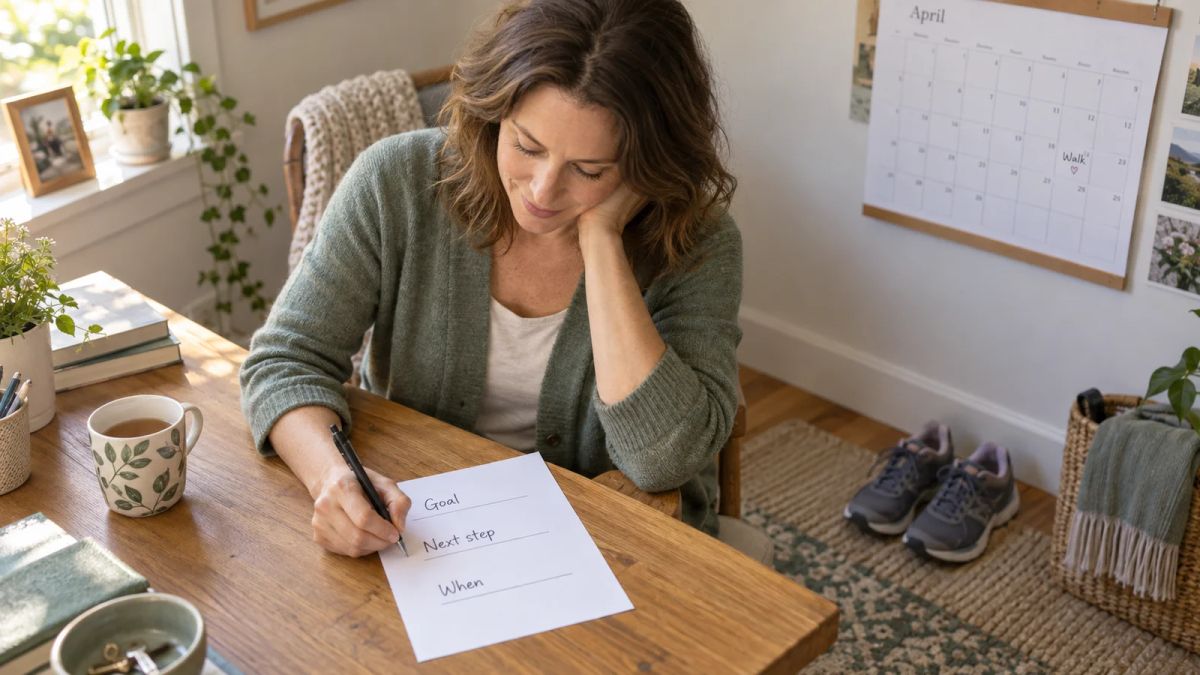
Write yours as a single sentence, decide the smaller version now while you're thinking clearly, and set up the easy version in advance.
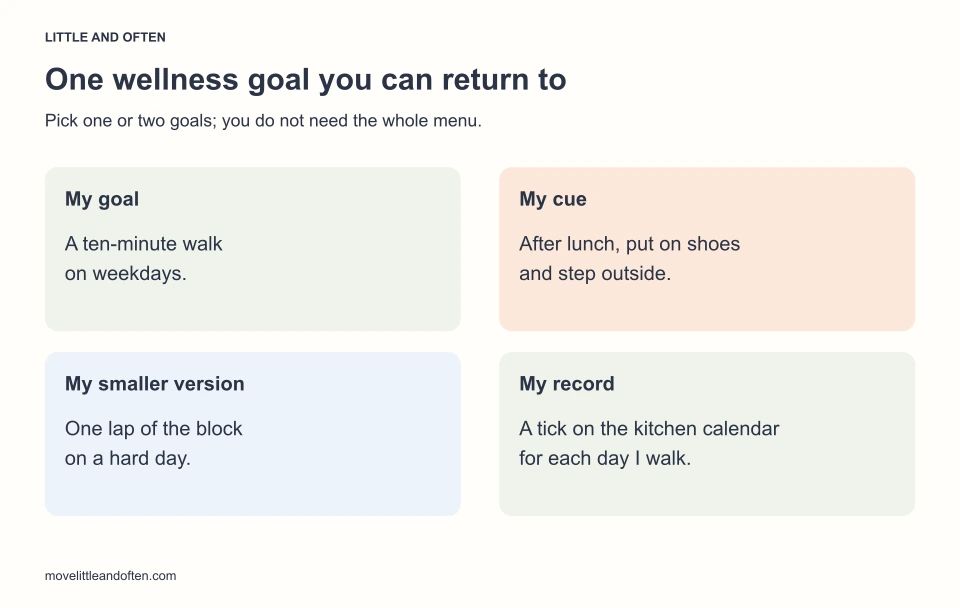
My wellness goal: ________
After I ________ (something I already do), I will ________ (one small action)
Smaller version for a hard day: ________
How I'll notice it's working: ________
Filled in, it might read like this:
My wellness goal: A ten-minute walk on weekdays
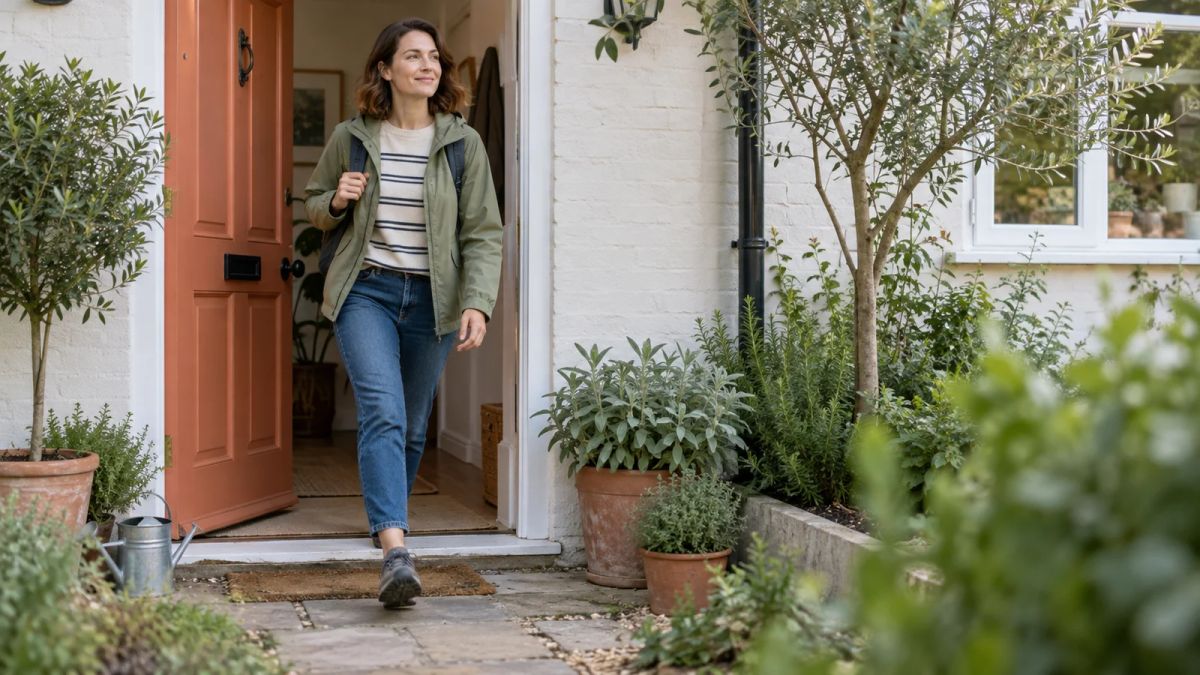
After I finish lunch, I will put my shoes on and step outside
Smaller version for a hard day: One lap of the block
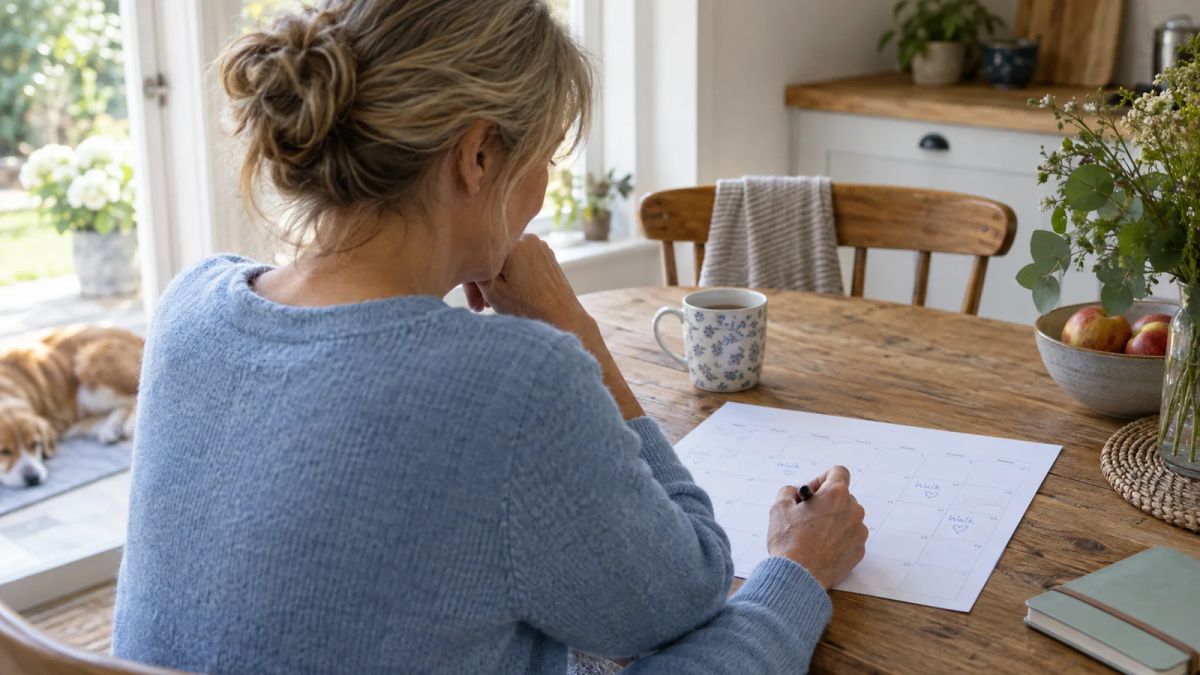
How I'll notice it's working: A tick on the kitchen calendar each day
Be patient with how long it takes to feel automatic. Work by Phillippa Lally's team found the time varied enormously from person to person and habit to habit, and that missing one day didn't wreck the process. Ignore the tidy "21 days" you've heard quoted. Keeping a small record helps as well: a meta-analysis of 138 studies found that monitoring your progress towards a goal made you more likely to reach it.
When you miss a day, and you will, you've undone nothing. Pick the goal back up at the next cue and carry on without the guilt tax.
Somewhere to keep all six in view
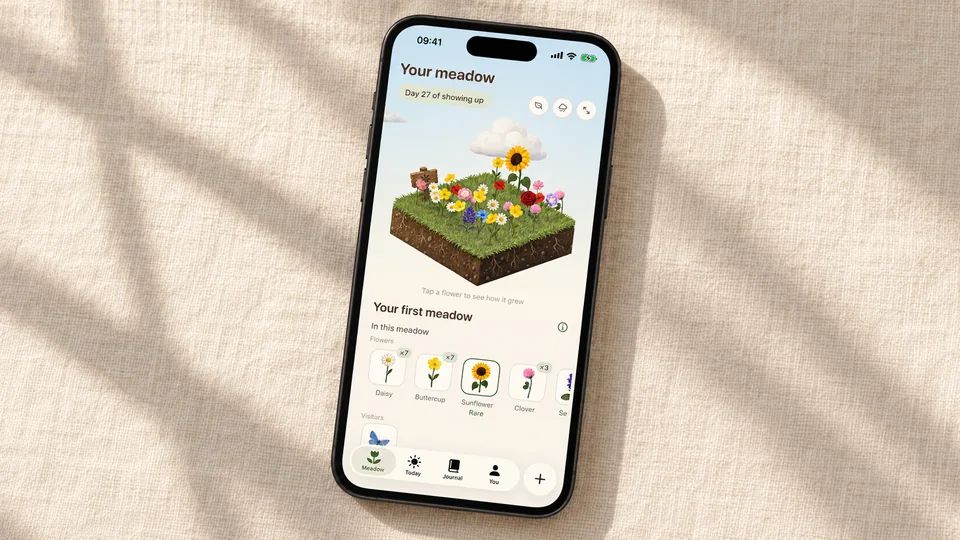
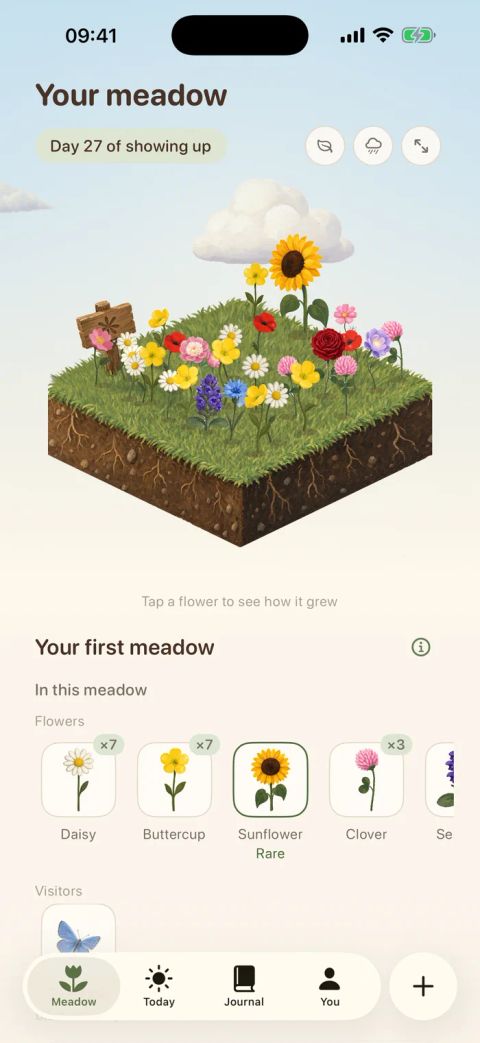
Wellness goals spread across movement, sleep, mind and the rest can be hard to hold in your head at once, and Meadow gathers them in one calm place. It's a habit app for iPhone from Wildcard Wellness where you log a little movement, a walk, a dance, some yoga, tick off small habits like drinking water or getting outside, and note your mood, energy and a daily win. Every day you show up grows a wildflower in a meadow that's your own, with rarer flowers and little animal visitors arriving over time. There are no streaks, so a missed day resets nothing and the flowers you've grown stay put, which fits a process goal you're meant to keep going without pressure. You can find it at Meadow.
Common questions
How many wellness goals should I set at once?
One or two. A single action tied to something you already do is the one you can keep honest while the rest of your week runs as normal. Add the next only once the first feels automatic.
What's the difference between a wellness goal and a New Year's resolution?
Mostly the framing. A resolution is usually a big outcome pinned to a date, while a wellness goal is a small action you repeat. The research on New Year resolutions found that people who kept their goals flexible and personal protected their wellbeing even when the resolution slipped.
What are good wellness goals for work?
Small ones that fit the day: a two-minute stretch each hour, a proper lunch away from your desk, a short walk between meetings, or your phone on charge in another room after 9pm. Pick one and anchor it to something your working day already contains.
How do I measure a wellness goal?
Track the action, not the result. A tick on a calendar for every day you did the walk tells you more, and sooner, than the bathroom scales. Monitoring progress is linked to reaching goals, so choose a record you'll keep looking at.
What if I keep missing it?
The action is probably too big or the cue too weak. Shrink the action until the small version feels almost too easy, move it behind a cue you never skip, and start again at the next chance instead of waiting for Monday.
One thing to do today
Pick the one area that's been nagging at you, name the smallest helpful action in it, and write a single line: after [something you already do every day], I will [that small action]. Then decide the version you'll still manage on a bad day. That line, anchored and shrunk to fit your worst evening, is a wellness goal already begun.
AUTHOR
Co-founder of Meadow.
Ash is co-founder of Meadow, a habit and movement tracking app that turns small acts of self-care into a growing wildflower meadow.
Little and often, with Meadow
Consistency, not intensity.
Meadow turns the movement you enjoy and the habits that help you feel good into a meadow of wildflowers. No streaks to break, and your flowers never wilt.
Download Meadow