A habit loop diagram is a circle with a few labelled points on it: a cue, a craving, a routine and a reward, joined by arrows that run round and back to the start. Draw the circle once for a habit of your own and the thing you've been wrestling with turns into a plain map you can change one point at a time.
This is the sketch-it-yourself companion to our habit loop guide. That one explains the idea. This one hands you a pen.
You don't need to be able to draw. Four dots and four arrows will do it.
What the loop looks like on paper
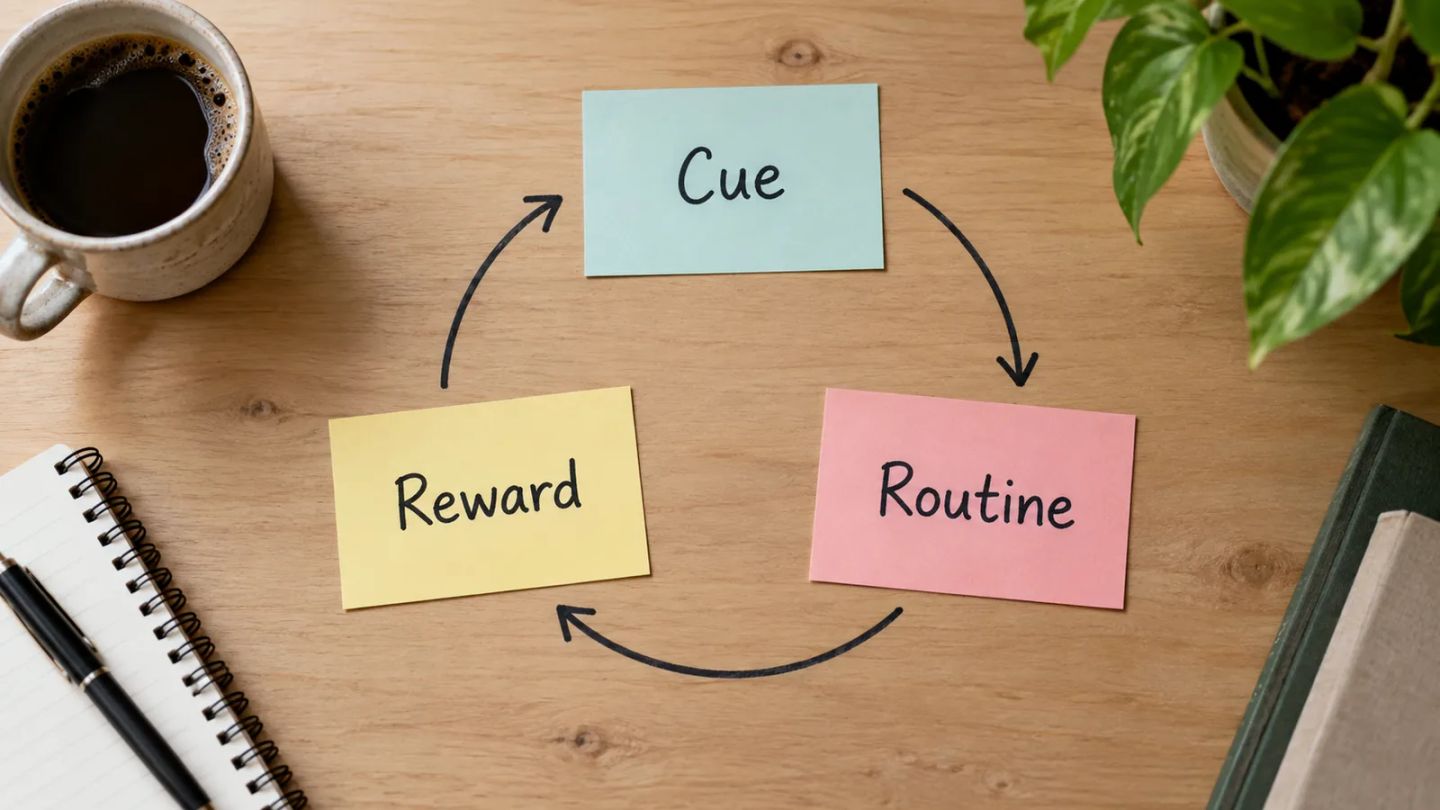
Picture a clock face. The loop lives on that circle, moving clockwise, and every habit you own runs round it the same way.
At the top sits the cue, the thing that sets the habit off. The arrow leaving the cue carries a craving, the small pull of wanting that the cue kicks up. Follow the arrow round to the routine, the behaviour itself, the part you'd point at if someone asked what the habit is. Keep going and you reach the reward, the payoff your brain gets for running the routine. Then the last arrow carries that reward back up to the cue, and this is the part people miss. The loop feeds itself. Each time the reward lands, your brain files the cue away as worth reacting to, so next time the cue shows up the pull is a little stronger.
There are two common labellings and they draw the same circle. Charles Duhigg's version in The Power of Habit has three points: a cue, a routine and a reward. James Clear's version in Atomic Habits names a fourth, splitting the wanting out as its own point so the circle reads cue, craving, response and reward, where "response" is Duhigg's routine under a different name. Clear puts the mechanism in one line: "The cue triggers a craving, which motivates a response, which provides a reward, which satisfies the craving and, ultimately, becomes associated with the cue." Draw four points if you want the craving in front of you. Draw three if that feels like clutter. The maths of the loop doesn't change.
Here's the key to keep beside your sketch.
Cue the trigger that starts the loop, drawn at the top
Craving the wanting the cue sets off, riding the arrow from cue to routine
Routine the behaviour you run, also called the response
Reward the payoff that closes the loop at the bottom
The return arrow the reward looping back to the cue, teaching your brain to want it again
How to draw your own, step by step
Grab any scrap of paper. This takes about a minute.
- Draw a circle in the middle of the page, big enough to write inside.
- Mark four dots on it like the 12, 3, 6 and 9 on a clock.
- Label the top dot Cue, the right dot Craving, the bottom dot Routine, and the left dot Reward. If you'd rather keep it to three, drop the craving dot and space the other three evenly.
- Draw arrows along the circle joining the dots in order, all pointing clockwise, so the line flows cue to craving to routine to reward.
- Draw one more arrow from Reward back up to Cue to close the circle. Make this one bold. It's the arrow that turns a one-off into a habit.
- Now write your real habit onto the diagram. Beside each dot, jot the actual cue, craving, routine and reward for the habit you're looking at. The loop stops being a textbook picture and becomes yours.
That last step is where the work happens. A loop you can see is a loop you can pull apart.
A good habit mapped onto the loop
Say you want a short walk to become automatic. Drawn out, the loop looks like this.
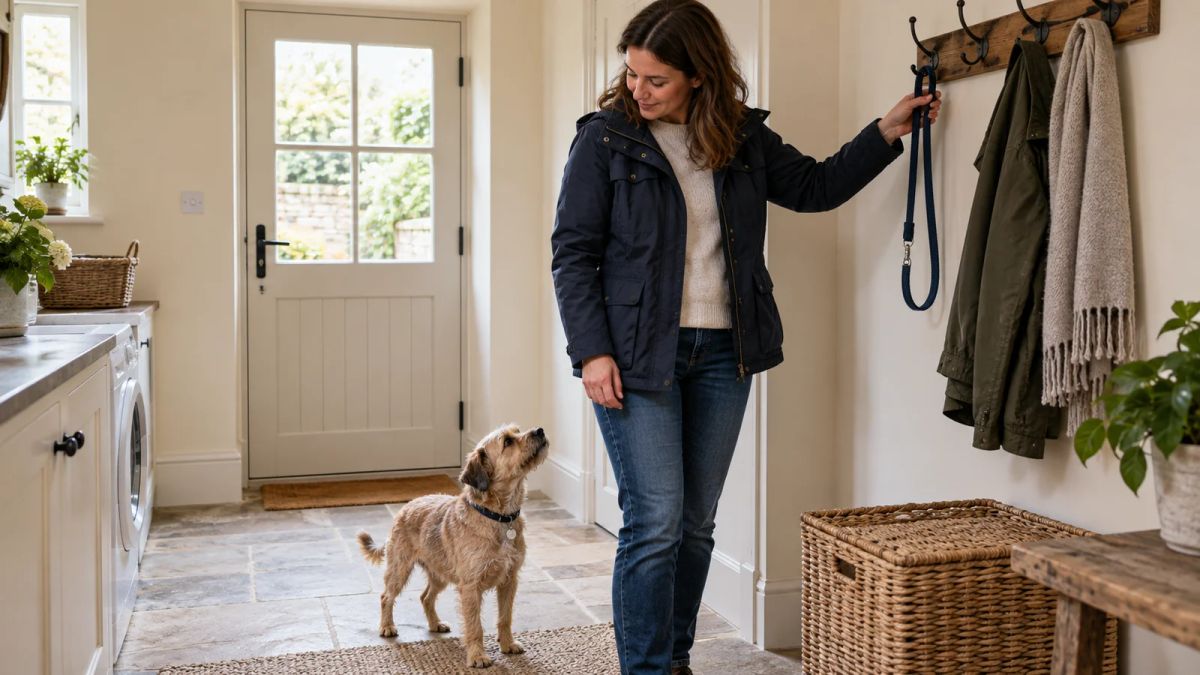
Cue: the kettle clicks off for your morning coffee. A cue that already happens every day holds up far better than a time on the clock, which is why the American Heart Association suggests hanging a new habit on a routine you already run.
Craving: you want the fresh-air lift before the day swallows you.
Routine: you take your coffee out the front door and walk to the end of the road and back. Keep this small at first. One short loop of the block, not a hike. Our guide to tiny habits explains why a routine you could manage on your worst day is the one that sticks.
Reward: the coffee tastes better outside, your head clears, and you tick the walk off. The return arrow does the rest, wiring the click of the kettle to the walk over a couple of weeks.
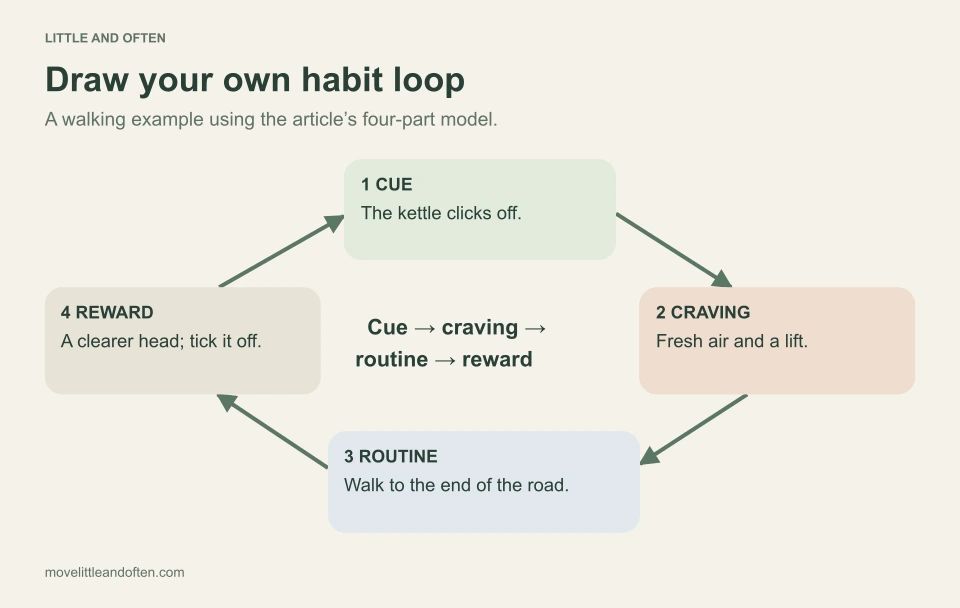
Draw that and you can see straight away where a wobble would come from. No cue that fires daily, and there's nothing to start the loop. No reward you notice, and the return arrow never gets drawn in your brain.
A habit you'd rather drop, mapped
Now the same circle for something you want less of. Take the mid-afternoon biscuit run.
Cue: it's around 3pm, energy's flat, and the inbox is dull.
Craving: you want a break and a lift, not sugar as such.
Routine: you wander to the kitchen and eat two biscuits.
Reward: a few minutes away from the screen, a chat if someone's there, and a quick hit of sweetness.
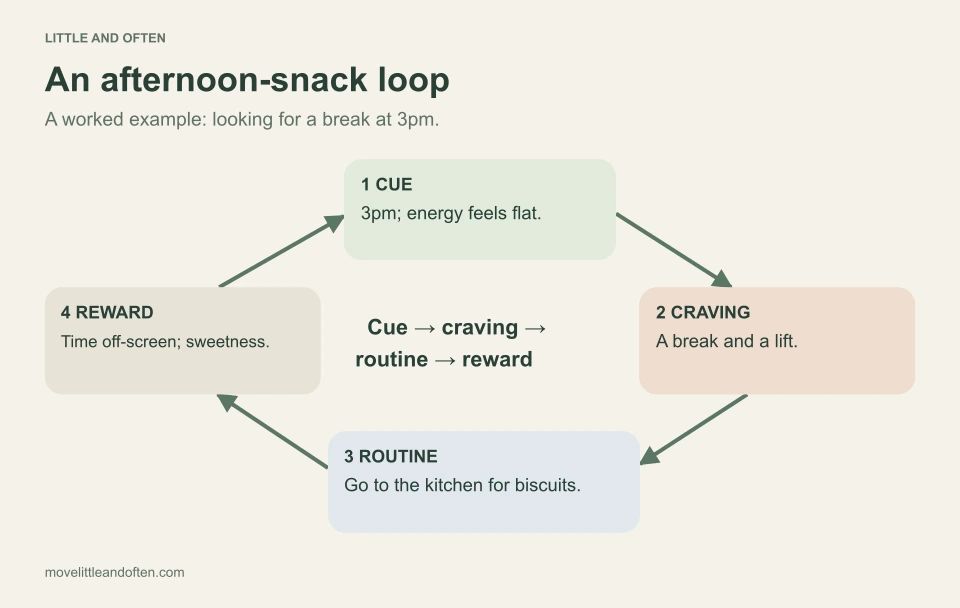
Seeing it on paper does something a craving in your head won't. It shows that the reward you're chasing is the break, and the biscuit is only the delivery van. That gap between what you crave and what you do is the opening you'll use in a minute.
One more, quicker, to show how small a loop can be. Cue: you finish brushing your teeth at night. Routine: you drink a glass of water. Reward: a clean, done-for-the-day feeling and a tick. Three dots, one arrow home, a habit that takes ten seconds to run and about ten seconds to draw.
Using the drawn loop to change a habit
With the loop on paper, changing a habit becomes a matter of pointing at one dot rather than fighting the whole thing. You can't rub the loop out, because the cue keeps arriving whether you like it or not, so the trick is to work on the points you can reach.
Keep the cue and keep the reward, and swap the routine in the middle. This is Duhigg's approach and it's the one the diagram makes obvious. On the biscuit loop, the cue stays (3pm, flat, bored) and the reward stays (a break, a lift), so you draw a new routine into the bottom dot: a walk to a colleague's desk, or two minutes at the window with a glass of water. The loop still runs. It ends somewhere you're happier with.

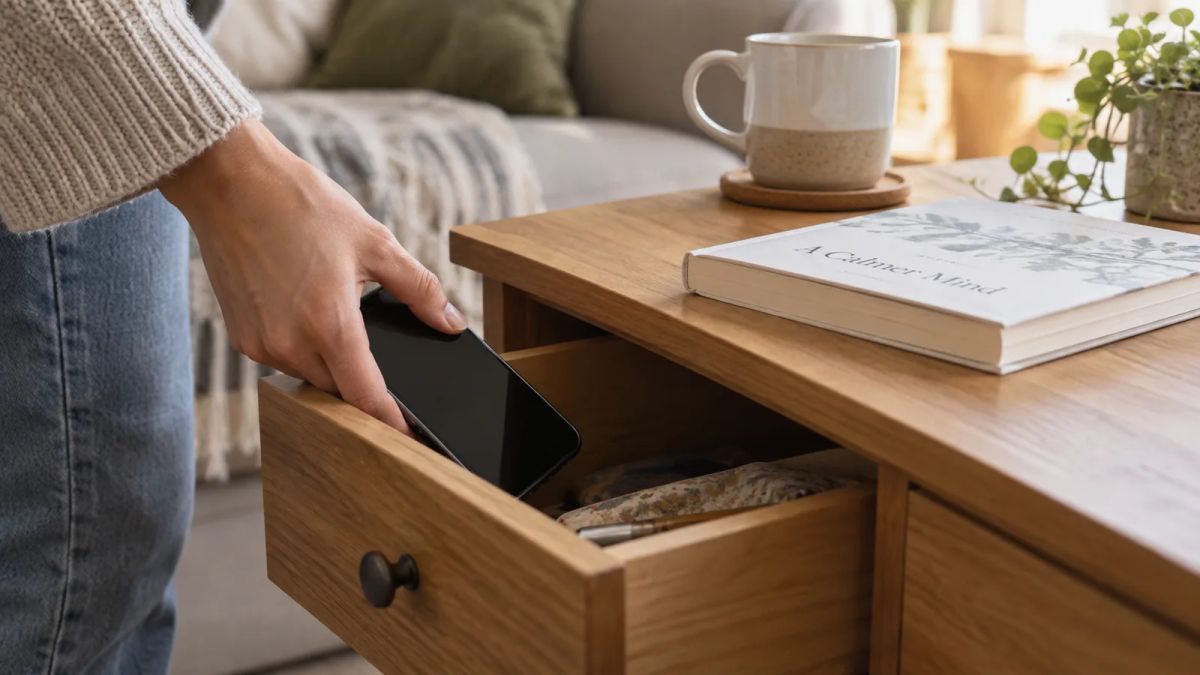
You can also draw on the cue and the routine dots directly. Clear frames good habits as making the cue obvious and the routine easy, and breaking a habit as the reverse: make the cue invisible and the routine hard. On your diagram that's a note by the cue dot ("put the biscuits out of sight") and a note by the routine dot ("keep them in the car, not the drawer"). Every extra step you add to the old routine is friction working for you.
Mark the change on the sketch, don't only think it. A crossed-out routine with the new one written above it is a decision you've made in advance, and deciding in advance is most of what makes a swap hold. For the full method of swapping routines and riding out the days you slip, our guide to breaking bad habits goes deeper.
A place to watch the reward build

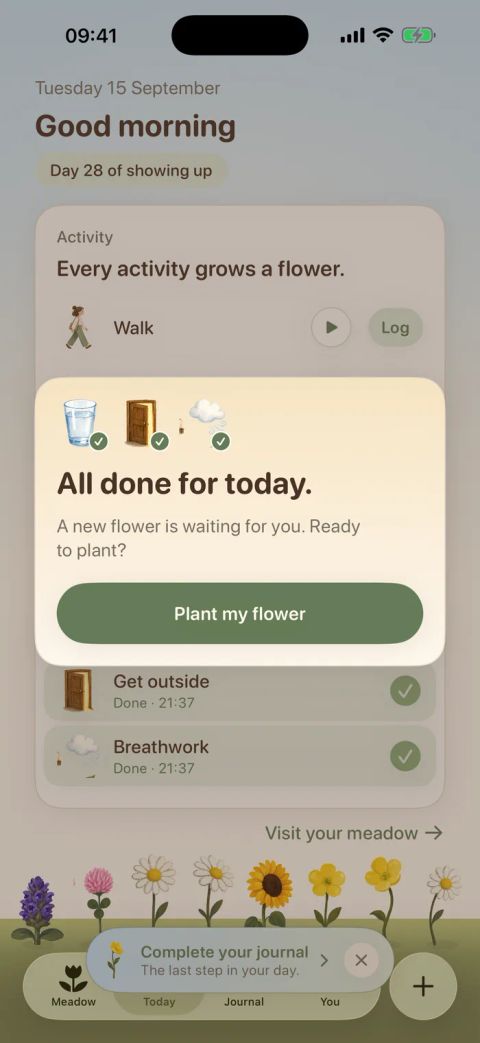
The reward dot is the one that's easiest to lose track of once the paper's back in the drawer, and Meadow keeps it in view. It's an iPhone movement and habit app from Wildcard Wellness where you tick off a small habit, log a walk or a few minutes of yoga, and note your mood, energy and a daily win. Every day you show up, a wildflower blooms in your own meadow, so the reward for running the routine is something you can watch fill out over the weeks. There are no streaks, so a missed day resets none of it, which fits a loop your brain is still learning to run.
Frequently asked questions
Why is the craving on the arrow and not a box of its own?
Because it lives between the cue and the routine, and drawing it on the arrow shows what it does: it carries you from noticing the cue to running the routine. If you'd rather give it its own dot, do. Clear's four-point version treats it as a full stage, and the loop reads the same either way.
Three points or four, which should I draw?
Draw four when you're trying to understand why a habit pulls at you, because the craving dot forces you to name the wanting behind the behaviour. Draw three when you want a quick working map. Neither is more correct. They're two labels for one circle.
Where does the reward go on a bad-habit loop?
Same place, the bottom-left dot, and it's worth being honest about what it is. The reward on a habit you dislike is usually a real payoff, a break or a calm or a lift, which is exactly why the habit stuck. Naming it on the diagram is what lets you meet the same reward with a routine you'd rather keep.
Can I draw it on my phone instead of paper?
Yes, a notes app or a whiteboard app works. Paper tends to be faster for a first pass, and there's some value in the friction of writing it by hand, but the loop doesn't care what it's drawn on.
Does the diagram match the science?
The cue-routine-reward shape is a tidy stand-in for messier research, and it holds up as a working map. Habits strengthen through repetition and cues from your surroundings, and researchers Wendy Wood and David Neal describe them as responses triggered by the context they've gone with before, without a goal steering each one. The circle is a simplification, and a useful one.
How long before the loop runs on its own?
There's no set number. In the habit-formation study run by Phillippa Lally's team, covered by the British Psychological Society, the time to reach automatic ran from 18 days to a predicted 254, and a single missed day barely dented the progress. Judge yourself by whether you're still turning up, not by a date.
One thing to do today
Pick one habit and draw its loop before you try to change anything about it. Four dots, four arrows, and your real cue, craving, routine and reward written in. You're not fixing it yet, you're only looking. Once the circle's on paper you'll see which dot to reach for, and the habit stops being a fight and starts being a thing with parts you can move.
AUTHOR
Co-founder of Meadow.
Ash is co-founder of Meadow, a habit and movement tracking app that turns small acts of self-care into a growing wildflower meadow.
Every little bit counts
Five minutes counts. So does a dance in the kitchen.
Log the movement you enjoy and the small habits that help you feel good, and watch them bloom into something you can see.
Download Meadow