Track your mood for a few weeks and something a single bad day hides starts to show. Your feelings move in patterns, and those patterns tend to line up with sleep, people, work and how much you move. That is the benefit of mood tracking. Not the charts themselves, but the evidence they hand you about your own weeks.
This is about the why, not the how. If you want the tools, our roundup of mood tracker apps compares the main ones. Here we stay with what a mood log can do for you, where the research holds up, and where it thins out or turns against you.
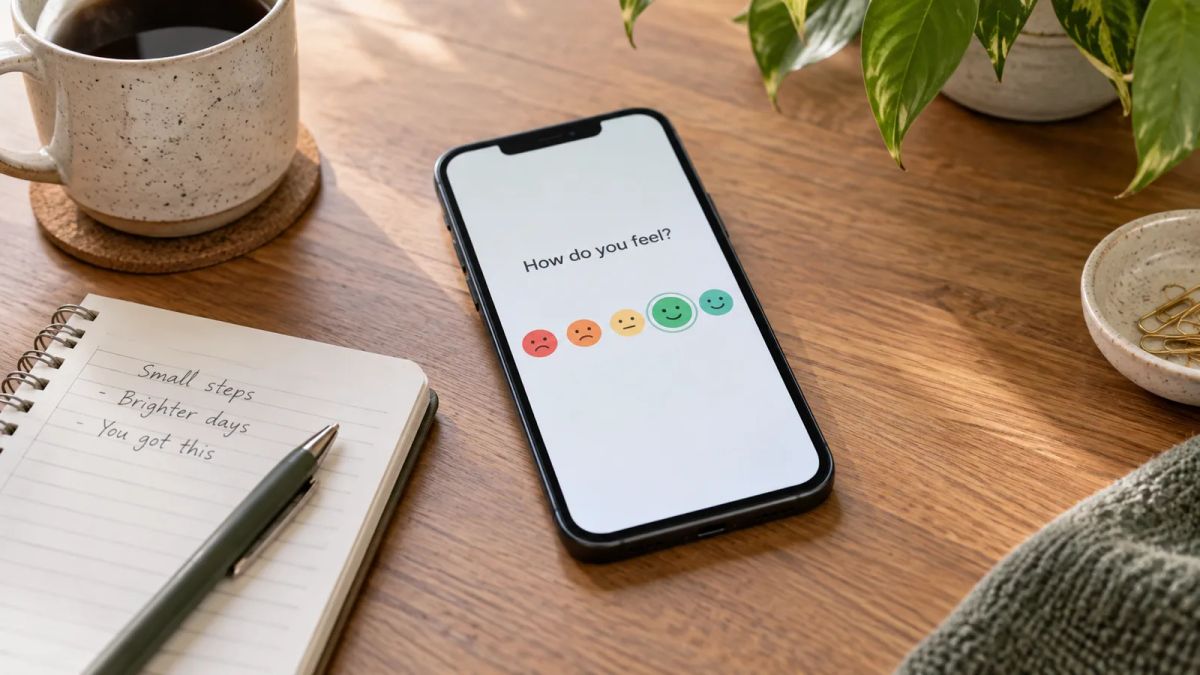
A mood tracker is a short daily note of how you felt. Sometimes a number, sometimes a face, sometimes a line of writing. One entry tells you little. Thirty start to talk.
You spot patterns you would miss day to day
Memory is a poor narrator of mood. Ask yourself how last week went and you'll answer from how today feels, because the present colours the whole recollection. A log won't do that. It keeps a flat record, so when you read it back you can see the dips that gathered around short nights, or the lift that followed two afternoons outside.
Researchers who study feelings in real time call it ecological momentary assessment, catching how you feel in the moment across ordinary days rather than reconstructing it later from memory. The same idea sits behind a home mood log. The worth of it is in the looking back, when a fortnight of small notes turns into a shape you can name.
Once you can see the shape, the triggers get easier to spot. A rough patch that always trails a badly slept week. A Sunday evening dip you'd blamed on nothing in particular. A better mood on the days you got outside before lunch. Naming the trigger is the first thing you can do something with.
Naming a feeling can take some heat out of it
There's decent evidence that putting a feeling into words settles it a little. In brain-imaging work summarised by the University of California's Greater Good project, people who named an emotion showed less activity in the brain's alarm centre and more in the areas that handle regulation. The label doesn't erase the feeling. It turns the volume down.
That effect is part of why a written mood log can do more than a number ever will. Writing "anxious about the meeting" is itself a small act of settling, before you've solved anything.
One caveat goes with it. The same research found naming worked best for strong, unpleasant feelings, and that labelling mild ones could tick distress up instead. So treat this as a tool for the hard moments, not a rule to apply to every faint flicker of mood across the day.
You learn what helps you, in your own life
Advice about mood is general by nature. Your log is specific. If your better days keep landing after a walk, or after an early night, or after time with one particular person, that's information no article can give you. It lines up with the wider case for movement, which we cover in the mental health benefits of exercise, but your own record is what tells you whether it holds true for you.
It cuts the other way too. A log can show that the thing you were sure was helping isn't moving the needle, which frees you to drop it and try something else. Over a month, that quiet process of testing beats guessing.
You can catch a downward trend early
A single low day is noise. A run of them is a signal. When the record is in front of you, a slow slide is harder to explain away one day at a time, and you can respond while it's still small. That might be an earlier night, a call to someone, a lighter week where you can arrange one, or a GP appointment booked before things get heavy. Spotting the slope early is where a plain little tracker quietly earns its keep.
You get something concrete to bring to a GP or therapist
"I've felt off lately" is hard for anyone to work with. Two weeks of notes is not. A short record of how your mood ran, and what it sat alongside, gives a clinician a running start. In one study of mobile mood-monitoring, clinicians said reviewing the data helped them see patterns in a patient they hadn't picked up from conversation alone.
You don't need anything elaborate to make this work. Dates, a rough score, and a few words on sleep, events or anything that stood out is enough to take into an appointment.
Somewhere to log it without the pressure
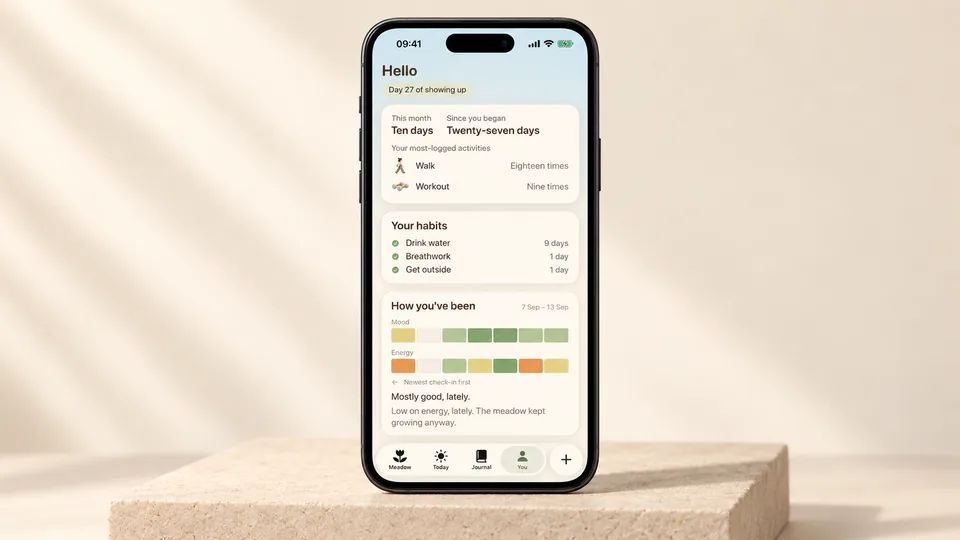
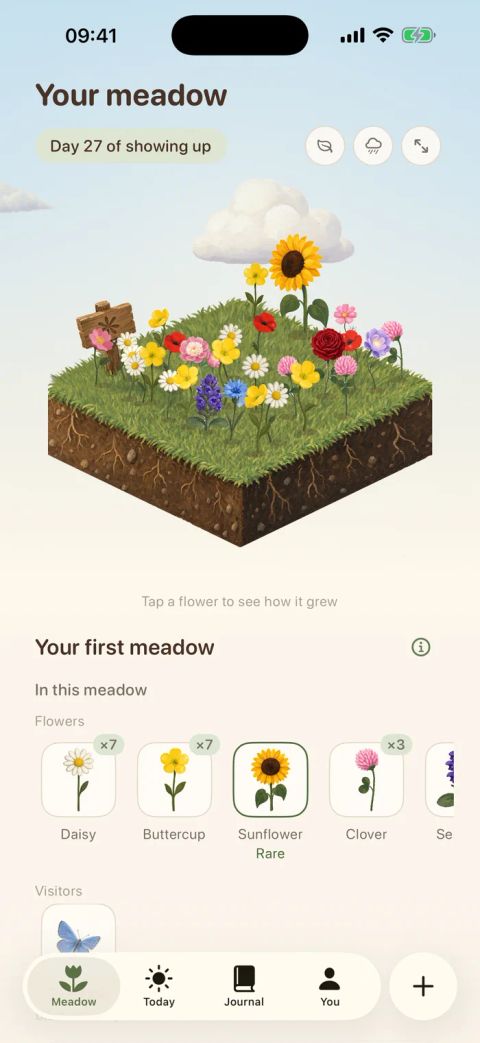
If you'd like the check-in to live on your phone, Meadow builds a daily mood and energy note into a gentle habit app for iPhone. You mark how you're feeling, write down one good thing from the day, and read a short affirmation, and alongside that you can log a walk or a few minutes of movement and tick off small habits like drinking water. Each day you show up grows a wildflower in your own meadow. There are no streaks, so a day you forget to open it resets nothing, which makes the log easy to come back to after a low patch. You'll find Meadow on the App Store.
Where mood tracking stops
Tracking builds awareness, and awareness is not the same as treatment. The clinical evidence for mood monitoring on its own is still thin. A study of a mood-monitoring app in young people found it might help as an add-on to existing care, especially for milder difficulties, and the researchers were clear that it's no substitute for proper support.
There's a second risk worth naming out loud. For some people, watching their mood closely tips into rumination, the repetitive circling over how bad you feel and why. That kind of self-focus is linked in research to prolonging and deepening low and anxious mood, not easing it. If checking in leaves you more tangled than before, that's a sign to log less, keep it to a quick score, and lean on other self-care ideas instead of long written post-mortems of the day.
The fair way to hold all this is that a mood log is a mirror. It shows you what's there. What you do with the reflection is where any change happens, and sometimes that means handing it to someone who can help.
Make it small enough to keep
Open our free Weekly mood journal (PDF). Record a mood, energy level and short note for seven days. A brief review helps you notice patterns without treating them as diagnoses. Save or print it; no sign-up needed.
A tracker only works if you fill it in, and the evidence on habits is friendly here. Pairing a new action with something you already do every day makes it easier to remember, which is why the American Heart Association suggests attaching a habit to an existing routine. Tie your check-in to brushing your teeth, or to putting the kettle on in the evening, and it has somewhere to live.
Keep the bar on the floor. On a good day you might write a couple of lines. On a hard day, a single number out of five is a complete entry, and often the hard days are the ones worth catching.
Tuesday. Mood 2 out of 5. Five hours' sleep, back-to-back meetings, no walk. Snappy by four.
Miss a day, or a week, and nothing's broken. Work on how habits form found that one missed go doesn't undo your progress, and that the time a behaviour takes to feel automatic varies so widely between people that there's no set number of days to chase. You pick it back up at the next entry, no penalty, no starting over.
Common questions
Does mood tracking change anything on its own?
The direct effect is modest and the research is mixed. Where a log earns its place is awareness and communication, seeing your own patterns and having something real to show a professional. Prompting people to monitor their progress towards a goal does tend to help them reach it, across a large body of studies, but a mood log is a starting point, not the whole answer.
How often should I track?
Once a day is enough for most people, ideally at the same moment so it becomes automatic. A short burst of more frequent notes can help a clinician see fine detail before an appointment, though heavy checking can tip into over-monitoring, so watch how it leaves you feeling.
Can it make me feel worse?
It can, for some. If logging pulls you into circling your low moods, shorten it right down to a score, or pause it, and speak to someone if your mood stays low for more than a couple of weeks.
What should I track alongside my mood?
Sleep, movement, and a note of anything that stood out. Those three tend to be the columns that light up first when a pattern finally shows itself.
When to check in with a GP
A mood log is good at flagging a problem and not built to fix one. If low mood, anxiety, or a trend you can see in your own notes carries on for more than a couple of weeks, gets in the way of daily life, or worries you, please talk to your GP. The NHS mental health pages explain how to find talking therapies and urgent help, and a tracker is at its best sitting alongside that support.
Tonight, before you put your phone down, write one line: today's date, a number out of five, and how you slept. That single entry is your tracker, already started. Tomorrow's is all it asks for next.
AUTHOR
Co-founder of Meadow.
Ash is co-founder of Meadow, a habit and movement tracking app that turns small acts of self-care into a growing wildflower meadow.
Little and often, with Meadow
Consistency, not intensity.
Meadow turns the movement you enjoy and the habits that help you feel good into a meadow of wildflowers. No streaks to break, and your flowers never wilt.
Download Meadow